
ELECTION 2020
How America Can Transition to a Fair Economy
Lessons from New Zealand, Spain, and our own ‘Pine Tree State’ Maine.
The current economic system is to blame for a lot of sh*t on this planet. And at the same time, it’s the everyday reality for all of us. We have to deal with it. So I want to give you all a peek into the future. Into a reality that is fair and also achievable. And we can all take some steps to get there.
I’ll not go into the problems. umair haque describes them all the time. And he is right. We live in a sh*tty system that causes poverty, inequality, illnesses, and also pollution, plastic soup, and climate change.
How come?
It’s all the same system. Our economic system is based on ever-growing consumption. Period. Our economic system is producing more and more and more without care and responsibility for the problems it is creating. A few people at the top get wealthier and wealthier and the rest? They suffer.
Let me explain what our economic system does.
An economic system creates value. And it needs three things to create this value: raw materials, capital, and labor. If an economic system is working well, the value that is created will give joy and happiness.
What is happening in our economic system?
Our economic system has spun out of control. We spend the raw materials, capital, and labor on stuff we don’t need just to keep the so-called economy happy. Well, that’s the other way around. The economy should make us happy. We shouldn’t break our backs just to keep the economy happy.
So, let’s go back to where it all started.
Humans have basic needs.
We need good food. We need healthy drinking water. We need a shelter (house). We need clothes. We need clean air to breathe. And we need love. LOVE. Lots of love.
Is that achievable for all humans on this planet? Yes. We just have to change a few things in our so-called economy to get there.
I’ll show you real-life examples from New Zealand, Spain, and the American ‘Pine Tree State’ Maine where the transition is taking place. And of course, I’ll give you some tips for your own personal life. Because we’re in this transition together.
Added Value in an Economy
An economy has producers and consumers. The producers are companies that make our products, ship them from the production location to us, the consumers. We pay them money for this service. And then we can eat our food, drink our water, take shelter in our houses and put our clothes on.
Of course, physical production is not the only thing companies earn money with. We have value-added services. We have shipping companies and auction houses. We have banks and governments. All of these companies add value to physical products. And they get paid for the services they add.
Okay. So what has gone wrong?
Companies make business models for what they earn their money with. And because they focus on one product or one service, they throw the problems they are creating over the wall for society to solve. Things like waste and pollution. Or burned-out people. Have a look at this regular, linear business model.

Companies have blinders on. They produce whatever they think the market wants. And they sell it with a lot of bullsh*t marketing. You need this to be happy. You need this to be beautiful. You need this to attract love.
And they use ‘scale’ as a means to keep production cheap. If you make a lot of uniform products, it’s efficient and cheap. But it also results in our current, ugly, one-size-fits-all economy based on destruction, waste, and pollution.
Okay, so what’s the first step towards change? Producers and consumers both should care enough to take responsibility for their own actions. For their production patterns and for their consumption patterns.
And luckily, there are other business models to keep products affordable and spread value and money wisely over all humans.
One big problem is that we made money our God. We do not think in value anymore, we think only in money. Our governments are saying: we need jobs. So they stimulate whatever jobs can be created. So we make more money. And we spend it on more sh*tty stuff that will not make us happy.
“Too many people spend money they earned… to buy things they don’t want… to impress people they don’t even like…“ — Will Rogers
We are in this downward spiral. We are unhappy. We think we need more money. We shop to make us feel better. And we binge-watch some Netflix series to not feel the pain in our hearts and souls. Or we take to the streets, protest, and are not heard. Sadly enough.
What Can Be Done?
Transition is a word you will hear for the next decades. We need to transition to a fair economy without waste. And I’m not going to beat around the bush, it’ll hurt. We are building a new tomorrow with a group of people who understand how everything is connected. But we have to do it in the current economic system. Which is not exactly helping.
I really hope it might go fast, though. A lot is already happening. And the current COVID crisis is shaking things up as well. Economic sectors that seemed so healthy, turn out not to be healthy at all. Tourism for instance. And air travel. It’s no longer easy to produce food just for exports. So, things are changing big time now. It might turn out well if we act wisely as humanity.
And let me tell you the good news. It is definitely possible to embrace abundance and create the economy again with different triggers. Together, towards a healthy and happy world.
The first step to remember is that we all want LOVE. And we all love our children. So, please, let’s transition with love. And be compassionate for all human perspectives, whatever background, culture, or social class we’ve been raised in.
Production Companies
Production companies can make the transition happen for real. They can start by adopting regenerative business models. These business models use synergy instead of scale to create value. They innovate with different materials. Local, abundantly available materials, such as bamboo, industrial hemp, seaweed, fungi, or thistles.
The materials used for our products will be biodegradable in soil, freshwater, saltwater. Even in the air, they will decompose after a certain amount of time. No more plastic waste. And if you think this is science fiction, have a look at Novamont. They make biodegradable bioplastics out of thistles.
Have a look at Biohm. They make houses and furniture from mycelium. The roots of fungi. Or take a look at the building that Julia Lohmann made from the seaweed kelp.
Our production companies will not only make the most beautiful products, they will create other values at the same time. Clean air. Healthy soil. Clean river water, so that all communities can have healthy drinking water with little effort.
We’re on it. We just need many more entrepreneurs! Designers! Innovators! Technical geniuses. We need to invent with (quantum) physics, biology, and green chemistry to create this better world. Join us!
So, what about these other companies? The service ones, adding value? They should take a good look in the mirror and ask themselves if they are really adding value. Or if the waste and pollution they are making are bigger than the value they create?
It might help to calculate the true price of their products/services and then make radical decisions, weighing if their time on this earth is well spent.
All companies can ask themselves what triggers they are working for. Are they working with toxic triggers? Or healthy triggers? Our health system is a good example. The economic trigger for pharma companies, hospitals, and doctors is ‘illness’, not health. Companies are being paid to cure sick people or to produce vaccines. That’s not a healthy trigger. It puts our doctors in a split.
If this medical system would be based on healthy triggers, it would be merged with the food and lifestyle sectors. We would create cross-sectoral business models. Our immune system matters most. Our bodies should be temples. Well, that’s not something our medical system is now working on.
Consumers Become Co-Creators
Thank you, iCanay, for giving me this subtitle. And Anna Blume for making me realize we need makers’ spaces all around the world.
So, what can we as consumers do to help this transition? We can first learn about what’s happening. See the stupid ways of our money-driven culture. Our toxic economic triggers. And stop running after money as a solution to make our lives happy. Our lives are much too valuable for that!
We need to create. Not consume.
We might run our whole lives, struggle, fight this wrongdoing, and that. And all the while, we forget to stop and smell the roses. We can spend our time much better by building a better tomorrow for our children.
We can make our lives simple and realize we do have an influence, by spending our money wisely. On basic needs. And with companies that are trying to make the transition work with regeneration. They need our help. With our spending, word-of-mouth, and support.
We might become co-creators instead of consumers. We can start with something simple. We can grow our own food. In our garden or better still, in a community garden. We can adopt permaculture principles and learn how everything is connected. Nature, humans, soil. And by experimenting with our food, we will rewild our souls as well. Become wise creators of our own lives.
We might value time more than we do now. Stop watching TV mindlessly and spend that time connecting with other people. Our loved ones. We might value freedom more than we do now and stop caring what others think. Create our own lives with our own values.
Of course, it also means that we respect others to create their own lives in whatever way they want. Without judgment…
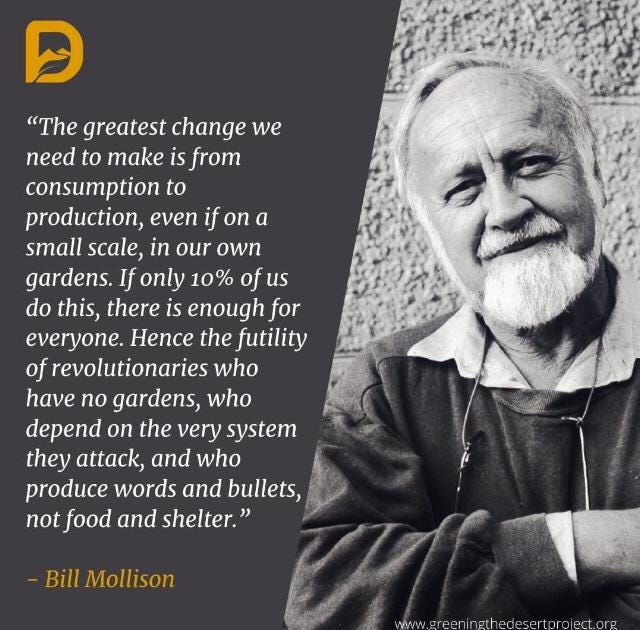
Thank you, Zairah Khan, for sending me this picture just when I was planning to write this story…
Please, also realize that if we buy beer from a multinational, the money is sucked out of our local system into the pockets of anonymous shareholders. If we spend the money on locally brewed beer with a regenerative business model, as shown in Montana, the beer brewer buys bread with the money earned. And vegetables from the farmer. The farmer thus has money to send her children to school.
Government Action
I promised you examples from New Zealand, Spain, and Maine. Well, here entrepreneurs and consumers/co-creators work together to make it happen. In some cases stimulated by their governments who are starting to understand.
It’s not easy for governments. They have to paint the vision and transition towards it. Transition causes pain. And vested interests (powerful lobby) resist fiercely because many multinationals will not be needed anymore if we adopt economies like this. The new economies can create an abundance of jobs…
I wrote about New Zealand recently. They have done everything right in the COVID crisis. Leadership with compassion. Building bridges instead of divide-and-rule.
Now is the time to take it further. Last year, they already changed their goals from just money (quantitative: GDP) to happiness and wellness (qualitative: values).
I really hope the other steps will be taken as well. They have the advantage that they are an island. For the new economic models to work, we need to have boundaries. Just like ecosystems do. Their first focus should be local and self-sustaining for basic needs.
We should adopt collaboration instead of competition, create diversity, and make the money as active as possible in the local system.
On top of local production, we can attract people from further away (conscious travelers) and we can add to this local, physical, happy economy by communicating all over the world with friends from other cultures.
Spain then. I wrote two articles on the Canary island El Hierro. You can read them here and here. In El Hierro, they have been working on the kind of economy I describe here for decades. And they have come far. They are a huge inspiration to me and many others working on the new economic models.
But we don’t have to be islands to make it happen. America’s own ‘Pine Tree State’ Maine is onto this economic thinking and doing. Recently I received a message from Dr. Kimberly Samaha, CEO of Born Global. They are envisioning a circular bio-economy for Maine.
Starting in Jonesboro with a living lab. Often an economic model like this starts with energy. They will be producing energy from woody biomass. A good choice compared to shale oil or shale gas, which is worse for our environment than even coal. Building the rest of the economy project by project. Tomato greenhouses, shrimp farming, beer production, recreation, retail, and education.
They can dense this economic system more and more and more over time. Involving healthy soil and a healthy sea. Making the money go round and round faster and making the economy more vibrant than ever before.
Have a look at their plans.
I’m looking forward to hearing more details from Kimberly soon. And of course, I’ll keep you posted.
Dear Americans, you can do it. Please keep your heads high and your minds clear. And feel in your hearts the connection with nature, your inner wisdom, and all other people living in your country.
Hope is a good thing to have. And taking action, building a better world, is the only way to transition. Together. With love.
I’m always open to comments or questions. And if you want to reach out, just connect via LinkedIn, Facebook, Twitter, Instagram, Pinterest, ManyStories, Quora, or my website.
Thank you, Mike, for adding your wise energy to my words.


