
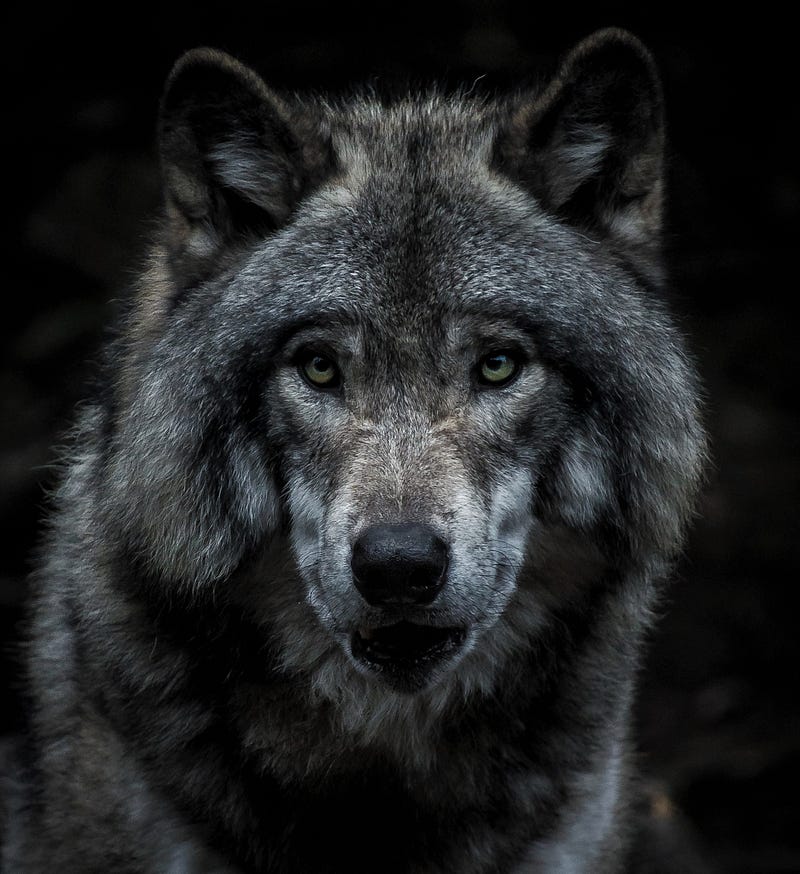
How a Wolf Transformed Aldo Leopold’s Environmental Worldview
The origin of one of the most influential ideas in environmentalism
In Aldo Leopold’s 1949 classic of environmental philosophy, A Sand County Almanac, there is a moment where he describes his encounter with a dying wolf. The wolf wasn’t dying from natural causes. It was dying because he and his hunting companions just shot her.
“We reached the old wolf in time to watch a fierce green fire dying in her eyes. I realized then, and have known ever since, that there was something new to me in those eyes — something known only to her and to the mountain. I was young then, and full of trigger itch; I thought that because fewer wolves meant more deer, that no wolves would mean hunters’ paradise. But after seeing the green fire die, I sensed that neither the wolf nor the mountain agreed with such a view” ([1949] 2001, 129).
Leopold describes this encounter as a moment when he is transformed — converted — to a new way of thinking about human-animal relationships.
Somehow, the wolf’s fiery green gaze ejects Leopold from his dull and confined human-centeredness into a more expansive ecological awareness of human-nonhuman interdependence.
Moreover, it isn’t just the wolf’s green gaze forcing Leopold to radically revise his anthropocentric worldview.
The mountain itself rejects Leopold’s naive and destructive view of human-environment relationships:
“I thought that because fewer wolves meant more deer, that no wolves would mean hunters’ paradise. But after seeing the green fire die, I sensed that neither the wolf nor the mountain agreed with such a view”
People travel thousands of miles, voyaging across oceans, trekking up mountains, or hiking into rainforests to encounter charismatic wildlife in their natural habitat. This deep-seated urge propelling millions of people every year to seek out close-up encounters with wildlife — from orcas to tigers––underlies the rapid growth of a global ‘ecotourism’ industry expanding at rocket-speed since the 1980s.
Researchers and operators in the wildlife ecotourism industry often refer to the experience tourists are after in these highly anticipated encounters with wildlife as ‘the connection’: that instant when an individual’s face-to-face encounter with a wild animal creates a sense of awe and even self-transcendence. ‘The connection’ transforms their understanding of nature, and their emotional connection to it. For ecotourism operators, there’s a lot riding on making ‘the connection’ happen for their ecotourists.
People will spend thousands of dollars, travel thousands of miles, and wait thousands of hours to experience a few minutes, or even seconds, in the charismatic presence of a wild animal, from gorillas in Tanzania, to wolves in Yellowstone (or dinosaurs at Jurrasic Park). If an animal fails to show up, is too far away, or simply less spectacular than expected, complaints, bad reviews, or even full refunds may be in store for tour guides and companies who fail to stage the magic of ‘the connection’ for paying ecotourists. If that happens, an excited ecotourist can quickly morph into an annoyed Jeff Goldblum/Dr. Ian Malcom:
I’ve seen it happen many a time during my research on sea turtle ecotourism in Hawai‘i. Tourists who traveled thousands of miles to see a real-life sea turtle in the wild arrive at so-called ‘Turtle Beach’ to find no turtles, just hordes of other disappointed tourists. As wild animals, sea turtles don’t tend to show up on cue for paying tourists, like a stage actor waiting to perform for an audience. They come and go as they please at unpredictable times of the day.
Wildlife ecotourism, of course, is not just about tour operators making money off of tourists’ desire to experience wildlife up close. After all, the underlying claim of ecotourism is that ‘the connection’ will lead people to appreciate wildlife, learn more about nature, and in turn, motivate them to protect the plants, animals, places, or wider habitats they encounter.
This is the hope, at least, for many conservation efforts that rely on tourism dollars to save threatened wildlife and places. Yet despite the importance placed on staging these fleeting moments of human-wildlife encounter, there is still little evidence that people will extend their experience of ‘the connection’ into any kind of long-term desire to protect nature.
“We are human only in contact, and conviviality, with what is not human”
One reason these moments of connection are so challenging to research and understand is that they do not happen in a cultural vacuum, but emerge in a thicket of cultural ideas about nature, and people’s relationship to it. Our understanding and attitudes towards wildlife and nature are deeply conditioned by the many encounters with wildlife we have experienced vicariously in books, magazines or on the screen. So when we travel into the wild, we don’t just pack in sunscreen and cameras on our trip: we also pack in a hefty load of cultural baggage too.
I wonder what kind of cultural baggage Aldo packed up the mountain when he shot that wolf? It seems ‘the connection’ he made that day led him to shed off the cultural baggage of dominant Western ideas of human superiority over nonhuman nature. For Aldo, his killing the wolf was a microcosm of the enormous lethal destruction human beings are leveling on the natural world all around them.
“We are human only in contact, and conviviality, with what is not human,” ecophilosopher David Abram writes. Did Leopold’s momentary eye contact with this dying animal looking back at him force him to finally dump his damaging cultural baggage? And what about the wolf, what was she thinking in her last moments?
In much of his writing, Leopold emphasizes this last point: that Western society needs a radically new approach to understanding human relationships with nature. An approach to thinking our connection to animals that doesn’t philosophize ourselves into an anthropocentric hole,¹ but that brings us back to our own animal senses: making us see, feel, smell, taste, and experience on a visceral level that we are deeply embedded in the natural world. That we can’t extract ourselves from nature, or dominate and control it. And that when we create a healthier relationship to nature, we simultaneously create a healthier relationship to ourselves.
The question for Leopold in all this was simply: What kind of human-wildlife ethics should we aspire to if the fleeting connection we make in the moment of encounter is to have any lasting impact on our actions in the world?
Leopold’s ‘Land Ethic’
Leopold’s connection with the dying wolf that day sparked the beginning of his development of the land ethic, one of the most influential ideas in environmental thinking today. ¹
“A land ethic, reflects the existence of an ecological conscience, and this in turn reflects a conviction of individual responsibility for the health of land.”
– Aldo Leopold
While not perfect, I look to Leopold’s Land Ethic as one important piece of the conservation puzzle in finding our way towards more ethical human-wildlife relationships in a time of growing social and ecological crisis.
“All ethics so far evolved rest upon a single premise: that the individual is a member of a community of interdependent parts…. The land ethic simply enlarges the boundaries of the community to include soils, waters, plants, and animals, or collectively: the land…. A land ethic of course cannot prevent the alteration, management, and use of these “resources,” but it does affirm their right to continued existence, and, at least in spots, their continued existence in a natural state. In short, a land ethic changes the role of Homo sapiens from conqueror of the land community to plain member and citizen of it.
– Aldo Leopold [1949] 2001, 203–204.
Notes:
¹ When writing this up, I couldn’t help comparing Aldo Leopold’s encounter with the wolf to the French philosopher Jacques Derrida’s encounter with his cat. In his essay ‘The Animal That Therefore I Am,’ Derrida writes about his jolting experience coming upon his cat staring at him. Not in a forest, or on a mountain. But when he was naked in his bathroom. He says,
“I often ask myself, just to see, who I am — and who I am (following) at the moment when, caught naked, in silence, by the gaze of an animal, for example, the eyes of a cat, I have trouble, yes, a bad time overcoming my embarrassment. Whence this malaise? I have trouble repressing a reflex of shame… Trouble keeping silent within me a protest against the indecency. Against the impropriety that can come of finding oneself naked, one’s sex exposed, stark naked before a cat that looks at you without moving, just to see… The impropriety of a certain animal nude before the other animal, from that point on one might call it a kind of animalséance: the single, incomparable and original experience of the impropriety that would come from appearing in truth naked, in front of the insistent gaze of the animal, a benevolent or pitiless gaze, surprised or cognizant. The gaze of a seer, a visionary or extra lucid blind one”
Derrida, like Aldo Leopold, is transformed — converted — to a new way of thinking about human-animal relationships by ‘the connection’ he makes when he stand naked in his bathroom, looking at his cat, looking back at him. But unlike Leopold, in Derrida's anthropocentric over-philosophizing, the cat becomes a mere stand-in for all animals, a kind of prop for his philosophical thinking. It’s clear Derrida is still burdened by the excessive cultural baggage he brings into his naked encounter with the cat, leading him further and further away from connecting with the actual cat in front of him. The environmental philosopher Donna Haraway sums up Derrida’s problem well:
Derrida “was sidetracked by his textual canon of Western philosophy and literature and by his own linked worries about being naked in front of his cat….
Somehow in all this worrying and longing, the cat was never heard from again in the long essay dedicated to the crime against animals perpetrated by the great Singularities separating the Animal and the Human in the canon Derrida so passionately read and reread so that it could never be read the same way again. For those readings I and my people are permanently in his debt.
But with his cat, Derrida failed a simple obligation of companion species; he did not become curious about what the cat might actually be doing, feeling, thinking, or perhaps making available to him in looking back at him that morning.”
² A wonderful example of how the land ethic is being applied in the real world today is the Black Family Land Trust. It shows how Aldo Leopold’s Land Ethic informs a path forward for environmentalism that recognizes the inseparable connection between environmental, economic, and racial justice. The organization writes that their philosophy of the African American Land Ethic involves “honoring the legacy of those stewards of the land that came before us and having faith in those stewards of the land that will come after us.”


