
How a Mindful Approach to Achieving Your Goals Could Best Your Current One
A tiny observation about your goals can influence a massive change in your strategy to reach them.

Understanding the Full Picture
If you clicked on this article, chances are you have some intent about what you hope to accomplish from reading it. The mere act of opening it implies you hope to gain something. Why open it otherwise? Call it a pleasure, reward, benefit, gain, or goal; hopefully, you’ll attain it upon reaching its end.
If you believe reading this will help you accomplish a goal, you might also believe it’ll lead to a greater goal. In other words, the reward for achieving this one could lead to further benefit.
For example, if you’re reading this only because a friend suggested it to you, then your gain might be as simple as the satisfaction of pleasing a friend’s request, which, depending on the friend, could improve your relationship with him. Maybe you work as an editor who has to read it for the benefit of keeping your job or collecting a paycheck. Perhaps the title caught your eye, and you’re looking for another strategy to achieve your goals. Each of these reasons, and an infinite number of others, are latent with intent to achieve.
What you intend to achieve might be as simple as your motivation to act, like wanting to satisfy your curiosity. Other times intent is couched a bit deeper and more complicated to pick out, like meeting our subjective norms or serving the direction of a much more ambitious achievement — like becoming a senator. Simple and shallow or deep and complex, intent is there nevertheless.
This idea of latent intent also influences why you chose to purchase that car, shirt, or watch, and why you made a deliberate effort to say something nice about your sister’s baking.
All intents and purposes are as varied as they are complex and unique as your individuality. What makes us all the same is our governing force of belief.
Collecting, Updating, Adapting
Whether you realize it or not, we are all carrying with us a massive collection of beliefs about ourselves, loved ones, strangers, the weather, the stock market, you name it. And moment-to-moment, we update these beliefs based on changes in our environment.
- Your beliefs about currently dry weather change when you notice it’s raining.
- Your ideas about the safety of your train commute might change when you read a story about a recent knife incident.
As your beliefs are updated and changed, so too may your actions surrounding them.
- How does your belief about it raining or the danger you might encounter on the train now govern how you approach these situations? Would you carry an umbrella? Would you be more vigilant?
How you respond to questions like these depends on your goals and your understanding of the links held between them.
Being Mindful of the Path
When you set out to accomplish a goal, you may believe you need to reach a series of prerequisite subgoals before you get there. This chain of subgoals we’ll call a “path.”
Let’s say, for example, you have a goal to lose twenty pounds, and you believe there exists a path of subgoals preceding it. Depending on your beliefs about the best way to lose weight, your subgoals might look something like this:
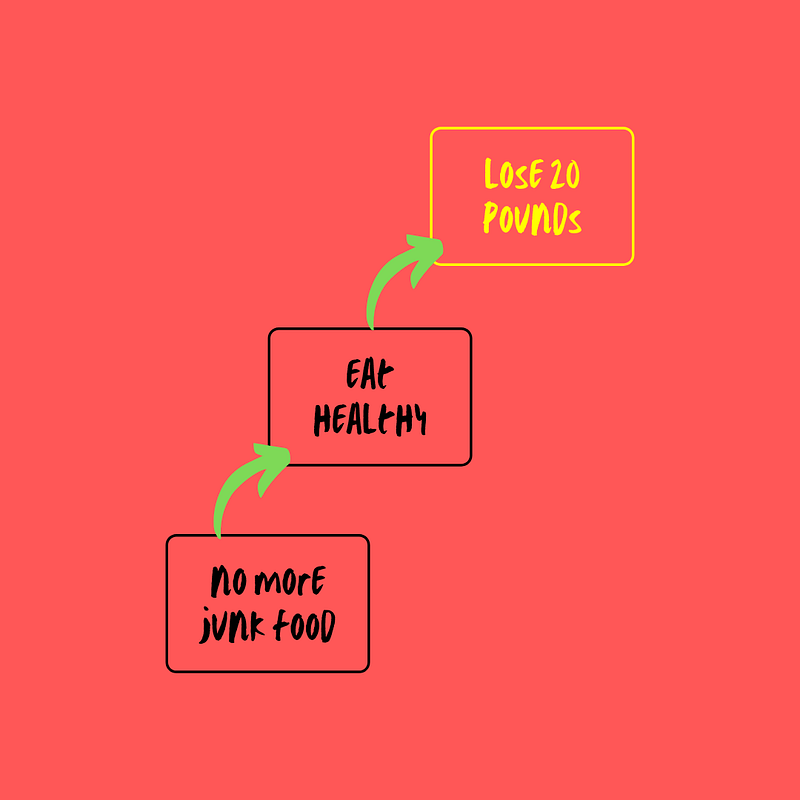
You believe you must meet two subgoals to achieve your main goal of losing twenty pounds: Eat healthily and no more junk food.
Simple, right? If that’s all your beliefs demand, then you know what you need to do.
But suppose you have other beliefs about what it takes to lose twenty pounds. How about a need to exercise regularly? What do your beliefs surrounding exercise entail?
As you ask and answer these questions, your path to losing twenty pounds widens; your subgoals increase in number and complexity.
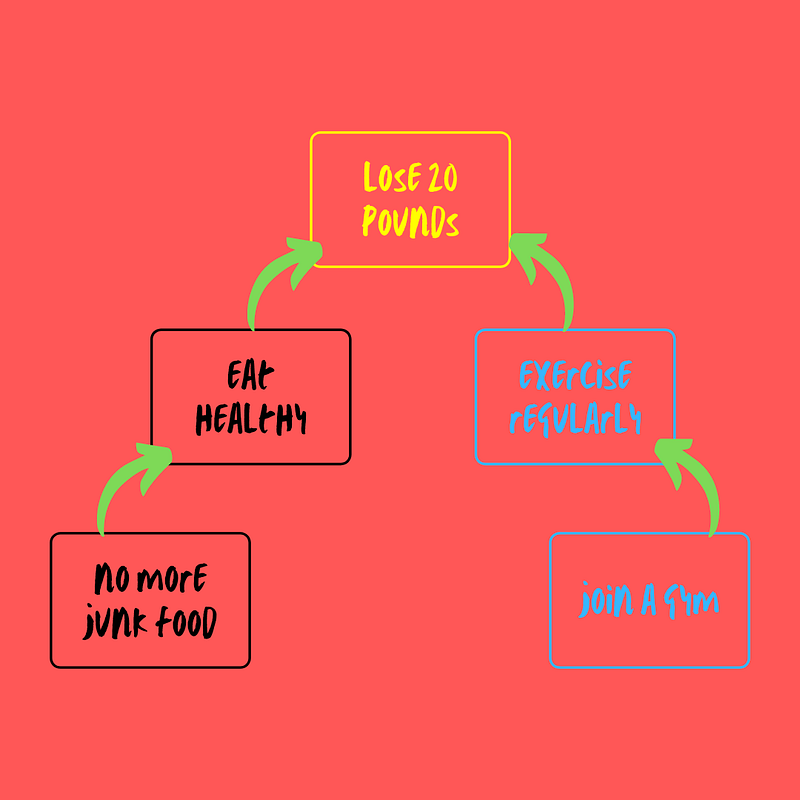
Is there anything else you believe about what it takes to lose twenty pounds?
- What are your beliefs about the need to count calories?
- Intermittent fasting?
- Managing stress?
- Sleeping better?
You might believe some, all, or none of them need consideration. It simply depends on what you believe and how you intend to reach your goal. Imagine now how the complexity of your path is evolving.
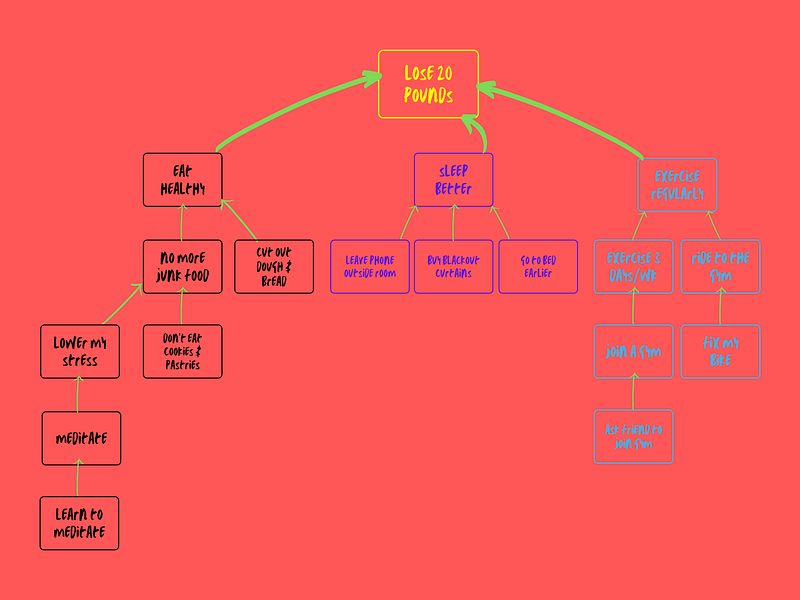
This is just a simple illustration, but things are becoming increasingly complex. Before reflecting on these beliefs at all, perhaps you wouldn’t have realized you believed you needed blackout curtains, to fix your bike, or that learning to meditate might help you cut out junk food.
This is the kind of mindfulness we need to dig deeper into our goals’ connected paths.
Remember: this flow chart illustrates the groundwork for what you believe you need to do to lose twenty pounds. These actions are not currently part of your existing behavior. You’ve only examined what you believe about getting to your goal.
So how do your beliefs about what you’ll need to do fit with what you already do?
Are you ready for an added bit of complexity?
Increasing Behavioral Mindfulness
Let’s zoom in on the path to losing twenty pounds via eating healthily and how it fits with what you already do — as indicated by the double border.
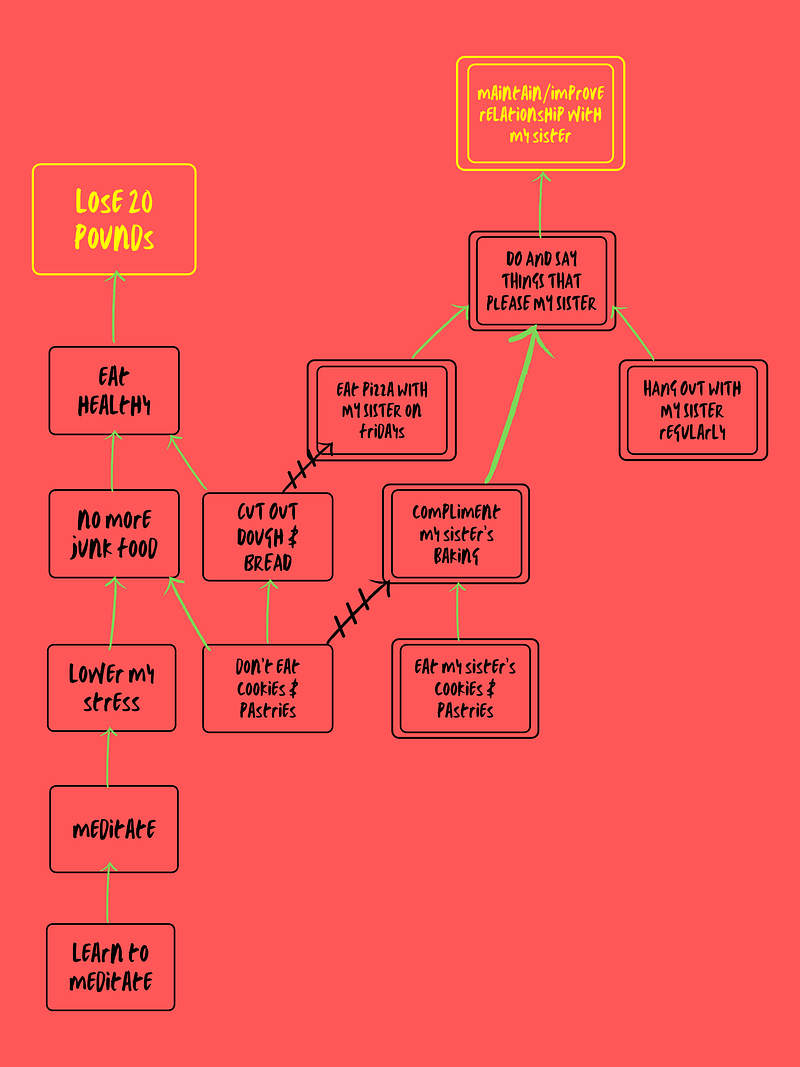
Some of your existing actions, contained in the double border, help you achieve another goal to maintain and improve your relationship with your sister. In this illustration, adopting a new path that would lead you to eat healthily would block your path to cultivating this relationship.
In other words, the actions you believe you need to eat healthily directly contradict the actions you believe you need to achieve relationship goals with your sister.
We are walking contradictions, after all; not an effective way to reach our goals.
Seeing the connection between what we believe and how we act provides us with the mindfulness we need to understand the connections between the goals we’re achieving and the goals we want to achieve.
Considering what you now realize about how your path to eating healthy harms a path to another goal, does it change your beliefs about how to lose weight?
Would it make you qualify your previous goal to cut out junk food to something like, “eat less junk food” or “cut out bread and dough except with my sister”? If you did, would you still believe you could reach your goal to eat healthily? Might it also change any of your beliefs about the way you cultivate your relationship with your sister?
If beliefs dictate how you might act in a given situation, they’re also going to dictate your willingness to follow a path toward your goal. If you don’t believe in the efficacy of your path, you probably won’t follow it.
Shaped by Experience, Defined by Belief
Because this network of goal-stepping is often so complex, it’s easy to lose sight of how to navigate it. But to be more mindful of our approach to achieving our goals, we need to witness the spectrum of complexity to comprehend the connections within it.
For some, that means engaging in relentless introspection, breaking down every part of the whole — editing, revising, revisiting, and reevaluating belief sets and goal paths to ensure our efforts are most pointedly focused.
Honest self-reflection takes practice. Uncovering what you really believe takes practice, too, as is spotting contradictory behavior. Pinpointing specific behavior that prevents you from achieving your goals, such as eating or not eating pastries, will be a crucial first step in understanding how you might change it.
It should be helpful to put pen to paper. Drafting a flowchart as simple as the figures above will help you visualize and simplify the complexity that is your mind.
Don’t be afraid to ask yourself, “Why do I [action]?” — repeatedly. You might be surprised where it takes you.
A more mindful approach to achieving your goals means knowing what you believe and how your beliefs guide your behavior.
If you began reading this with the hope of discovering something helpful, I hope you have. The more we understand about ourselves, the better we can be.
For another illustration using the observations covered above, check out “How ‘Making an Effort’ Becomes Meaningful Change.”