
How “Making an Effort” Becomes Meaningful Change
Grab a pencil, paper, and your honest self-reflection.

Kevin and his partner have been together for several years. Each performs a family role they do not feel forced to play by the other. That is, they treat each other and their roles within the family with equal dignity.
On Sundays, Kevin usually spends part of the day watching televised sports — a significantly enjoyable part of his week — while his partner entertains their two young children and prepares meals for the coming week.
One particular Sunday, Kevin’s partner asks him to help out with the kids for two hours to prepare meals more efficiently. He puts down the TV remote and takes the kids to the backyard to play. His partner feels relief because of his effort to help. But if his partner asks again the following week and the week after, how long will Kevin be able to continue making an effort to help out?
We might immediately greet this question with an answer like, “It depends how important watching sports is to him.” While that may be true, it would fail to appreciate his complexity as a person.
If asked to help on irregular Sundays, Kevin only needs to make an effort. But if he’s asked regularly, week after week, his partner is requesting something far more. His partner is soliciting for a meaningful behavioral change: to take on a new responsibility.
Kevin and his partner know this will be substantially more complicated than just “helping out.” If he’s ready and willing to oblige, he’ll have to do more than making an effort; he’ll need a whole new strategy.
Behavioral Theories Past and Present
Theories of behavioral change have been around as long as humans have been eating too many cookies — erm, building habits. A few of the most regarded offer useful insight regarding determinants of behavior.
For example, the Self-Efficacy Theory suggests behavioral change depends on an individual’s assessment of their ability to perform a given action and achieve a defined success. Advocates of this theory posit a simple truth: People are motivated to accomplish what they believe they can accomplish. Such beliefs are among the most critical determinants for the behaviors in which people choose to engage.
It’s true. Kevin needs to believe he can make the change before he tries. Although what would Kevin’s beliefs about his ability to sacrifice some Sunday sports to help his partner tell us about his actual ability to do it? An honest assessment of ability won’t necessarily yield a correct one. And what would his beliefs about ability tell us about his willingness? Kevin might tell you “nothing” if he believes his willingness has nothing to do with his ability.
Beyond self-efficacy, there must be other determinants, other sets of beliefs, at play. What does Kevin personally believe about the consequences of this behavioral change? How will his partner and the friends with whom he watches sports perceive this change?
Reflections on personal attitude and perceived subjective norms toward the behavior shape our intention to perform it. This is the theory of Reason Action, which highlights another important determinant of action: intention.
The perceived consequences of Kevin’s desired action are undeniably critical in determining his enthusiasm to perform it. In fact, if Kevin is the kind of person that cares a lot about how he is perceived, then his reasoned action could play a heavy role in determining his ability to make this change.
More recent work on behavioral change like Marshall Goldsmith’s Triggers and Charles Duhigg’s The Power of Habit conclude internal and external stimuli command and reinforce behavior by placing us into loops of habit. An example of such stimuli might be Kevin’s urge to turn on the television when he receives a message from a group chat that simply reads, “GAME TIME,” or his urge to grab a beer when he hears a sport’s theme song.
Being able to pick out the stimuli that shape our behavior will provide invaluable feedback for understanding how to manipulate it. Unfortunately, it doesn’t make the process of behavioral change any less complicated. Despite the accomplishments made in the world of behavioral change, many of us still struggle to achieve a lasting transition toward more desirable behavior. This is the challenge of turning mere effort into lasting, meaningful change.
Instead of emphasizing a focus on beliefs about his ability to change, how he and others will perceive him, or on the stimuli that drive his behavior, perhaps Kevin would benefit by examining the behavior itself: Watching hours of sports on Sundays. To do this, we have to ask him why he does it. In other words, we need to understand Kevin and what benefits he has to gain from this behavior.
Understanding Kevin’s Complexity
Knowing what Kevin gains from watching sports is a crucial first step in understanding how he might change it. He probably has all kinds of benefits to gain from watching sports on Sunday. Here are a few he could claim:
- I love sports, so watching them brings me a lot of pleasure.
- I get to relax, which I need after a long week.
- It increases my engagement with my friends and strengthens my relationships with them.
- Watching and knowing about sports gives me credibility among other men.
- Etc.
It’s no wonder Kevin likes watching sports so much. All of the benefits he has to gain presumably serve something further. That is, his gains from watching sports are paying dividends toward further goals. If Kevin watches fewer games or stops entirely, he could be undermining his path to those greater goals. The possibility of that truth would have to come from Kevin and the complexity of his individualism.
Suppose Kevin believes he would start losing credibility among other men or lose connection with his friends if he doesn’t watch sports. Would he be willing to make that kind of sacrifice for the sake of helping occupy the kids while his partner prepared meals?
Kevin’s answer would depend on the fulfillment he gains from spending time with his children and helping his partner. Both of these actions certainly serve some of Kevin’s further goals concerning family. But they do nothing for his goals behind watching sports.
What is Kevin left to do?
Kevin’s Reflection
The simplest solution for Kevin and his partner would be to find another way around it. Maybe Kevin could listen to the games via headphones while playing with the kids outback or doing arts and crafts at the kitchen table. The answer to solutions like these would depend on Kevin and his willingness to compromise with his partner. For this case, we’ll assume there’s no way around it; Kevin wants his cake, and he wants to eat it — particularly on Sunday afternoons.
He’ll need to dive a little deeper into his belief system. The first step is figuring out if he currently acts in other ways that help provide a path to the goals he achieves by watching football. If he does, he’ll want to figure out if he believes he needs to perform them in conjunction with watching sports or can perform them independently to reach the same goals.
Here’s an illustrative example of Kevin’s current behavior and his perceived benefits that follow:
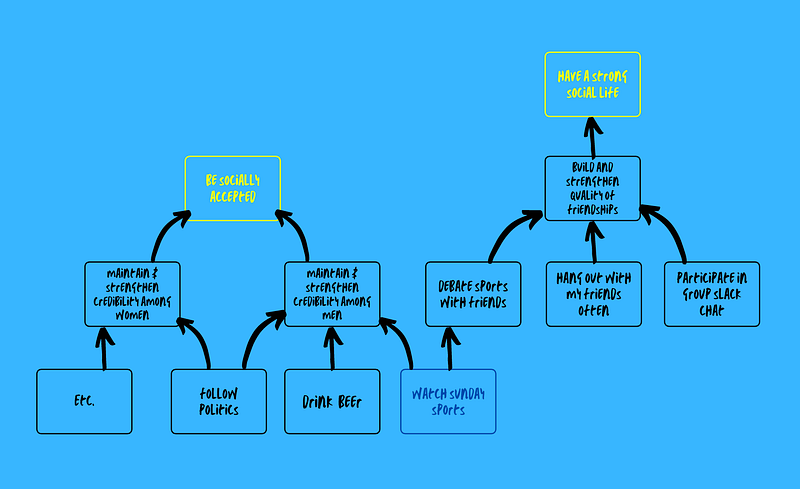
For illustration purposes, I’ve left out all other possible benefits he might reap from watching sports, like pleasure, as previously mentioned. For real-world applicability, Kevin needs to examine all of the things he gains by watching sports. This will be a complicated process; nevertheless, doing so will help him understand what his behavior is helping him achieve.
Watching football provides a path toward two further, larger goals: being socially accepted and having a strong social life. But Kevin also does other things that help him get there, as indicated in his behavioral flowchart.
The question then becomes, “Does Kevin believe he can still be socially accepted or have a strong social life if he stops watching sports on Sundays?”
When Kevin understands the full scope of what he is achieving from the action he seeks to change, it will equip him with the insight he needs to alter it.
Having gone through the process of unpacking his existing behavior and the benefits that follow watching Sunday sports, it will help to start unpacking his beliefs surrounding the desired behavior*.
*It’s worth noting that how Kevin chooses to define his new behavior will significantly change his approach to dealing with it. Kevin might translate his partner’s request to “Help my partner on Sundays” or “Spend more time with my kids on Sundays.” There are clear differences in the benefits that follow these two actions.
What does he believe he will gain from adopting this new behavior? What kind of fulfillment is there for him to draw? Does any of it fit into the effects of his current behavior?
We must leave questions like these for Kevin to answer. However, it is inevitable that if Kevin concludes the new behavior provides him no greater fulfillment toward further goals or blocks his existing paths entirely, he’ll continue just making an effort to help out.
Making an effort becomes meaningful change when two things happen:
- We believe a new behavior can provide equal or greater fulfillment toward the same goals our existing behavior currently serves.
- We believe our path to the benefits of our existing behavior (i.e., achieving further goals) will remain attainable even if we stop a current behavior.
These two things cannot happen without first acknowledging the complexity of our belief system. Illustrating a personal flow chart like the one above can help us do that.
The benefits we have to gain from our behavior may serve some of our greatest goals. Many of us don’t know why we do the things we do because we haven’t taken the time to understand what they’re helping us achieve; it’s no wonder we struggle to change them.
The next time you seek a new behavior, the difference between making an effort and meaningful change might just be a little self-reflection.


