
What Is a Marketing and Sales Funnel and How Does It Work?
Attract leads online and then convert them into customers through a systemic process.
The marketing and sales goals are both simple to increase our sales.
A popular marketing tactic online is to create a funnel.
A funnel integrates marketing and sales to capture as many leads as possible (marketing), nurture them (marketing and sales), and convert them into customers (sales).
But even then, the job isn't over.
Relationships with customers need to be retained and strengthened, so they keep coming (Customer Service).
In the age of digital marketing, we can monitor and track our marketing and interactions with customers; the marketing and sales funnel has become a powerful tool for businesses.
The blog explores what a funnel is, and how it works and discusses marketing activities businesses can use in their marketing funnels to attract and then convert leads into customers.
What is a Marketing & Sales Funnel?
The Marketing and Sales funnel is a model and framework to simplify and quantify each customer journey step.
It is turning a lead into a customer from a marketing (and sales) perspective.
From the awareness stage, when someone learns about the business, to the purchase stage, to post-purchase — satisfaction, word of mouth and customer retention.
A funnel is a fundamental way for any business to model their marketing and sales systems to work together to first connect with a lead and then convert that prospect into a customer.
The funnel works together holistically, so every phase needs to align and work together to make the buyer journey to the bottom successful.
“The marketers` goal is to funnel prospects into buyers, moving them from the top to the bottom of the funnel. The shape reflects the fact that a large number of people will never complete the journey through the funnel.” (Sapian & Vyshnevska, 2019)
A significant advantage of using a funnel is mapping out your process and measuring any weak points in your marketing and sales systems.
If they are not moving from one stage to the next, you can tweak your email copy or increase your content marketing, or wherever you do not have the impact to drive customers to the next phase.
Data analysis helps businesses learn how to better "influence" or persuade a consumer at each phase.
Like you would expect, given its shape, a funnel tries to capture as much volume as possible, like fishers throwing a net out wide to catch as many fish as possible.
As prospective customers go through the purchasing decision, there is a reduction of numbers at each level. As the shape suggested, you will not convert every single lead. But you can make continuous tweaks to improve your result as you understand the process better.
“A Marketing Funnel is a way to frame other marketing strategies and understand how the customer interacts with a company.” (Sapian & Vyshnevska, 2019)
Example of a marketing and sales funnel
An example of a simple funnel is as follows. And it is a simple funnel — there are some overly complicated funnels out there, but I do not want to over-complicate things.
I will use an example from when I was in real estate for four years before starting a marketing business.
- First, I post on LinkedIn about a local infrastructure update in the news or something that would interest local businesspeople.
- When they are on my website, they read the article, and there might be a pop-up before they leave to join a mailing list for local news/updates.
- Even if people do not join the mailing list, a tracking/marketing pixel can start marketing to these people on Facebook or other social media with targeted paid advertising.
- They might then start following my Facebook page and see a house for sale on one of my posts interested in coming to an open home.
- If they do not buy that house, they supply their phone number at the open home.
- I call them to ask for feedback on the house and build rapport, and after following the usual script of "Are you looking to upsize or downsize? Have you had an agent look at your house yet?"
- They then later agree to sell their house with you and sell them their new home.
- The clients enjoyed their experience. They are emailed quarterly by you with market updates and local news, and you send them a Christmas card every year. You might call them once or twice.
- Five years later, they sell with you again.
This explanation is the best-case scenario but an example of how a funnel can work from top to bottom.
History of the Marketing Funnel
The sales funnel originated over 100 years ago, with ideas from John Dewey and Elias St. Elmo Lewis. John Dewey introduced the Buyer Decision Process, which is still relevant today in understanding buyer behaviour.
There are five stages: Problem Recognition, Information Search, Alternative Evaluation, Choice, and Outcomes.
Lewis was even more influential, introducing the AIDA (attention, interest, desire, and action) model of customer persuasion to illustrate the stages of a customer's relationship with a business. The model is still commonly used today and puts the purchase process into four phases.
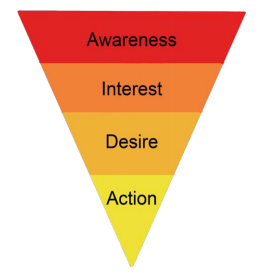
- Awareness: The prospect is aware of their problems and practical solutions. Marketing attracts customer attention to the product. The customer becomes aware it is available.
- Interest: The prospect shows interest in a group of services or products. Marketing develops an interest in a product or service.
- Desire: The prospect begins to evaluate a particular brand. Marketing develops a desire to own a product. The customer wants it.
- Action: The prospect decides whether to purchase. Marketing prompts action to buy the product.
Initially, many funnels only included aspects up to a sale.
Still, as we have begun to understand the importance of customer retention, models have included customer service and post-purchase factors such as "loyalty" and "advocacy" to help improve marketing strategy.
The design of a marketing funnel differs depending on the context; for example, between business 2 business, and business 2 consumers. The steps might be similar, but the execution will vary.
“The firm is going to need a well-devised sales funnel that will effectively guide the target audience throughout the purchase process and turn them into buying customers.” (Sapian & Vyshnevska, 2019)
Developing a marketing and sales funnel
The process of developing a funnel that works is easier said than done. Businesses are set up that concentrate solely on online funnels, which was not the case ten years ago.
Businesses need to thoroughly develop a marketing plan for executing each funnel stage to yield their desired results. We need to consider each step's role in generating a positive buyer journey through the funnel.
We leverage what we learn through analytics to tweak the marketing at each funnel stage.
Essential tools for creating a funnel
Sales teams and marketers have never entirely agreed on whose funnel and how much control each should have.
In the age of digital marketing, marketers have taken most of the control, leaving sales to look after the bottom of the funnel.
But, to work together efficiently, they should meet somewhere in the middle. The Cross-sell or upsell goal is popular with digital marketing and having a product available for every step of the buyer's journey.
Digital marketing is a powerful tool across an entire marketing funnel. Tactics used via social media help brand awareness at the top, content marketing in the middle, and customer relationships at the bottom. These are some digital marketing tools useful in the marketing and sale funnel.
- Social media is a crucial tool to use at the start of the funnel to build brand awareness, but it is also great for customer retention and keeping people engaged in your brand.
- Email is powerful throughout a funnel and is especially effective in the retention stage. Just stay in touch and dangle a carrot in front of leads every so often (so to speak).
- User Reviews are often the deciding factor on whether the buyer purchases. Roughly half of the people find the information in a user review more important than any marketing material.
- Website and SEO are essential in the awareness phase — you want to get traffic to your website. Creating SEO-friendly content, such as blogging and getting backlinks, will help.
- Lead magnets are valuable information given in exchange for contact information (usually an email address), a free e-book or a whitepaper.
“Cutting through clutter now requires more-imaginative and sophisticated use of social tactics across the marketing funnel, including the integration of social with paid media. Simply raising awareness through social has become a more sophisticated and rapidly changing exercise in which new approaches can make an impact and then become passé in a matter of weeks.” (Deal, 2014)

Phases of the Marketing and Sales Funnel
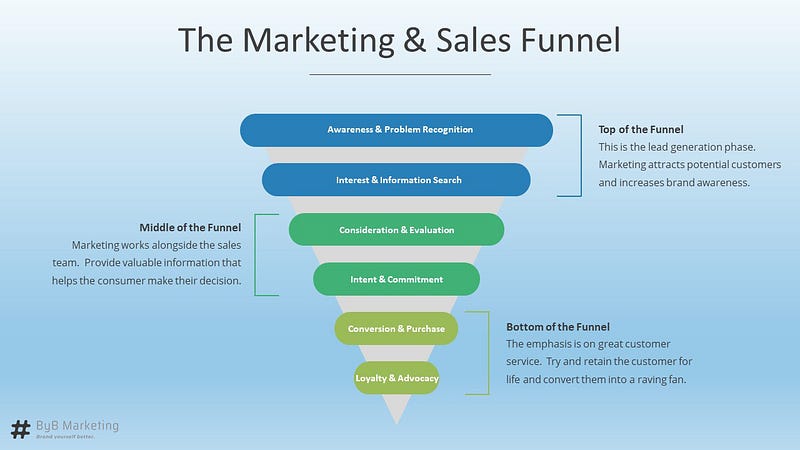
These are the six phases of a sales and marketing funnel.
There are several variations in the marketing and sales funnel, but they all follow the same methodology.
I have created this example based on the typical components of popular versions of the funnel.
The six levels are Awareness & Problem Recognition, Interest & Information Search, Consideration & Evaluation, Intent & Commitment, Conversion & Purchase, and Loyalty & Advocacy.
1. Awareness & Problem Recognition (TOFU)
Awareness and problem recognition is the first phase of a funnel. When a person recognises one of their particular needs, this triggers the first phase of a marketing and sales funnel. This stage is the lead generation phase.
A brand must attract the attention of potential customers, so they are aware that it is available. A prospect must become aware of two things: customers' problems and the company's solution.
This phase is where a business needs to throw its marketing net wide and have a presence in places where its target market spends time trying and capturing its attention. Try to engage with potential customers.
Position yourself / your brand as a thought leader in your industry through marketing activities such as SEO, social media, advertising, events, and content marketing. Positioning yourself as an expert establishes the initial trust.
This recognition of a problem or need triggers a search for more information.
2. Interest & Information search (TOFU)
Once Marketing has created awareness and interest in a product, brand or service, we move into the interest and information search phase.
Consumers learn more about a company or brand and its offering. Your content marketing continues in this phase and is more information and value-based than brand awareness.
Here, you position your brand in potential customers' minds and start to develop and nurture a relationship. You also begin to introduce customers to your services.
“Using tailored landing pages, webinars, newsletters, testimonials, customer guides, online videos, media interviews, blogs, and even customer service training is a perfect way to get consumer interest.” (Sapian & Vyshnevska, 2019)
Nurture leads through more targeted marketing such as email marketing, Case studies, e-newsletter, whitepapers, "how-to videos", webinars, and targeted ads. The goal is to reinforce that the prospect is in the right place and guide customers towards what they need to know about the offering.
Here you position yourself as an expert in your industry with your content marketing strategy that provides valuable information that helps people, with no strings attached. Whoever your target audience is, centre this content around helping them with their problem. Help your audience understand that you can solve their problems.
You can do keyword research through Google Trends, and other tools will indicate what types of searches people are doing related to your industry. You can then create content that matches those queries.
You want to understand why a customer would have to choose your company's product or service.
Each search phase will be contextual. Buyers will search for a solution on Google or another search engine like social media.
The amount of time and energy put into this phase depends on the product or service. It could be a voice search on Maps for nearby cafes, for example, or visiting numerous stores for a more significant purchase like a car.
3. Consideration & Evaluation (MOFU)
Following the information search, the next funnel phase is consideration and evaluation.
Elias St. Elmo Lewis referred to this as "desire", and some models refer to this as "Middle of the Funnel".
Consumers start forming their decisions, so businesses should nurture their leads as they have become more qualified. At this phase, Marketing must develop a desire to own or have the product.
Emailing is more regular at this phase, and case studies are a helpful tool to highlight your previous success and increase your credibility.
Marketing content contains more product information, and you might give exclusive offers to these leads. A low-cost or even free e-book is another tool at this phase.
Resources like pricing guides and "how-to" guides help marketers keep leads' attention at this phase. Including text on your website covering things such as FAQ and Shipping also helps give peace of mind and provide powerful social proof.
Depending on the product or service type, the time spent at each stage varies.
It could be a snap decision for something like fast food.
A significant investment will take a careful and thorough evaluation process. The evaluation phase is often the longest in a funnel, lasting weeks or even months. Marketers must consistently reinforce their relationship with the customer and give them the necessary information to evaluate this decision.
4. Intent / Commitment (MOFU)
After the consideration phase, leads move on to intent & commitment. The lead is ALMOST a customer.
These people have demonstrated some interest in buying a product or service.
Marketers offer free trials, demonstrations, and consultations and arrange sales meetings with people at this phase as they are ready to go. They might have left a product in a cart on the website. They have shown strong intent to consume—marketers to make a compelling case for why their product is the best choice for a buyer.
This point is also where the sales team would take over, and marketing can be more direct to help people make their final decision. Ideally, marketing and sales tactics work together to nurture the decision-making process and convince the buyer.
5. Conversion / Purchase (BOFU)
If consumers reach the Bottom of the Funnel, they have decided to buy and become customers.
Congratulations!
The customer has gone through all the phases — determining they have a problem and deciding you provide the solution.
The Conversion and Purchase phase is where sales processes have control of the customer. The aim is to make the purchasing process online as simple, safe and efficient as possible. Reduce any risk for the customer. The customers can also be cross-sold or up-sold to a more expensive product or service.
If this stage is effective and efficient, and customers are happy with their purchase, this phase should mostly take care of itself.

6. Loyalty & Advocacy (BOFU)
What happens after the sale is critical, but many companies fall short at this phase.
Happy to make the sale, firms let many potential future customers walk away. We want to retain our best customers. The cheapest path to conversion is through existing customers. Loyalty and Advocacy are the final phase of a marketing funnel.
“And one last thing to remember, buyers can always finish the action or purchase but still be left frustrated, confused, or upset. A truly positive experience at this stage in the funnel means the marketers have moved the customer closer to the advocacy and loyalty stage.” (Sapian & Vyshnevska, 2019)
Email and social media are great tools to stay in touch with customers and nurture your relationship.
You can send the odd offer and keep the customer aware of what you are selling, but mostly, you want to create value to try to bond with that user so they advocate on your behalf. Word of mouth is a powerful marketing tool, and it is free!
Try to create "raving fans" who will become loyal advocates for your brand.
But do not expect the time and effort you should put into this phase to be free. Create a brand promoter.
Thanks for reading.
I hope you found this content helpful and can use it to create your own funnels to attract more customers!
Remember, sales and marketing are different processes. Marketing attracts leads, and sales convert them. To optimise a funnel, the two must work together.
If you enjoyed the content, you might enjoy this article about the marketing mix.
Read More Medium Articles
Non-Medium members can only read 3 articles a month.
Become a Medium Member for unlimited access to my content and articles from thousands of other writers for just $5 a month.
Subscribe to be notified when I publish more content.