
“Horseman, pass by!”
…or the long legacy of van Dyck’s famous ‘Equestrian Portrait of King Charles I’
This equestrian portrait of King Charles I, painted around 1637 by Anthony van Dyck is larger than life, measuring more than 3.5 metres high and nearly 3 metres across. It was a time when the King reigned without a Parliament, and is one of the many portraits van Dyck made as Court Painter to King Charles I.
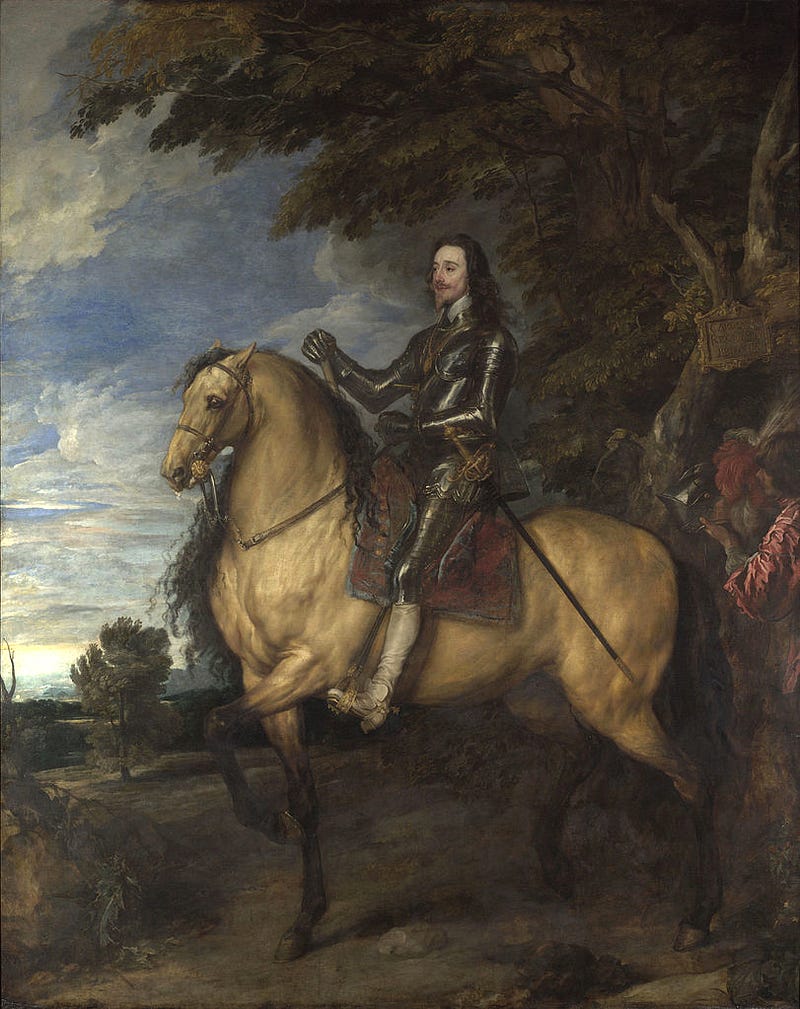

The King is in full armour with sword at his side as he grips the reins in his left hand, while his right hand rests confidently on the baton of command. He is being shown in complete control, ready for battle, state appearance, or perhaps some equestrian contest. He was known to be a skilled horseman and tilted at tournaments. He wears a medallion of St George called ‘The Lesser George’ which was the symbol of the Knights of the Garter, an order of high chivalry begun in medieval times, by decree of King Edward III of England.
Anthony van Dyck had trained under Peter Paul Rubens and travelled extensively in Europe before settling in England in 1632 and being appointed as Court Painter. He worked tirelessly and was rewarded with a knighthood and finally interred at St Paul’s Cathedral when he died in 1641. That was the year before the outbreak of the English Civil War that would end the monarch’s reign...
Here, van Dyck portrays King Charles I as pale, serene, and resolute, with long hair and a pearl earring which was the height of court fashion. An equerry to the right offers him a plumed helmet which matches his shining armour. He’s ready to fight but prepared to rule in peace.
His mount is powerful, wide-eyed, and champing at the bit, with powerful muscles, but restrained by the King into a graceful pose that’s almost ‘passant’ which, in heraldic terms means strong, protective, and courageous. Van Dyck seems to have intentionally refenced the King’s luscious locks in the horse’s flowing mane, emphasising their harmony and unity of purpose. This takes on additional connotations if the horse represents the nation behaving as one under the command of the King.
The background is the English countryside and woodland, on a blustery day in early summer. A sign on the trunk of an oak tree reads ‘Charlus Rex Magnae Brittaniae’ — Latin for ‘Charles King of Great Britain’ — an aspirational motto as the Act of Union to unite the kingdoms of England, Wales, and Scotland, did not happen for another seven decades.
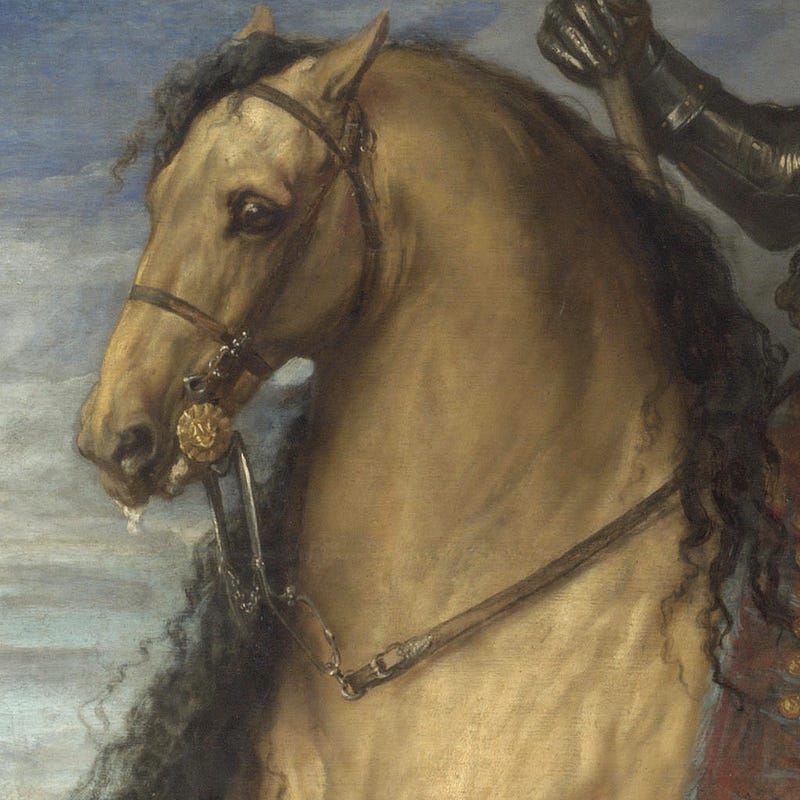
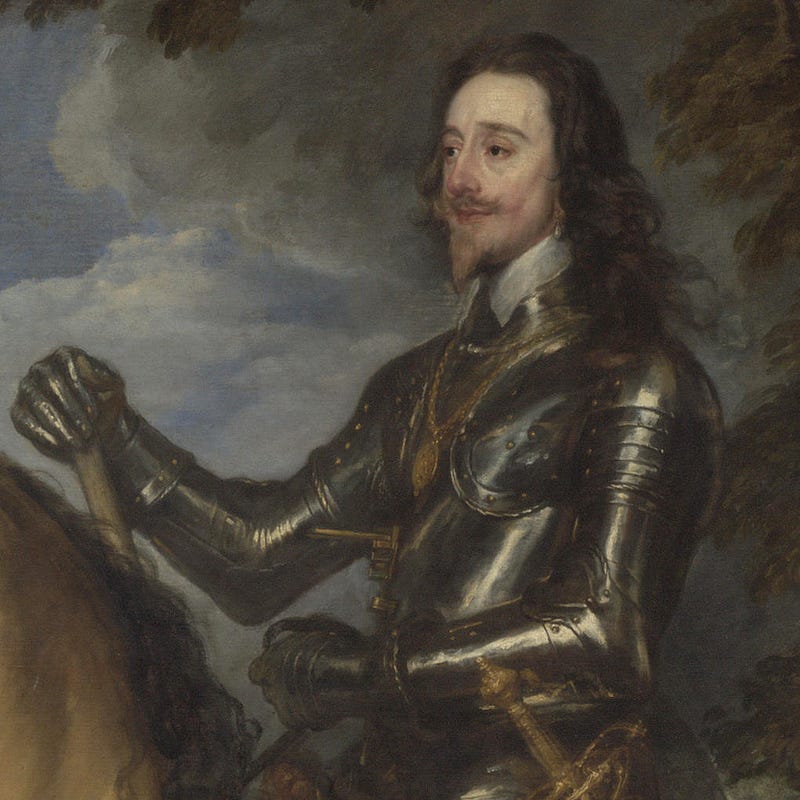
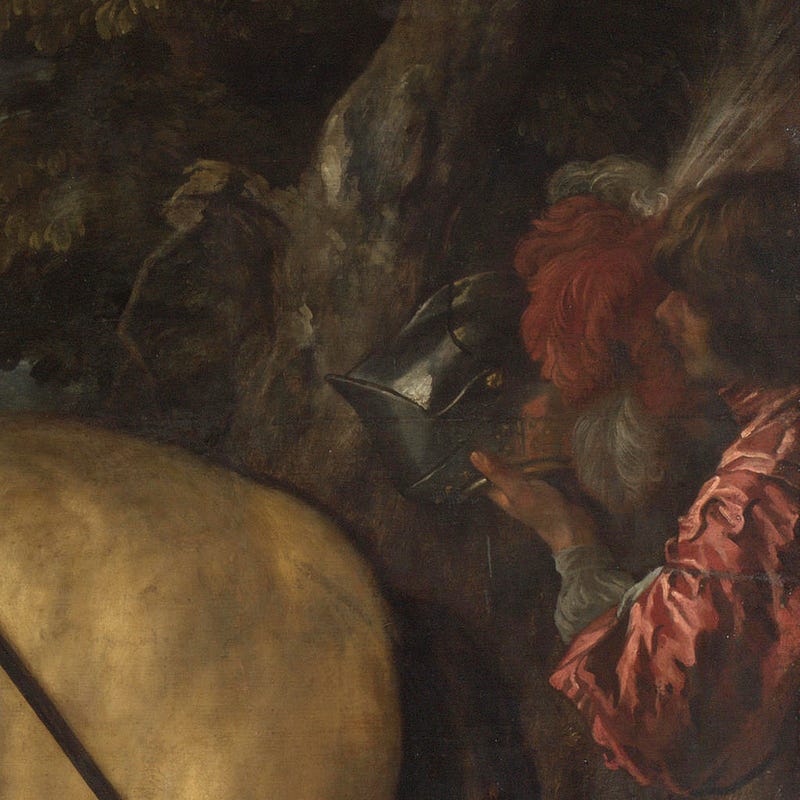
This is an image designed to emphasise the belief of Charles I in the Divine Right of Kings to lead and protect their subjects, and also depicts a worthily cultured man in control of his passions. The large portrait on horseback may also compensate for Charles’ comparatively short stature. He was five-foot-four and had weak legs since suffering from rickets as a child. It also expresses van Dyck’s love of the English countryside as he captures the quality of light, the bright clouds, and deep shade of the leaf canopy, with vigorous brushwork. His style and skill at portraiture would influence later artists such as Joshua Reynolds and Thomas Gainsborough.
It is believed that the portrait hung at Hampton Court, which is surrounded by woodland and estates used as the Royal hunting grounds. It’s also where Charles I was imprisoned following his defeat by Oliver Cromwell during the English Civil War in the decade after this portrait was painted. Charles I was executed in 1649 and his son and heir fled to Europe, living as a guest at various Royal courts until Cromwell’s death and the end of interregnum, the period of his Puritan austerity in England. The restoration of the English monarchy began with Scotland proclaiming Charles King before he was invited back to rule England as Charles II with powers restricted by a selected Parliament.
For his coronation in 1661, new ceremonial regalia was created as the old ritual objects had been melted down by the Cromwellian Republic. The new crown, orb, two sceptres, and anointing ampulla, have been used in coronations ever since and were most recently seen in action for the very recent coronation of the current King, Charles III.
The reign of Charles II saw the Great Plague and Great Fire of London in 1666, but also the creation of the Royal Society and the Royal Observatory for the furtherance of knowledge as well as renewed support for the arts including the reopening of theatres. Charles II died in 1685… of natural causes, possibly exacerbated by regular exposure to toxic chemicals in his own, well-appointed laboratory where he undertook serious studies in alchemy.
The van Dyck portrait of his father, King Charles I was sold and went abroad for many years until it was acquired by the Duke of Marlborough in the eighteenth-century and was hung at Blenheim Palace, which would later be famed as Winston Churchill’s childhood home. The painting was sold to the National Gallery in 1895.
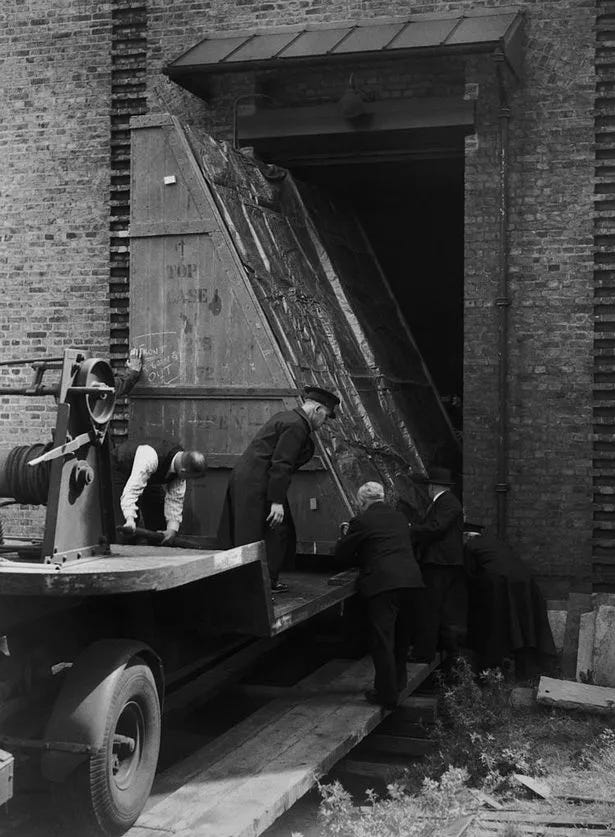
It has since been moved from the gallery twice, to be protected during both World Wars. When it was moved to the National Collection’s secret hiding place in North Wales in 1941, it was so large its container was almost stuck under a railway bridge. The road had to be dug out to lower it and on arrival at the deep mines where it was to be hidden, it barely fitted through the door which had already been considerably enlarged. It has recently been extensively restored and is once more on display in the National Gallery, London.
(The title of this article is taken from the poem Under Ben Bulben, a mediation on death and legacy, written in 1938, by the poet William Butler Yeats: “Cast a cold eye, On life, on death. Horseman, pass by!”)
* All images are used with license, or presented here for educational purposes under fair usage policy.