
Power up your homeschool schedule
Homeschooling Schedule That Works for the Whole Family
Learning through core, creative, and character sessions

Homeschooling doesn’t have to be overwhelming for either the child or the parents. A realistic schedule with room for flexibility and good planning can facilitate a good learning and teaching environment that will produce results.
A schedule that works for both the child and supervising adult
Your schedule is your blueprint for building an educational framework that will allow your child to learn through study, play, project sessions, and character development.
An appropriate schedule also takes in the needs of the person supervising/teaching and the whole family.
It’s not easy taking care of the daily needs of a family, and at the same time, adding the task of preparing and maintaining a good homeschooling program.
Let’s break down the following schedule and examine how it can help you reach your goal.
The schedule
Monday — Thursday: 8:00–4:30 Friday: 8:00–11:00
- 8:00 Breakfast
- 8:30–11 Core curriculum learning (1 subject per day)
- 11–12:00 Outdoor/Indoor Play
- 12:00–12:30 Lunch
- 12:30–2:00 Nap/Read/Quiet time
- 2:00–3:00 Creative Learning (projects/hands on)
- 3:00–4:30 Character Learning (Chores and Responsibility)
Breaking down the schedule

8:00 AM Breakfast
A good morning routine is essential to allowing your child to adjust his mindset and ready himself for the day’s activities.
Waking up in time to wash their face, brush their teeth, choose their clothes for the day, make their beds, and sit down to an unhurried breakfast will help them accomplish that task.
You know your children best. Be sure to give them the time they need to be ready for breakfast at 8:00 AM.
- Tip — This is a good time to spend a few minutes of quality time with your child as you eat breakfast together.

8:30–11 AM Core curriculum (1 subject per day)
Concentrating on one subject a day gives your child the maximum exposure needed to absorb and retain core information.
It also allows the parent time to fully plan for each day’s curriculum.
Build each part of the learning process around the core subject, making it the theme of projects and character learning.
You’ll find that one day devoted to one subject will work as well, if not better, than disjointed sessions throughout the week.

11–12:00 Outdoor/Indoor Play
This playtime is necessary after a child had finished an extended period of concentration. Physical activity will re-energize and relax them in preparation for their next learning session.
This activity time is scheduled just prior to their lunch break which will also help build in them a healthy appetite.
Tip — Parent can use this time to prepare lunch, make necessary phone calls, drop a load of clothes in the wash, or work on the next day’s curriculum materials
12:00–12:30 Lunch
Another good time to just enjoy eating and conversing with your child. Warm association at mealtimes are moments your child will remember with their heart. In later years, it may be the times they most often recall with pleasure.

12:30–2:00 Nap/Read/Quiet time
Everyone benefits from some alone time. Whether your child naps or spends this time curled up with his favorite book, it should be geared toward relaxation. This is not the time for electronic games, stimulating movies, etc.
And parents shouldn’t feel as though they are too old for an afternoon nap or some precious alone time. Take advantage of this break to recharge your batteries because there is still a long afternoon ahead filled with more learning sessions, dinner preparation, etc.

2:00–3:00 Creative Learning (projects/hands-on)
Build project learning around the day’s curriculum theme.
Design projects that will take several sessions to finish. This will allow for projects that are more detailed and advanced. It will also minimize the number of projects that you will need throughout the school year — cutting down on preparation and cost.
Combine project learning with research and application. When possible include visuals — modeling, artwork, dioramas, etc.
Explore the Benefits of hands-on learning. Children can develop skills much faster when they’re having fun.
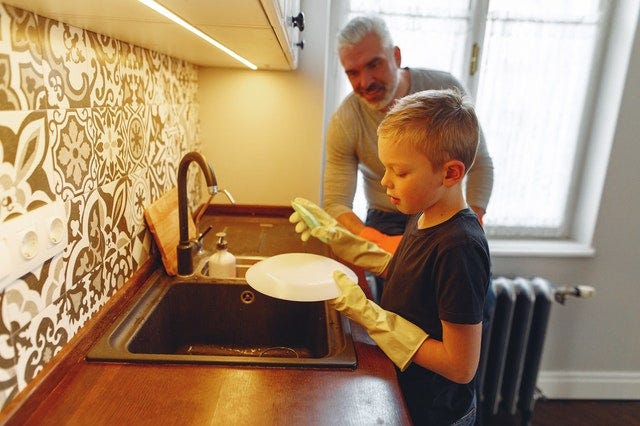
3:00–4:30 Character Learning (Chores and Responsibility)
One of the most beneficial learning sessions is the one that teaches you child how to be a contributing member of the family.
The best education may prove to be useless without character skills that help your child build and maintain good relationships throughout their lives.
- Tip — The key to making the character learning session successful is to be engaged with your child through each of the tasks assigned. This allows the child to approach this time as a true learning session that’s part of his overall education.
Have fun together, work together, plan together, make decisions together. Make sure that your child sees the benefit in the work he does. Discuss some of the following principles with them as you work together.
- Why is the task necessary
- How does it benefit each member of the family
- How will it benefit them as an individual
- How is it an expression of love, respect, or good manners
- Discuss ways to work with others successfully
- Get their opinion on the best time and ways to accomplish specific tasks
- Continue to think of teaching points that fit your family and child’s needs
What are the benefits of having a regular, consistent homeschool schedule each day?
Conclusion
Nothing gets accomplished without good planning — wouldn’t you agree? However, part of the crucial planning process for homeschooling is the need and opportunity for flexibility. Schedules are wonderful, but life has never marched to the tune of a perfect schedule. Adaptability will allow for adjustments when necessary without sacrificing your working schedule.


