
Design Wisdom: The HITED Framework for Methodological Empathy
A new visual language for the Design Wisdom project
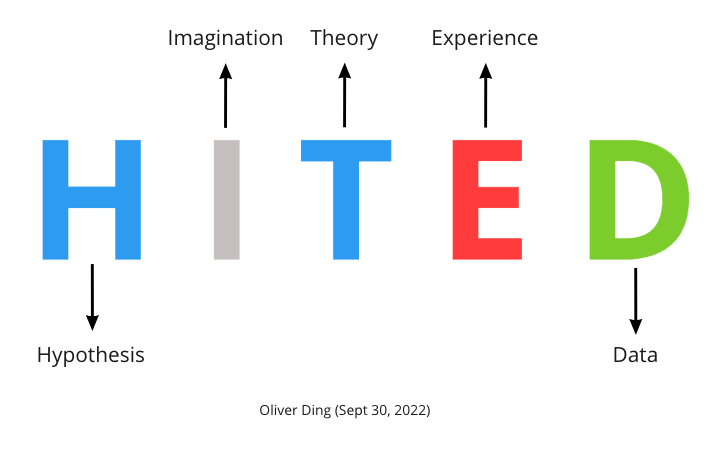
In Sept 2022, I made many new ideas such as a set of methods for mapping the complexity of creative life. The last idea I made last week is the above diagram.
The above diagram is called the HITED framework. It is about the way of knowing. For philosophists, the way of knowing refers to the subject of epistemology. For scientists, the way of knowing refers to the subject of methodology.
I consider this framework a tool for the Design Wisdom project.
Several months ago, I wrote a post about the Design Wisdom project and encourage designers to adopt theory-based reflection for their intellectual development.
I also work on a new approach called Knowledge Curation that aims to connect Theory and Practice.
Why do I create the HITED framework?
What’s the relationship between the Knowledge Curation project and the HITED framework?
The answer is the THEORY-PRACTICE Gap.
The THEORY-PRACTICE Gap
The mission behind the Knowledge Curation project is Connecting Theory and Practice.
The Theory-Practice Gap is an important issue in a wide range of disciplines including education, organization learning, and development, community building, academic development, enterprise R&D, professional service firms (PSFs), etc.
If we can find a good solution to close the Theory-Practice Gap, then we can improve existing social systems of knowledge production, knowledge application, and knowledge management at the individual level and the collective level.
In the past three years, I have developed a set of tools and run several sub-projects.
- 2020: The HERO U framework | The Activity U project
- 2021: The Model of Knowledge Curation and Canvas | The D as Diagramming project
- 2022: The Thematic Space Canvas | The Life Discovery project
- 2022: The Thematic Landscape Map | The Thematic Engagement project
The outcome is pretty amazing. I produced various types of knowledge products such as concepts, diagrams, canvases, methods, toolkits, etc. I also wrote articles and edited books. The approach roughly suggests the following three steps:
1. Practice-based reflection 2. Theory-based reflection 3. Practice — Theory dialogue
Both researchers and designers are knowledge heroes. Designers are not only users of knowledge, they can be makers of new knowledge too. I hope the Knowlege Curation approach could help designers grow their design wisdom.
All knowledge heroes face a creative challenge: the “Hypothesis — Data” Gap.
The “Hypothesis — Data” Gap is a sub-issue of the THEORY-PRACTICE Gap.
The HITED framework is all about the “Hypothesis — Data” Gap.
The “Hypothesis — Data” Gap
The original model of the HITED framework is the diagram below. You can see two gaps now.
- The “THEORY — EXPERIENCE (Practice)” Gap
- The “HYPOTHESIS — DATA” Gap
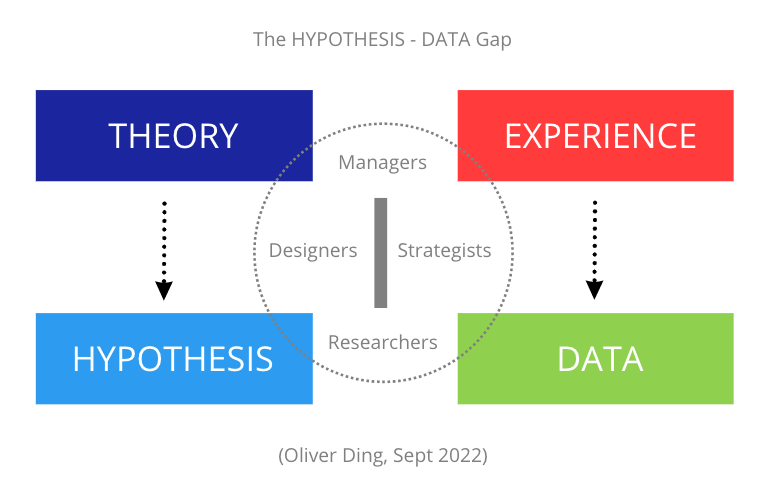
The above diagram also shows two connections between two levels:
- THEORY -> HYPOTHESIS
- EXPERIENCE -> DATA
There is a “THEORY” behind a HYPOTHESIS. Each THEORY can generate several HYPOTHESES.
DATA comes from real EXPERIENCE. Experience can generate DATA.
The core of the above diagram is “I” which refers to managers, designers, strategists, researchers, etc.
We have to notice that there are three types of “I”:
- Scholars/Scientists: they work on public knowledge creations.
- Professional Workers: managers, designers, strategists, researchers, etc.
- Actors: Ordinary people
In HERO U — A New Framework for Knowledge Heroes, I mentioned three types of knowing.
- Knowing-for-all
- Knowing-for-us
- Knowing-for-me
See the diagram below.
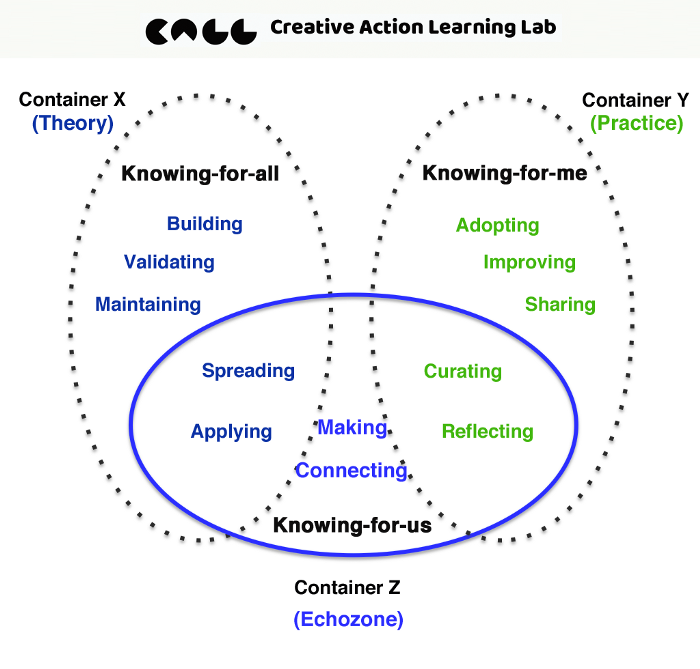
The “Knowing-for-all” refers to public knowledge creations. Scholars and Scientists belong to this section.
The “Knowing-for-us” refers to team knowledge engagement or community knowledge engagement. For example, most professional workers belong to this section. Managers, designers, strategists, and industry researchers, don’t have to create new knowledge for the public. They tend to produce new knowledge for internal purposes. You can find many examples in The Knowledge-Creating Company.
The “Knowing-for-me” refers to ordinary people who only consider personal development without contributing to teams or public knowledge creations.
Can we directly connect this typology with three types of “I”?
I’d like to mention that Professional Workers can be divided into two groups:
- Knowledge Makers
- Knowledge Users
While Knowledge Makers commit to both using knowledge for practical tasks and creating new knowledge for public purposes, Knowledge Users only think about using knowledge for internal activities.
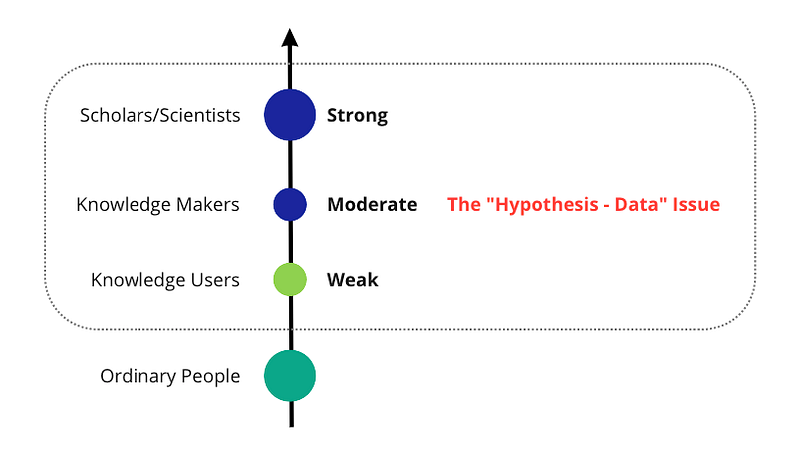
Different groups of people hold different attitudes to the Hypothesis — Data Issue. See the above diagram.
There are many academic papers about the Hypothesis — Dada Issue. My goal is to develop a new visual language for Professional Workers in order to encourage the discussion about the Hypothesis — Data Issue.
The HITED Framework
Based on the above model, I use five letters to develop a new visual framework for curating different approaches to the Hypothesis — Data Fit. See the diagram below.
Five letters stand for:
- H: Hypothesis
- I: Imagination
- T: Theory
- E: Experience
- D: Data
Based on these five letters, we can add more elements to expand it and build new sub-frameworks. Each sub-framework can represent an approach to the Hypothesis — Data Fit.
For example, the diagram below represents the “Imagination Design” approach to the Hypothesis — Data Fit.
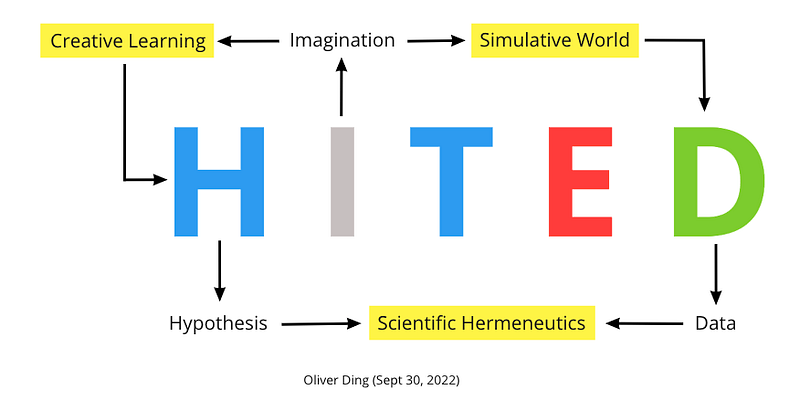
Several days ago, I had a conversation with Maurizio Goetz who is working on Imagination Design and providing cognitive tools for imaginative organizations.
His daily practice is to help companies imagine new things and manage the uncertainties of a complex world. For example, one of his clients develop an innovative technology that could be used in a traditional social practice such as home water supply.
They face many challenges because there are so many “Unknown”. What’s the right approach to apply the technology to the existing social practice? How does it change the laws? What will be the industry in the future?
He works with analogies and remixing ideas, then fill the gaps with imagination. Also, he emphasizes the moral aspect of imagination. It is not only about what you know but also about your values. What’s right? What’s ethical? What’s good?
Imagination Design Coaching is a dynamic process of explorative learning and generative learning through curation, remixing, and meaning-making.
Based on our conversation, I used the framework “HITED” to make the above diagram for modeling his practice. I only touch the cognitive part.
My understanding of his practice is that 1) Imagination impact both H (Hypothesis) and D (Data), 2) There is a need of considering Scientific Hermeneutics for matching Hypotheses and Data.
During the process of Imagination Design, creative learning will lead to some new hypotheses. On the other side, Imagination Design will make a simulative world in which we can get new types of data.
If we consider the strong stance to the Hypothesis — Data Fit, then we need to consider Scientific Hermeneutics for matching hypotheses and Data.
This experience encouraged me to create more diagrams for other approaches.
Then, I realized that this is a new visual language for discussing these issues.
The Anti-theory Stance
Let’s see an example called “Anti-theory” which rejects theory and hypothesis. See the diagram below.
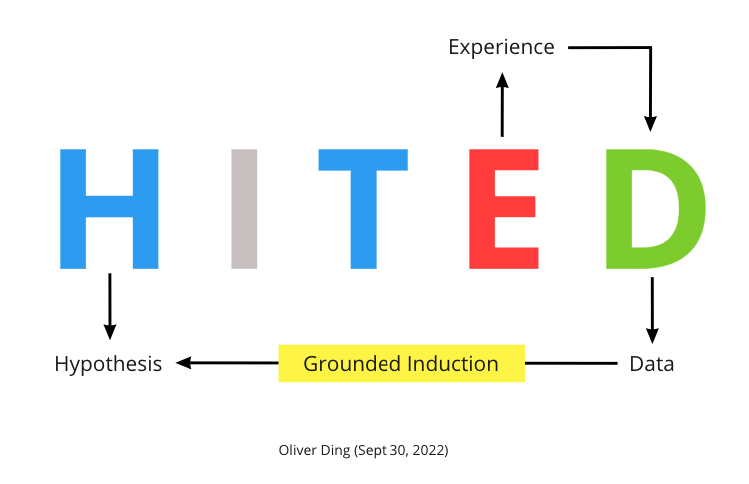
The Anti-theory stance only believes in the induction reasoning approach for generating ideas. Every Hypothesis should start with Data which should start from real Experience.
I use the term “Grounded Induction” to refer to the key process of the Anti-theory stance. It is inspired by Grounded Theory which is a typical “Anti-theory” approach.
Grounded Theorists strongly believe the induction reasoning and reject any preexisting theory. However, there are several versions of Ground Theories, different approaches to grounded theory reflect different views on how preexisting theory should be used in research.
The Hypothetico-deductive Model
The Hypothetico-deductive model is a popular approach to the scientific method. See the diagram below.
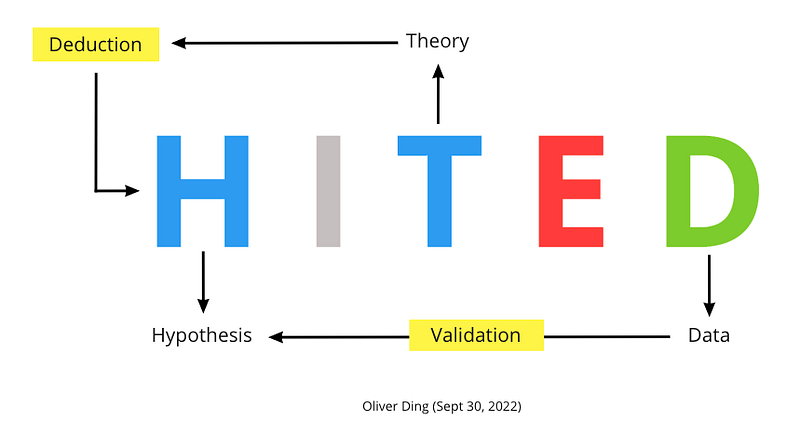
The Hypothetico-deductive model considers both Hypothesis and Data. This model has different approaches too. The above diagram only shows one approach.
The above diagram highlights two key ideas: Deduction and Validation. While a Hypothesis is generated by deductive reasoning from a pre-existing Theory, the Data is used to test the hypothesis.
Some scientists emphasize the concept of Falsifiability which was introduced by Karl Popper in his 1934 book The Logic of Scientific Discovery. For professional workers, I use the term “Validation”.
The Experimental Approach
The Experimental approach is a standard method in some fields such as natural science. See the diagram below.
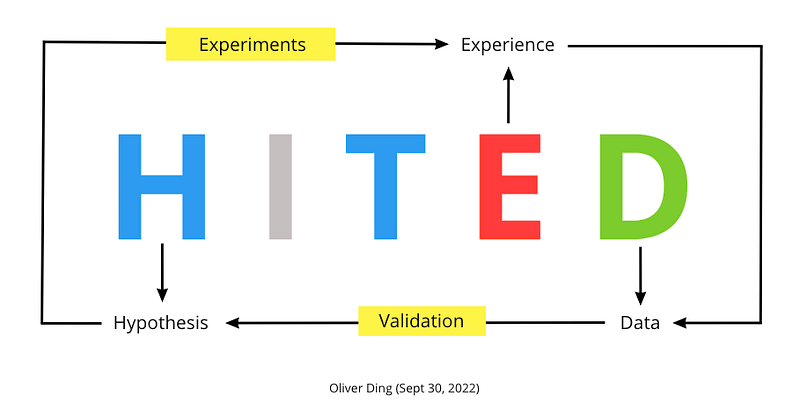
The approach starts with a hypothesis that guides the design of an experiment. The uniqueness of the experimental approach is that it creates Artificial Experience and uses the experience to produce Data to test the original hypothesis.
Scientists tend to control variables and separate Dependent and Independent variables.
The “Private Science” Model
The term “Private Science” is inspired by the historian of science Gerald Holton’s 1973 book Thematic Origins of Scientific Thought: Kepler to Einstein. I use the term “Thematic Orientation” to highlight a special way of generating hypotheses. See the diagram below.
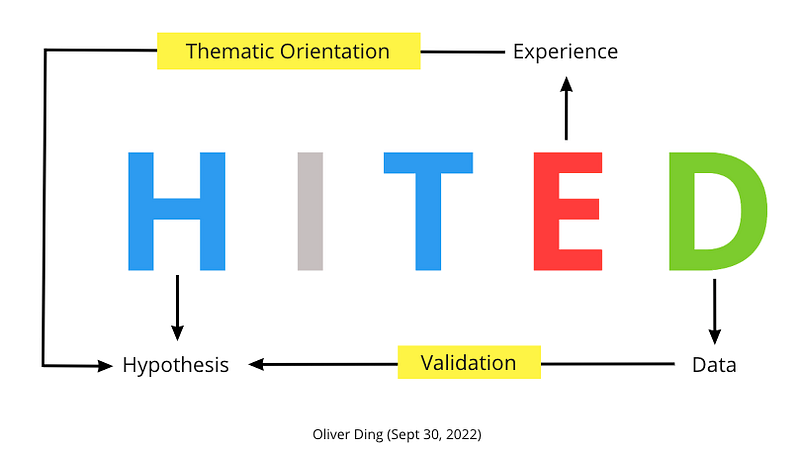
According to Gerald Holton, the traditional view of scientific methods can be distinguished into two types of “meaningful” statements: empirical (or phenomenic) and analytical statements. Gerald Holton suggests the third view: the thematic dimension.
For example, “the modern version of the cosmological theory based on the thema of a life cycle (Beginning, Evolution, and End) may seem to triumph on experimental grounds over the rival theory based on a thema of Continuous Existence, and throw it out the window — but we can be sure that this thema will come in again through the back door.” (p.46)
Why is the thematic dimension important to the history of science?
Because it offers an explanation for a common phenomenon: though scientists see the same data, they could believe it supports different theories.
Gerald Holton points out that it is hard for scientists to discuss their thematic notions publically. So, it is only can visible in the private world of scientists.
The “Action Research” Approach
A popular approach in the field of professional knowledge and organizational development is Action Research.
There are several versions of the Action Research approach. The diagram below only highlights the “Reflective Practitioner” approach which was developed by Donald Schön.
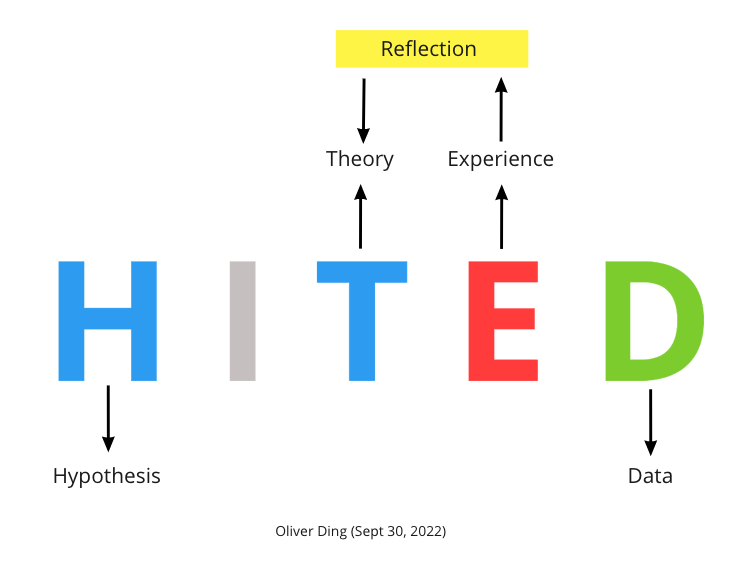
The above diagram is a simple version of the “Reflective Practitioner” approach. In fact, Schön expanded John Dewey’s “Reflection” to double reflections:
- Reflecting-in-action
- Reflecting-in-practice
Reflecting-in-action refers to immediate situations and reflecting-in-practice means cross-situation level.
Inspired by Michael Polanyi’s notion of “Tacit Knowledge”, Schön and his friend Arygris made a distinction between Espoused theory and Theory-in-use.
- Espoused theory: the worldview and values people believe their behavior is based on.
- Theory-in-use: the worldview and values implied by their behavior, or the maps they used to take action.
This distinction also led to a concept called “Double-loop learning” which means a change in the deep level of the mental model.
Methodological Empathy
There are various approaches to the Hypothesis — Data Fit! You can use the basic model of HITED framework to make your versions.
Which one is the correct way?
It all depends on your situation. Some theories require corresponding methods.
We all know the difference between scientists and practitioners.
I’d like to encourage Methodological Openness and Methodological Empathy.
Maybe you are an expert on a particular method, you don’t have to reject other methods.
The HITED framework is a new visual language for making methodological issues visible. We need to see the difference between scientists and practitioners. We also need to see the difference between you as a practitioner and me as a practitioner.
We need Methodological Empathy.


