


History of the Dutch Republic
The Republic that Made the Modern World
The Dutch Republic was one of the greatest inventors and creators of history, as their unique structure formed many of the systems that society uses today. For instance, the stock market and numerous republican institutions had been invented or popularized by the innovative Dutch. However, the Republic failed to keep its position as the innovator of the world, as its neighbours took the Dutch inventions and used them against its originators. As a result, the story of the Dutch Republic is one of experimentation and discovery, but also one of hardships and struggle, as the discoveries and innovations they found were used against them during its darkest hours.
Stock Market
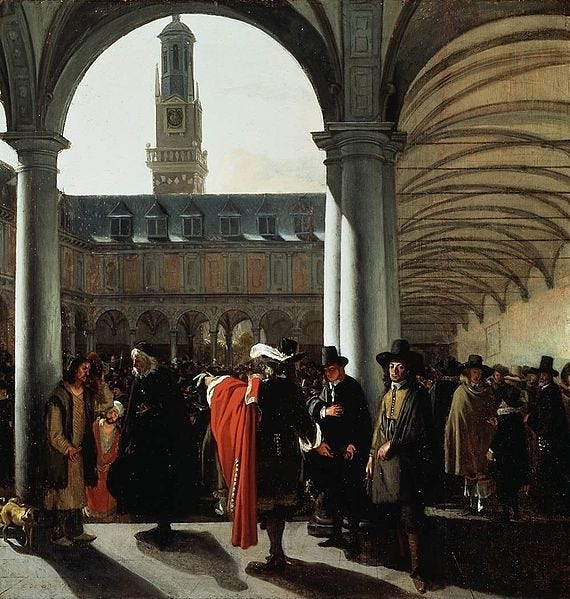
Many Dutchmen in the 16th and 17th Centuries sought fame, riches, and to establish successful trading companies from the lucrative Spice Trade of Asia. However, only 50% of voyages made it back from Asia to Europe, and these losses quickly began to stack upon single-owned businesses and trading companies. The Dutch company owners attempted to counter this issue by making limited liability deals with one another, but this was not enough to stem the tide.
Their experience as navigators allowed the Dutch to bring more than 50% of the ships from India into Europe without failing. But despite that, a lot of the wealthy people could afford to lose a ship every once in a while as for others a shipwreck would destroy their entire lives.
This all changed when the state-owned company called the Dutch East India Company opened its stocks for the average person to buy in 1602, giving the population a share in the profits and losses as well. This system was ingenious, as companies could more easily raise money and the losses were distributed across their shareholders. As a result, the Dutch East India Company grew to become the richest company in Europe and became dominant in the Indian Spice Trade and the Dutch Economy. However, these joint-stock companies began to spread outwards towards the rest of Europe. Moreover, numerous Spice Trade companies similar to the Dutch East India Company began to rise in rival countries, which eventually served as the downfall for the Dutch enterprise.
American Constitution a copy of the Dutch?
The Dutch created some of the most influential economic systems in history, but they had several other great contributions as well, such as their leap of faith into unique forms of governments and civics. Due to the experimentative and unique character of the Dutch people and politics, it created a form of government that was nearly unmatched in its complexity and freedoms for its time. Furthermore, the small Dutch Republic spread its institutions across the large world, and as a result, modern states such as the United States and France use the Republican Style of government.
The Dutch Republic’s ideology was based upon freedoms and balances in the government. The freedoms were essential to the Dutch, as each town could vote and debate on matters, and each town could send as many representatives as they like towards the “States General”, or the parliament. Furthermore, the Republic had a “Stadt-Holder” who was a prince. The role of the prince fluctuated greatly throughout its existence, as there were periods where the Stadt-Holder held absolute power and times where there was no Stadt-Holder in government. However, the basic principle of their job was that they were the head of the military and foreign affairs, and they encouraged centralization among the disunited provinces.
The name “Republic of the Seven United Netherlands was not a mere act of lip service, but a core institution of the state. Each province was a sovereign state and had always referred to the others as allies rather than fellow members of a united Dutch state (with the exception of Holland who dominated the provinces economically). Moreover, the provinces had wide-ranging internal powers, from establishing local laws to foreign representatives, they valued their autonomy over the central government.
However, what makes the Dutch model fascinating is the amount of American politics that reflect the old republic. The decentralized and confederate nature of the States, the deep political divide, and the anti-monarchism in 1776 America were inspired by the Dutch example. As a result, it was thanks to the Dutch experimentations in unorthodox political systems that republics dot the Modern World.
The Fall of the Creators
For all of its innovations and worldly developments, the Dutch were never going to dominate the trade routes and maintain naval supremacy for long, as the English were growing in naval strength while the French retained a deadlock over the beleaguered republic on the continent. Moreover, the natural advantages of the Dutch innovations had begun wearing off by the mid 17th century, as foreign companies also implemented stock exchanges to challenge the Dutch trade. Moreover, the unique system of the Dutch proved to be their undoing, as the steep divide between the Stadt-Holder and provinces tore the nation apart. For all of its creativity and contributions to the world, the Dutch could only walk for the world to run.
Follow our publication The History Inquiry for more daily articles!
Sources:
Irina Damascan. (2020, March 21). The Dutch invented the stock market and here's why that's important during the coronavirus outbreak. Medium. https://readmedium.com/the-dutch-invented-the-stock-market-and-heres-why-that-s-important-during-the-coronavirus-outbreak-4482b100daee.
Beattie, A. (2021, May 19). What Was the First Company to Issue Stock? Investopedia. https://www.investopedia.com/ask/answers/08/first-company-issue-stock-dutch-east-india.asp.
Secretan, C. (n.d.). “True Freedom” and the Dutch Tradition of Republicanism. ARCADE. https://arcade.stanford.edu/rofl/true-freedom-and-dutch-tradition-republicanism.