
Watch Your Tone, Ladies
How voice and tone play into subjugation
The speculative fiction novel “The Power” hooked me in the first chapter. Set in a future where women hold the dominant roles in society, it begins with a correspondence between a male Writer and a female Editor. Without being obvious, his tone is obsequious. “I’ve finished the bloody book. I’m sending it to you, with all its fragments and drawings, in the hope that you’ll give me some guidance…Anyway, sorry, I’ll shut up now…Thank you so much for this. I am so grateful you could spare the time.”
This is not necessarily a gendered conversation. It’s true the Editor holds the power and the Writer seeks approval, regardless of whether one or the other is male or female. But the tone sounded so familiar! It’s how all women are taught to approach all men, including bosses, peers, and even subordinates — with a bit of bowing and scraping thrown in.
The servile tone was jarring coming out of a male mouth. You almost never hear men self deprecate like that, although you hear women doing it all the time. The role reversal reminded me of a funny cartoon I saw on Medium recently. It pretends to instruct women about how to interact with men in the workplace without appearing “uppity.”
Even more surprising in the opening chapter was the female Editor’s response. Like powerful men often do to women today, she belittled the Writer in a friendly, teasing way — nothing he would feel comfortable about objecting to, but definitely insulting. “Wow! What a treat!” she begins, and later addresses him as a “saucy boy!” While what she’s working on is a serious project, his work is amusing and “will be a welcome relief from my own book.”
The premise is the Writer has done serious historical research, up to and including even archeological digs, which supports his outlandish premise that once things were very different — once the world was run by men.
“Looking forward to this!” the Editor tells him. “I’d rather enjoy this ‘world run by men’ you’ve been talking about. Surely a kinder more caring and — dare I say it? — more sexy world than the one we live in. More soon, my dear!”
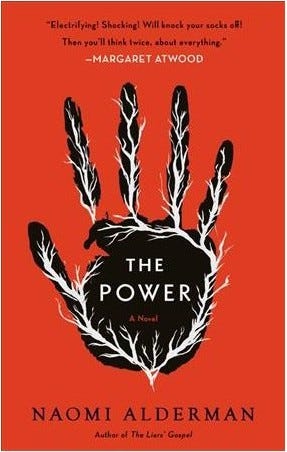
Men are kinder? More caring? Sexier? Wow. What’s happened in The Power is that women have evolved to develop an electric current in their hands (operating biologically something like electric eels) which has made them physically superior to men. And while I began the book hoping that women being able to protect themselves from rape and assault would result in a better world, in the imaginary future created by Naomi Alderman, it’s pretty much the same old crap, except the roles are reversed. Now the women are a-holes and the men are oppressed. It proves the old adage: power corrupts, and absolute power corrupts absolutely.
And really, when you think about it, having women take over and create a peaceful, loving world without war where everyone is fed and well cared for would just be a validation of all the gender stereotypes which limit and reduce women today. So good job helping us to understand that all is lost and humankind is basically hopeless, Naomi Alderman!
It’s not because women are female that they are kind, caring, and sexy. It’s because they are trained to adopt these subservient traits in order to please the dominant gender.
It was interesting to see the gender roles currently attributed to women being adopted by men in The Power. It illustrated the idea that gender roles are constructed. It’s not because women are female that they are kind, caring, and sexy. It’s because they are trained to adopt these subservient traits in order to please the dominant gender.
The book got me thinking about tone in general, and how women are complicit in their own subjugation when they adopt light and silly and falsely cheerful tones.
In Bad Blood the book, and movies and podcasts based on it, we watch Elizabeth Holmes, a young Stanford dropout, convince many smart people to put up millions of dollars to back her phony blood testing company by making false claims in an artificially lowered voice. Apparently, Holmes thought people would take her more seriously if she used a low voice. And they did.
When I was a pre-teen, I remember marveling at how my sister’s voice would change when her boyfriend came over. His voice and his big hearty laugh were deep and resonant, very attractive. Hers sounded like a wee yitto baby — but only when her big man was in the room.
We women have had many models in the media to convince us that it’s attractive to talk like children. Take Marilyn Monroe, the original sexy baby. Here’s Rachel Bloom parodying her in one of my favorite numbers from her brilliant Crazy Ex-Girlfriend series.
I can’t help wondering if adopting that diminished persona had something to do with Marilyn’s depression. I hope not.
Now that I’m an old lady, I notice myself sometimes veering in that direction. While my husband of 35 years is cultivating his inner curmudgeon, I continue to foster my inner child. She comes automatically, unconsciously, unbeckoned — this cheery interloper.
And you might think there’s nothing wrong with that. That it’s pleasant to speak in a soft, lilting tone. That it’s for the common good. But watch out, ladies, because it’s also a trap. Because the more I fawn and endeavor to please the curmudgeon, the more he grumbles and is displeased. The two roles play off of and feed each other. How much richer and better it is to interact with a partner as adult to adult, instead of child to old man.
I can’t say I understand the psychology of it, but I know it’s true. I noticed a similar positive result in my sex life when I consciously made an effort to drop the dumb blonde act.
So now that’s become an important life goal: to be true to myself; to pay attention; to shed the roles imposed on me from outside.
I remember a brilliant young woman I had as a high school student who prefaced every sentence with “I’m sorry” and a strangled giggle. It was just a nervous habit. I asked her to stop. Another female teacher asked her to stop. We told her it was annoying. She didn’t really believe us. I finally got the message across via a movie about voiceover artists that we’d both seen.
“Have you seen ‘In a World?’” I asked. She had. It was a favorite, she said. “What you sound like is not as bad as the girl ordering a smoothie at the end of the trailer — but almost. It’s on that continuum.” She stopped.
That might have been one of the biggest successes of my 17-year teaching career.
Using a childish, obsequious, subservient tone doesn’t benefit anyone. It harms people by perpetuating oppressive gender stereotypes. So watch your tone, ladies, if you want to be taken seriously. And I sure hope you do.
For further reading…
My writing is free to readers who follow my links from Twitter, Facebook, and LinkedIn, but if you’d like to read more, click here to join Medium for $5 a month and they’ll give me some of that money. (Yes!) For an email whenever I publish, click here. Find more stories about women and feminism on this List. And for more of the good stuff, follow Fourth Wave, where we’re changing the world for the better, one story at a time. Got one of your own? Submit to the Wave!


