High Noon: 70 Years On
McCarthyism allegories and contemporary resonance in a celebration of Fred Zinneman’s classic western.
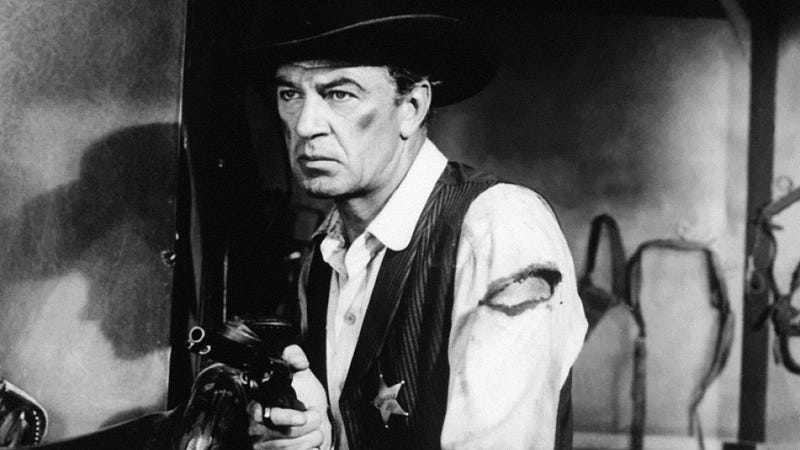
Fred Zinnemann’s 1952 western masterpiece High Noon didn’t win Best Picture at the Oscars. It deserved to, especially when compared with the entertaining but unquestionably inferior The Greatest Show on Earth (which did win). Then again, perhaps it’s just as well it didn’t win, because my all-time favourite musical Singin’ in the Rain also deserved the top prize just as much that year. Choosing which film ought to have won feels like choosing between my children. Both films are iconic, enduring classics, celebrating their 70th anniversary this year, and both are among my all-time favourites.
I may return to Singin’ in the Rain in a future article, but for now, because I consider westerns America’s most outstanding contribution to world cinema — a genre offering a unique blend of adventure, history, myth, metaphor, and social commentary — I shall put the case for High Noon. Even if you can’t abide westerns, I’d recommend giving this one a go. It’s a taut, tense, gripping gem in which not one second is wasted, not one line of dialogue is irrelevant, and in which the spare 85-minute running time is utilised as a plot device, so events occur (more or less) in real-time.
However, this is far more than 24 in the Old West. The 1950s are a fascinating period in mainstream Hollywood. Many features, including High Noon, contain treasure troves of subtext about the social and political concerns of the time. For example, On the Waterfront (1954) was interpreted by some as an apology for informing and therefore pro-McCarthyism. Invasion of the Body Snatchers (1956) can be read as pro or anti-McCarthy. By contrast, High Noon is intended as a condemnation of McCarthyism. As such, it was an exceptionally courageous film for screenwriter Carl Foreman to write (adapting magazine story The Tin Star by John W Cunningham). The film was a box office success, winning well-deserved Oscars for editing (Elmo Williams, Harry W Gerstad), music score (Dimitri Tiomkin), and acting (Gary Cooper). However, it wasn’t without controversy, and it even has contemporary resonance, which I’ll come to in a moment.
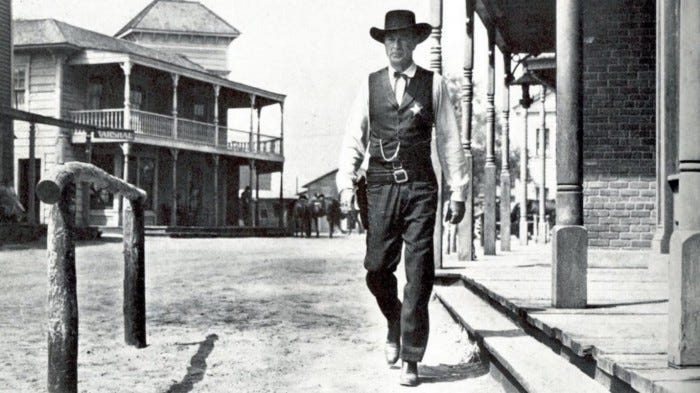
Cooper plays lawman Will Kane, who just after marrying his pacifist Quaker bride Amy (Grace Kelly) is told a violent criminal he sent to prison years before, Frank Miller (Ian McDonald), is returning on the noon train. Miller and his gang have vengeance on their minds. Initially, Will decides to flee, but then decides he has to face Miller, or he’ll spend the rest of his life looking over his shoulder. However, when he tries to drum up support to stand up to Miller, the townsfolk he protected for so long turn their backs on him, one after the other. As the clock ticks down to the arrival of the train, it appears Kane may have to face Miller and his companions alone.
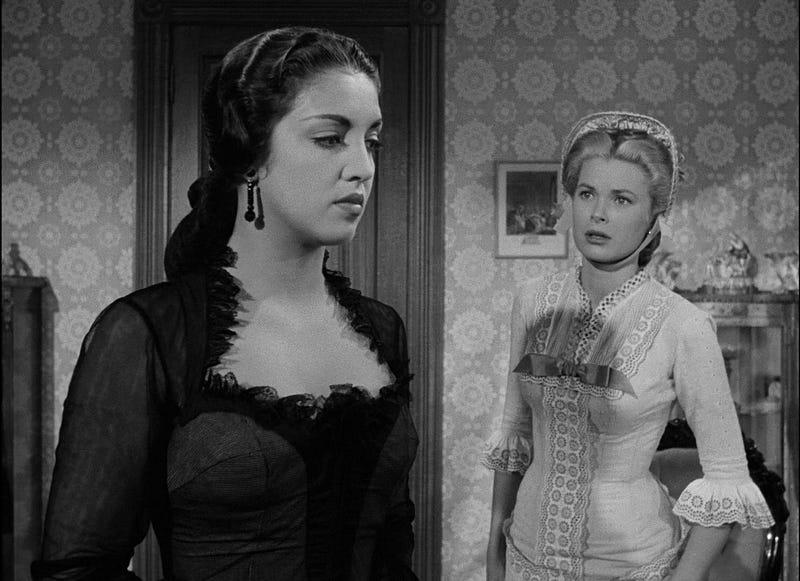
Performances from Cooper and Kelly are excellent. There are also fine supporting roles for the likes of Lloyd Bridges as Cooper’s young, inexperienced, prideful deputy Harvey Pell, and Katy Jurado as saloon owner Helen Ramirez. The latter was once romantically involved with Will, and also has reasons to fear the return of Miller, to the point that she sells up and flees.
Cinematographer Floyd Crosby worked closely with Zinneman to recreate the look and feel of Matthew Brody’s Civil War photographs. This monochrome artistry, combined with Zinneman’s innovative camera angles, cleverly edited as the tension builds, resulted in a singular picture that remains a stand-out entry in the genre. It is ironic that Crosby’s rushes were initially considered visually “incompetent” by studio bosses, who wanted to fire him. Thankfully for us, sense prevailed, leaving us with the masterpiece we have today.
At this point, I recommend bailing if you haven’t seen the film, as I’m about to get into spoiler territory.
A superbly tense shootout finale is all but inevitable, as demanded by the genre. However, what gives the film real dramatic power and emotional poignancy are the actions of Amy. A strict Quaker who abhors violence, she believes Will should flee, and is angry when he doesn’t. Such is her religious conviction that she determines to leave him if he insists on facing Miller. However, after Helen urges her to stand at Will’s side, Amy chooses her husband over her Quaker beliefs, shooting one of Miller’s gang in the back. It’s a stunningly powerful moment, given the cowardly way the townsfolk have abandoned Kane.
The parallels to McCarthyism, with friends and neighbours turning their backs on Will, are clear. As to the controversy, John Wayne famously hated High Noon. He claimed the moment in the finale when Will throws down his tin star in disgust was un-American (check out the latter end of this interview). But Will’s contempt is for the townsfolk and their cowardice, not America. Had the town stood as one to resist Miller and his gang, they would have had an easy victory. Instead, they gave in to fear and intimidation, bringing division and shame, forcing Amy to make an appalling choice between her husband and her principles that will likely haunt her for the rest of her days.
John Wayne was wrong. High Noon isn’t un-American. Rather, it was a wake-up call to America to see what it had become and to turn back. The fact that it did is encouraging, and brings hope that perhaps, given current tendencies in American culture to witch-hunt and ostracise (particularly online), it might turn back again.
This is a substantially revised version of an article originally published at Simon Dillon Books. For more about me and my writing on Medium, please click here. For a list of my published novels and other works, please click here.


