
Hiding In Plain Sight
Sometimes you can be effectively invisible
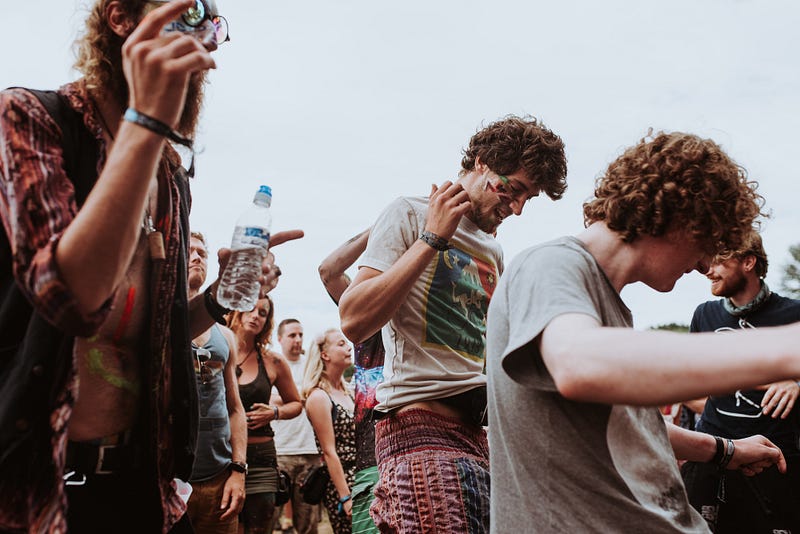
Paul advocates anonymous living as the best kind.
Sometimes, you can even live invisibly amid a traveling circus. The circus draws attention, but the individual performers don’t.
In his late-teen assault on adulthood, Paul followed The Grateful Dead around the country. The psychedelic band was popular only with a small subset of the American concert-going crowd. Still, a wandering community evolved to follow them from show to show from their inception in the mid-60s to their last concert in the mid-90s. For a four-year stretch in the middle 80s, Paul was a member of that mobile crowd.
Not every DeadHead, as the nomadic fans are known, made it to every show. But a sufficient number attended enough of the shows that a roving community formed. If you were one of these, as Paul was for those years, you’d meet the same people over and over. He knew many fellow travelers by face, or trade, though only a few by name or history.
Even in the midst of community, anonymity reigned supreme. Persons knew each other for their kindness, their charity, their falafel, or avocado and bean sprout bagels, their t-shirts, or their drugs—but not by name or title. Culture, at its rudimentary level, is about actions and interactions. In that spirit, the Deadhead culture tugged on the same rope, but they tugged at it like a sidewinder slithering across the desert, not in a straight line.
Deadheads dressed sufficiently alike that they made quite a “kaleidoscope of clowns” as one of their song lyrics put it. Yet, as individual clowns, they were nameless and faceless. They were effectively a “sub-culture”, though often mistakenly characterized as “counterculture”. They arrived at a locale en masse, never sought to overturn any cultural norms by either violent or political means, and within a few days, simply left.
The worst thing Paul ever saw DeadHeads do was mid-day at a suburban Virginia shopping mall when they dumped an entire box of Mr. Bubble into the mall’s central fountain. Within minutes, bubbles were spilling out of the water feature; delighting the toddlers riding in their strollers, but infuriating their mothers. Security arrived, and the hippies scattered. No one was hurt.
Another time, in Oklahoma City, just inside the ticket gates, a cadre of ten or twelve blue-uniformed local police rushed upon a group of several dozen early arriving concert goers. They took up positions surrounding the knot of hippies, not letting anyone leave the invisibly cordoned circle. The hippies exchanged anxious glances, fearing pat downs or warrant checks seeking those with outstanding “bad paper”.
None of the surrounded Deadheads, including Paul, formally knew each other. They’d just gotten into the outdoor venue. The concert start time was more than an hour distant. Barely inside the ticket turnstiles, the individuals were slowly getting their bearings about where they might want to stand or sit for the show. (In those days, almost all tickets were ‘General Admission’). The flanking action of the police had taken them all by surprise. They all knew better than to make a run for it.
The police calmly took up positions in a sort of human corral. Feet spread to shoulder width, each officer about an arm’s length from the one beside them. Several had batons drawn, holding them with arms crossed in front of their blue chests. They glared at the group with narrow eyes. The group of naturally curious hippies stared back. Two cultures in an Oklahoma stand-off — the atmosphere electric in anticipation of resolution.
The cops’ heads swiveled slowly about, warily eyeing the tiny set they’d encircled, compared with the colorful throng streaming around and past the detained knot of concert-goers. They wore the expressions of those witnessing alien life for the first time. Some officers struggled to suppress grinning at the ludicrous combinations of clothing and colors the teeming Deadheads wore. Other officers appeared angry at the universe, wanting to hold their breath to avoid a stench.
One of the trapped hippies got nervous and reached to light a cigarette; drawing an instantaneous rebuke from several officers who quickly stepped forward and bellowed for him to drop it. He complied and plunked down cross-legged. Paul and the others sank, too. All melted down to the warm pavement, sitting Indian-style.
One cop, the leader Paul assumed, had a walkie-talkie-like radio affixed to his shoulder. He yelled into it, “What’s the description?” (Someone must have snuck in, or jumped the fence, or otherwise evaded this posse of blue-uniformed police officers). “Bearded male,” crackled the radio, “Caucasian; brown hair and ponytail. Possible blue bandana. Suspect wearing rainbow tee-shirt and blue denim shorts.”
The cops studied Paul’s group. The detainees all side-eyed each other with mock suspicion before bursting into laughter. Paul, broke, had casually walked in by flashing a window decal at the ticket-taker, and saying, “I’m with the band.” The description matched all the young men sitting there. Drifting past were several thousand more tie-dyed hippies wearing bandanas, ponytails, and cut-offs. The cops deflated visibly and marched away. Whoever the supposed culprit was, he was effectively invisible.
Paul often recounts this story and others of his years on the road. He believes in living as you want — but as invisibly as possible. Sometimes, you can hide in plain sight.