
Hong Kong English/Cantonese (VII)
Which Church Are You from?
You don’t need to start a great talk about religions after being asked this because it’s not a question!
Really. “Which church are you from?” and questions of the same kind are often not related to religions or Christianity in Hong Kong. Instead, it is a sarcastic way to tell you that you sing badly or totally out of pitch, or the lyrics you write does not fit the melody.
But why? It’s a long, long story.
Thanks to the missionaries a century (if not centuries) ago, Christianity, mainly Catholic and Protestant, has widely been spread in this tiny city of Hong Kong ever since. As a result, there are a lot of songs from the churches that have had their lyrics translated into Chinese.
But the translation causes problems when singing: The lyrics were only translated with reference to their (original) meaning. It seemed that nobody really cared if the sounds (or tones) of the words fits the melodies.
Then, it’s high time we talk about lyric-writing in Cantonese songs.
It was true that lyricists in the past did not care about the tones and the melodies, but within the past century, Cantonese-speaking people started to feel awkward that it would have been hard to understand if the lyrics and the melodies didn’t fit. After decades of its development, writing lyrics in Cantonese has one special requirement apart from normal standards: the tones of the words in the lyrics and the melodies of the song must fit.
It’s well known that Cantonese has 6 tones. In our Hong Kong accent, four of them are flat tones while the remaining two are rising tones (Canton City accent is a bit different, they have falling tones). Our usual tone numbers are:
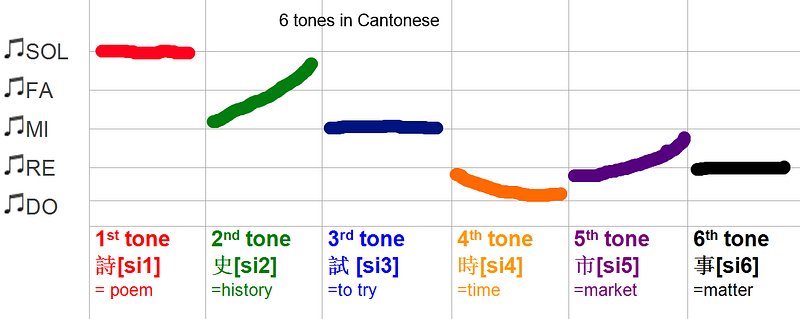
- High flat
- High rising
- Mid flat
- Low flat
- Low rising
- Mid-low flat
There have been researches looking into Cantonese songs and lyrics. They found that the end-points of the tones matter when putting words into the melodies.
As you can see in the picture above, there are only 4 end-points in Cantonese tones. The distance between end-points become a marker of how we should put the words into the melodies. (Yes, having melodies before lyrics is a commonplace in Cantopop.)
I have never learnt musical theory before, so I may be struggling to give a perfect term for everything I am talking about. If you understand what I am talking about but I explain it clumsily or use a wrong word, please do tell me.It would be great if the Cantonese lyrics are sung as though we were speaking. Therefore, we need to give a link between the distances among musical notes and that among tones. I have just written that only the end-points are important when writing lyrics. We can give names to the end-points then.
With use of one of the most traditional way of calling them, let’s call them “3”, “4”, “2” and “0” from the highest end-point to the lowest, and the pronunciation are in accordance with the end-points in their own Cantonese tones.
Therefore, “3” (Jyutping: saam1) is for tones 1 and 2, “4” (Jyutping: sei3) for tones 3 and 5, “2” (Jyutping: ji6) for tone 6, and “0” (Jyutping: ling4) for tone 4.
It is not absolute which musical note corresponds to which “number”. The neighbouring sounds in the melody affects it most. Therefore, the same musical note in the same sentence can be given a different “number”; or in reverse, the same “number” is given to different musical notes in the same sentence. The relation “restarts” in every new sentence.
Let’s look at a(n) (in)famous example: the hymn He’s Able written by Paul E. Paino.
This is the English version of the song. It seems writing English lyrics is pretty easy. People only need to count the number of syllables as well as the number of notes in the melody. Then they can put anything they like (mostly with good metric feet, like iambic pentameter) and hopefully the lyrics rhyme.
However, we need to think more when writing Cantonese lyrics. This hymn was translated into Chinese, and Christians in Hong Kong sing it in Cantonese. And it become a “disaster” everyone laughs at.
The lyrics and the melody do not match. We may hear inappropriate content in this Cantonese version.
It is quite difficult to find a version that has a person sing the lyrics. This is the best one I found. Perhaps this Youtuber sang a slightly different melody, but this is close enough.
The first line (or the most famous line) “He’s able” sounds like “Lord plays with dogs” or even worse, “Lord plays with dicks”. How inappropriate this is.
Let me explain with the following pictures. This is the whole song. The words in black are the melody, and the “end-point system” when we write Cantonese lyrics. Those in red are the Cantonese lyrics, their pronunciation (in Jyutping), the “end-point system” of the words themselves, and finally the literal meaning of the lyrics. Those highlighted in yellow are the parts where the melody and the lyrics don’t match (in the “end-point system”, and thus in the song).
Sing it.
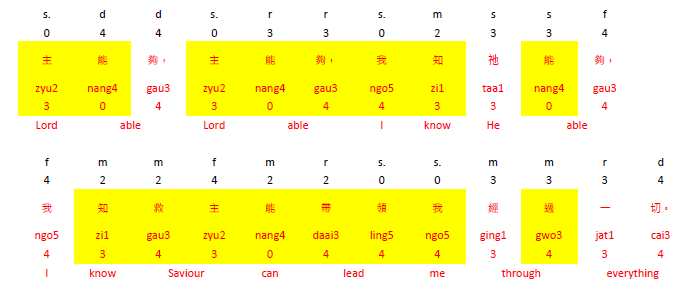
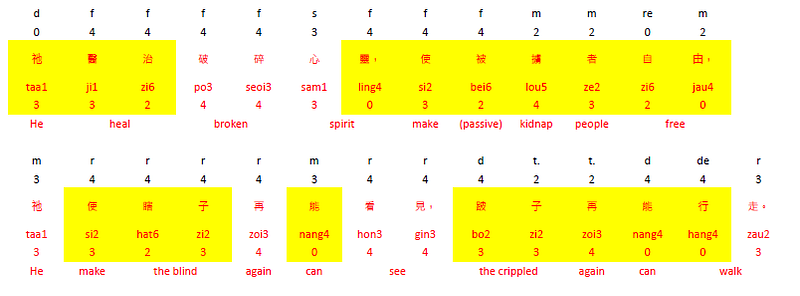
In these (23*3+27)=96 words, (16*3+19)=67 words are out of pitch. Nearly 70% of one song is sung out of pitch. You can imagine how horrible it is when people get to sing the hymns in Cantonese.
Most Hongkongers know that the hymns in Cantonese are out of pitch. As you know, we speak a tonal language, pitch is very important when we speak. It is possible that people will get mad when they are told that they sing “totally out of pitch” (Cantonese: 走哂音; Jyutping: zau2 saai3 jam1). Therefore, we rather say “Which church are you from?” (Cantonese: 你邊間教會㗎; Jyutping: nei5 bin1 gaan1 gaau3 wui2 gaa3) to prevent confrontation.

One of the most famous “churchgoer” (Chinese: 教友; Jyutping: gaau3 jau5) in anime history should be Takeshi Goda in Doraemon.
In addition, since we think lyrics usually come after the melody, it is also common for netizens to re-write Cantopop lyrics and post onto well-known internet forums.
Here is the most recent pick. The song is re-written with some Hong Kong place names.
In the internet forum, people would argue what words are more suitable in the lyrics, netizens also post their own trials onto the post.
When a lot of lyrics in a version is found not fitting, people will say that the version is a “church song” (Chinese: 教會歌; Jyutping: gaau3 wui2 go1)
The one who wrote the “church song” will also be called a “churchgoer”, like the one who sings badly. Of course, if the one who writes hymn isn’t a churchgoer, how can he get people sing their songs that praise Him?
Here it is the original post in the internet forum. Certain level of Cantonese is required in order to understand the post.
I’m not a churchgoer (who believes God), but I may be a churchgoer (who sings out of pitch).