
Here’s When You Should Sell Your Altcoins (Complete Guide)
Don’t lose profits — you can win this game

Taking Profits on Your Crypto
It’s not a popular subject, but I think it’s time we talk about taking profits on your digital assets. Not because they aren’t going up, but because everyone should have an exit strategy. Unless you’re one of those freaks from r/WSB that is.
Before you start looking at selling your altcoins, you should be familiar with the characteristics of an altcoin cycle. This will put you in a much better position to know when to sell both your Bitcoins and your altcoins.
Disclaimer: This article will get a little nerdy
Altcoins Follow the Bitcoin Four Year Cycle
Altcoins tend to follow the four-year cycle of moving up after a Bitcoin halving event. Bitcoin has a fixed supply of 21 million. So upon a halving event, a little less Bitcoin is released into the market until all of is out by 2140.
After the halving, the price of Bitcoin rises for a period of about 16 to 18 months with altcoins following Bitcoin’s lead.
However, it’s important to note: where altcoins usually perform best is once BTC slows down a bit. Crypto investors call this “Altcoin season.”
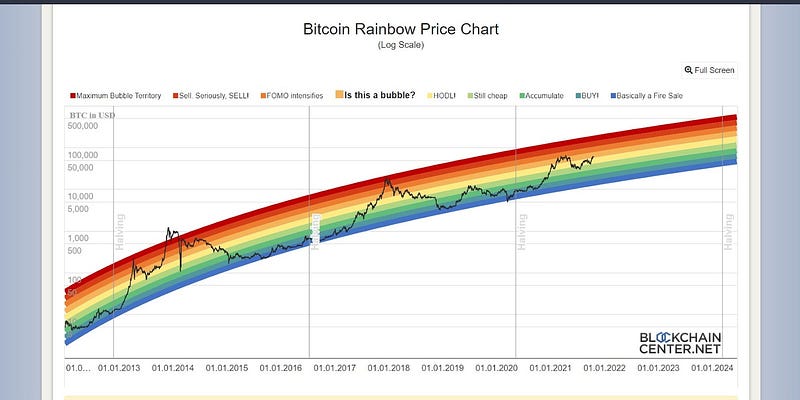
Although Bitcoin is the initial market mover, you should always wait for BTC to die down a bit in price action before selling your altcoins.
The only thing that could throw this general trend out the window is if Ethereum — the number one altcoin on the market — eclipses Bitcoin in market cap. Goldman Sachs has recently opened up that this is ‘highly likely’ in the coming years.
The Bitcoin Dominance Chart Plays a Big Role in Altcoin Performance
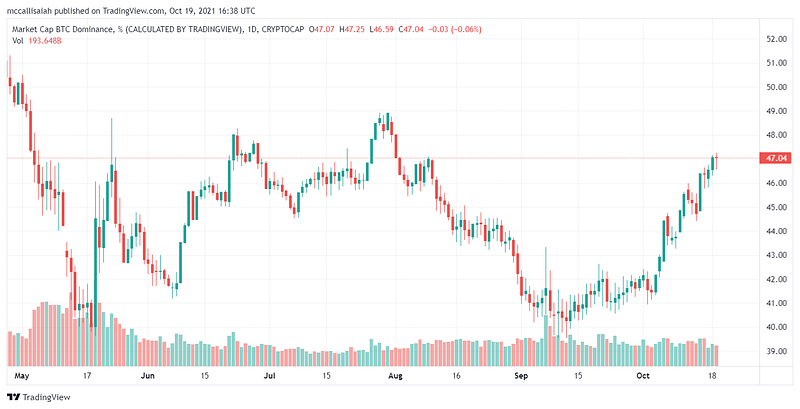
Bitcoin dominance refers to how much of the total cryptocurrency market cap is in Bitcoin. Simply put, the Bitcoin Dominance Chart is an indicator that demonstrates the percentage of Bitcoin’s market cap relative to the entire crypto market cap.
When Bitcoin dominance is falling, that means that more money is going into altcoins. If you want to see where altcoins are headed, check the Bitcoin dominance chart to see if it is trending up or down.
How to Exit an Altcoin Trade
Now that you have a good idea of how the altcoin market moves, let’s take a look at the various ways that you can exit an altcoin trade. You will want to integrate one or more of these approaches in your trading.
1). Profit Target
One of the most common ways to exit an altcoin trade is to have a profit target.
For example, if you purchase Polkadot at $40, you may decide to take profits at $75. At this point, you can put in a sell order at $75 and wait for the price to hit your sell order target.
The nice thing about setting a profit target is that the trade can automatically close without you having to constantly monitor it.
2). Sell Signals
You can also use what are known as “Sell Signals.”
There are a number of websites that have buy and sell signals on various assets — including altcoins.
Sell signals can be generated on a minute, hourly, daily, weekly, and monthly time frame. If you see a sell signal across multiple time frames, then you may want to consider selling. Or you could just hold on like a total sicko.
3). Technical Indicators
You can also use technical indicators such as the 50-day moving average to determine when to sell your altcoins.
For instance, if an altcoin falls below the 50-day moving average of the crypto market leaders (e.g. Bitcoin, Ethereum) it could be time to sell. This is especially true if we’re in a bear market.
Cryptocurrencies die during prolonged bear markets as investors are more likely to invest in trusted and more secure projects. And if you’re holding for the long-term then you’ll just have to endure the crash.
4). Portfolio Rebalancing
My preferred way to sell an altcoin is to rebalance my portfolio while doing it.
Let’s say you buy five altcoins for $5,000 each. A month later, three of the altcoins have risen in value, while two of the altcoins have fallen.
You can sell off a part of the positions on the three winning altcoins and increase your positioning in the falling altcoins — buy that fucking dip — until all five altcoins have the same value. This allows you to lock in profits on winning altcoins while buying the dip on falling altcoins.
5). Determine Where You Will Hold Your Proceeds from the Sale
When I sell an altcoin I never stick the proceeds back in my savings. There’s no point. I can wipe my ass with a 0.5% yield — if that.
Instead, I swap my profits on Coinbase or Uniwsap into a stablecoin like USDC or Tether.
Keep in mind that swapping cryptocurrency counts as a “taxable event.”
Holding funds in a stable coin can make it easier for you to buy back into an altcoin. Furthermore, some exchanges like BlockFi and Celsius, among others, offer 8% interest on stablecoins like Tether or USDC.
7). Consider the Tax Implications
Death and taxes. Altcoins aren’t an exception to either.
Altcoins held for less than 12 months are taxed at your regular tax rate. Altcoins held for longer than 12 months are taxed at 0%, 15% or 20% based on your filing status and income.
Maybe I’ll do a full article on crypto taxes in the future. But God is it so boring. The government sucks.
8). Dollar Cost Average Your Way Out of Position
One more smart way to sell your altcoins is to dollar cost average out of a position. This method allows you to avoid panic selling.
Just as you can put $500 into a trade over a duration of time you can also slowly take that money out when you hit your price target.
“[DCS] is a policy that will pay off ultimately, regardless of when it is begun, provided that it is adhered to conscientiously and courageously under all intervening conditions.” — Benjamin Graham, mentor to Warren Buffet
Final Thoughts
Even with looming inflation concerns, the U.S. dollar isn’t going anywhere anytime soon. If it does then the price of Bitcoin is going to be the least of your worries.
Don’t fall for the cryptocurrency fervor of holding until the end of days and never selling a cent. Make an exit strategy. Lock in your gains.
With the right strategy, you can realize some incredible profits from your altcoins and maybe even change your life.
Ever since I was a child it was my dream to become a financial advisor. Unfortunately, it never came true. Therefore I am not a financial advisor and you should do your own research and not just listen to random people on the internet. Nothing contained in this publication should be construed as investment advice.
Join 1500+ people on my newsletter for a free copy of my eBook “Mind and Muscle.”