
Her Majesty, the Royal Hakea
All the colours of sunset
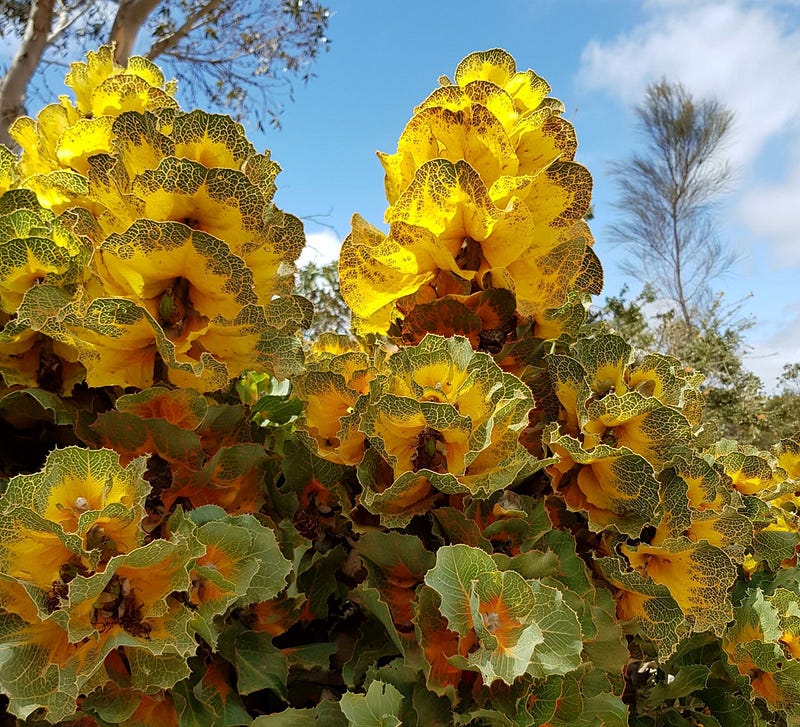
It started, as these stories often start, with a dirt track and a distraction. The track ran through heathland of Fitzgerald River National Park in Western Australia, and the distraction was a plant.
Fitzgerald River NP lies at the western end of the Great Australian Bight, about 400 kilometres (250 miles) SE of Perth. It is a wild and beautiful place, with white limestone beaches, rocky hills, and sandy plains. I was supposed to be bird watching — the park is a good location for Crested Bellbird, Western Whipbird, and Southern Scrub-robin—but temperate Western Australia also is home to an incredible diversity of plants. From peas to Proteaceae, almost all of them are stunning.
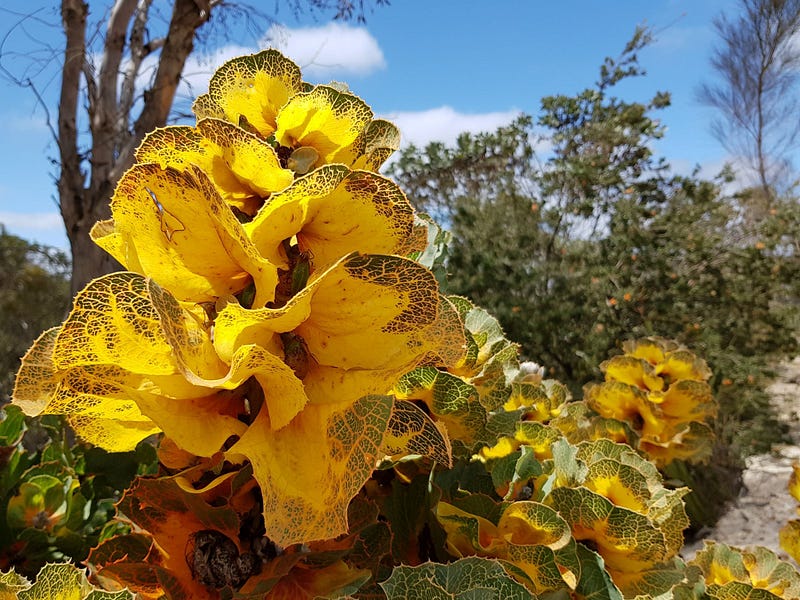
One of the most spectacular is the Royal Hakea (Hakea victoria, Proteaceae), a species that I had never thought I would see in the wild. Yet here they were — not at the end of a long walk through dense bush or at the top of a steep rocky mountain, but growing in ridges of sand pushed off the road by a grader.
While living in Melbourne, I planted a Silky Hakea (Hakea sericea), a bird- and insect-attracting shrub native to the area. The alternative name for this species is Needlebush because its leaves are rolled into spines. It was all fun and games and oh, look at the lovely bees in the flowers until I had to prune it. Then it was swearing and dabs of antiseptic cream and leaving the prunings where they fell, claiming they were mulch.
The Pincushion Hakea (H. laurina) I planted next to it was equally popular with wildlife and much more benign. Not only did this Western Australian species not require much pruning, but its sea-urchin flowers were showy and its leaves soft and round. Not that I played favourites, you understand.
In the right conditions, many hakeas are easy to grow. So easy that several species, including the two in my Melbourne garden, have become invasive.
Most are modest plants. Their flowers resemble those of grevilleas but are generally smaller and less brightly coloured. There are exceptions, of course. Red Pokers (H. bucculenta) and Emu Tree (H. francisiana) both produce long orange to hot pink inflorescences; the flowers of the Bird Beak Hakea (H. orthorrhyncha) are brilliant crimson.
But the Royal Hakea has small, almost insignificant white flowers. For this species, it is all about the leaves.
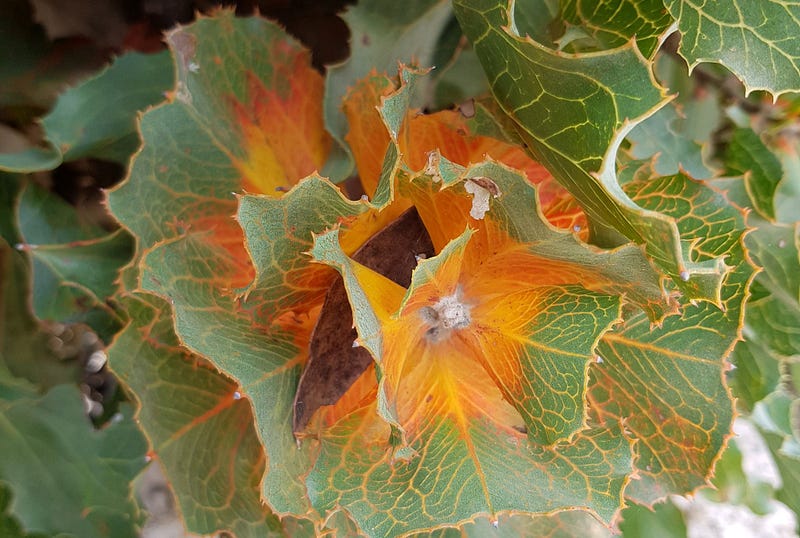
When botanist James Drummond collected Royal Hakea near Mount Barren in 1847, he did not even try to hide his delight. In his expedition journal, published in Perth’s Inquirer, he wrote:
I found a most extraordinary plant, a species of Hakea…The variegation of these bracts is so extraordinary, that I almost fear to attempt a description. The first year they are yellowish white in all the centre of the bracts, and the same colour appears in the veins and in the teeth, which grow on the margin ; the second year, what was white the first year has changed to a rich golden yellow ; the third year, what was yellow the second changes to a rich orange ; and the fourth year, the colour of the centre of the same bracts, their veins and marginal teeth, is changed to a blood-red. The green, which has a remarkably light and luminous appearance the first year, varies annually to deeper and darker shades, and the fourth year, when the centre of the bracts has acquired a blood-red colour, the green of the same series is of the richest hue… To this most splendid vegetable production which I have ever seen, in a wild or cultivated state, I have given the name of our gracious Queen, Hakea Victoria. It will soon be in cultivation in every garden of note in Europe, and in many other countries.
The Royal Hakea was soon in cultivation, first at Kew Gardens and then in private collections. As early as September 1848, specimens were offered for sale (‘very rare’) by Veitch and Son at their nursery in London. The cost of a plant was 42 shillings.
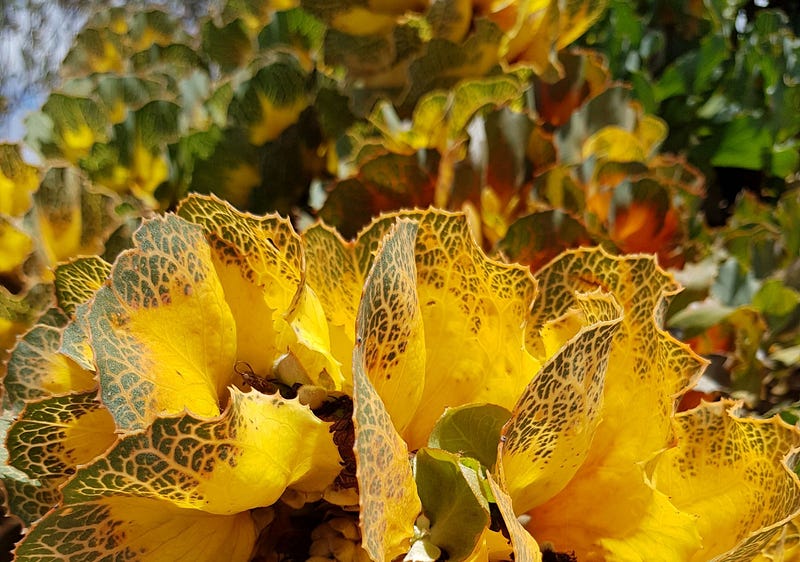
As predicted, specimens appeared in botanical gardens all over the world. Royal Hakea grows well from seed, which is readily available. But there’s a catch —cultivated specimens often fail to develop the intense leaf colours. Even when conditions are similar to those in its native range, the plants don’t always match the beauty of those in the wild. The best place to see them is Fitzgerald River National Park, where they line the roads like living abstracts.
Read more about Western Australian plants at Tea with Mother Nature: