Roleplaying Games | Horror | Fantasy
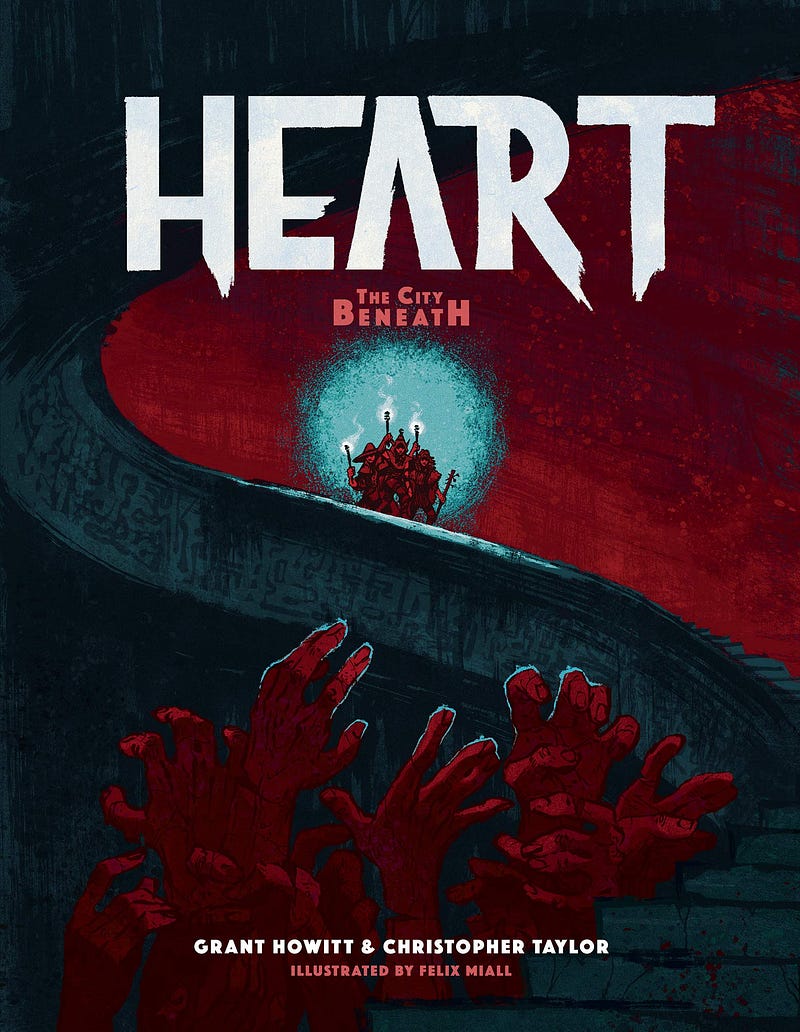
‘Heart: The City Beneath’ is D&D meets Call of Cthulhu
The Cthulhu Mythos and Lord of the Rings were vivisected and reassembled as a roleplaying game
“Heart: The City Beneath is a tabletop roleplaying game about delving into a nightmare undercity that will give you everything you’ve ever dreamed of — or kill you in the process. It is a dungeon-crawling, story-forward tabletop RPG that focuses on what characters have to lose in pursuit of their dreams in the chaotic darkness beneath the world.”
Like its sister game Spire, the word “heart” has multiple meanings. The game is called Heart. The underworld “city” is called Heart or THE Heart. The thing at the bottom of it all is the Heart Itself, and the Heart Itself is unknowable. It’s been described as…
- “An enormous organ of flesh and gristle … that pumps unreality from an alternate plane into this one…”
- “The eye of a creature of unfathomable size, dreaming of another world…”
- “A single point of tremendous energy that’s collapsed in on itself and is impossible to return from…”
…and so on. But you’re unlikely to find out what the Heart Itself really is. And if you do find out, you’ll be sorry you did.
The Art is Maddeningly Good
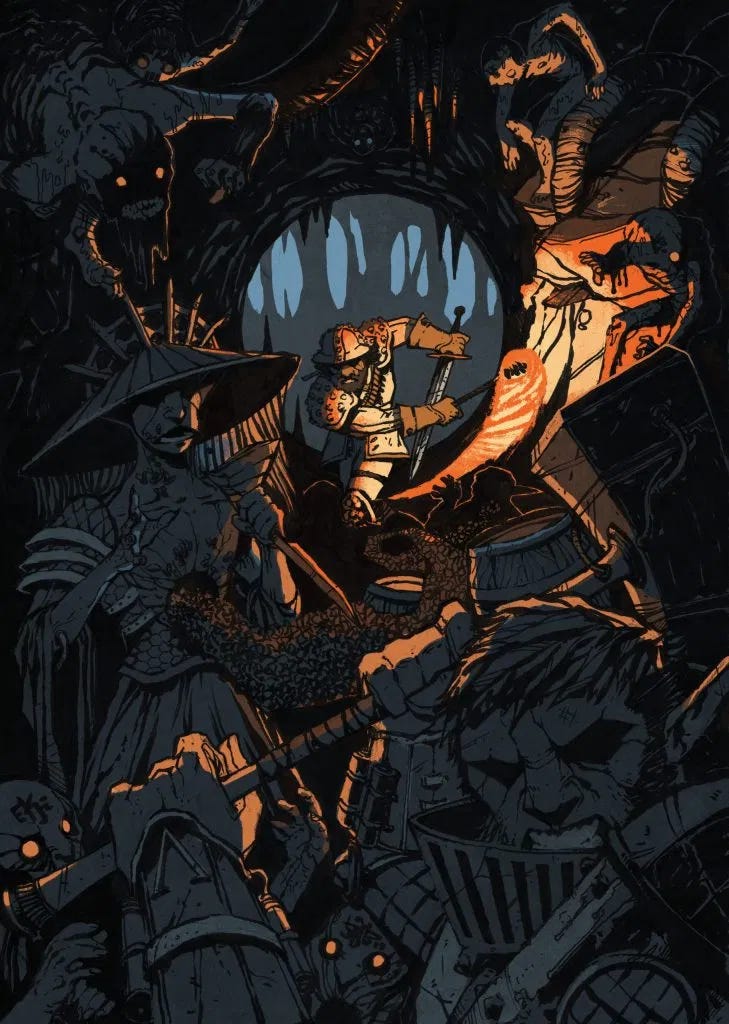
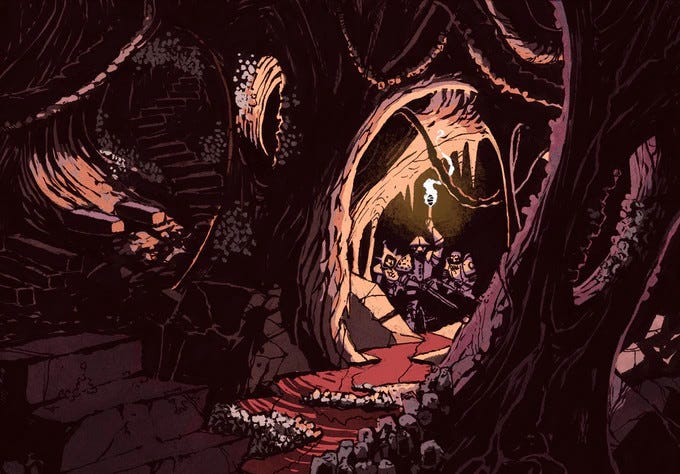
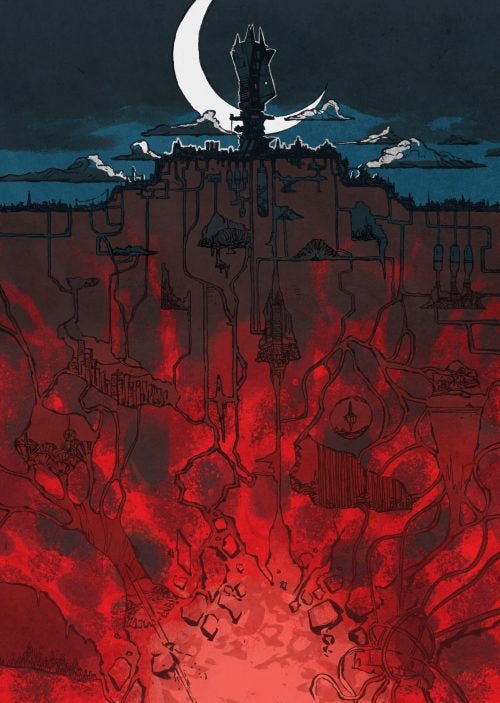
Heart is far more bizarre than Spire, and Spire is plenty bizarre as it is. The writing conveys the world’s fascinatingly sickening details just fine, but the art hammers home the grimdark masterfully. The tunnels are grimdark. The “sky” is grimdark. Your chances of survival are grimdark. The blood oozing from the “walls” is grimdark.
Gnolls Rule, Humans Drool
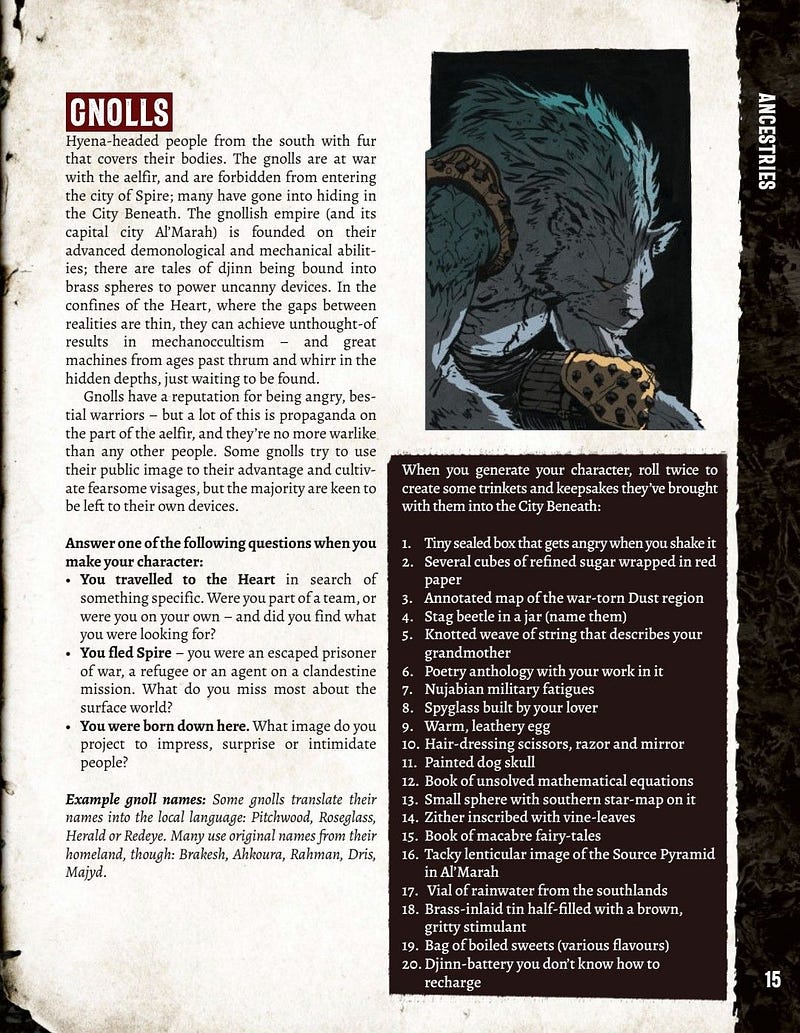
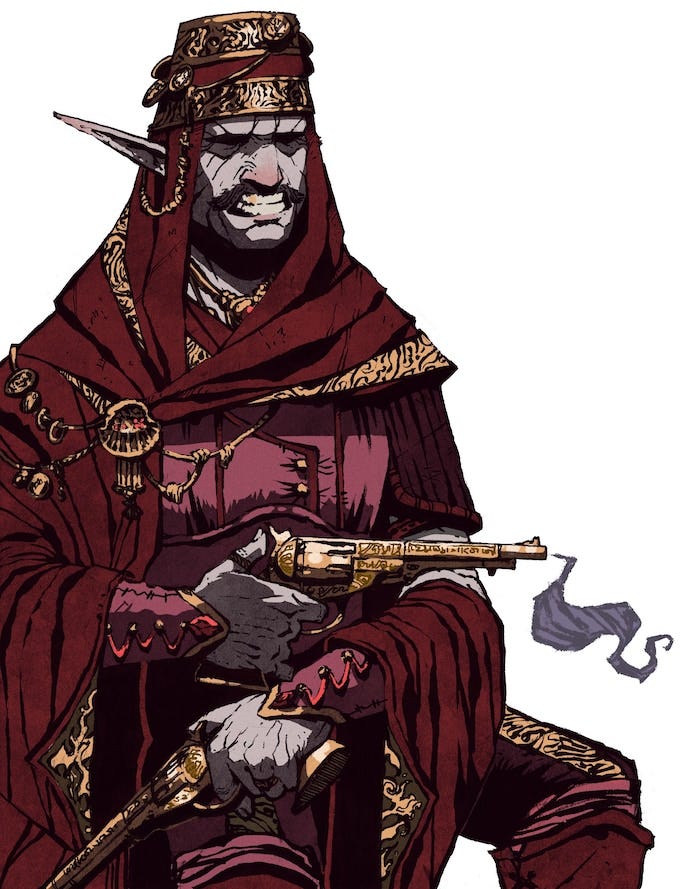
Heart has four playable Ancestries: drow (dark elves), aelfir (high elves), humans (monkey people), and gnolls (hyena people). There are no mechanical differences, but gnolls are objectively the best Ancestry. Their empire is “founded on their advanced demonological and mechanical abilities” and “mechanoccultism”. That is dungeonpunk as Hell! Sure, humans invented guns and promptly sold them to everyone, but gnoll incursion teams have arcanochemical bombs. Arcanochemical bombs win.
Heart Does Monsters Right
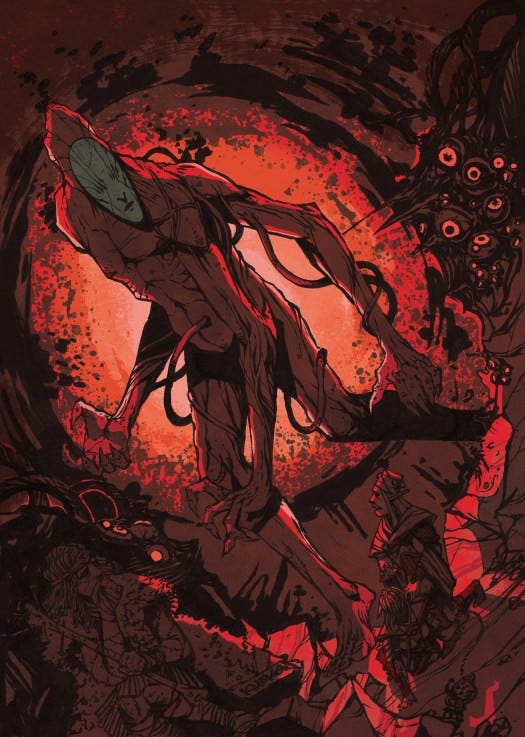
Heart won an Ennie award specifically for its monsters. There are a few normal enemies, the best being the Druid Legbreakers, but those are just the tip of the iceberg. Cults of sentient knives urge “bearers” to stab themselves with each member-blade so they can commune and conspire. Mirror spiders, all fragments of a wounded god, cannibalize each other to become divine once more. Burnt-out occultists, who treat sorcery like a drug, endanger havens by dabbling in magic too great to control. Blighted trees, made sentient and driven mad by itchy parasites, attack anything alive to feed to the parasite and make the itching stop.
Heart’s legendary adversaries are even worse/better. They’re all subverted mythological monsters, re-imagined into Lovecraftian nightmares. The Hydra has so many heads, it can’t move. But it doesn’t need to. It’s necks are so long and numerous, it can pretend to be a twisted forest. The Gorgon is the last of a high elf cult that turned everyone around them, including each other, into stone. The Gorgon now surrounds himself with mirrors in a desperate attempt to preserve himself forever. The other legendary adversaries are equally twisted.
Heart Spotlights Economic Desperation
“It’s easy to fall into debt; it’s not easy to fall into the catastrophic levels of debt that you managed to achieve. You had to be good at borrowing money — and time, and the faith of others, anything you could get your hands on — to attract the attention of Incarne, the Crimson God of Debt.” — Heart: The City Must Fall, page 52
Heart is littered with references to economic reality. The Supplies stat represents a delver’s material “health” just as Blood and Mind represent physical and mental health, and running out of any of those spells your doom. Human delvers can begin the game with a “Pop-arcana book about humanity’s ability to ascend to godhood, and how YOU can do it”. But the most on-the-nose references come from the Incarnadine character class.
Incarnadines worship a god of debt. Incarne has bought off the delver’s creditors, of which there were many. Now the delver serves Incarne, and that service is rewarded with the power to leverage physical, mental, material, or spiritual debt in their favor. They can determine others’ debts, be they monetary or karmic. They even have their own servants, market serfs, to help run their enterprises.
But unlike the Azurites in Spire, Incarnadines always operate in the red. The Incarnadine is a walking ponzi scheme. Robbing Peter to pay Paul is their religion.
People in Spire may be hard-up, but you have to be beyond desperate to go into the Heart for “treasure”. Well, Incarnadines are beyond desperate. So much so that they basically suffer from philosophical Stockholm Syndrome and embrace debt as a way of life.
Heart’s Delving Mechanics are a Masterclass in Elegant Game Design
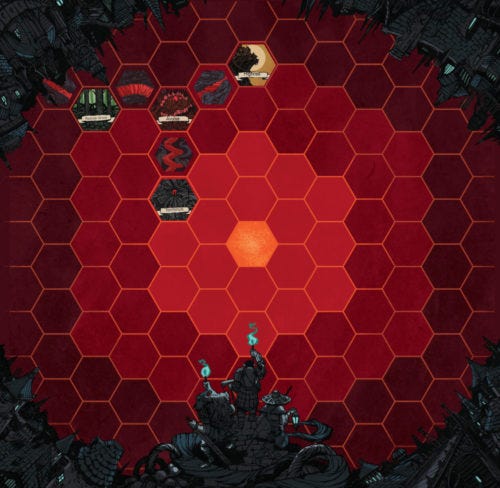
Calling Heart a dungeon crawl would be disastrously inaccurate, but it does use a hex-map as part of its delving system. There’s no canonical map of the Heart. Players fill in their own hex map, or use the official sticker set to place Landmarks and whatnot. Or you can use crayons, because nobody can stop you.
Every trip between Landmarks is mechanically treated as an adversary, with its own resistance score. This score is basically the Delve’s “health”. You roll to beat it the same way you roll to beat a monster. And the Delve can inflict material, mental, or physical injury onto the Delver.
It’s Easy-Peasy to Play
D&D’s character sheet is two pages long; three for spellcasters. Call of Cthulhu’s character sheet is two pages; three if you like to keep notes. Heart’s character sheet is one page, and it isn’t nearly as information-dense as the other two.
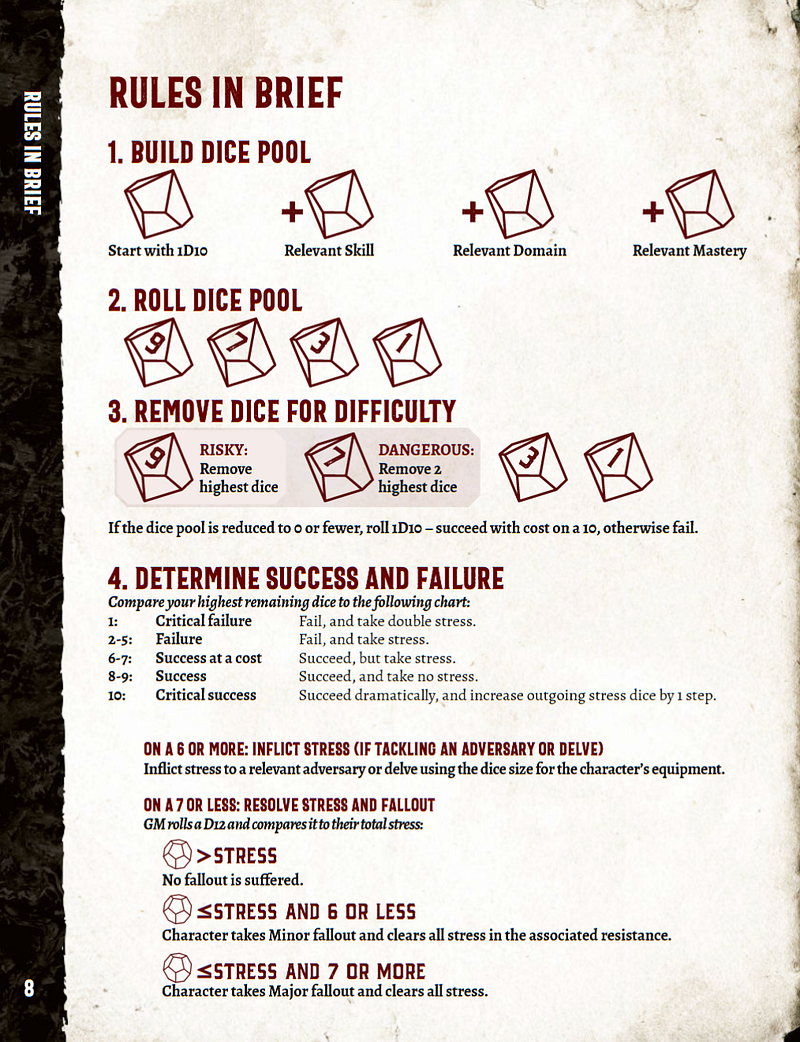
Further, Heart includes two pages of nifty cheat sheets: Rules in Brief and Rules Summary. D&D and CoC’s cheat sheets are called GM screens, because they don’t love you like Heart loves you! Heart rules respect a gamer’s time. Nobody wants to spend half an hour gaming out one sword duel.
Heart Crosses Over With Spire (Sorta)
Vermissian Black Ops, a supplement book, lets delvers delve up into the Spire to do the Ministry’s REALLY dirty work. And maybe your gnoll Junk Mage can go kill that aelfir the paraded your captured brethren around Spire.
Burned and Broken translates discovered or sold-out Ministers into delvers. But there are no rules for returning to Spire. The Heart warps people so much it’s practically impossible to live with normal people again. It’s a one-way ticket.