
He Wrote What is Called ‘The Black Man’s Bible’
Chancellor Williams(1893–1992) was a scholarly force to be reckoned with
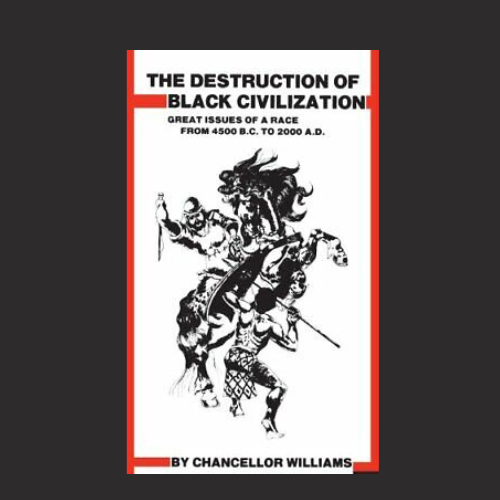
For quite some time, my husband and I would have conversations about who we were BEFORE slavery. We believe that to achieve higher self-esteem and self actualization, it is important to know the stock from which we came from. I don’t understand how anyone can go through life not knowing all the different parts of who they are versus what society deems them to be.
Little did we know that,
“In a small town in South Carolina, a little Black boy in the fifth grade harassed teachers, preachers, parents and grandparents” with ye old question: Why does it seem like white people have everything and Black folks have nothing?”~(Destruction of Black civilization, p. 18)
That young boy was Chancellor Williams. A child with an inquisitive mind and who would not stop asking questions. Like Williams, I’m sure any Black person has silently asked themselves, “How did Blackness become a symbol of slavery and wickedness? A skin tone equated with Loser-ville but exploited a bit too much?”
With these questions in mind, Chancellor Williams set out to do the unthinkable: he was going to study who we were pre- slavery. We have enough literature out there that only shows us who we were from 1619 onwards, but who were we before?
No one could answer that question, so Williams took some admirable steps that, in my opinion, are steps any true historian should take when embarking on a quest for truth.
The quest for truth begins with matriculating an awful lot
Chancellor Williams studied a LOT — a LOT!
It did not satisfy him with just pat answers. He decided to put every effort into diligently shaping Afrocentrism.
Even though Chancellor Williams was told, “Blacks are in their predicament because of slavery”, he knew there had to be a deeper reason because whites were enslaved too! So, how did Black skin become the “face” of a century's long chattel slavery and no one else?
In other words, there can be no real identity with our heritage until we know what our heritage is. It is all hidden in our history. We have been floating alone, basking blissfully in the sunny heritage of other peoples.” ~Chancellor Williams
As a historian now, he had to get active. He had to be involved. See things for himself and do the rigorous task of collecting factual data to soothe his burning questions.
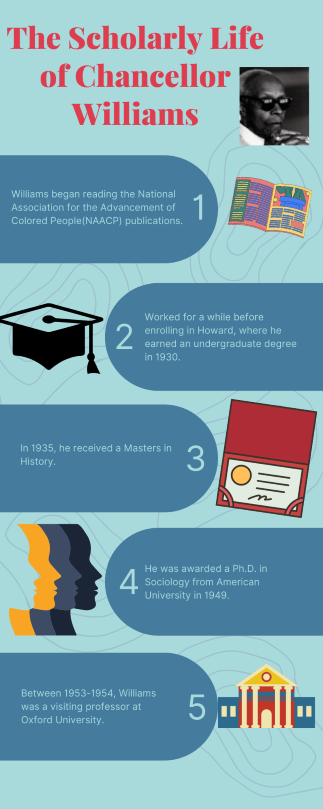
In 1935, Williams placed himself in service by becoming an administrative principal at Cheltenham School for Boys. Around 1939 he went on to become a public school teacher in Washington, District of Columbia. He also served as section chief on the Census Bureau, with WWII making its way in, and by 1945, Williams lectured in social sciences.
Yet, more needed to be done.
Williams decided to live in and study in Africa for two years. During those two years, he made groundbreaking discoveries that will lead him to write his most popular masterpiece on Black History — The Destruction of Black Civilization.
We should not leave Chancellor Williams and William Leo Hansberry out of 21st Century classrooms
I want to give a quick shout out to Shanté Nixon for her piece on W.L. Hansberry. Her piece is a kind of tie into the studies we’ve been doing while reading The Destruction of Black Civilization.
Willians and Hansberry are notable for their tireless work in Black studies. Someone probably swept much of their work under the rug unless universities make their works required reading. However, the massive work these men put into Afrocentrism is astounding.
“His [Hansberry] massive documentation of early years of labor leaves one to wonder how the utterly false teaching that Africa had no written history spread over the world.” ~ (The Destruction of Black Civilization, p.361)
Chancellor was referring to the fact that Hansberry did an incredible amount of research on Black history by first studying documentation by the Greeks and Romans — this was super important because many of them learned from the Africans and documented it.
In case you are wondering, a part of Williams’ and Hansberry research involved having to learn Black history by first going to Europe.
Yes. Europe.
If one wants to know Black history, they must go through the museums of Europe and Asia, seeing as most that was taken out of Africa, was by these two groups.
Secondly, oral history is probably more accurate than written history. In the video below, Chancellor tells why the oral history of Africans will never die and also about our peculiar history with the Asians.
These two historians — and there are more — should be required reading in homes and in schools. As George G.M. James says in his book, Stolen Legacy, the only way Blacks will have self-respect and others respect them, is for everyone to learn the accurate history of Black people. If we keep putting this idea in people’s minds that Black people just aren’t smart and we’re only slaves, it will produce a new generation of low self-esteem, ignorant people — both Black and White.
When Chancellor set out to write The Destruction of Black Civilization, he wanted to make it a two-volume book but due to failing eyesight and other medical problems, and the urgent need to get this book out to the hands of Blacks right away, Chancellor had no choice but to release the book as is. He could not wait another five years for more research and more travel — Blacks need this now.
The book is copyrighted and was published in 1987 but the ideas written in the book: the maps, artwork, the bright details of the past, present and future are so relevant right now. All of this talk about CRT, the Hebrews, and the sudden influx of the Chinese into the African continent, mirrors the past. It’s kind of eerie.
This is why having The Destruction of Black Civilization is so important to have in the home. I would have never known about Woman Kings and Queens, the formation of Egypt and Egyptians, nor learn that we were top leaders in mathematics and sciences all those years ago, if it was not for this book.
We must tip our hats to Mr. Chancellor Williams.
Thank you for reading!
Resources
- African Warrior Scholars Biography of Chancellor Williams
- Williams, C. (1987). The Destruction of Black Civilization: Great Issues of a Race From 4500B.C,. to 2000A.D. (3rd ed.). TWP.