He quit NASA to start folding paper: You won’t believe what happened next
Nine remarkable lessons on finding your entrepreneurial calling
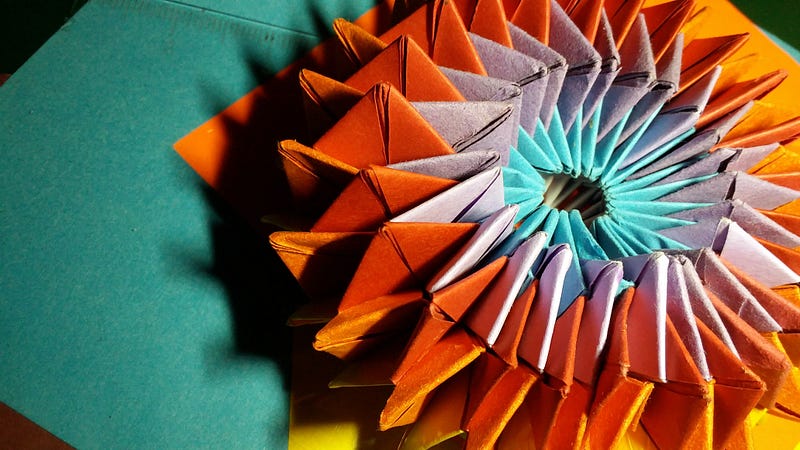
Robert Lang is a physicist. He worked at NASA for 13 years studying lasers. He authored over 80 publications on lasers and optics. He had 46 patents on optoelectronics to his name.
In 2001 he quit his job at NASA. This was a very unexpected move, given that he was very accomplished in his academic job.
Everyone asked him: Why on earth would he do this? Why would you leave a secure job where you are already successful? Why would you walk away from a respectable career?
Lesson 1: Find your true passion and calling in life and pursue it.
Robert wanted to pursue his one true passion in life: The art of paper folding. He wanted to focus on origami full time and create original origami designs.
He explains his reasoning as follows:
“There were plenty of people doing lasers. The things I could do in origami — if I didn’t do them, they wouldn’t get done.”
Lesson 2: Focus on the things only you can do in your life
Robert Lang thought there would be many others who could do laser research at NASA. But, there would be no other person with years of engineering knowledge and experience who would dedicate his life to origami. He felt he was the only one who could do this and it was his true calling. He began his new career as a full-time origami artist and consultant.
It was the culmination of a new strange career that brought together arts, engineering, maths, design, writing, teaching, consulting, and creativity. The origami was the anchor bridging all these fields.
He became wildly successful in his new pursuit. With a deep understanding of mathematics, engineering, and materials, Robert Lang created folding designs that would revolutionize the field of origami.
Lesson 3: Establish your own game where you can be the master
Robert Lang has become a legend in the world of origami. He is now one of the foremost origami artists and theorists in the world.
The following are some of his wide-ranging accomplishments in the field of origami:
- Robert Lang has written 8 books and numerous articles on origami. His books include “Twists, Tilings, and Tessellations: Mathematical Methods for Geometric Origami”, “Origami Design Secrets”, and “Origami in Action”.
- He takes full advantage of modern technology in his origami, including using a laser cutter to help score paper for complex folds.
- He is now known for his complex and elegant designs, most notably of insects and animals.
- He helped take origami to the next level, developing computer software to create complex designs.
- Robert has also created computer programs for origami design. One of them is called TreeMaker. If you draw a stick figure of the shape you want, TreeMaker calculates a crease pattern based on that stick figure.
- Robert is recognized as one of the leading theorists of the mathematics of origami. He has developed algorithms to improve the design process for origami.
- Dr. Lang gave his famous MIT lecture when he was an artist-in-residence there about origami and its relationship to mathematics.
- Robert specializes in finding real-world applications for the various theories of origami he has developed. He used paper folding to create innovation across aerospace, heart surgery, and bio-engineering industries.
- Robert’s intricate designs are cutting edge, and they have wide applications in engineering. His designs have been incorporated into everything from spacecraft to airbags. He has designed folding patterns for a German airbag manufacturer. He has worked with a team to develop a powerful space telescope with a 100-meter lens in the form of a thin membrane. The lens can be folded in a small rocket and can be unfolded in space.
- Lang designed the Google Doodle for Akira Yoshizawa’s 101st birthday, which was used by Google.
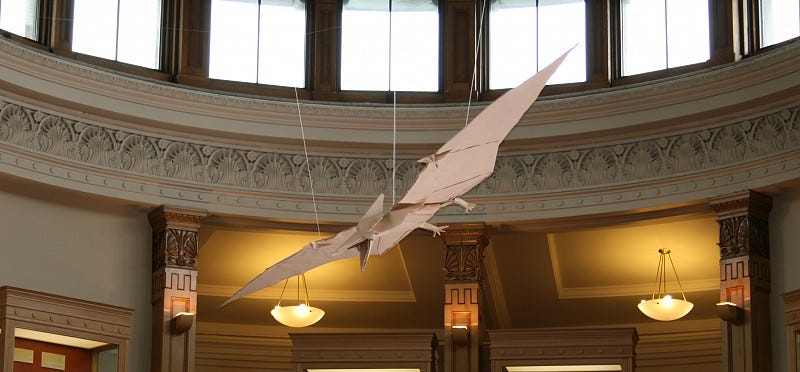
- Robert’s works are not limited to functional objects, he has also produced a wide range of original artworks that have been exhibited around the world. I have seen his origami artwork when I was pursuing my Ph.D. at McGill University. His creation would hang at the Redpath Museum at our university campus in Montreal, Canada.
Lesson 4: Follow your own heart and curiosity
There is something about Robert Lang’s story that resonated with me. I have also been in an academic career for a long time. I love my job — I love teaching and doing research. However, on my 41st birthday, I have been yearning for more. I have written on my soulsearching on Medium:
I wanted more creativity in my life. I have recently been involved in a lot of doodling. Doodling soothes me. It feels very liberating to do mindless doodling. I love wasting my time by doodling — there is no accountability whatsoever. There is no ambition, no end game. There is no career move or progress. I do not seek approval from anyone when I doodle. I do not seek anyone’s consent or support. I do not seek money nor attention. I feel completely free to be foolish, naive, and playful. And this is the ultimate freedom.
Robert’s story has inspired me to take doodling more seriously and turn it into a more serious body of work. I will not quit my academic job, but I will continue to devote serious time to doodling and related creative activities.
Lesson 5: Discover connections across fields — doodling and origami
Similar to folding papers, doodling is also deceptively simple. Although it is very simple, it involves endless possibilities. You can do some mistakes while you are doodling, and this will take you to uncharted territories on each page.
There is also a soothing element in the monotony of moving your hand and your pencil on your notebook. As you make hundreds of circles, spirals, or lines, you feel liberated. You feel a strange sense of tranquility. It is almost as if the world has stopped around you. You are just content with where you are and what you are currently doing.
Origami is also known to be soothing and it has been prescribed as a therapy method. At the Conference on Origami in Education and Therapy in 1991, a mental-health professional presented a paper about her origami work with prisoners and mentioned how origami had a calming effect on psychopathic killers.
Similar to origami, doodling is also soothing for your mind and refreshing for your spirit. It helps you to develop mindfulness and focus on the present. You will feel relaxed and calm when you doodle. You will leave your stresses, anxieties, worries behind. You can doodle when you are tired or bored. No one will judge you. You will not let your inner criticism judge you. What matters is capturing your stream of consciousness and fresh ideas as they occur to you.
Doodling and origami are both simple acts of magical creation. Like origami, doodling is also very accessible and practical. Doodling does not require professionalism, expertise, or exceptional talent. Everyone can learn and do it with an amateur spirit. Doodling and origami are both democratic and anti-elitist art forms — as they are open to all. Anyone can doodle, but only you can create your own unique doodles. Like fingerprints, your doodles are your creations only. Even if they look crude, your doodles are actually beautiful and honest — they reflect layers and emotions deeply hidden in you. Each line, circle, or dot will connect with others in mysterious ways. You will be part of the mystery and the adventure.
Lesson 6: Stay curious, stay naive, and stay hungry
Lang subscribes to a sense of amateur spirit, curiosity, and wonder when he does origami. Many people who know Robert Lang as a scientist are surprised when they hear that he is one of the world’s foremost paper-folding artists. They are surprised that there is a job of being a professional origami artist. Yet, Lang does not care about how others think about him. He is interested in pursuing his curiosity and passion — regardless of the consequences.
He believes that there is still much more to do in origami:
“It’s like math. It’s just out there waiting to be discovered. The exciting stuff is the stuff where you don’t even know how to begin.”
“Once we have understood the way paper folds and unfolds, we can apply those patterns to things that are very different from paper.” — Robert J. Lang
Lesson 7: Go back to your childhood passions and hobbies
Robert Lang never lost his childhood interests and curiosities. He began origami when he was six years old. He solved origami puzzles and he created his own designs when he was a child. He discovered he loved origami and decided to pursue his passion for life. He describes his journey as follows:
“I started origami when I was about six years old. I found some instructions in the origami book, and I thought it would be a fun puzzle to follow the instructions and fold the figures. Throughout my childhood I pursued origami as a hobby, looking for books that had instructions and trying to fold everything I could find. Eventually, I started making up my own designs because I wanted to make origami subjects that were not in any books.
I really never thought it would be anything but a hobby, and so I pursued other interests as well. In high school I enjoyed mathematics, science and natural history and I chose my career in science. I went to Caltech and studied electrical engineering for my BS and MS, and then switched to applied physics for my Ph.D., focusing on semiconductor lasers.
My scientific focus was on theoretical modeling of lasers, developing mathematical models of their function and behavior, but I was also pursuing origami on the side, trying to develop more complex structures. I had the idea of developing the mathematical underpinnings of origami; if I could describe origami using mathematical language, then I could use the tools of mathematics to accomplish the artistic goals I wanted in the world of origami.
That’s what led me to merge the two, and that merging worked. Putting origami into mathematical language allowed me to use mathematics to develop new design techniques that let me create the things I wanted to create. Besides that, I was also able to teach a lot of these techniques to other people, which helped them to advance their own art.
The language of math and science, applied to origami, also made it possible to apply origami structures and mechanisms to engineering problems. That got me involved in the consulting of how to use origami to create deployable structures and folded products.”
Lesson 8: Combine your profession with your hobbies and arts
Robert Lang crafted a remarkable career where he brought together his childhood hobbies and his professional strengths and skills. The key was to never give up his curiosity and childhood passion. Origami was always where his heart was and he just followed his heart.
His unique ability was to bridge his artistic interest and passion (the art of origami) and his professional expertise and skills (mathematical knowledge and engineering skills).
Lang is passionate about expanding the practical applications of origami across diverse fields. His interests are wide and wild: Solar sails, airbags, optical devices, nanotech devices, medical implants, manufacturing…The list goes on and on. Everything that needs to be packed tightly benefits from origami patterns.
It turns out that origami is wildly useful in space. Things that are big and flat, such as solar arrays, telescopes, or antennas can be folded into patterns using origami. Robert is a master of folding patterns, structures, and mechanisms and this is where he comes in. He applies his origami magic by folding space objects down to much smaller sizes.
Origami has many applications in product design, packaging, engineering, and consumer goods. For example, you can use origami to make things smaller, such as furniture that folds down for storage or shipping. Origami is also useful for medical devices, such as heart implants.
Here is how Robert Lang explains his ongoing curiosity of origami:
“Perhaps, the main thing that keeps origami interesting to me is the fact that there is always something new. I can try an idea in one conceptual area and then switch to something completely different. The common factors that keep me excited are novelty, solving problems, and creating something that did not exist before. Usually, that’s also something that’s aesthetically beautiful as well.”
The field of origami is advancing every day, and Robert is at the frontiers of all these current developments. For centuries, origami patterns were simplistic. Now, origami has become very complex and sophisticated. Surprisingly, as origami becomes more complex, it also becomes more practical.
Lesson 9: Find your own Ikigai
What is the most important lesson we can learn from Robert Lang? He has been able to combine his profession, passion, vocation, and mission into something that is beautiful and meaningful.
He found his own “Ikigai”.
Ikigai is a Japanese term that means the “reason for being”.
The secret is to create your own “Ikigai” in your life. Ikigai can be found at the intersection of:
- what you are good at (your strengths),
- what you love (your passions),
- what the world needs, and
- what you can be paid for.
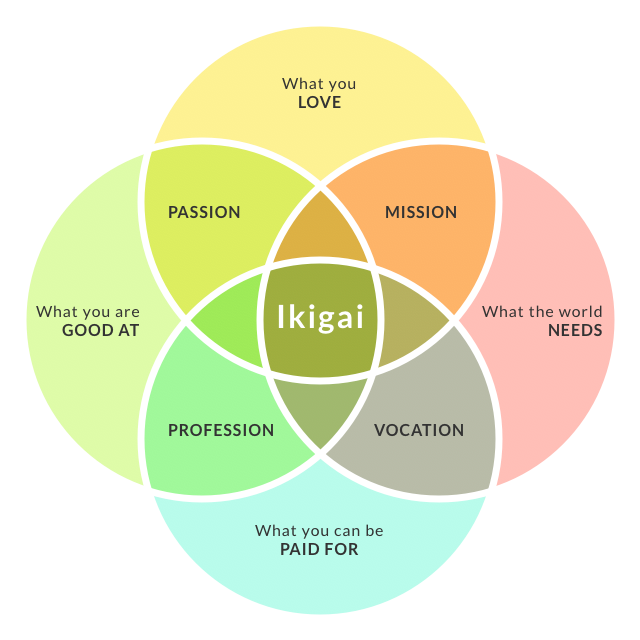
Robert Lang has found his “Ikigai”. Origami is a way of life for him that balances and connects everything:
- he is really good at origami and its applications,
- he loves origami and everything that has to do with it,
- the world needs him to work on origami designs, and
- he is also paid for his work as an origami consultant.
The big lesson: Ask yourself where your Ikigai is. Find it, own it, create it, and defend it at all costs.
Where is your Ikigai?
Make 4 different lists to explore and find your Ikigai:
- What do you love?
- What are you good at?
- What does the world need from you?
- What can you get paid for?
Respond to these four questions and come up with four different lists. Then, look at what unites all these lists. What are the things that are at the center?
How can you implement and enact your Ikigai?
Think of a long term perspective of how you will live a better life. Find time to develop your Ikigai, put it in action, and sustain it over time. This will help you find fulfillment and self-realization in your life. Thus, you will live a happier, healthier, and longer life.


