
Harvard Taught Me to Dream Smaller
A drop from the summit of achievement into the dark valley of doubt. A story about resilience, mental health, and a new vision of success.
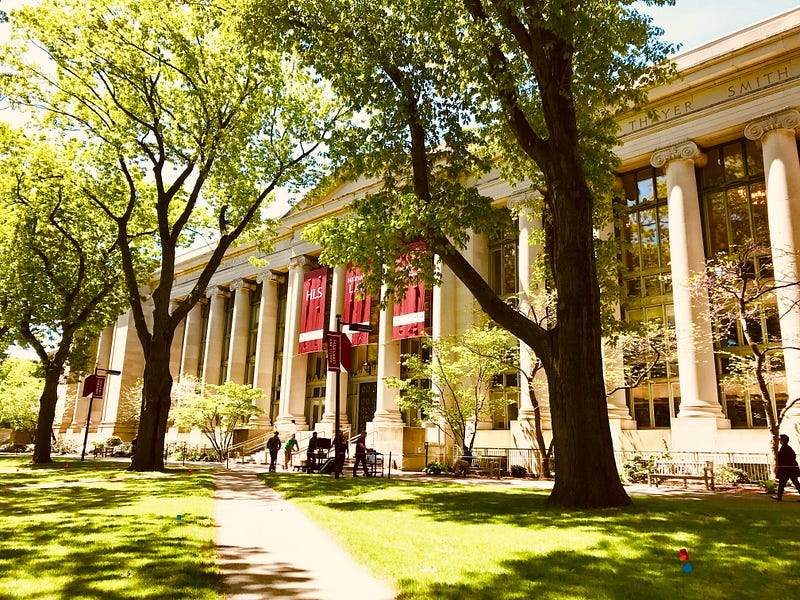
When I got accepted into Harvard Law School, I thought I could achieve anything.
It was three years post-college and I was working overseas. With no access to test prep courses, LSAT tutors, or academic advisers, I taught myself the LSAT on the weekends and finally got a marginally good enough score after two tries. I spent the next six months meticulously going through every detail of my admission essays, ordering every “How To Get Into A Top Law School” book on Amazon, and closely followed every piece of advice on how to edit my resume. One day in March of 2017, I got an acceptance letter from Harvard.
I have always dreamed of attending Harvard Law; I even performed in a community theatre version of Legally Blonde, secretly wishing I could be the real-life Elle Woods one day (despite I wasn’t blonde).
Back then, I didn’t envision what I would do with my law degree. Getting into my dream school seemed to be the be-all and end-all. Holding that acceptance letter, I thought I reached the finishing line of this journey of prestige and success. I was dead wrong.
“Getting in is the hardest part” was the mindset that set me up for failure. Instead of brushing up on my basic legal knowledge, I spent my summer before law school picking out furniture for my dorm room.
Being the first lawyer in my family, I had no idea how the court system works, let alone legal terminologies and the names of Supreme Court Justices.
I also never lived in America before law school. Law in this country is a very America-centric subject. Things that my American classmates learned in the news, such as DACA and the Affordable Care Act, were completely alien to me. On top of that, using English as a second language to cope with the law school’s “Socratic method” — a pedagogy in which the professor constantly calls on students to answer questions in class, was the most anxiety-inducing experience ever.
Adjusting to a new country while juggling the demands of law school quickly put my academic performance and mental health into a downward spiral.
I Was Not Special
A few weeks into law school, I realized I was not special. I came to law school because I was a Type A student who was organized, analytical, and detail-oriented. At Harvard Law, everyone possesses all these skills. But they are better. My first year in law school gave me a sobering view of where I stand — I scored below the median, I got rejected by numerous internships and student clubs, I never had intellectual discussions with my professors during office hours because I was too shy to go, and I had trouble catching up with class readings because English was not my first language. I felt drowned.
Gradually, I withdrew from most competitive endeavors. I never signed up to compete for Law Review (a student-run legal journal that recruits editors through a week-long writing competition — Barack Obama was the President of Harvard Law Review, to give you some context), I never tried out for moot court, I never applied for judicial clerkships (working in a judge’s chamber).
In retrospect, belittling myself was unhealthy, but retreating from the most competitive spaces at Harvard Law was a necessary protective mechanism at the time. It shielded me from more immediate failures and preserved much-needed mental energy for me to handle demanding schoolwork.
Dreaming Smaller
Failing at law school was not all grim and disappointing. Because I shy away from prestige, I was not distracted by things that everyone else was doing. At elite spaces like Harvard, it’s so easy to get sucked into traditional formulas of success — do well in classes, network with famous professors, get a clerkship, land a lucrative job, become the 1%. It is also easy to lose sight of one’s growth as so much attention is devoted to comparing your successes with others’ achievements.
Because I wasn’t good at traditional classes, I focused on less popular classes that interest me; seminars in Health Law, Fashion Law, and Digital Privacy were some of my favorites.
Because I was not good at legal research, I ventured into practice areas that require other skills. For example, I enjoyed representing independent artists through the Recording Artist Project, which focuses on skills like contract drafting and client management.
Traditionally prestigious “Harvard Law things” closed its door on me, but it opened up space for me to explore less-trodden paths.

Renewed Vision of Success
“Dreaming smaller” does not mean losing ambition. It means having a realistic perception of who I am, what I’m good at, and what I truly enjoy.
By accepting my limitations, I free up more attention and time to work on my strengths.
By coming to terms with the fact that I am not the brightest law student, I become more effective in pursuing excellence in areas that fit my personality and skills.
At the end of the day, being mediocre is okay. Harvard Law might have shattered my dreams of becoming a great legal mind, but Harvard Law taught me humility and contentment that will prepare me for many more challenges to come.