
Harness the Remarkable Power and Earnings Potential That Can Result From Being a Generalist-Specialist Writer
Find how much success you can achieve by letting yourself have the best of both worlds.

There has been a lot of discussion among writers as to whether it is better to be a generalist or a special in order to achieve a successful career. Many people have said that the only way to be a successful writer is to write in a popular niche. There are countless articles that discuss this and doing a quick search you’ll find titles like, “The Most Profitable Writing Niches,” “How to Choose a Writing Niche,” and “101 Writing Niches For You to Explore.”
However, for many of us, writing exclusively in a niche is not overly attractive. The limitations of writing only in a single area every day, over and over, can lead us to lose interest and become stagnant in terms of identifying new ideas to write about. Instead, some of us prefer to leave out options open, and to not just write on a number of different topics but in several different genres as well. For example, it is not unusual for those who have more of a generalist focus, to take breaks to write fiction or poetry.
While many in the field state you need to choose a niche that people are interested in and stick with it, because generalists don’t succeed and no one will work with them because they know a little about a lot but don’t know a lot about anything.
I think that there are actually many people who write outside of a niche who are extremely successful and that it is more about how you structure your writing focus. I propose a different idea that allows writers to integrate some niche writing with writing outside the box. It isn’t impossible to write on different areas and still realize satisfactory earnings and followers but it takes a bit of thought and planning to accomplish.
Niche Writers vs. Generalists
Specialists are writers that write in a niche and aim to become an expert or to be considered one of the experts in that area.
The best niche writers are often referred to as influencers because they have a particular area they are believed to be highly skilled in, and they have a wide following who they actively engage with. This allows them to influence the behavior of their audience.
Some of the big influencers in the writing field today include people like Seth Godin who specializes in marketing, advertising, business venturing and leadership, Neil Patel who is known for online marketing, Jeff Goins on writing and creativity, and John Morrow who is known as the “Mr. Blogger” of the internet.
Many writers hesitate to have a niche because they don’t want to constantly write about the same thing. They jump from topic to topic, based on whatever they are interested in at the time. Some people consider this approach to be lazy, believing these writers just don’t want to put in the effort to create a well developed niche area.
Yet writing general articles across a broad range of topics is a great way for new writers to gain experience and for established writers to maintain an interesting work life through variety. Being a generalist lets someone have practically unlimited job opportunities allowing the writer to constantly try new things. It also means that they can quit something that isn’t working in favor of something else.
The truth is there is no absolute evidence that one of these models is far and away better than the other. It could be that new writers get a better result by using a generalist model, to learn skills and gains exposure before focusing on an area. It could also be the case that new writers become overwhelmed with all the potential topics there are to write about. I propose a different approach that lets you take advantage of the best of both types of writing focus.
Capitalize on Being Both a Specialist and a Generalist
While both specialist writing and generalist writing have pros and cons, it isn’t necessary to choose between the two types to have a successful career. In fact, I would argue, the most lucrative way of handling what you write about is to mix both niche writing and general writing. If done well, this can lead to an extremely successful, profitable and satisfying writing career.
All writers have or can develop an area of interest where they have special knowledge which they can write about easily and repeatedly, whether it is a broad topic like health, personal finances, or business, or a narrower topic such as writing about credit cards. At the same time, if asked, most writers would also likely say they’d prefer to branch out and write on other topics to keep things interesting.
How to Mix Niche Writing and Generalist Writing — The Four Category Approach
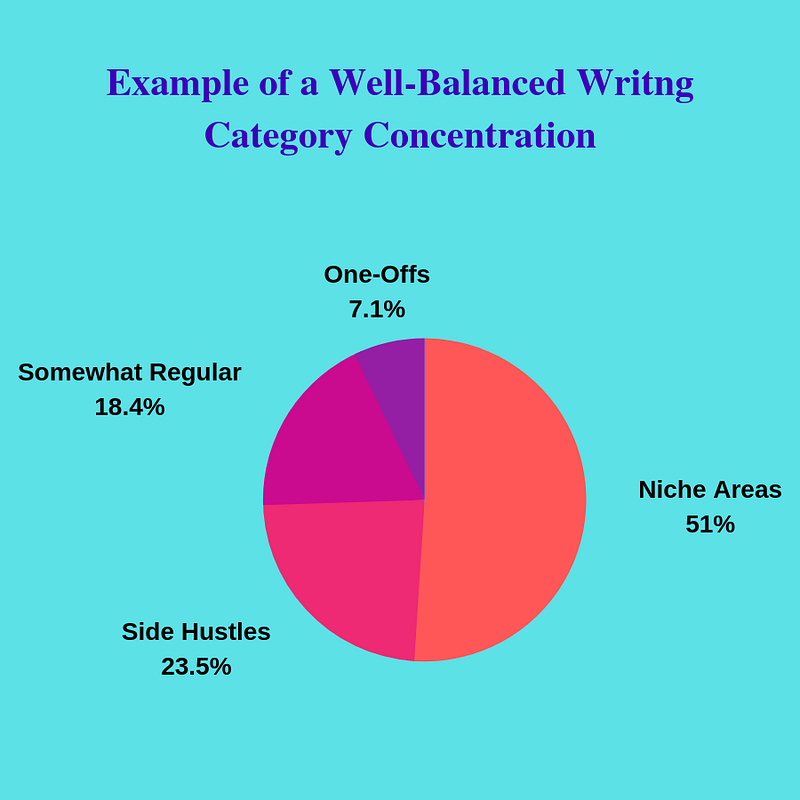
I recommend breaking up your writing topics into four categories; Niche Areas, Side Hustles, Regular Exploration and Interesting but Not Necessary. Making sure that you have a certain concentration of each of these areas will help you establish yourself as a respected writer in an area or two. You will also be able to gain a reputation for being able to write on many topics. This approach will make it apparent that you are not just jumping from topic to topic but that you have an organized, well thought out writing plan in place.
Niche Areas
Ideally, you should have one or two areas that you write in regularly. These should be topics that you have some kind of credentials for that establish credibility and expertise. For this category, it’s not enough to just really like a topic. You need to have something you can point to which the reader will interpret as a reason to look to you for information on that topic.
If you decide to write on car mechanics but have nothing that establishes that you know anything about it, people are not likely to follow you. If you have a Ph.D in cellular biology and teach at a recognized university, people are likely to listen to what you have to say about CRISPR technology .
Your credentials don’t have to just be degrees and licenses. You can also focus on areas you have a lot of experience in or have demonstrated great success in. Many writers who focus on writing fall into this category, as they don’t have a formal degree in the area but can demonstrate a lot of experience, skill and successful writing venture.
Whatever it is that you decide to establish as your niche area, make sure that you indicate it somewhere on each piece that you write — about that niche, whenever possible. When I write articles on psychology, at the end I include a line that says I have a Ph.D in Clinical Psychology and add what I specialize in. For articles about writing, I use a paragraph that lists my editorial experience on and off Medium and add a few journals I’ve published in as well to show practical experience.
It’s important when determining what you will write about on a day to day basis, you keep in mind certain concentrations of topic areas. For example, you don’t want to have two niche areas with a dozen articles each then another 50 articles that are all one-off.
Spend enough time weekly to establish you niche area credibility. Also consider exploring more than one channel, platform or other way of getting your name out there for your niche areas. This might be a website, blog, Youtube channel, Instagram channel, Pinterest platform, ebooks, or you might even serve this purpose by acting as a regular guest blogger or speaker. The idea is to establish your name and associate it with your one or two niche areas.
A niche area is one where if you are successful at establishing your credibility in it, readers will say, “Oh, Jane Doe? She’s an expert on cat herding!” Once people see you as an expert on something, they are more willing to read things you write outside of your niche areas.
🔸Try to have around 50 to 60 percent of your articles be about a niche area.
Side Hustles
What I call side hustles are areas that you are interested in but maybe not to the same extent as you niche areas. Or they may just be areas you can’t establish that you have a great deal of expertise in but you enjoy writing about them. These are things that you should want to write about regularly enough that readers become familiar with your writing in these areas and associate your name with the topics on some level.
It won’t stand out as much as your niche area/s but side hustles can be remarkably rewarding. I use side hustles to offset the formality of my psychology articles a lot of times. A successfully established side hustle will have readers saying, “Oh, John Doe? He’s an expert on becoming invisible and he also often writes about running away from reality through time travel!” If you have any experience at all that you can use to establish street cred, then so much the better. Street cred means that those who write in a certain area recognize your experience as relevant.
For example, An MFA in Creative Writing is a formal credential. Publishing in journals that who’s who write fiction or poetry would recognize as quality publications is street cred. Side hustles can be a great way to break up your niche writing while growing your audience.
A couple of my side hustles are flash fiction and poetry. While I don’t have any kind of formal credential and it’s difficult to establish credibility in creative writing, when I write fiction or poetry, I add a statement which lists some literary journals where my work has been published. For simplicity’s sake I use a similar paragraph to the one I use to establish my writing credentials though with less information about my editorial experience.
So, keep in mind that the same paragraph can be used to establish formal credibility in one area, such as expertise as an editor for writing, and street cred for another area, such as being published in journals for creative writing.
🔸Try to have around 20 to 25 percent of your work be about a side hustle topic.
Topics Explored Somewhat Regularly and Creatively
These are topics that you write about sporadically but have enough of an interest in to return to, even if it’s not that frequently. So if someone scans your list of articles, they should get the impression that despite not necessarily having a ton of experience or expertise in the area you still have something valuable to offer about the topic.
These areas may also not actually have a lot of need for expertise or experience and may be areas you can write about creatively and uniquely generating interest in the reader by giving them a different view of the topic. Topics in the category might include things like hobbies, book or music reviews or life advice. For me, inspiration is one that falls into this category.
🔸Try to have around 10 to 20 percent of your writing fall into this category.
Things You Find Interesting But Not Necessarily Enough to Make Into One of the Above Categories
These are topics that perhaps you have an interest in learning more about and as you are doing so, discover something of interest to say. At the same time you won’t likely return to these areas more than once or twice. These can be one-off articles or articles that happen to be on topics you have written about in the past but not because you are trying to establish yourself in the area.
While it may be enticing to do a lot more of these one-off articles than anything else, it’s important to focus on the first two categories with some of the third and only a few articles every so often in this category. Remember, your readers willingness to follow and read your work, depends in large part on them believing you have something to say, and the experience to say it.
Establish expertise in at least one area, and street cred in one or two others and your audience will be willing to go with you anywhere. If you frequently write one-off articles when you don’t yet have an audience or have a limited one you haven’t established any kind of credibility with, you may get followers, but after hitting that button they may not ever return to your writing.
🔸I would recommend not having more than about 5 percent to an absolute maximum of 10 percent of your articles fall into this category at any point in time.
Review and Rebalance
It is worth it to take stock of your writing portfolio every now and again to determine if you are really off in terms of where you are putting your efforts. If everything is skewed towards categories 3 and 4 you’ll want to balance that our by focusing more attention on the first two categories.
Being A Specialist Generalist Writer and Jobs
Having at least one area of expertise while demonstrating that you can write in a number of different areas effectively, can also serve to help you with other freelance writing jobs. The niche focus will attract customers that need a writer with credentials who can write expertly about a specific topic.
The rest of your portfolio will help you ensure that you haven’t excluded yourself from other work.You will be able to attract clients who need someone who can easily write in multiple topics that are either assigned or that you are expected to choose. You will also be able to pitch a variety of stories to magazines, newspapers and online platforms and if you have published on different types of channels, to those as well.
Takeaway
In today’s world, it may not be necessary to only write only in a single niche to be successful. At the same time, those who do, usually succeed at it because they have a strong background and credentials to be able to consistently write commanding and practical articles in the area. Their level of interest in the topic also allows them to write about it over and over without becoming bored or running out of ideas.
Many writers, however, are not cut out to be niche writers. If you are one of these, you likely have interests in many areas, enjoy experimenting with your writing and don’t want to limit yourself by only writing about a single topic. Even if this is the case it is still important for you to have at least one area in which you can establish your expertise.
The way you define the rest of your job description in terms of what to write about is up to you. You can mix and match side hustle topics, things you return to every so often, and one-off types of topics to keep your writing life interesting and productive. If you choose the model I advocate here, it will be important to practice your elevator pitch so you come across as curious and adaptable without seeming as if your attention is going in a hundred different directions.
Combining the focus of a niche writer with the flexibility and talent of a generalist will help you be successful with a variety of readers, maintain your interest in what you write about and make you attractive to a wide range of possible clients.
Natalie Frank (Taye Carrol) has had work featured in Haunted Waters Press, Weirdbook Magazine, Siren’s Call Publications, Lycan Valley Press and Zero Fiction among others. Her poetry has been featured in several anthologies. She is Editor for 1-One-Infinity and One Table, One World and Editor in Chief for Promposity and Mental Gecko. She is also the Managing Editor for Novellas and Serials at LVP Publications.

If you enjoyed reading this article, you might also like these:
You can follow me and find links to all of my articles, essays, fiction and poetry on Medium here. Thanks for reading!