
Happiness Is Not a Mountain. It Is a Landscape.
There’s more than one form of the good life.

What is happiness? How do we become happier? What is the path to a happier life?
These can seem compelling questions. Sometimes it seems as if happiness is a towering mountain peak, and we are standing in the foothills, wondering how to begin the ascent. We are restless, wondering how we reach the peak when it seems so out of reach. We read books that promise to help us find the hidden path to the top, that promise us the secret of happiness.
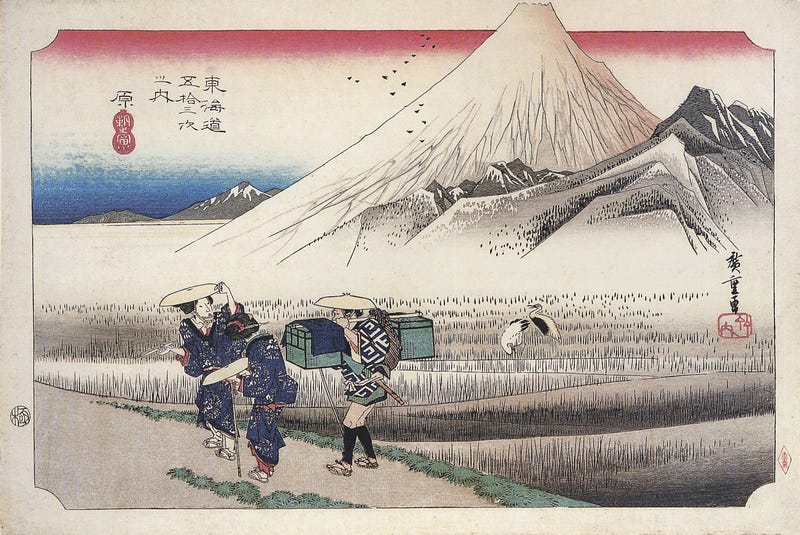
But perhaps happiness is not like this. Perhaps there is no great secret to happiness, no mountain peak, no ascent. Instead, maybe the reality is both simpler and more complex. Perhaps happiness is not a single mountain peak, but instead a landscape that reflects the richness and complexity of human experience.
Agree, somewhat agree, neither agree nor disagree…
One summer more than a decade ago, I was living in Birmingham in the UK, working on a research project on the subject of happiness. The job involved surveying old people about how their lives were going. It was part of an international research project that aimed to understand the relationship between happiness and ageing. I was one of the footsoldiers in this massive international campaign. I was paid per survey that I completed. Each survey was forty pages long. All summer, I went from door to door, carrying a bag of unwieldy paperwork. I knocked on the doors and asked if there were any old people at home. If there were, I fixed up a time to come back and carry out the research.
For much of the summer, I shared cups of tea, slices of cake, and the occasional glass of rum with the elderly residents of Birmingham. The survey took about an hour to complete, often more. It was full of statements like these:
- My life has gone well for me.
- I am happy with how my life is going.
- I have lots of friends.
- I sometimes want to escape from it all and leave my life behind.
My job was to ask the questions. Then, having evaluated the answers, I had to tick the right boxes: Agree, somewhat agree, neither agree nor disagree, somewhat disagree, disagree.
Some of my interviewees submitted to the survey with a kind of Stoic calm. Others thought long and hard about every question before they replied, as if I was asking them to reveal deep truths about their lives — which perhaps I was. Still others saw each question as the opportunity to head off on long digressions, telling stories from the past. And there were many old people who didn’t want to answer the questions at all: they were just lonely and wanted the company, or wanted me to fix their TV sets or unblock their sinks.
My favourite interviewees were those who saw the interviews as a chance to make trouble, as an opportunity for mischief and delight. They laughed at the pomposity of the questions, and they poked fun at me. One man — the same man who served me glasses of rum — was reduced to tears of laughter by the interview. Over and over, he repeated: “What stupid questions! Who has ever heard such stupidity?” I laughed too and told him I’d tick the boxes to say that he was happy, to spare us both. “Good idea!”, he said. “Have some more rum!”, and he refilled my glass, and we laughed and chatted. As I staggered out of his house, my head swimming, I thought to myself: he certainly seemed happy.
Sometimes, as I went door to door, I wondered about the questions in the interviews: Was I happy with how my life was going? Had my life gone well for me? Didn’t I too sometimes want to escape from it all and leave my life behind?
The more interviews I did, the less I knew.
What we talk about when we talk about happiness
Happiness is strange like this. The more closely you look at it, the more it seems to slip away. In his book Groundwork for the Metaphysics of Morals, the philosopher Immanuel Kant summed up the trouble well. Everybody wishes to be happy, Kant wrote. But at the same time, happiness is such a slippery concept that nobody can say what it is they’re wishing for.
Nevertheless, philosophers throughout history have attempted to pin down this elusive thing and to say what makes for a good and happy life.
For the followers of Epicurus (341–270 BCE) in Greece, and the followers of Yang Zhu (c. 440–c. 360 BCE) in China, happiness was all about pleasure. Pleasure is good, pain is bad. So the trick of a happy life is to find ways of maximising pleasure. Both Epicurus and Yang Zhu saw that one of the impediments to happiness is our desire for the wrong things. For Epicurus, we seek out pleasures that bring suffering in their wake. It’s what you could call the hangover principle. Some pleasures lead to further pain, and some pleasures are simple and uncomplicated. Work out which is which, and you can increase the pleasurableness of your life. Meanwhile, for Yang Zhu, it is our desire to accumulate wealth and possessions that is the problem: we take great risks to pursue these things, forgetting that possessions are replaceable while life is irreplaceable, and so we diminish our chances of living out our natural life-span.
These kinds of approaches to happiness are sometimes called hedonic approaches (from the Greek hedone, meaning pleasure). But other philosophers take a different view. For philosophers such as Aristotle (385–322 BCE) in Greece and Mencius in China, happiness is not about pleasure so much as about allowing our virtues to flourish. These kinds of approaches to happiness are often talked about as eudaimonistic, coming from the Greek eudaimonia, or ‘flourishing.’
For Aristotle, a well-lived life is not a life where we have as much pleasure as possible, but a life where we live and act well, where we can fully express our capacities as a human being. A life of pleasure, for Aristotle, might be a seriously diminished life. For example, imagine you decided — as the Epicureans often did — to withdraw from public life and simply cultivate pleasure. You might have a pleasant enough time. But you would miss out on cultivating the kinds of interpersonal capacities that you could develop by being more socially engaged. Over in China, Mencius takes a different view of flourishing. For Mencius, flourishing is about tending to the natural “sprouts” of our virtues: ren or fellow-feeling, yi or justice, li or a sense of appropriateness in social rituals, and zhi or wisdom.
As for the surveys I was carrying out in Birmingham, they were neither about pleasure nor about flourishing. Instead, they were about something that present-day social scientists and psychologists call “subjective well-being” (sometimes abbreviated to SWB). One of the foremost researchers into the psychology of happiness, Professor Ed Diener, defines SWB as, “people’s cognitive and affective evaluations of their lives.” Subjective well-being is about how you evaluate your own life, how well you think things are going.
But this evaluation is not straightforward. Often when I was tramping the streets of Birmingham, I thought about the statement, “I sometimes want to escape from it all and leave my life behind.” I knew as I filled in the survey that if I ticked that box, according to the researchers, it was a sign that the interviewee was unhappy. But was it? Is the desire to leave things behind a sign of unhappiness? Is it an indication that something is wrong? Or is it a sign of curiosity, passion and engagement? It made me wonder what notions of the good life were already assumed by the writers of the survey. It made me wonder if their view of the good life was a life where nothing ever radically changed.

The map of human experience
One thing that reading philosophy reminds you is that there is no one approach to happiness. Subjective well-being is not the same as flourishing. And neither subjective well-being nor flourishing are the same as pleasure. In fact the more you dive into the work of the philosophers of the past and present, the more you can see that happiness isn’t a single thing at all. Yang Zhu and Epicurus may take more or less hedonic approaches to happiness, but their approaches to pleasure are not the same. Yang is all about living out your natural lifespan, while Epicurus is all about forensically distinguishing between the pleasures that cause you suffering and the pleasures that don’t. The same goes for Aristotle and Mencius, and their eudaimonistic approaches to happiness. Both philosophers may talk about flourishing, but their concerns are different, and their view of the good life is not the same.
This is why philosophy still matters for how we think about happiness. Because philosophy teaches us the sheer diversity of human experience and aspiration. And it reminds us there is more than one way to lead a good life. There are, as the philosopher Isaiah Berlin pointed out, many things that we might value in human life, and not all of them are compatible.
There is something liberating in this realisation. Because when we recognise this, we can give up on the idea of happiness as a single mountain peak that we have to climb. Instead of a single mountain, the diversity of philosophical approaches to happiness suggests a different image. Happiness is not a single mountain peak that rises from the plains of everyday life. Instead, it is a much broader, more complex landscape, with its many peaks and valleys, its endless criss-crossing paths.
There’s a kind of relief in this. If happiness is many things, there is no single secret to happiness. There is no one mountain to climb. When we see this, we can start to unroll the map of human experience, and see it for the first time in its full richness.
And then, in the spirit of adventure, we can ask ourselves: where do we want to go?


