
Ethical Rewilding
Cultivating the forests of our virtues

The forgotten sage
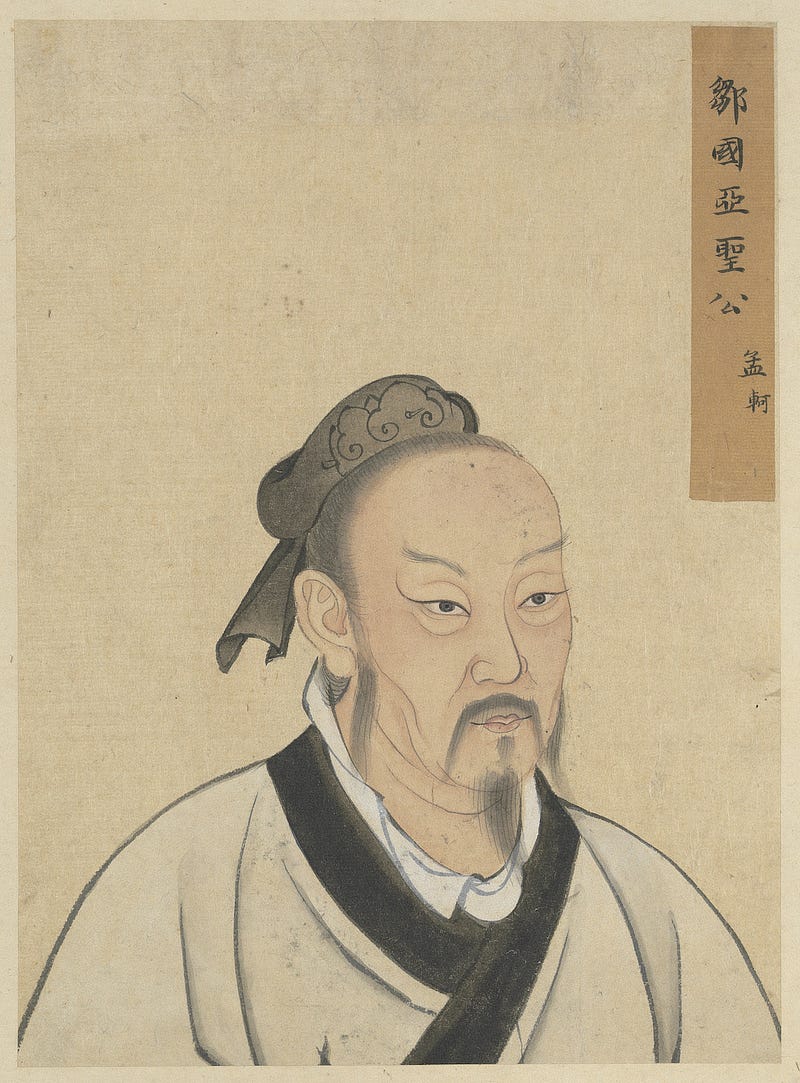
A decade ago, I took a trip to the town of Zoucheng in China’s Shandong province, to visit the Chinese philosopher-sage Mencius, or Mengzi (372–289 BCE). I went there because I was fascinated by his insights into human life. And because I wanted to find out more about what I have come to see as his programme of “ethical rewilding.”
Mengzi is a Confucian philosopher, but today he is almost entirely eclipsed by his predecessor. Bryan W. Van Norden, professor of Chinese philosophy and Mengzi’s translator, calls him, ‘the most influential philosopher in world history whom you have probably never heard of.’
And it is true. In contemporary China, Confucius is an important cultural symbol. Confucius’s home-town of Qufu is boisterous with tour parties. It is crowded, bustling, and — as they say in Chinese — renao, or ‘hot and noisy.’ It’s a kind of Confucian carnival.
By contrast, Mengzi has few groupies. When I caught the bus from Qufu to Zoucheng, 25 km away, I was the only person to get off outside the Mencius temple. I went through the gates and into the courtyard. Inside, the courtyard was calm. Slippery green moss covered the flagstones. Birds called hollered at each other in the branches of the ancient trees. The temple was dilapidated, paint peeling; but not uncared-for. I sat down and drank in the silence. I was entirely alone. I took out my copy of Mengzi’s collected teachings, and I thought about human nature.
On human goodness
Mengzi’s big idea, and it is an appealing one, is the human beings are naturally good. “The goodness of human nature,” Mengzi claimed, “is like the going-downhill of water.” In other words, if you leave human nature to its own devices, it naturally tends towards goodness.
This was not a widely-shared view in Ancient China. Confucius didn’t talk about human nature in any great depth, at least not directly. And the later Confucian philosopher Xun Kuang or Xunzi (possibly 310–235 BCE) argued against Mengzi to say that human nature was bad, and that it was only through the artificial intervention of culture that we become good.
But Mengzi believed he had good evidence for his claims. In his collected teachings, he asks us to consider the following scenario.
This is why I say that everyone human has a heart that cannot bear others’ suffering. If somebody happens to see a child fall into a well, they will respond with fear and compassion. This is not because they want to get into the good books of the child’s parents. It is not because they want to be praised by people thereabouts and by their friends. It is not because they can’t bear the child’s crying.
From this we can see that if there is no feeling of fear and compassion, we are not human.
Mengzi, Book 2A.
There is something more than wishful thinking at work here. As the primatologist Frans de Waal argues in his book Primates and Philosophers (p. 52), Mengzi’s insights are in accord not only with the “rich literature on human empathy and sympathy,” but also with studies of other social animals. Our spontaneous response to the suffering of others seems, somehow, to be built-in. We hear the cries of distress, our mirror-neurons fire, and we respond before we have even thought about it. The suffering of others affects us, prior to any of our rationalisations about goodness and badness.
The cry of a child falling into the well is like a blow to the heart.
The tender sprouts of virtue
But if human nature is good, what is goodness? Here, Mengzi drills down to give us more detail. He says that goodness is not just a single virtue but instead is made up of a bundle of different virtues. Mengzi identifies four of these virtues. He calls them duan or ‘sprouts.’
The first is ren, sometimes translated as humaneness or benevolence. This is an idea that goes back to Confucius himself. The Chinese character for ren is made up of the component that means “person” and the component that means “two.” So you could see ren as the ideal form of interpersonal relationship. Mengzi associates ren with our feelings of pity and compassion towards others, the firing of our mirror-neurons, the blow to the heart as the child falls into the well.
.jpg)
The second sprout is called yi in Chinese, often translated as “rightness” or “justice.” Mengzi says yi is associated with a sense of shame, with the inner feel for whether we are acting well or badly. Yi, or rightness, is our internal moral compass, our built-in feel for fairness and unfairness (again, research by people like Frans de Waal suggests that fairness is hard-wired, not just in ourselves, but in other primates).
The third sprout is li or ritual. This focus on ritual also goes back to Confucius, who argued that ritual was a central component of shared human life. Confucius drew close parallels between ritual and music because both music and ritual help us collectively bring about harmony. Ritual is about the shared music of our being together. It is, Mengzi says, about knowing to obligingly go along with something and when to politely decline, when to act and when to not act, when to engage and when not. It is about those delicate nuances of our interpersonal relationships. Ritual, Mengzi says, is the heart or mind that respects others.
The final sprout is wisdom, or zhi in Chinese. This is the ability to distinguish between what is and what isn’t the case, what is and what isn’t true. For Mengzi, the sprouts of wisdom are already deep within us: all they need is nurturing.
Nourishing our sprouts
But if Mengzi is right, and we do all have these sprouts of virtue, this raises interesting questions. First, how can human nature be good, when the world is in a state of disarray? And second, why does it sometimes seem that goodness is so hard to find?
One reason for the apparent shortfall in goodness, Mengzi argues, is that our sprouts need cultivation. We need to care for the tender shoots of our virtues. Van Norden says in his translation of Mengzi that we do this by “delighting in the manifestations of the sprouts when we do have them” (p.20). So to some extent, moral cultivation is up to us. It is something that we actively do, by actively cherishing goodness.
But for Mengzi, there’s much more at stake than individual moral cultivation. Because Mengzi’s agricultural metaphor also enables him to argue that these natural sprouts of virtue need a whole wealth of external conditions if they are to flourish.
And here, Mengzi tells a powerful parable about how thanks to external conditions, the shoots of our virtues can wither, fail to grow, or be cut down when they are at their most tender.
Once, the trees on Ox Mountain were beautiful; but it was on the borderlands of a great state; and after people came with axes to cut down the trees, how could it still be beautiful? And yet, with the nourishing breath of day and night, the rainfall that moistened the soil, how could new shoots not start regrowing?
But then ox and sheep were pastured on the sprouts, so that it looked bare and barren. People saw this barrenness, and they believed the mountain had never been forested; but how could this barrenness be the nature of the mountain?
Mengzi, 6A
Rewilding the moral world
The parable of Ox Mountain leads Mengzi to the conclusion that there is a political responsibility to put in place an environment that can enable the sprouts of people’s virtues to grow. For Mengzi, social conditions matter. If people are oppressed by hunger, need or social disorder, this will do violence to their nature.
Adverse social conditions are like the people with axes who come to cut down the trees or the cattle that come to graze. People might be good by nature; they might even cherish goodness. But goodness is not going to flourish if the conditions for its flourishing are not in place.
In years of good harvests, all the young men are at ease; when there are bad harvests, the young men are violent. It is not what has befallen them from heaven that makes a difference. It is because of the sinking and drowning of their hearts.
Mengzi 7A
.jpg)
Mengzi’s parable of Ox Mountain has been used by some environmentalists to talk about early environmental consciousness in China. And Mengzi was remarkably clear-eyed about the human impact on the environment.
But what I’m interested in here is taking an idea from contemporary environmental thinking, and applying it back to the questions of ethics that preoccupied Mengzi. I’m interested in how external conditions can lead to the “sinking and drowning” of our hearts, and how we can go about preventing this. And I’m interested in how Mengzi seems to be proposing the moral equivalent of what, in present-day environmental circles, is called rewilding.
“The main aim of rewilding,” George Monbiot writes in his book Feral: Rewilding the Land, the Sea and Human Life, “is to restore to the greatest extent possible ecology’s dynamic interactions” (p. 84).
Rewilding is about putting the conditions for natural regeneration in place. Monbiot is talking about the natural environment, but Mengzi has his eyes on a different ecology: he is interested in how we might restore the dynamic interactions of our moral ecology. He is interested in how we can attend more closely to the things that cramp, stifle or cut down the virtues that are natural to us as human beings. He wants to ask what the environmental factors are that get in the way of a rich, wildly-flourishing moral life. And he is interested in exploring how we can remove these destructive factors to let the forests of our shared human ethical life grow vigorous and strong.
And this is why I made the pilgrimage down to see Mengzi in Zoucheng. Because his philosophy delivers a powerful message that still stands, well over two thousand years after his death. What Mencius tells us is this: that whatever kind of social groups we care about — nations or schools, family groups or online communities—we need to attend to questions of our moral ecology. We need to avoid cutting down the sprouts of virtue, the forests of human goodness. And if everything seems barren, we need to think about removing the factors that hold people back from goodness, so we can set about rewilding ethics.
Because what possibilities might be opened up, what human richness, if we really rose to the challenge of rewilding our moral ecologies, and letting the forests grow back?
References
The translations from Mengzi are my own, with the original text on ctext.org. I used Van Norden’s excellent translation as a reference.
Bryan W. Van Norden. Mengzi: With Selections from Traditional Commentaries. (Hackett 2008).
George Monbiot. Feral: Rewilding the Land, the Sea and Human Life (Chicago University Press 2014).
Frans de Waal, Primates and Philosophers: How Morality Evolved (Princeton University Press, 2016).
Will Buckingham has a PhD in philosophy. He runs LookingforWisdom.com, which delivers free weekly philosophy lessons by email.