avatarAvi Kotzer

Free AI web copilot to create summaries, insights and extended knowledge, download it at here

3145

Abstract

<i>in-</i>, so I did some research.</p><p id="a7f9">All three languages use the prefix <i>in-</i> in two different ways: (1) meaning “not” and (2) meaning “within,<b> </b>inward,<b> </b>into<b>, </b>or toward”. What’s interesting is that, although some words in Spanish, French, and English share the same meaning of <i>in-</i>, others signify the complete opposite! For example:</p><ul><li><i>inactive</i> and its Spanish and French equivalents mean “not active” [<i>in- </i>as “not”].</li><li><i>inspire</i> and its Spanish and French equivalents mean “easily set on fire” [<i>in-</i> as “into”]</li></ul><p id="d10e">But while <i>inhabitable</i> nowadays means “good for living in”, the same word in Spanish and French is an <b>antonym</b>! So when you say a house is <i>inhabitable</i> in Mexico City or in Paris, for example, you’re telling someone there’s no way in hell you’re paying that exorbitant rent they’re asking for that piece of crap apartment. In San Francisco, you’d say it’s <i>uninhabitable</i>. And in Brooklyn… well, over there you’d just yell, “fuggedaboutit!!!”.</p><p id="b227">Here’s the kicker, though. <b>Inhabitable</b> in English <i>used</i> to mean <b>uninhabitable</b>. Somewhere along the way, usage gave the term a 180 spin and never looked back.</p><h2 id="1242">Parlez-vous français?</h2><p id="0bdf"><i>Habitants</i> was the term used to describe French settlers and their descendants who lived near the St. Lawrence River in the present-day Province of Quebec, Canada. They farmed plots of feudal land that had been sub-granted to them by a figure called the <a href="https://en.wikipedia.org/wiki/Seigneur"><b>seigneur</b></a>. Habitants were free individual, though, and the seigneurs merely had specific and limited rights over what was farmed. Despite this, most <i>habitants</i> grew crops only for their own household needs instead of selling them at the market.</p><p id="735b">The term was used by both the <i>habitants</i> themselves and the rest of French Canadian society from the 17th century until the early 20th century, when it gained a more negative and offensive connotation. These farmers started being called <i>agriculteurs</i> or <i>producteur agricole</i> (agricultural producer).</p><p id="5d4e">Here is a mid-19th century selfie taken by some <i>habitants</i>.</p><figure id="08ed"><img src="https://cdn-images-1.readmedium.com/v2/resize:fit:800/0*GJ2UScOQUJd2pVnC.jpg"><figcaption>Credit: wikipedia.com</figcaption></figure><p id="97df">If you’re French Canadian, or Canadian, or just a really knowledgeable hockey fan, you probably know that <i>habitants</i> is also used as a nickname for the Montreal Canadiens who play in the NHL. That’s because the farmers of that time plowed the land with tools similar to hockey sticks, which they then used for playing the sport in the evenings on their frozen ponds.</p><p id="1388">Kidding. But I did sound convincing there for a few seconds, didn’t I.</p><p id="47d3">Actually, the nickname <i>Les Habitants </i>(from which the more modern “Habs” tag derived) has an interesting back story to it. When the Canadiens started playing, there

Options

was no NHL yet. But there was a National Hockey Association, which included a team called the Wanderers. They happened to play in the same Montreal arena as the Canadiens between 1911 and 1918. The team colors were similar, too: red and white for the Wanderers; red, white, and blue for the Canadiens.</p><p id="a098">This was quite confusing for fans when the two teams played each other at home. I mean, how would you know who was a rival fan you could yell at and punch in a heated discussion after downing a dozen beers?</p><p id="5c7c">Wait a second… we’re talking about Canada here. Beer drinking and punching are okay. But no yelling. That’s rude.</p><p id="fd21">Anyway, the Canadiens fans resorted to wearing clothes typically used by their ancestors who first settled the country: woolen hats, multicolored belts, and moccasins with beaded embroidery. Because it was mostly the French-speaking supporters who did this, creative sports journalists — as they typically do — instantly came up with the <i>habitants</i> nickname for the team.</p><p id="a678">The first recorded term appears to have been published in 1914 when a newspaper reported about a game between Montreal and Toronto. Later, creative sports journalists — as they typically do — shortened the incredibly long and hard-to-pronounce <i>habitants</i> to… <i>habs</i>.</p><p id="ccee">If you go watch a Canadiens game in Montreal, feel free to cheer in French for <i>Les Habitants</i>. But if you go see them play at Madison Square Garden, you’ll have to call them something else. You’re not allowed to use the word <i>habitant</i> in the States.</p><p id="5590">And that’s because the editors of the New York Times Spelling Bee decided that it’s a <a href="https://www.merriam-webster.com/words-at-play/dord-a-ghost-word"><b>dord</b></a><b>.</b></p><p id="9fe5">Please check out my previous entry on another <b>dord:</b></p><div id="002e" class="link-block"> <a href="https://readmedium.com/ruana-b7856518208"> <div> <div> <h2>Ruana</h2> <div><h3>Let’s cover this word</h3></div> <div><p>medium.com</p></div> </div> <div> <div style="background-image: url(https://miro.readmedium.com/v2/resize:fit:320/0*2cgkjXCswk5_Cx3W.png)"></div> </div> </div> </a> </div><p id="172c">*What the heck is a <b>dord, </b>anyway? Here you go:</p><div id="6a59" class="link-block"> <a href="https://www.merriam-webster.com/words-at-play/dord-a-ghost-word"> <div> <div> <h2>'Dord': A Ghost Word</h2> <div><h3>One of the questions people like to ask lexicographers is this: Can you sneak something into the dictionary? Can you…</h3></div> <div><p>www.merriam-webster.com</p></div> </div> <div> <div style="background-image: url(https://miro.readmedium.com/v2/resize:fit:320/0*tK3mP1tYmCwnVpE9)"></div> </div> </div> </a> </div></article></body>

Habitant

Say this word with a French accent to change its meaning

Photo by sebastien cordat on Unsplash

Today’s New York Times Spelling Bee letters:
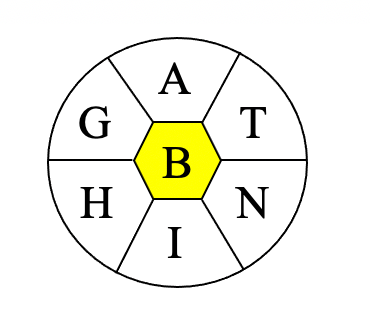
Art: Iva Reztok

A, G, H, I, N, T, and center B (all words must include B).

Merriam-Webster says…
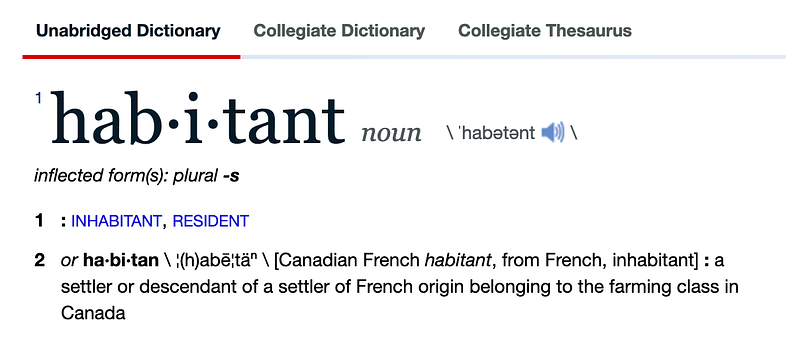
Credit: merriam-webster.com

Silly little dictionary! Don’t you know habitant can’t possibly be a word if the New York Times says it ain’t?

For further fascinating facts, check out the Spelling Bee Master.

What’s your favorite dord* from today’s puzzle?

My Two Cents

If you’re wondering why the heck habitant is not a valid word in today’s puzzle… welcome to my world. That’s my frustration on a daily basis as I type in letter combinations that I’m sure are words and get rejected. Which is why I started this column.

The Spelling Bee Master I mentioned above always has a list of “valid-yet-not- valid” terms at the bottom of the web page. I always check it to see which entry might be the most interesting for my Medium article. Today I was considering gangbang and bhang. But I ended up choosing habitant. I’m sure the other two will show up again at some point. Each puzzle can be repeated on seven different occasions, using a different center letter each time.

To prefix or not to prefix, that is the question

If habitant sounds very much like inhabitant to you, that’s because they are both versions of the same term. It’s just that habitant is no longer used when we talk about “one that occupies a particular place regularly, routinely, or for a period of time.”

As a Spanish speaker, when I play the Spelling Bee I sometimes try words in that language, knowing it shares many cognates with English, some of them spelled identically the same. Although English was primarily a West Germanic tongue in its origin, there has been a lot of influence from Latin and French over the centuries.

Habitante in both Spanish and French means the same as inhabitant in English. I was curious about the addition of the prefix in-, so I did some research.

All three languages use the prefix in- in two different ways: (1) meaning “not” and (2) meaning “within, inward, into, or toward”. What’s interesting is that, although some words in Spanish, French, and English share the same meaning of in-, others signify the complete opposite! For example:

  • inactive and its Spanish and French equivalents mean “not active” [in- as “not”].
  • inspire and its Spanish and French equivalents mean “easily set on fire” [in- as “into”]

But while inhabitable nowadays means “good for living in”, the same word in Spanish and French is an antonym! So when you say a house is inhabitable in Mexico City or in Paris, for example, you’re telling someone there’s no way in hell you’re paying that exorbitant rent they’re asking for that piece of crap apartment. In San Francisco, you’d say it’s uninhabitable. And in Brooklyn… well, over there you’d just yell, “fuggedaboutit!!!”.

Here’s the kicker, though. Inhabitable in English used to mean uninhabitable. Somewhere along the way, usage gave the term a 180 spin and never looked back.

Parlez-vous français?

Habitants was the term used to describe French settlers and their descendants who lived near the St. Lawrence River in the present-day Province of Quebec, Canada. They farmed plots of feudal land that had been sub-granted to them by a figure called the seigneur. Habitants were free individual, though, and the seigneurs merely had specific and limited rights over what was farmed. Despite this, most habitants grew crops only for their own household needs instead of selling them at the market.

The term was used by both the habitants themselves and the rest of French Canadian society from the 17th century until the early 20th century, when it gained a more negative and offensive connotation. These farmers started being called agriculteurs or producteur agricole (agricultural producer).

Here is a mid-19th century selfie taken by some habitants.
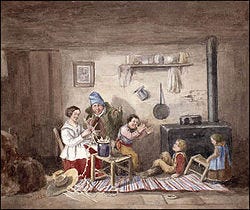
Credit: wikipedia.com

If you’re French Canadian, or Canadian, or just a really knowledgeable hockey fan, you probably know that habitants is also used as a nickname for the Montreal Canadiens who play in the NHL. That’s because the farmers of that time plowed the land with tools similar to hockey sticks, which they then used for playing the sport in the evenings on their frozen ponds.

Kidding. But I did sound convincing there for a few seconds, didn’t I.

Actually, the nickname Les Habitants (from which the more modern “Habs” tag derived) has an interesting back story to it. When the Canadiens started playing, there was no NHL yet. But there was a National Hockey Association, which included a team called the Wanderers. They happened to play in the same Montreal arena as the Canadiens between 1911 and 1918. The team colors were similar, too: red and white for the Wanderers; red, white, and blue for the Canadiens.

This was quite confusing for fans when the two teams played each other at home. I mean, how would you know who was a rival fan you could yell at and punch in a heated discussion after downing a dozen beers?

Wait a second… we’re talking about Canada here. Beer drinking and punching are okay. But no yelling. That’s rude.

Anyway, the Canadiens fans resorted to wearing clothes typically used by their ancestors who first settled the country: woolen hats, multicolored belts, and moccasins with beaded embroidery. Because it was mostly the French-speaking supporters who did this, creative sports journalists — as they typically do — instantly came up with the habitants nickname for the team.

The first recorded term appears to have been published in 1914 when a newspaper reported about a game between Montreal and Toronto. Later, creative sports journalists — as they typically do — shortened the incredibly long and hard-to-pronounce habitants to… habs.

If you go watch a Canadiens game in Montreal, feel free to cheer in French for Les Habitants. But if you go see them play at Madison Square Garden, you’ll have to call them something else. You’re not allowed to use the word habitant in the States.

And that’s because the editors of the New York Times Spelling Bee decided that it’s a dord.*

Please check out my previous entry on another dord*:

*What the heck is a dord, anyway? Here you go:

Spelling Bee
Language
History
Sports
Culture
Recommended from ReadMedium