
Gyri
This is your brain on video games
Today’s New York Times Spelling Bee letters:
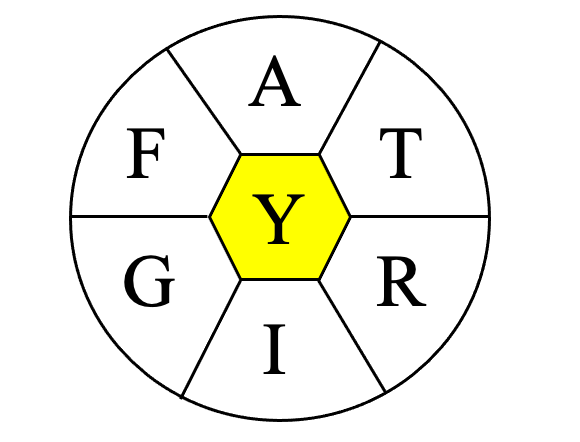
A, F, G, I, R, T, and center Y (all words must include Y)
Merriam-Webster says…

Silly little dictionary! Don’t you know that gyri can’t possibly be a word if The New York Times says it ain’t?
For a complete list of rejected words, check out the Spelling Bee Master.
What’s your favorite dord* from today’s puzzle?
My Two Cents
When I was growing up in Venezuela, my parents made friends with a couple who had lived in a rural area of the country. They later moved to Caracas before ending up in New Jersey. Occasionally we’d visit them on trips to the U.S. The couple’s daughter and son were older than my brother and I, but they still let us hang our with them.
One of our visits to Parsippany, the township where they resided, happened in the early 1980s. Video arcades had become all the rage and Pac-Man was the king of games. I remember walking with the son to one such arcade and watching him play. Although I had heard classmates discussing arcades, I had never played video games that were not connected to the Atari connected to the living room TV.
It was fascinating to watch my friend. He bounced back and forth between a few games, and ended up getting a streak going on one of the Pac-Man machines. One of the interesting things about the arcades was that if you were playing well you could get a crowd of onlookers. This is what happened after my friend had been racking up points and advancing levels for a good while. Eventually he ran out of lives.
Here’s the part that’s fuzzy in my mind. A man who was in the crowd watching the my friend play offered him a quarter to either go again or continue. And I think my friend, having run out of quarters, took him up on the offer. Back in the early 1980s a quarter was not small change like it is now. You could go to McDonald’s, buy two Happy Meals, and get a dime back. I’m exaggerating, of course. But you get the picture. My friend played some more Pac-Man thanks to this random stranger’s generosity, and then we went back home.
What stuck in my mind was the reaction my friend’s mom had when he told her the story. She was very upset. Furious that he had accepted the quarter from the stranger at the arcade. Because I was living in Venezuela –-where kids’ photos didn’t grace the sides of milk cartons like they did in the States–- I was completely befuddled when she yelled at him. I could tell she was not only angry, but frightened… of what could have happened. Now, we had been inside the arcade, surrounded by people, and had no other interaction with the man besides my friend accepting his quarter. But that wasn’t an excuse for my friend’s mother. I think he didn’t get punished only because he had company over. I don’t know if he was grounded after we left, though. I didn’t see him for many years after that (we weren’t very close), and never thought of asking him.
Many years later, of course, I realized why my friend’s mother had been so upset. And I always wondered if the man who gave us the quarter had done so with ulterior motives. To this day, any time someone mentions 1980s video arcades or Pac-Man, that story immediately pops into my head.
Mind games
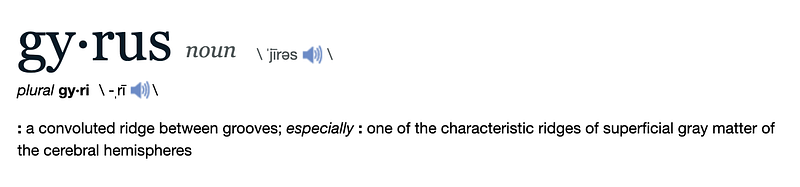
It’s not very helpful to know that gyri is the plural of gyrus if you don’t know what a gyrus is. Fortunately, we here at Silly Little Dictionary! know people in high places who can give us that information:
Just like good and evil, up and down, and life and death, gyri can’t exist on their own. They need the help of sulci (the plural of sulcus), which are brain furrows. Since it’s late here in Spain where I live and write, I’m going to save myself a thousand words by showing you a picture instead. And it’s a big one, too.
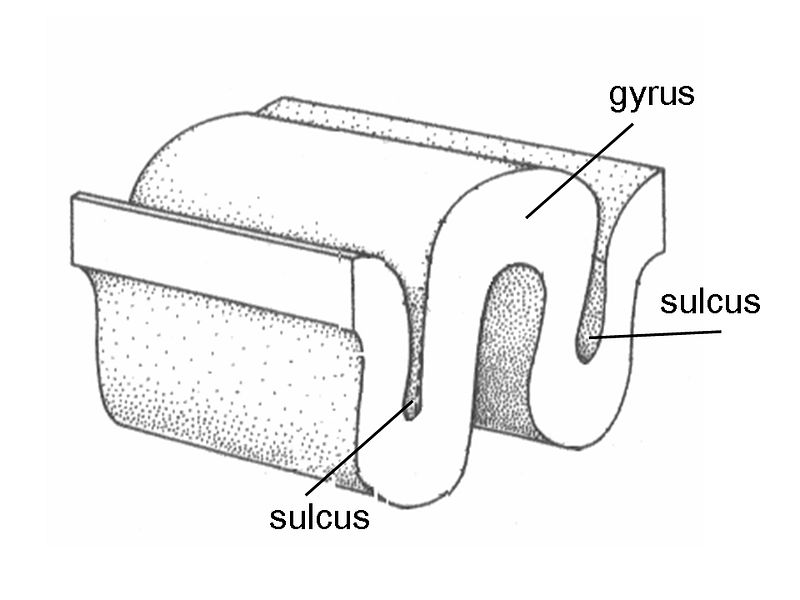
These folds and ridges allow the brain to have a larger surface area than if the gray matter was completely smooth. Which in turns allows for greater cognitive function in smaller volume. Considering human heads are not very large in proportion to the rest of our bodies, this is a good thing. The gyrification of our brains begins in the uterus, during fetal development.
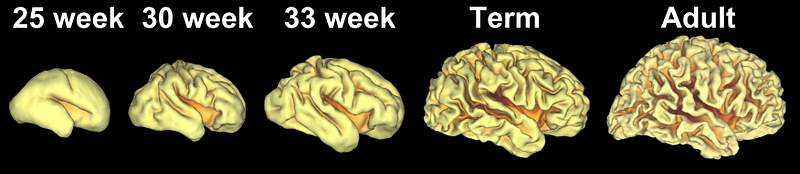
Interestingly, the brains of people with autism may have higher levels of gyri in their brains. This might suggest or explain brain hyper-connectivity in people on the spectrum.
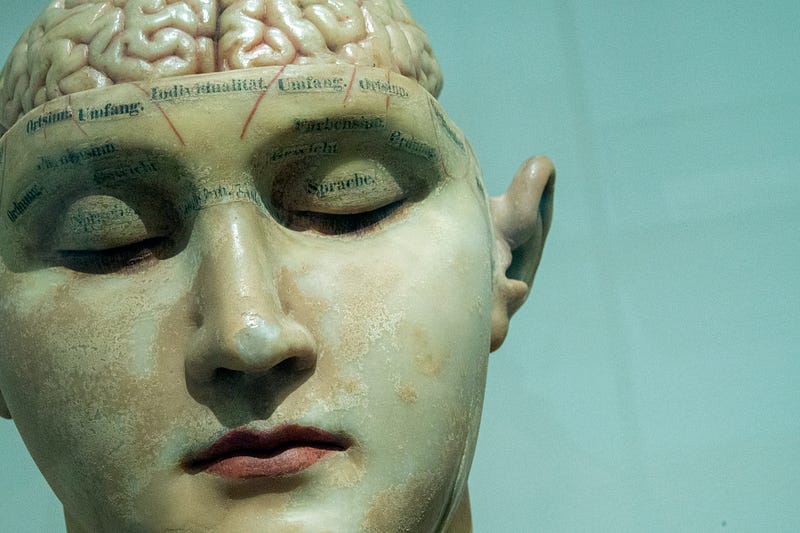
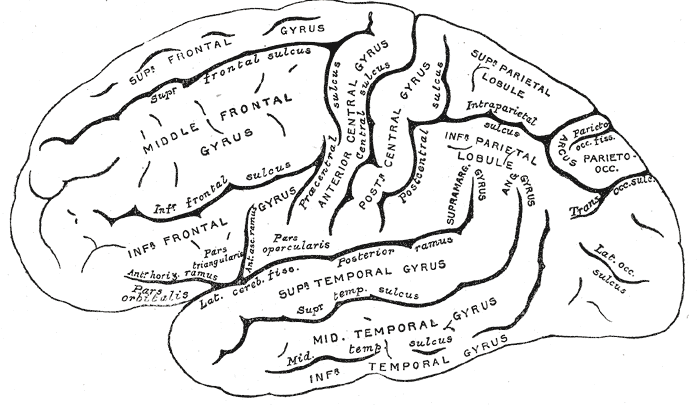
And since we’ve already shown two pictures, saving us the need to type two thousand words, why not save an additional thousand with this not-so-great drawing from a hundred years ago of the left brain, complete with labeled gyri.
Game mind
Even though I’m a child of the 1970s and 80s, there are times when I discover things from those decades that I knew nothing about. In this case, it happens to tie into my story about video arcades:
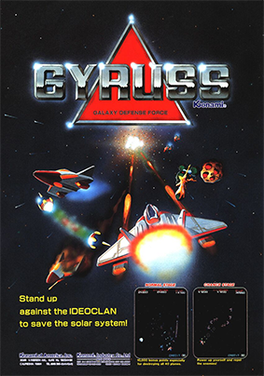
Yeah, that’s Gyruss with two s’s.
I remember a lot of shoot ’em-up video games from my yute, like Space Invanders, Galaga, and Tempest… but not this one. It was released in 1983 by Konami, the makers of one of my all-time favorite Nintendo games: Blades of Steel. Gyruss was designed by Yoshiki Okamoto, who later went on to produce Street Fighter II for Capcom.
The Arcade History website summarizes gameplay as follows:
Gyruss is a single-player shoot-em-up in which the purpose is to fly through the solar system, destroying waves of alien attackers, before finally reaching Earth. Planets that must be passed before Earth is reached are Neptune, Uranus, Saturn, Jupiter, and Mars. It only takes two warps to reach Neptune, but all of the others, including Earth, take three warps to get to. Each time the player reaches a planet, they will be faced with a ‘Chance Stage’, a bonus stage in which players try to destroy as many aliens as possible to accrue points. After reaching Earth, there is a Chance Stage, followed by a very fast ‘3 Warps to Neptune’ stage. After this, the levels and the background music start over.
According to the authors, the player’s rotating ship that fires inwards was influenced by Atari’s 1981-released Tempest, while the alien ships are reminiscent of the ones created for Galaga, which also came out in ‘81.
In the video below you can see how the game is played. And if the soundtrack rings a bell, that’s because it’s a synthesizer version of Johann Sebastian Bach’s Tocatta and Fugue in D Minor.
It seems clear that the game’s name may have come from the fact that the spaceship gyrates around the screen. The only question left to answer is whether the plural form of Gyruss is gyrii, with two i’s.
Now you know. Next time someone offers you the chance to play a game of Gyruss, you can explain to them how you’re going to use your gyri to do it. Don’t be surprised if they give you a nasty look. Not because you’re being pedantic… but because the editors of the Spelling Bee decided that gyri is a dord*.
You can check out my previous entry on another dord* here:
*What the heck is a dord, you ask? Here’s the answer: