
Bobeche
Clowning around on a Sunday afternoon

Today’s New York Times Spelling Bee letters:
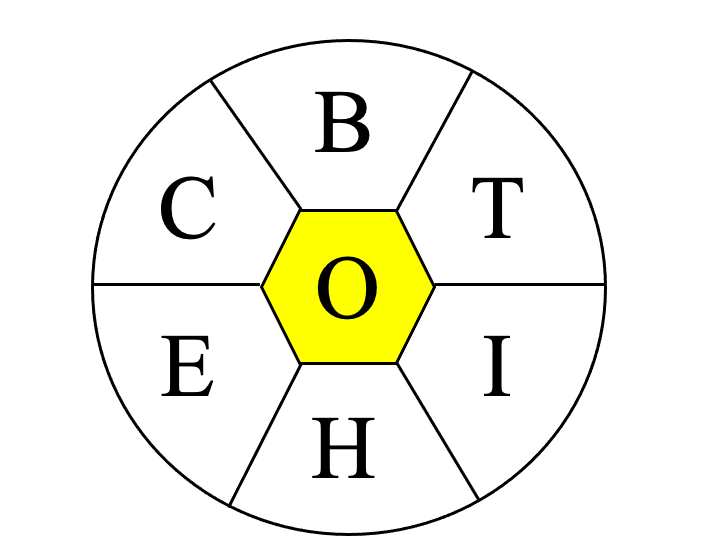
B, C, E, H, I, T, and center O (all words must include O)
Merriam-Webster says…
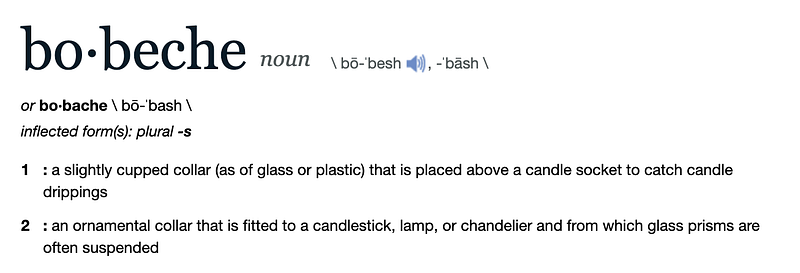
Silly little dictionary! Don’t you know that bobeche can’t possibly be a word if The New York Times says it ain’t?
For a complete list of rejected words, check out the Spelling Bee Master.
What’s your favorite dord* from today’s puzzle?
My Two Cents
No offense to the hard-working people in that profession, but I never understood the appeal of clowns. It’s not that I was afraid of them as a kid. I mean, if you put creepy makeup on someone, they’re gonna look scary no matter what character they portray. So yes, killer clowns are obviously something you don’t want to run into in real life:

But clowns wearing standard makeup and performing slapstick antics just never cut it for me in the humor department. I was ––and still am–– mostly indifferent to this type of comedy.
Unless you’re French, you may be wondering why I’m talking about clowns if today’s daily dord* is defined as “a slightly cupped collar (as of glass or plastic) that is placed above a candle socket to catch candle drippings”. Well, the only answer I can give you for now is… read on!
Sticking it to the candle
Our friends at Merriam-Webster tell us the bobeche was borrowed from the French bobèche, which means… bobeche. At least that’s what Word Reference confirms:

Oh, and also a “collar for catching wax”. Sorry. My bad. Of course, when you add the accent and French pronunciation, saying “Hey, pass me that bobeche” sounds much fancier than “Gimme that wax collar!” (By the way, in English the word is pronounced boh-BESH.)
Bobeches are usually made out of glass, if meant to be reused, or out of paper or cardboard if you’re too lazy to scrape of wax and just want to throw it away. Also, whatever material the bobeche below is made out of.
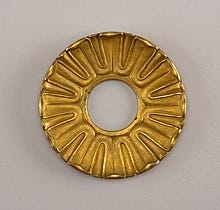
The second dictionary definition mentions an “ornamental collar that is fitted to a candlestick, lamp, or chandelier and from which glass prisms are often suspended”. Like this one below.
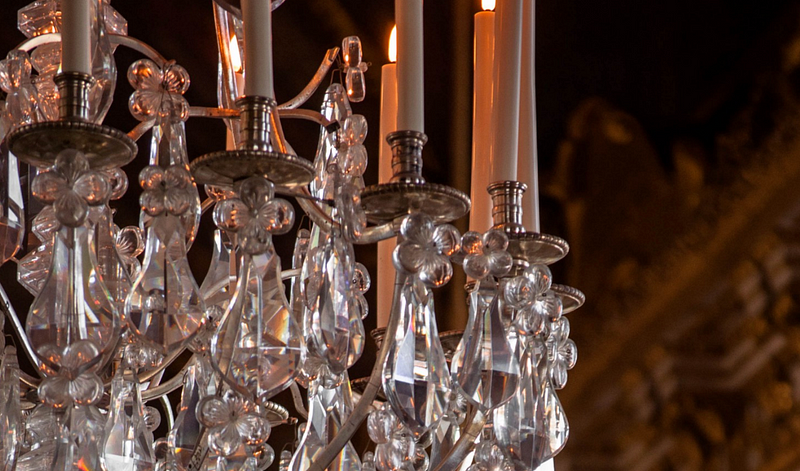
Many candlesticks come with flared parts at the top that serve as bobeches. These are sometimes known as… drumroll… bobeche candlesticks. Shocking, I know!
Those old-timey pans with handles used to carry candles in old-timey castles without any electric lights are known as chambersticks. Surely you’ve seen them in old-timey movies. In these candle holders, the pan acts as a bobeche.
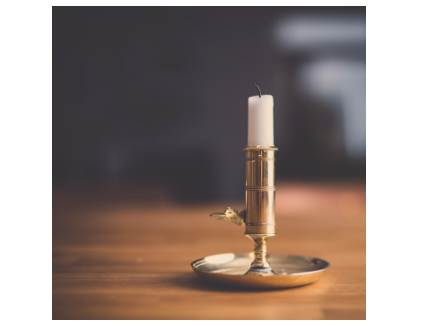
In an article written for AC Silver, Louise Snowden explains the following about chambersticks as opposed to regular candlesticks:
Other features of the chamberstick are a central socket to hold the candle, a sconce which can sometimes be removed, and a handle to the side. Some examples even feature a snuffer. The name is directly related to the purpose of the item, as chambersticks were mainly used for escorting one to and around their chambers without getting wax everywhere… Chambersticks were typically kept by the entrance hall so they could be used by any family member that was looking to retire for the evening. In the morning, chamber maids collected the chambersticks, cleaned them, and returned them for use again…The type of wax used in chamberstick candles was tallow, as opposed to the beeswax that was used for most candles in the home. Beeswax burns 3 times brighter than tallow, which made them useful for lighting entire rooms, as candlesticks were generally placed near mirrors in order to maximise the light achieved. Since the chambersticks were only used to light the darkness from room to room, and then used to light the candlesticks in the room, it would have been wasteful for them to be made of the same wax as most candlesticks.
You can read more about candlesticks and chambersticks in Snowden’s article, linked below. Just promise to come back to us and finish scrolling down so we can earn our daily 13 cents.
Le clown
It turns out that in the early 1800s France had a Bobèche with a capital B.
Bobèche the clown was born Antoine Mandelard in 1791 in Paris, the son of Jean Baptiste Mandelard, an upholsterer and Madeleine Dubé, his wife… and not an upholsterer. At a young age he was improvising comedy sketches with his close friend Auguste Guérin, to the delight of their friends and coworkers. A street acrobat apparently got wind of their routines and recruited them to become part of the troupe performing at the Boulevard du Temple.
This Parisian thoroughfare had its height of popularity for almost 50 years beginning with the reign of Louis XVI until the 1830s. It became a sort of Broadway of Paris, with theaters and cafes opening or moving there. Eventually it became known as the Boulevard du Crime. Not because people were being mugged on a regular basis, but because of the many crime melodramas featured in its theaters.
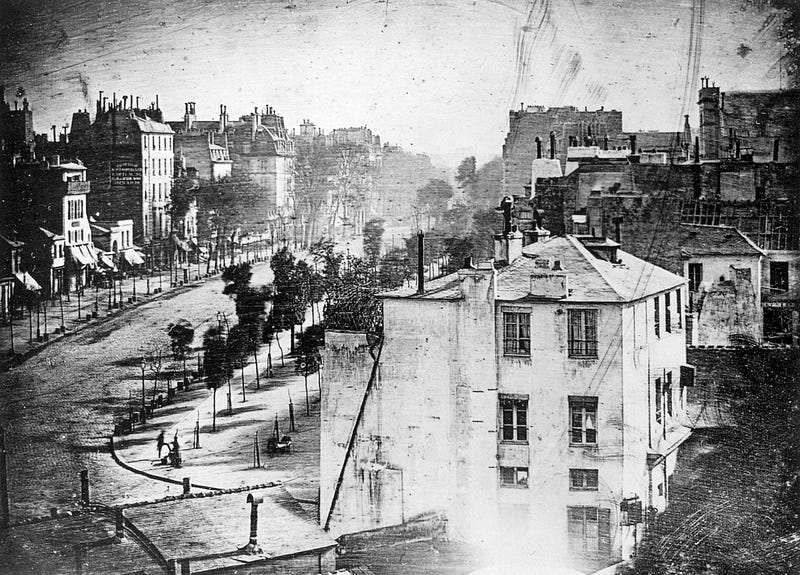
In 1838 Louis Daguerre ––inventor in 1837 of the daguerrotype, an early form of photography–– took a picture of this street. That image is still preserved today, and is believed to be the earliest surviving photograph showing a person (seen below towards the lower left, near the curb).
Okay, back to our clowns. Antoine Mandelard took the stage name Bobèche, while his pal Guérin became known as Galimafré. Both became hugely popular amongst the frivolous Parisian crowd of the early 19th century.
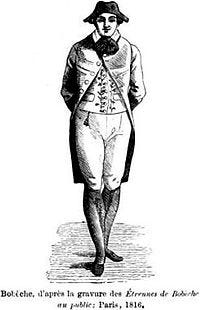
Bobèche was described a tall and gaunt, and his costume consisted of yellow breeches, patterned stockings, a red jacket, a yellowish wig, and a small horned hat adorned with a butterfly. Below is a sketch made in 1816, when he was in his mid-twenties.
Bobèche provided humor in troubled political times and became a surrogate for the freedom of press, expressing with his humorous antics what many wanted to say but couldn’t. He became one of the biggest celebrities of Paris, cherished not only by his regular crowd, but also by the greates event stagers of the time. Any party that wanted to be considered a great party would hire him to “spout his nonsense” with his friend Galimafré.
Apparently he ended up going to Bordeaux, where his popularity waned. Either that, or he was making wine. In any case, an interesting thing happened in 1837. The short-lived theater magazine Le Monde Dramatique published an article about Galimafré and Bobèche, claiming on page 15 that the former “ still exists today and is a stagehand at the Opera-Comique”, while the latter “died a long time ago and rests in the Père-Lachaise cemetery, where you can see his tomb with this inscription: Mardelard, aka Bobèche, king of the farce, inventor of red tails, died in action, sincerely regretted by his family, if he had any, and the many friends of French society”.
Several pages later, however, the magazine published a letter by Bobèche himself, basically stating he was very much alive. If you know enough French and are interested, you can read it starting on page 43 and ending on page 45.
It’s likely Bobèche was still alive in 1837. However, his friend Galimafré later claimed not to have heard from him after 1840 or 1841.
Now you know. Next time the power goes out at home and you need to light a candle, ask your family or friends to go find that bobeche you keep in the kitchen drawer for such occasions. They probably won’t be able to find it, though. Not because it’s pitch dark… but because the editors of the Spelling Bee decided that bobeche is a dord*.
You can check out my previous entry on another dord* here:
*What the heck is a dord, you ask? Here’s the answer: