
Gun control does not reduce gun murder rates
In my first post, I showed that high gun ownership states are no more violent than low gun ownership ones. You might still wonder why we shouldn’t just ban all guns to stop all shootings.
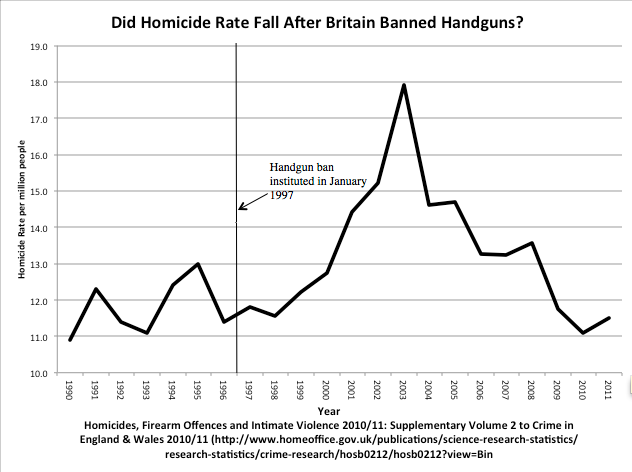
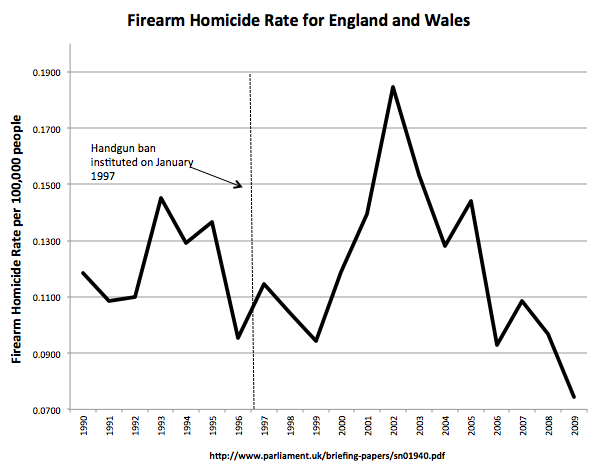
Just as making drugs illegal doesn’t eliminate drug use, making guns illegal doesn’t seem to eliminate murder. Australia, Ireland, and the UK have all tried gun bans. In the UK, the ban was followed by an increase in murders:
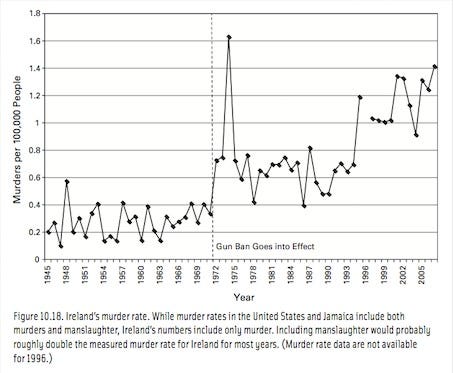
In Ireland, murder also went up:
And in Australia, murder remained roughly flat for the next 15 years:
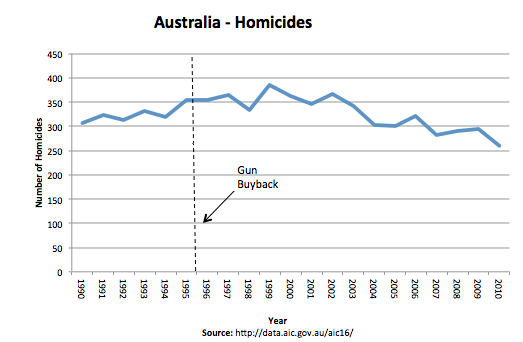
These graphs were created by CPRC and John Lott. You can go straight to the UK and Australian government numbers if you prefer, all these claims are true.
Evaluating why gun bans failed would be more complicated. Perhaps too many guns remain in circulation. Perhaps the Australians most likely to sell their guns back to the government weren’t the most likely to murder with them. Perhaps criminals are willing to buy guns illegally.
Those were all fairly peaceful countries with small gun problems. Jamaica is a much more violent country, they attempted a gun ban and also saw an increase in murders.
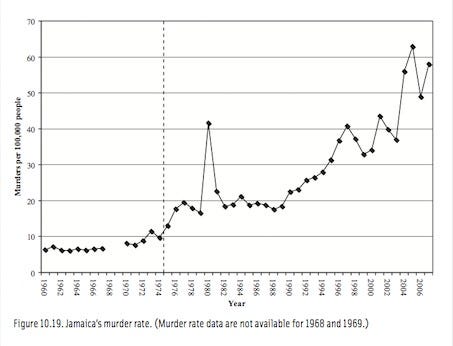
It’s possible the US could respond differently to gun laws, but there isn’t an obvious precedent to show that they’ve worked in other countries.
CPRC has made scatter plots of gun ownership and murder rates in developed countries. Just as I showed with US states, higher gun ownership doesn’t lead to more gun murders:
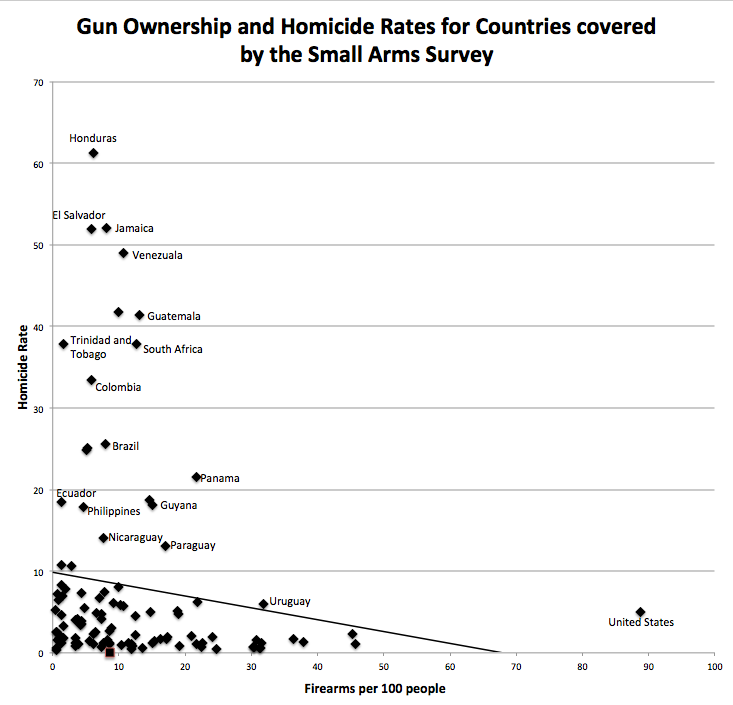
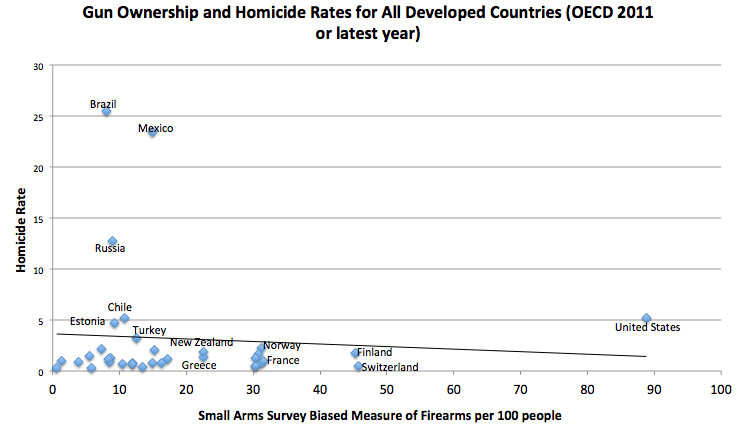
The data here is a little bit inaccurate, because the small arms survey data reflects private gun ownership and does not include military guns held in private houses. People in Switzerland and Israel both have higher access to guns than this data would suggest, and neither country has a large problem with gun violence.
The US is an outlier, among the developed world, both in high gun ownership rates and also higher murder rates. As I discussed in my first post, the high murder rates may not be related to the high gun ownership. Even the non-gun murder rate in the US exceeds the total murder rate in many other developed countries. Other factors like poverty, education, and racial inequality may explain the difference better than gun ownership does.
Murder is uneven across states, but even more concentrated in specific urban areas, it is associated with poverty and gang violence.
Mass shootings follow different patterns as average shootings — they’re rarer, so it’s harder to study demographics and patterns in them. People often claim that the US is the only country with a mass shooting problem. That’s not statistically true, the rates of death, or frequency of shootings, are similar or higher in some other places.
I haven’t vetted their numbers, here, I worry that CPRC might be cherry picking time windows or the definition of mass shooting in such a way as to support their argument. At the very least, it’s fair to say that people flip out and mass murder in many countries, it’s not a uniquely American problem.
Mass shootings are terrifying, and it seems reasonable to me to pass some common sense laws to make it harder for one person to amass an arsenal of 50 semi-automatic weapons. That said, I’m not certain such laws would prevent a motivated person from becoming a mass murderer. I am certain that a ban specific to semi-automatic weapons would do little to reduce the overall rate of murder in America. To reduce the murder rate, it might be better to stop and think hard about how to improve life for various groups in America. 538 did some good work reporting on the specific issues, thinking about how we might reduce gun violence among gang members, suicide among middle-aged white men, or domestic violence against women. Gun nuts say some ridiculous things, at times. Sean Hannity thinks he could have stopped the Vegas shooter if only he’d been there with his concealed pistol:
Instead of focusing on the most ridiculous political arguments, it’s often better to look at detailed research. CPRC makes a good statistical case that gun control is not a simple solution to violence in America.


