avatarAvi Kotzer

Free AI web copilot to create summaries, insights and extended knowledge, download it at here

4690

Abstract

0/1*jFax3XhfV9mam-k4kI_NSQ.png"><figcaption>A paragraph is summarized into one sentence</figcaption></figure><p id="2e04">Another use of text summarization is to present a user with a auto summarized dialog, with a <i>read more </i>option, which can then expand into the longer un-summarized version.</p><figure id="82f1"><img src="https://cdn-images-1.readmedium.com/v2/resize:fit:800/1*mlG74R9ZBY7NQcvQ2C8dMw.png"><figcaption></figcaption></figure><h2 id="58c0">Keywords</h2><p id="4f31">Keywords can be extracted from a block of text. You can configure the environment to be conservative and select only keywords from the text. Or a higher <i>temperature </i>can be set to where related words or keywords are generated.</p><figure id="286e"><img src="https://cdn-images-1.readmedium.com/v2/resize:fit:800/1*FGE3OBMcMyDDcpgKRQb9AQ.png"><figcaption>Key words generated from a Wikipedia paragraph.</figcaption></figure><p id="3a5c">This is very helpful to categorize text and create a search index. In the image above a extract on soccer was taken from Wikipedia. GPT-3 converted this quite large paragraph into six key words or themes.</p><figure id="93e7"><img src="https://cdn-images-1.readmedium.com/v2/resize:fit:800/1*mlG74R9ZBY7NQcvQ2C8dMw.png"><figcaption></figcaption></figure><h2 id="e562">Parse Unstructured Data</h2><p id="3191">Create tables from long form text by specifying a structure and supplying some examples.</p><figure id="6942"><img src="https://cdn-images-1.readmedium.com/v2/resize:fit:800/1*X9YWrg_wlpg3hbKCmoq62A.png"><figcaption></figcaption></figure><p id="6984">Here you can see the first entry is directly related to the sentence. The subsequent entries are somehow related and still relevant and applicable.</p><figure id="90e7"><img src="https://cdn-images-1.readmedium.com/v2/resize:fit:800/1*mlG74R9ZBY7NQcvQ2C8dMw.png"><figcaption></figcaption></figure><h2 id="7585">Classification</h2><p id="72fe">Classify items into categories via example inputs. Companies are named with categories defined. A new company can be mentioned and auto classified.</p><figure id="2265"><img src="https://cdn-images-1.readmedium.com/v2/resize:fit:800/1*IOkqXlAV2ZCxFpMNaeL2XA.png"><figcaption>With limited training data a new company can be mentioned and auto classified.</figcaption></figure><figure id="9feb"><img src="https://cdn-images-1.readmedium.com/v2/resize:fit:800/1*mlG74R9ZBY7NQcvQ2C8dMw.png"><figcaption></figcaption></figure><h2 id="281c">Extract Contact Information</h2><p id="0f31">Extract contact information from a block of text. In this case, an address.</p><figure id="8a87"><img src="https://cdn-images-1.readmedium.com/v2/resize:fit:800/1*5imfXfm2gvrGbA1uRTOkiQ.png"><figcaption>A complete address from the free text message.</figcaption></figure><figure id="ea15"><img src="https://cdn-images-1.readmedium.com/v2/resize:fit:800/1*mlG74R9ZBY7NQcvQ2C8dMw.png"><figcaption></figcaption></figure><h2 id="95b2">Summarize For A Second Grader</h2><p id="9a5d">This functionality takes a complex and relatively long piece, summarize and simplifies it into a sentence or two.</p><figure id="0da8"><img src="https://cdn-images-1.readmedium.com/v2/resize:fit:800/1*ReUEmdf0XZ3r54rcYqibfA.png"><figcaption>A large and complex piece of text is summarized and simplified.</figcaption></figure><figure id="d85e"><img src="https://cdn-images-1.readmedium.com/v2/resize:fit:800/1*mlG74R9ZBY7NQcvQ2C8dMw.png"><figcaption></figcaption></figure><h1 id="e7ec">Conclusion</h1><p id="3c79">There are definitely good implementation opportunities for the Conversational AI aspect of GPT-3.</p><figure id="6f46"><img src="https://cdn-images-1.readmedium.com/v2/resize:fit:800/1*5m48Qw7hRcbi7gsL5ZoRAQ.png"><figcaption>Restaurant review is created from a few key words and the restaurant name.</figcaption></figure><p id="2f01">As a support API where text can be processed to assist existing NLU functionality, there is a very real use case.</p><p id="25d7">As mentioned, GPT-3 can be a great help in pre-processing user input as a help for the NLU engine. The challenge is that GPT-3 seems very well positioned to write reviews, compile questions and have a general conversation. This could lead to a proliferation of bots writing reviews, online adds and general copywriting tasks.</p><figure id="b3c1"><img src="https://cdn-images-1.readmedium.com/v2/resize:fit:800/1*26A6H7nHUvLW10CkKSlaCQ.png"><figcaption>An apple pie review based on four generic words.</figcaption></figure><p id="4fae">This automation does not need to be malicious in principle. Open AI is seemingly making every effort to ensure the responsible use of the API’s.</p><p id="99a2">The fact the extensive

Options

training is not required, and a few key words or phrases can <i>point </i>the API in the right direction, is astounding.</p><p id="a28c">There are however opensource alternatives for most of the functionality available.</p><figure id="04a8"><img src="https://cdn-images-1.readmedium.com/v2/resize:fit:800/1*mlG74R9ZBY7NQcvQ2C8dMw.png"><figcaption></figcaption></figure><h2 id="3cbc">Positives</h2><ul><li>GPT-3 has quite a bit of functionality which can serve to augment a current chatbot.</li><li>Dialog can be diversified with the NLG capability.</li><li>General chit-chat can easily be created.</li><li>Copywriting is made easy for slogans, headlines, reviews etc.</li><li>Text transformation</li><li>Text generation</li><li>Creating a general purpose bot to chat to.</li><li>With their underlying processing power and data, creating flexible Machine Learning stories should be a good fit.</li></ul><figure id="a4fc"><img src="https://cdn-images-1.readmedium.com/v2/resize:fit:800/1*mlG74R9ZBY7NQcvQ2C8dMw.png"><figcaption></figcaption></figure><h2 id="b03c">Not-so Positives</h2><ul><li>The API is cloud hosted</li><li>Cost</li><li>Social media bot content generation</li><li>Not a framework for sustainable chatbot scaling; <i>yet</i>.</li><li>Possible over and under steering with training data.</li></ul><figure id="bfc0"><img src="https://cdn-images-1.readmedium.com/v2/resize:fit:800/1*mlG74R9ZBY7NQcvQ2C8dMw.png"><figcaption></figcaption></figure><div id="9145" class="link-block"> <a href="https://cobusgreyling.me/thank-you-for-subscribing/"> <div> <div> <h2>Subscribe to my newsletter.</h2> <div><h3>NLP/NLU, Chatbots, Voice, Conversational UI/UX, CX Designer, Developer, Ubiquitous User Interfaces, Ambient…</h3></div> <div><p>cobusgreyling.me</p></div> </div> <div> <div style="background-image: url(https://miro.readmedium.com/v2/resize:fit:320/0*sxVx6IgC_6AZXIX-)"></div> </div> </div> </a> </div><div id="1141" class="link-block"> <a href="https://cobusgreyling.medium.com"> <div> <div> <h2>Cobus Greyling - Medium</h2> <div><h3>Read writing from Cobus Greyling on Medium. NLP/NLU, Chatbots, Voice, Conversational UI/UX, CX Designer, Developer…</h3></div> <div><p>cobusgreyling.medium.com</p></div> </div> <div> <div style="background-image: url(https://miro.readmedium.com/v2/resize:fit:320/0*e6KH9V073Egac4ua)"></div> </div> </div> </a> </div><div id="2e0e" class="link-block"> <a href="https://cobusgreyling.medium.com/gpt-3-conversational-ai-chatbots-3fb1cfb99942"> <div> <div> <h2>GPT-3: Conversational AI & Chatbots</h2> <div><h3>What Will The Impact Be On Chatbot Design & Development</h3></div> <div><p>cobusgreyling.medium.com</p></div> </div> <div> <div style="background-image: url(https://miro.readmedium.com/v2/resize:fit:320/1*VKDfysUcdNJtCEQwmxSE-w.jpeg)"></div> </div> </div> </a> </div><div id="59bc" class="link-block"> <a href="https://openai.com/"> <div> <div> <h2>OpenAI</h2> <div><h3>OpenAI is an AI research and deployment company. Our mission is to ensure that artificial general intelligence benefits…</h3></div> <div><p>openai.com</p></div> </div> <div> <div style="background-image: url(https://miro.readmedium.com/v2/resize:fit:320/0*SzqTQqBlnX8UOa8A)"></div> </div> </div> </a> </div><div id="47a1" class="link-block"> <a href="https://openai.com/blog/openai-api/"> <div> <div> <h2>OpenAI API</h2> <div><h3>We're releasing an API for accessing new AI models developed by OpenAI. Unlike most AI systems which are designed for…</h3></div> <div><p>openai.com</p></div> </div> <div> <div style="background-image: url(https://miro.readmedium.com/v2/resize:fit:320/0*iD7cRdNC9EDQkZQ2)"></div> </div> </div> </a> </div><figure id="f7c7"><img src="https://cdn-images-1.readmedium.com/v2/resize:fit:800/1*mlG74R9ZBY7NQcvQ2C8dMw.png"><figcaption></figcaption></figure></article></body>

Grig

The cricket, not the composer

Photo by Food Photographer phototastyfood.ru on Unsplash

Today’s New York Times Spelling Bee letters:
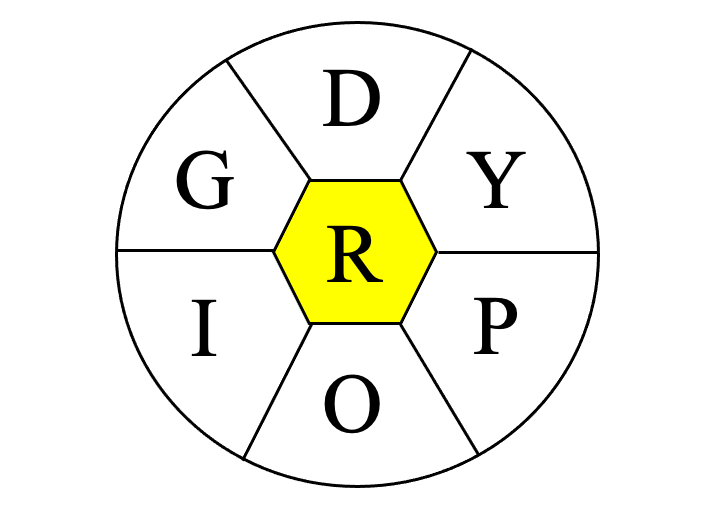
Art: Iva Reztok

D, G, I, O, P, Y, and center R (all words must include R)

Merriam-Webster says…
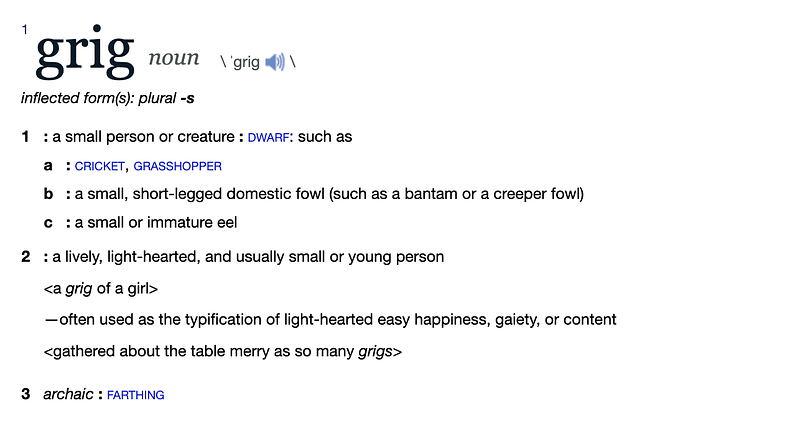
Credit: merriam-webster.com

Silly little dictionary! Don’t you know that grig can’t possibly be a word if The New York Times says it ain’t?

For a complete list of rejected words, check out the Spelling Bee Master.

What’s your favorite dord* from today’s puzzle?

My Two Cents

The rules of the Spelling Bee state that there is “No cussing, either, sorry”. I’m not sure if that refers to rejecting obscene terms or is meant to prohibit players from yelling out epithets when they can’t find any more words even though they haven’t reached the maximum level in the game.

“Obscure” words are not included either, although what is considered obscure is anyone’s guess when it comes to The New York Times editors. Here’s a blunt and clear example: Two days ago kaboom was rejected. Yes, kaboom, the onomatopoeia known by anyone who has glanced at a comic book over the course of their life. And yet this past Sunday the word phablet was accepted. I had to look it up in the dictionary, and even that wasn’t much help:
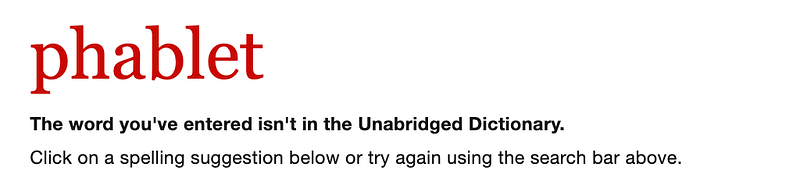
Credit: merriam-webster.com

When I googled phablet I discovered it was a mobile device that’s roughly between the size of a phone and a tablet. A nice portmanteau, to be sure, but one I wasn’t very aware of despite my own smartphone being very close in size to a phablet.

One assumes that there might be a large population of Spelling Bee players who also read the Times on a regular basis. Based on this speculation, grig should not have been rejected today… because just over three weeks ago the newspaper published an article mentioning them.

In case you can’t access it, the paragraph that mentions the insect in question says this (boldface words by yours truly):

They were left with a sputtering chirp reminiscent of squeaky gym shoes. The song hung around 4.7 kilohertz, a frequency slightly higher than the standard smoke alarm beep. This frequency is much lower than the noises emitted by hump-winged grigs, another modern Prophalangopsid found in the Rockies, which look like brawny crickets. When startled, grigs emit squeaks that soar into ultrasonic frequencies around 13 kilohertz to scare off predators.

So… what’s up with this double-standard, Times? I won’t hold my breath waiting for an answer.

Oh, you may be wondering why I used a picture of sushi at the top of today’s article. It’s one of the two results I got when I typed “grig” into Unsplash’s search function. My best guess is it’s connected to definition 1c in the dictionary: “a small or immature eel”.

Jiminy Grig!

Our friends at Merriam-Webster tell us that grig comes from the Middle English grege, which is not very helpful if you don’t know what grege means. Presumably a “small person or creature”, as per definition 1. Dictionary.com says the origin of grege is uncertain. So that’s that.

Grigs belong to the family Prophalangopsidae, of which there are many many many genera (plural of genus)… that no longer exist.
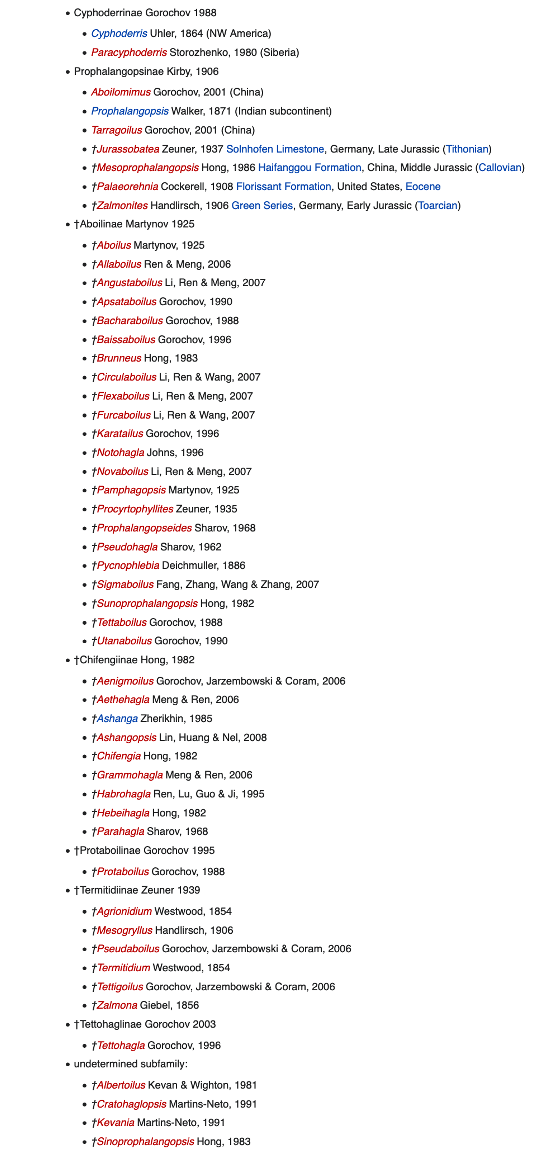
Depressing list of extinct species screenshotted by Iva Reztok

That one in blue at the top, Cyphoderris, is the genus mentioned in The New York Times article I discussed before. The three species are collectively called hump-winged grigs. The biggest one, Cyphoderris monstrosa —is known as the great grig.
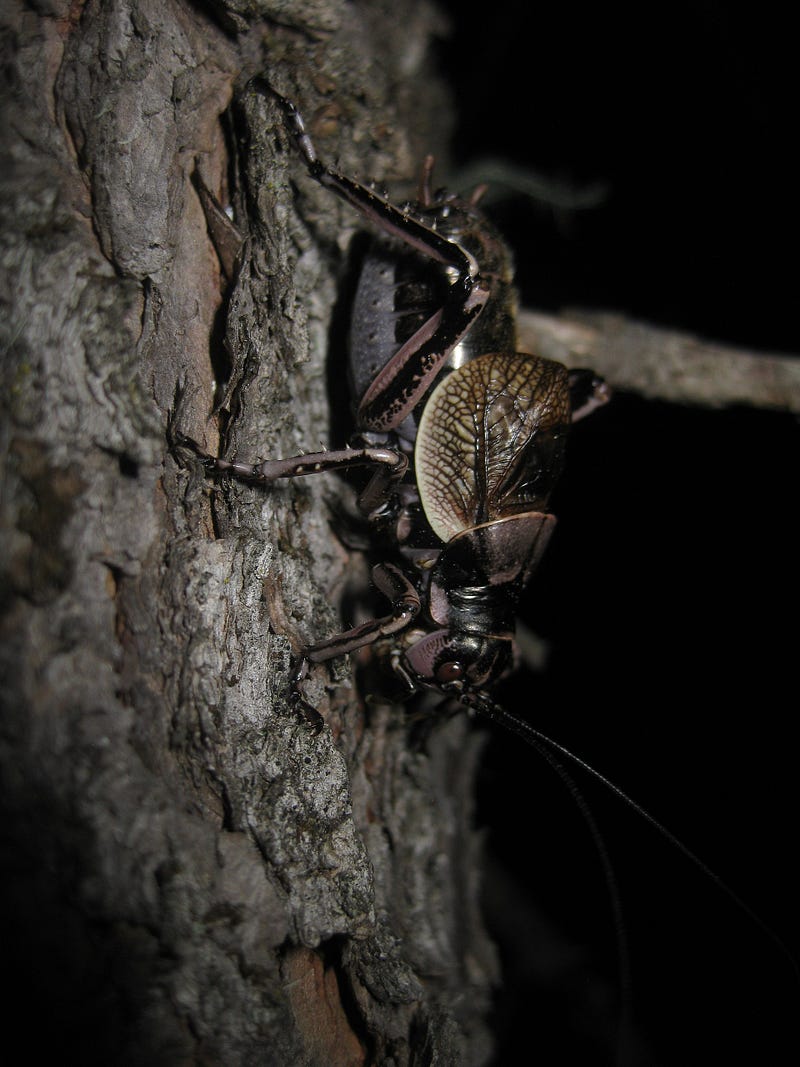
Photo by Kevinjudge

Yes, that’s a huge picture… but it is a great grig!

According to bugguide.net, this species is the largest of the three in North America (measuring about an inch or so in length, or 20–30 mm). The males are described as “dark gray dorsally, pale whitish ventrally, with short wings humped up and wrinkled like a loosely-folded blanked heaped on the insect’s back; male subgenital plate with a ventrally-directed process shaped like the nail-pulling claw of a hammer” with the female lacking wings or having only small stubs.

The great grig’s anti-predator mechanism consists of rapid ultrasonic frequency pulses produced via a structure called the Ander’s organ, about which you can read more here. I will include a photo used in the article taking into account the fair use doctrine. I’m using it fairly.
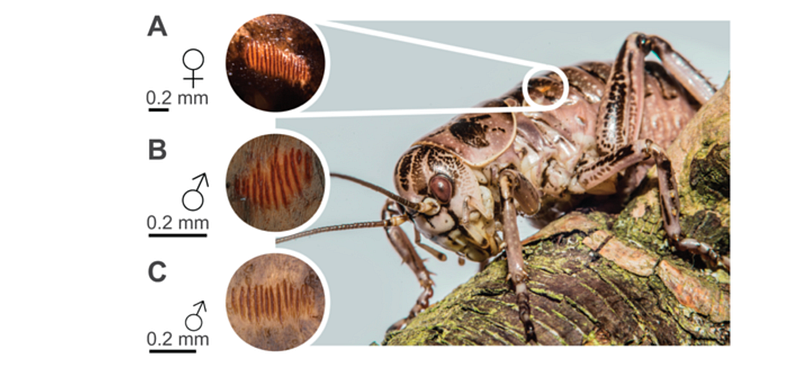
Location of the Ander’s organ of Cyphoderris monstrosa and examples of the stridulatory file. A) Adult female stridulatory file. B) Adult male stridulatory file. C) Juvenile male stridulatory file.

Since we are speaking of sounds, I will use that as a poor and feeble excuse to segue to…

Edvard Grieg

Edvard Hagerup Grieg the famed Norwegian composer and pianist, was born June 15th, 1843 and passed away on September 4th, 1907 (exactly 115 years ago in three days) at the age of 64. One of the top Romantic era composers, his use of Norwegian folk music in his compositions helped both his country develop a stronger national identity as well as spread the music of Norway across the world.

Peer Gynt, likely Grieg’s most famous and enduring work, was music he composed for Henrik Ibsen’s 1867 eponymous play based on a Norwegian fairy tale. The author himself requested the composer to write the music. (Although the play was published in 1867, Ibsen commissioned the score seven years later, and it premiered in 1876.)

Two pieces stand out in the collective unconscious of society. The first one, from Act IV of the play is called “Morning Mood” (Morgenstemning) and is very familiar to all of us who grew up watching Bugs Bunny and company…

The second piece, from Act II, has been brilliantly described as “the definition of procrastination, being relaxed in the beginning and in a total state of panic towards the end to somehow reach the deadline” by YouTube user No One.

“In the Hall of the Mountain King” (I Dovregubbens hall, in Norwegian) has attained iconic stature, being versioned from everyone from the Electric Light Orchestra to Trent Reznor and Atticus Ross (for the soundtrack of The Social Network).

Wikipedia sums up the composition as follows:

The piece is in the overall key of B minor. The simple theme begins slowly and quietly in the lowest registers of the orchestra, played first by the cellos, double basses, and bassoons. After being stated, the main theme is then very slightly modified with a few different ascending notes, but transposed up a perfect fifth (to the key of F-sharp major, the dominant key, but with flattened sixth) and played on different instruments. The two groups of instruments then move in and out of different octaves until they eventually “collide” with each other at the same pitch. The tempo gradually speeds up to a prestissimo finale, and the music itself becomes increasingly loud and frenetic.

Much better than words is, of course, the music itself. Here is one classically-played version, courtesy of the Oslo Philharmonic Orchestra:

Now you know. Next time you’re listening to a version of “In the Hall of the Mountain King”, you can smugly point out to your friends that what they’re hearing was composed by a man named Grieg, not an insect called grig.Don’t be surprised if your friends tell you to shut up. Not because they’re trying to enjoy the music… but because the editors of the Spelling Bee decided that grig is a dord*.

You can check out my previous entry on another dord* here:

*What the heck is a dord, you ask? Here’s the answer:

Spelling Bee
Language
Music
Edvard Grieg
Insects
Recommended from ReadMedium