avatarJoseph Serwach

Free AI web copilot to create summaries, insights and extended knowledge, download it at here

3564

Abstract

s overlapped.</li><li>Both were captured and put under house arrest by hard-line communists trying to maintain the old regimes (Walesa starting in 1981, Gorbachev in August 1991).</li><li>Both changed their nations and the world but were unable, ultimately, to maintain control of the forces they helped unleash.</li><li>Both won the Nobel Peace Prize, Walesa in 1983 and Gorbachev in 1990.</li><li>Both roll their eyes at their more nationalistic successors and today’s politics.</li><li>Both are far more liked and respected abroad than at home. Walesa, the anti communist, is accused of having been a communist collaborator while Gorbachev, the communist reformer, is disliked for losing the mighty Soviet Super Power that lasted from 1917–1991.</li></ul><h2 id="c883">Both came from peasant families, outsiders preceeded by and replaced by Establishment figures</h2><p id="d1e3">“Nearly half the population of my native village, <a href="https://en.wikipedia.org/wiki/Privolnoye,_Krasnogvardeysky_District,_Stavropol_Krai">Privolnoye</a>, starved to death, including two sisters and one brother of my father,’’ Gorbachev wrote of the 1933 famines caused by Soviet ruler Joseph Stalin.</p><p id="6e44">Now 87, Gorbachev recalls his father returning from World War II, which killed 20 million Soviets. They fought “until we ran out of fight… That’s how you must live,’’ his father taught him.</p><p id="128b">Walesa, now 76, was the rebellious electrician from a peasant family, one of eight children. Someone who kept butting heads with superiors, the perfect working class hero to reverse then break the great gears of communism.</p><figure id="55fd"><img src="https://cdn-images-1.readmedium.com/v2/resize:fit:800/1*mqRUkZ1zD_UaEFcn5TwL1Q.jpeg"><figcaption>Polish building with a mural of St. John Paul the Great, who inspired the Poles during his June 1979 return to Poland and Lech Walesa, who carried out the revolution during the August 1980 strikes that established Solidarity, growing the movement to more than 10 million within months. Photo by <a href="https://commons.wikimedia.org/wiki/User:Tsca">Tomasz Sienicki</a></figcaption></figure><p id="37a8">Walesa often explains he and the people of Poland were inspired by the June 1979 return to Poland of St. John Paul the Great, the first Polish pope who had millions chanting “We want God, We want God.’’</p><blockquote id="8200"><p>“The whole world was looking at Poland in amazement wondering what on earth was happening in this supposedly communist country,’’ Walesa recalls. “Fifty years of indoctrination and there they were were praying like nobody’s business.’’</p></blockquote><p id="3acd">Walesa now recalls: “Even the communist party members, the secret police, all were there. They even learned how to cross themselves. They didn’t know the proper wording but they did cross themselves… We obviously looked at them in amazement wondering what they were doing…</p><p id="9f26" type="7">“We realized that they couldn’t be true communists. They were like radishes: red on the outside and white on the inside… Solidarity followed a very simple strategy: If you have a burden you cannot lift, you ask other people to join and help you lift it.’’</p><p id="38c5"><b>A year after John Paul’s 1979 visit, </b>Walesa was instrumental in the Gdansk shipyard strikes, defying the communists and insisting they recognize Solidarity, their independent labor movement. They won but by the end of December 13, 1981 the communists roared back, declaring marshal law, imprisoning him.</p><p id="4e05"><b>Co

Options

nsidering Poland “the linchpin,’’</b> John Paul and Ronald Reagan fought back as detailed in the new film, <a href="https://www.thedivineplanmovie.com/">The Divine Plan</a>. Marshall law was lifted in 1983 and eventually, Solidarity and Walesa won the first free elections in the communist world on June 4, 1989. He would serve as president of Poland from December 1990 to December 1995, losing to a former communist. He’s been accused of collaborating with the communists.</p><p id="9fb1">Walesa recently <a href="https://notesfrompoland.com/2019/11/20/lech-walesa-wears-constitution-protest-t-shirt-for-white-house-meeting-with-mike-pence/?fbclid=IwAR32ez3rycrNs6mu_JpWUxkAWhUcNr8kpW1HU7I0RhfjuOMrnWte8IuFthU">visited Vice President Mike Pence at the White House </a>again wearing another “Constitution’’ T-shirt under his sport coat to try to poke at the ruling nationalist government he is at odds with. He did the same at Oakland University in Michigan and at the funeral of former President George H.W. Bush.</p><h2 id="6f09">Gorbachev: Who comes late in politics will be punished by life</h2><p id="8f7a"><b>“Americans thought they won the Cold War</b> and this went to their heads,’’ Gorbachev says of 21st century geopolitics in the new documentary <a href="https://www.amazon.com/Meeting-Gorbachev-Werner-Herzog/dp/6317823731">Meeting Gorbachev</a>. “What Victory? It was a joint victory. We all won.”</p><p id="b8f7">Gorbachev’s three predecessors, much older and colder remnants of the old guard, all died in office during the frostiest years of the Cold War between November 1982 and March 1985. Gorbachev was much younger, full of energy, the new generation, ready for change.</p><p id="16a6">“Everyone knew we had to do something,’’ Gorbachev recalls.</p><p id="92f9">The Chernobyl nuclear disaster hit the Soviet Union in April 1986. His Reykjavik summit with Ronald Reagan came soon after.</p><p id="d111">Today he describes his successor, Russian President Boris Yeltsin, the way today’s Establishment describes Donald Trump, remembering Yeltsin climbing onto a tank when Gorbachev was captured by communist hardliners.</p><p id="34c2">He calls “politicians like Yeltsin the reckless type… I probably should have acted differently towards him but I’m not that kind of person… I’m not vengeful… I should have sent him off somewhere…’’</p><p id="0808">His wife and inseparable partner Raisa Gorbachev, died of leukemia in 1999 and he has felt lost without her. Though she was a professed atheist, he recalls she kept telling him at the end: “For God’s sake, don’t leave me.’’ For the last ruler of the atheistic Soviet Union, he seems to reference God quite a bit.</p><p id="2339">Looking at the transformation of the world, Gorbachev adds:</p><p id="440c" type="7">“They started a fire and everything burned down… There was a power struggle… Forces didn’t want democracy.’’</p> <figure id="be38"> <div> <div> <img class="ratio" src="http://placehold.it/16x9"> <iframe class="" src="https://cdn.embedly.com/widgets/media.html?src=https%3A%2F%2Fwww.youtube.com%2Fembed%2Fc18V6Y3HL38%3Ffeature%3Doembed&amp;url=https%3A%2F%2Fwww.youtube.com%2Fwatch%3Fv%3Dc18V6Y3HL38&amp;image=https%3A%2F%2Fi.ytimg.com%2Fvi%2Fc18V6Y3HL38%2Fhqdefault.jpg&amp;key=a19fcc184b9711e1b4764040d3dc5c07&amp;type=text%2Fhtml&amp;schema=youtube" allowfullscreen="" frameborder="0" height="480" width="854"> </div> </div> </figure></iframe></div></div></figure></article></body>

The Last Cold Warriors

They sparked revolutions, winning Nobel Prizes, reshaping the post — communist world: “We Tried.”
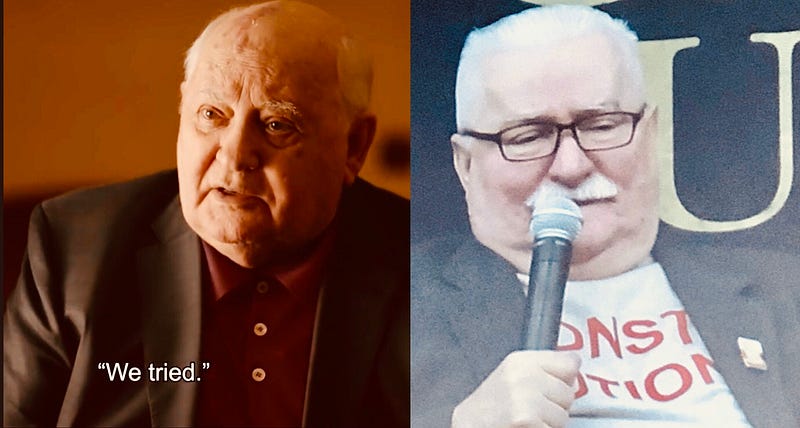
“We tried,’’ former Soviet leader Mikhail Gorbachev says in the new film “Meeting Gorbachev.’’ He now fears a new war. Lech Walesa, meanwhile, has been touring the United States, including a recent visit to Oakland University in Rochester, Michigan. Gorbachev photo is from “Meeting Gorbachev” promotions. Walesa photo by Joseph Serwach.

Revolutions invite counter-revolutions. Their peers are gone. Two shooting stars crashed as quickly as they rose but the economic, business and political changes they unleashed were so intense we still feel them today.

Three decades after the fall of the Berlin Wall, Mikhail Gorbachev, the last Soviet Union leader, and Lech Walesa, the first truly post-communist leader, are back making news abroad.

Gorbachev is worried about a new Cold War or a “Hot War.’’ The rapid changes of 1989 made him nervous then and make him nervous now. Today, it’s the United States trying to escape endless war in Afghanistan (then it was the Soviet Union trying to get out).

“We tried,’’ Gorbachev says of the 1980s events that remade the world, inviting a whole new set of problems. Both Gorbachev and Walesa are widely disliked in their own countries but welcome on the lecture circuit.

International borders collapsed because of their work. Recent polls show American Millennials know little about communism. But the 1989 revolutions and the then-new technology of the internet transformed today’s hyper-capitalist global market while splintering access to information.

“If I had had the kind of weapons that are available today back then, I would have won many wars,’’ Walesa says. “My aspiration is that when I go… that I don’t end up in hell… If I ended up there, (the old communists) would really torment me for bringing the system down.’’

It stings seeing them again. Both historic heroes once seemed larger than life, now much older, feeling left behind. Very human.
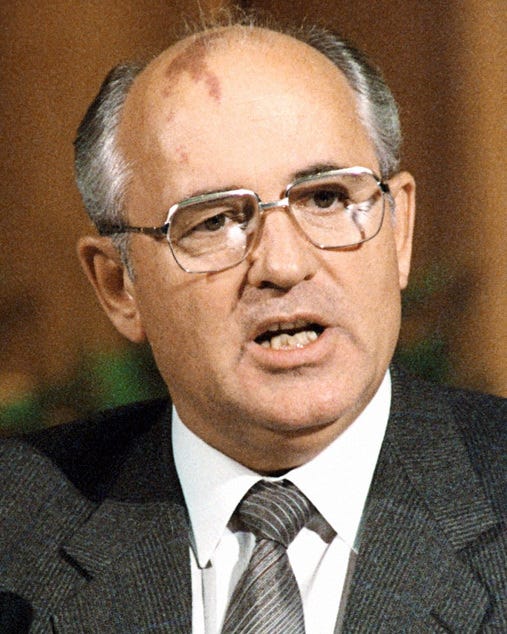
Gorbachev in 1986, one year after taking power and the same year as the Chernobyl nuclear disaster took place on Soviet soil. Just five years later, he was done and so was the Soviet Union. Photo by Yuryi Abramochkin via Wikimedia Commons.

Weakened, humbled humanity makes both seem more interesting — all these years later.

Gorbachev tried to save and reform communism, losing his party and his country along with his power. Walesa pushed the dominoes that toppled communism but he too, lost power and popularity with his own people.

The similarities are bizarre:

  • Gorbachev ran the Soviet Union for six years (1985–91). Walesa ran Poland for five years (1990–1995). Two of those years overlapped.
  • Both were captured and put under house arrest by hard-line communists trying to maintain the old regimes (Walesa starting in 1981, Gorbachev in August 1991).
  • Both changed their nations and the world but were unable, ultimately, to maintain control of the forces they helped unleash.
  • Both won the Nobel Peace Prize, Walesa in 1983 and Gorbachev in 1990.
  • Both roll their eyes at their more nationalistic successors and today’s politics.
  • Both are far more liked and respected abroad than at home. Walesa, the anti communist, is accused of having been a communist collaborator while Gorbachev, the communist reformer, is disliked for losing the mighty Soviet Super Power that lasted from 1917–1991.

Both came from peasant families, outsiders preceeded by and replaced by Establishment figures

“Nearly half the population of my native village, Privolnoye, starved to death, including two sisters and one brother of my father,’’ Gorbachev wrote of the 1933 famines caused by Soviet ruler Joseph Stalin.

Now 87, Gorbachev recalls his father returning from World War II, which killed 20 million Soviets. They fought “until we ran out of fight… That’s how you must live,’’ his father taught him.

Walesa, now 76, was the rebellious electrician from a peasant family, one of eight children. Someone who kept butting heads with superiors, the perfect working class hero to reverse then break the great gears of communism.
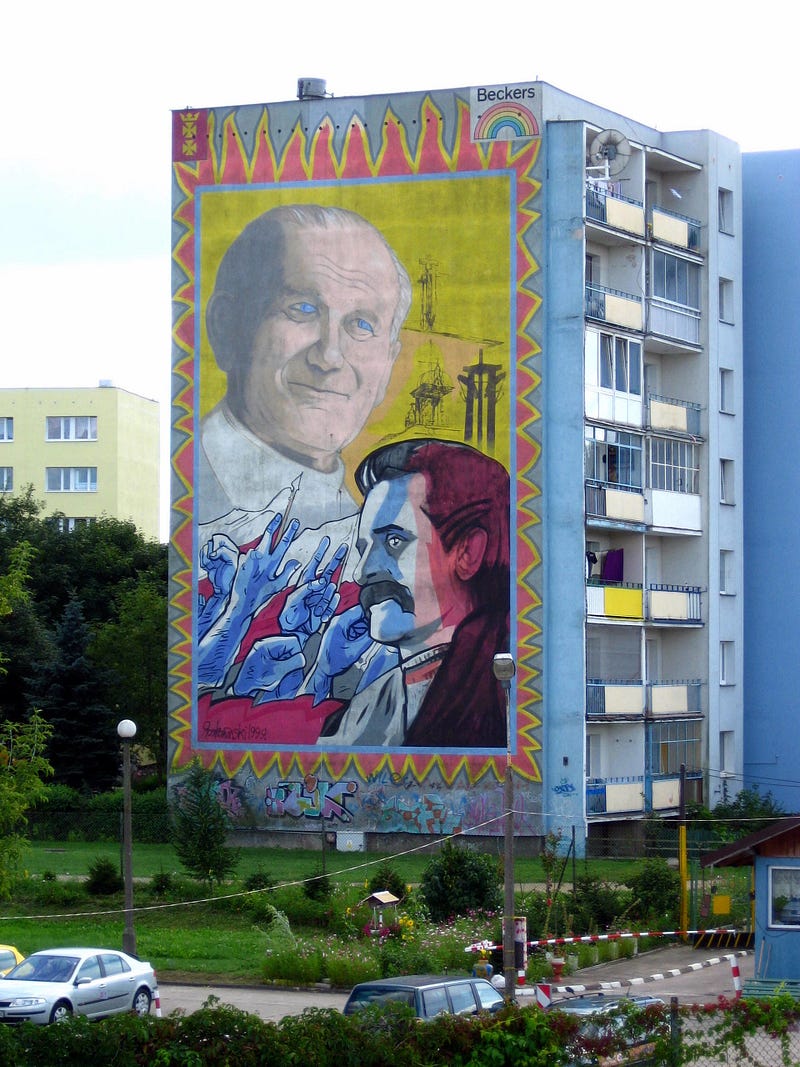
Polish building with a mural of St. John Paul the Great, who inspired the Poles during his June 1979 return to Poland and Lech Walesa, who carried out the revolution during the August 1980 strikes that established Solidarity, growing the movement to more than 10 million within months. Photo by Tomasz Sienicki

Walesa often explains he and the people of Poland were inspired by the June 1979 return to Poland of St. John Paul the Great, the first Polish pope who had millions chanting “We want God, We want God.’’

“The whole world was looking at Poland in amazement wondering what on earth was happening in this supposedly communist country,’’ Walesa recalls. “Fifty years of indoctrination and there they were were praying like nobody’s business.’’

Walesa now recalls: “Even the communist party members, the secret police, all were there. They even learned how to cross themselves. They didn’t know the proper wording but they did cross themselves… We obviously looked at them in amazement wondering what they were doing…

“We realized that they couldn’t be true communists. They were like radishes: red on the outside and white on the inside… Solidarity followed a very simple strategy: If you have a burden you cannot lift, you ask other people to join and help you lift it.’’

A year after John Paul’s 1979 visit, Walesa was instrumental in the Gdansk shipyard strikes, defying the communists and insisting they recognize Solidarity, their independent labor movement. They won but by the end of December 13, 1981 the communists roared back, declaring marshal law, imprisoning him.

Considering Poland “the linchpin,’’ John Paul and Ronald Reagan fought back as detailed in the new film, The Divine Plan. Marshall law was lifted in 1983 and eventually, Solidarity and Walesa won the first free elections in the communist world on June 4, 1989. He would serve as president of Poland from December 1990 to December 1995, losing to a former communist. He’s been accused of collaborating with the communists.

Walesa recently visited Vice President Mike Pence at the White House again wearing another “Constitution’’ T-shirt under his sport coat to try to poke at the ruling nationalist government he is at odds with. He did the same at Oakland University in Michigan and at the funeral of former President George H.W. Bush.

Gorbachev: Who comes late in politics will be punished by life

“Americans thought they won the Cold War and this went to their heads,’’ Gorbachev says of 21st century geopolitics in the new documentary Meeting Gorbachev. “What Victory? It was a joint victory. We all won.”

Gorbachev’s three predecessors, much older and colder remnants of the old guard, all died in office during the frostiest years of the Cold War between November 1982 and March 1985. Gorbachev was much younger, full of energy, the new generation, ready for change.

“Everyone knew we had to do something,’’ Gorbachev recalls.

The Chernobyl nuclear disaster hit the Soviet Union in April 1986. His Reykjavik summit with Ronald Reagan came soon after.

Today he describes his successor, Russian President Boris Yeltsin, the way today’s Establishment describes Donald Trump, remembering Yeltsin climbing onto a tank when Gorbachev was captured by communist hardliners.

He calls “politicians like Yeltsin the reckless type… I probably should have acted differently towards him but I’m not that kind of person… I’m not vengeful… I should have sent him off somewhere…’’

His wife and inseparable partner Raisa Gorbachev, died of leukemia in 1999 and he has felt lost without her. Though she was a professed atheist, he recalls she kept telling him at the end: “For God’s sake, don’t leave me.’’ For the last ruler of the atheistic Soviet Union, he seems to reference God quite a bit.

Looking at the transformation of the world, Gorbachev adds:

“They started a fire and everything burned down… There was a power struggle… Forces didn’t want democracy.’’

Politics
History
Leadership
World
Inspiration
Recommended from ReadMedium