
Google’s AI Improving Diversity in the Fitting Room — Or Just a Wolf in Sheep’s clothing?
AI In The Fashion and Modeling Industry
Shopping in-store comes with a highly personalized experience, trying on clothes lets you know immediately if they are right for you, and if not, you can always ask for a different color or size.
Google believes this should also be the case for online shopping, and they have developed a solution.
“You should feel just as confident shopping for clothes online. So today we’re introducing two new features that bring this fitting room experience to you.” — Google, 2023.
The solution Google has provided can prove to improve inclusivity and diversity, however we will discuss how equally, this can be a little bit problematic.

The Tech
Google revealed earlier this year how it will be using AI to improve the online shopping experience through virtual try-ons, by using its latest AI technology “TryOnDiffusion”.
The technology analyzes a piece of clothing, and is then able to project the garment onto different human models, showing how it fits, drapes, and behaves on different body types, genders, skin colors, etc…
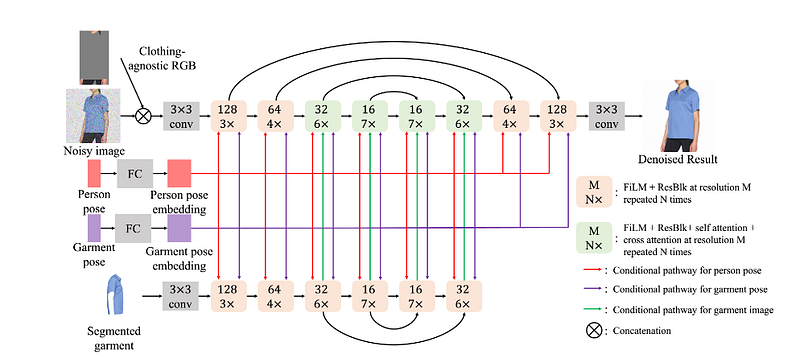
This way, online shoppers can select a model that looks like/resonates with them, so they can predict how the clothing will look on them.
Google believes this will lead to shoppers being more satisfied with their online purchases.
“Forty-two percent of online shoppers don’t feel represented by images of models, and fifty-nine percent feel dissatisfied with an item they shopped for online because it looked different on them than expected.
Now, thanks to our new virtual try-on tool on Search, you can see whether a piece is right for you before you buy it.” — Google, 2023.
How This Can Be Problematic
While this improves the shopping experience for underrepresented groups, Google’s new tech might not be the best way to serve these communities.
In my opinion, it is not the solution we need.
Through reading about the new technology, and the Tweet from Google shown above it seems like they are using a set amount of real-life models, and each model has one photoshoot which is then used to generate thousands of unique images.
This raises questions about how ethical this is due to the disruption in the modeling industry.
As AI is adopted in the fashion industry, and the “preset” model images are made, the demand for new human models will undoubtedly fall.
While at face value, using AI in this context seems to serve underrepresented groups, it hurts the people in the modeling and fashion industry from the same groups it was meant to serve.

The Takeaway
While Google’s new generative AI model “TryOnDiffusion” lets shoppers see what a piece of clothing that looks like on a model like them, improving inclusivity in online shopping, it potentially harms individuals from underrepresented groups in the modeling industry.
If you found this to be a good read, then definitely take a look at some of my other popular stories: