
Google attacks Snowflake with BigQuery Migration Assessment
How Snowflake Users can now easily switch to the Google Data Warehouse

Both, Google BigQuery and Snowflake offer modern and SaaS based Data Warehouse & Data Lakehouse solutions. Now, Google attacks Snowflake with BigQuery Migration Assessment.
Google has already tried to overcome barriers by offer customers a cloud independent SQL data analysis platform with BigLake.
Built on years of investment in BigQuery, BigLake is a storage engine that allows organizations to unify data warehouses and lakes, and enable them to perform uniform fine-grained access control, and accelerate query performance across multi-cloud storage and open formats. — Google [1]
So often, companies tend to use the Data Warehouse which is also built on the provider where their most cloud workflows lie. Hence, AWS users may use Amazon Redshift while Azure customers use Azure Synapse. Of course this makes sense, since you have integrated data integration capabilities and don’t need to build up a second landing-zone, security, network, etc. for a second cloud. Alternatively, you use Snowflake which is available for all the big cloud providers. So this is quite a big advantage for Snowflake.
With BigLake, Google offers you the access to Google internal storage as well as cross-platform data such as Microsoft Azure or AWS within BigQuery using SQL, very easy and without having to cache it. This is a great benefit that you do not have to duplicate your data in two separate environments and create data silos. You can also back-up your data governance because with BigLake, you can additionally assign rights to the data.
Now, Google goes even a step further and offers customers the BigQuery migration assessment which is now available for Snowflake in preview. You can use this feature to assess the complexity of migrating data from your Snowflake Data Warehouse to BigQuery[2].
This migration assessment lets you plan and review the migration of your existing Snowflake Data Warehouse into BigQuery. You can run the BigQuery migration assessment to create a report to assess the cost to store your data in BigQuery, to see how BigQuery can improvise your existing workload for cost savings in the best way possible, and to prepare a migration plan that outlines the time and effort required to complete your Data Warehouse migration to BigQuery[3].
Who now thinks — oh wow another cloud cost predictor tool which gives me inexact data and probably will of course tell me to switch to BigQuery can save tons of money — I can say Google actually provides here a bit more. They offer you a dwh-migration-dumper tool with which you can download data from your existing Data Warehouse, upload your metadata and query logs to your Cloud Storage bucket, run the migration assessment and review the Looker Studio report[3].
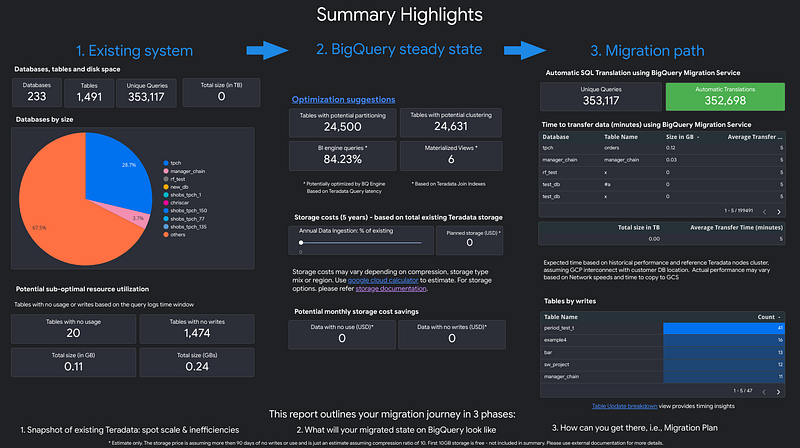
So while with BigLake, Google already offers a cloud independent analytics service to overcome cloud barriers. Now, they also provide an easy migration assessment to nudge customers into their Google Cloud. While BigLake is already a big advantage for BigQuery over Redshift and Azure Synapse, Google now also wants to aim at Snowflake. Snowflake’s advantage was always the ability of being hosted on different clouds. Google now offers the same possibilities with BigLake and with the Migration Assessment a good overlook whether a migration to BigQuery is also the right choice with respect to performance and costs.
Sources and Further Readings
[1] Google, BigLake (2023)
[2] Google, BigQuery release notes (2023)
[3] Google, Migration Assessment (2023)