
APPLE SILICON
Of Course Apple Is Ditching the iMac Pro
Less But Better
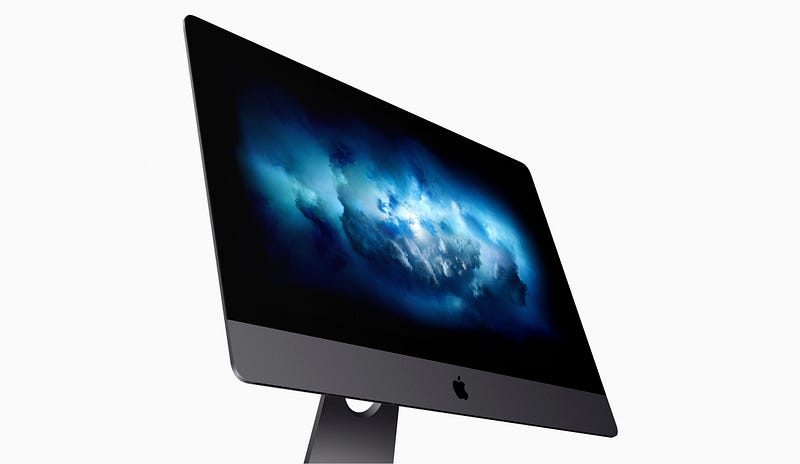
In what should come as a surprise to no one, Apple is discontinuing the iMac Pro, a computer predicated upon Intel’s fall from grace when it comes to CPU efficiency. A quick trip to Apple’s website confirms that the all-in-one, workstation-class, desktop Mac is only available in a single configuration, with a 3.0GHz 10-core Intel Xeon W processor, 32GB of memory, 1TB SSD, and the caveat “While supplies last”. Apple Insider’s reporting provides further information:
Previously, there were configuration options for 14-core and 18-core processors, Vega 64 graphics, up to 4TB of storage, and up to 256GB of memory.
The change does not apply to third-party resellers, who will have some stock of other configurations on hand.
While Apple hasn’t declared the model to be discontinued, the minimal choice of configuration and the “while supplies last” warning strongly point to Apple discontinuing the model. It is unknown whether a new version of the iMac Pro line will be available in the future or if it will be absorbed into the main iMac range in a future product line update.
The end-of-life for the iMac Pro is almost certainly a casualty of the Mac transition to Apple silicon.
Past is Prologue, Redux
In the decade leading up to last year’s launch of Apple silicon, there were numerous rumblings of Apple’s discontent with Intel. After processor shortages and Intel’s unwillingness to standardize chipset designs, the nail in the coffin may have been the poor quality of Skylake CPUs, as reported by Liam Tung for ZDNet:
“The quality assurance in Skylake was abnormally bad,” said Piednoël.
“We were getting way too much citing for little things, and basically Apple became the number-one filer of problems with the architecture. And that went really, really bad. When your customer starts finding almost as much bugs as you found yourself, you’re not leading into the right place.
“For me, this is the inflection point. This is where the Apple guys that were always contemplating to switch, they went and looked at it and said, ‘We’ve probably got to do it’.
But even more important than chip shortages and poor quality assurance was the fact that Intel processors had long since lost their power efficiency advantage. When Steve Jobs announced the switch to Intel at WWDC 2005, power efficiency was the stated reason for the transition:
When we look at Intel, they’ve got great performance, yes. But they’ve got something else that’s very important to us, just as important as performance is power consumption. And the way we look at it is performance per watt. For one watt of power, how much performance do you get? And when we look at the future roadmaps projected out mid-2006 and beyond, what we see is the Power PC gives us sort of 15 units of performance per watt but the Intel roadmap in the future gives us 70. And so this tells us what we have to do.
So Long Thermal Corners
Thanks to Craig Federighi’s comment “I think we designed ourselves into a bit of a thermal corner, if you will”, the 2013 Mac Pro is the Mac most associated with the thermal output constraints that go along with power consumption. But Apple has spent years struggling with the power needs of Intel CPUs across its entire line of laptop and desktop computers. What was once a major competitive advantage for Intel has become an Achilles heel.
Here are the maximum power consumption and thermal output listings for Intel-based desktop Macs from Apple support pages:
- Mac mini (2018): 122 W and 417 BTU/h.
- iMac (27-inch, 2020): 295W and 1007 BTU/h
- iMac Pro (2017): 370W and 1262 BTU/h
- Mac Pro (2019): 902 W and 3076 BTU/h
And here’s the listing for the M1 Mac mini:
- Mac mini (M1, 2020): 39W and 133 BTU/h.
When Apple announced the iMac Pro in 2017 as “the most powerful Mac ever”, with “Workstation-Class Performance in an iMac Design”, the key factor in the new design was its increased thermal output:
With next-generation processors, a stunning Retina 5K display, the most powerful graphics ever in a Mac, super-fast storage and advanced I/O, iMac Pro is designed to handle the most demanding pro workflows and is the first all-in-one built from the ground up to deliver true workstation-class performance. Featuring an all-new thermal architecture, iMac Pro delivers up to 80 percent more cooling capacity in the same amazingly quiet, thin and seamless aluminum and glass enclosure customers know and love.
With the arrival of Apple silicon, thermal output is no longer the dominant constraint in determining Mac form factor designs. And with the iMac soon to be freed from Intel-based thermals, there doesn’t seem to be a justification for two nearly identical all-in-one Macs.
Less But Better
Less But Better is, of course, the approach to product design made famous by Dieter Rams, and honed at Apple by Steve Jobs and Jony Ive. While some have complained that without Jobs’ direction, Ive focused on less at the expense of better, Apple seems to have fully embraced Rams’ philosophy with the rollout of Apple silicon.
As I wrote in All I Want For Christmas is an M2 Mac, before the release of the M1 Macs there were twenty-five different Intel CPU options available across the Mac product line. An approach that benefited Intel, but made no sense for Apple to replicate. With the launch of three Macs sharing the same M1 design, it seemed likely that the remaining Intel-only Macs would also share M-series designs. Here’s the lineup I came up with:
- M (low-performance): MacBook Air, 13-inch MacBook Pro, and Mac mini
- MR (medium-performance): 16-inch MacBook Pro, and iMac
- MS (high-performance): iMac Pro and Mac Pro
Since then, there have been rumors of a new ultra-portable MacBook, a 14-inch MacBook Pro and another new computer thought to be either a smaller Mac Pro or a larger Mac mini. I’ve been arguing in favor of it being a larger Mac mini, but with the discontinuing of the iMac Pro, perhaps this new computer will be a brand new model. Let’s call it the Mac midi. Sticking with my previous paradigm of three M-Series variants, the revised Mac lineup would be:
- M (low-performance): MacBook Air, 13-inch MacBook Pro, Mac mini, and MacBook
- MR (medium-performance): 14/16-inch MacBook Pro, iMac, and Mac midi
- MS (high-performance): Mac midi and Mac Pro
Listing these models by form factor:
Laptops
- Entry-level: MacBook Air (M)
- Mid-range: 13-inch MacBook Pro (M)
- Ultra-portable: MacBook (M)
- High-end: 14-inch MacBook Pro (MR)
- High-end: 16-inch MacBook Pro (MR)
Desktops
- Entry-level: Mac mini (M)
- Mid-range: iMac (MR)
- Mid-range to High-end: Mac midi (MR/MS)
- Flagship: Mac Pro (MS)
You probably noticed I didn’t include the processor generation when listing M-Series variants (e.g. M1). Assuming I’m correct, and Apple designs three SoC variants, it seems unlikely that every Mac model will be updated with each generation of Apple silicon. For example, the Mac Pro seems unlikely to ship with a first-generation M-Series SoC. A more plausible scenario is that the first Apple silicon Mac Pro ships with an M2S or M3S chip based on TSMC’s 3nm process.
Conclusion
My hypothetical Apple silicon Mac lineup is based on the latest rumors in the tech press with no additional inside information. It’s just what makes sense to me. Maybe I’ve made some correct guesses, or maybe I’m not even close. Either way, with the demise of the iMac Pro, and the likelihood of a March Apple event, I get the feeling the next wave of M-Series Macs will soon be upon us.
If you’d like to read a feel-good technology story, please take a look at Software Engineering a Better Life, a book that recounts the twenty-two month software startup that changed my life forever.


