
Apple Silicon
Get Ready for the Mac mini Pro
A high-end Mac mini makes more sense than a small Mac Pro.
These are exciting times for the Mac. The first Apple silicon chip, the M1, powers the new MacBook Air, 13-inch MacBook Pro, and Mac mini. With Apple acknowledging that this is just the start of a two-year transition for the Mac, the rumor mill has been in overdrive, with MacRumors providing a roundup the day after the M1 Macs were announced:
14-inch MacBook Pro: In July, reputable analyst Ming-Chi Kuo forecasted that new 14-inch and 16-inch MacBook Pro models with Apple Silicon and an all-new design will launch in the late second quarter or third quarter of 2021. Kuo has previously suggested that these notebooks may feature Mini-LED displays.
16-inch MacBook Pro: Earlier this month, Bloomberg’s Mark Gurman and Debby Wu reported that a new 16-inch MacBook Pro with Apple Silicon is in development, but the report did not provide a release timeframe. As mentioned above, analyst Ming-Chi Kuo expects a new 16-inch MacBook Pro with Apple Silicon and an all-new design to launch in the late second quarter or third quarter of 2021.
24-inch iMac: In June, reputable analyst Ming-Chi Kuo forecasted that Apple would launch a 24-inch iMac with an all-new design in the late fourth quarter of 2020 or early first quarter of 2021 at the earliest.
A smaller Mac Pro: Earlier this month, Bloomberg’s Mark Gurman and Debby Wu reported that Apple is developing a new Mac Pro that looks like the current design at about half the size. The report said it’s unclear if that Mac will replace the current Mac Pro or be released as an additional model.
Apple is Redesigning the 2019 Mac Pro?
The rumor that caught my eye is Bloomberg’s report that a new half-size Mac Pro is under development. It took Apple 2,182 days to deliver the 2019 Mac Pro and now, a year later, they’re either radically changing the design or adding a second model? Neither option makes much sense. Perhaps they’ve been forced to undergo a redesign with the switch to Apple silicon, but why would they add a low-end version of their high-end Mac?
Reasonably configured, the Mac Pro costs close to $20,000; go top-of-the-line and it’s over $60,000. A reasonably configured “Mac Pro mini” would likely still cost over $10,000. That’s a computer that’s too compromised for the high-end pro market, and too costly for the low-end pro market. How many of those is Apple going to sell? And unlike the existing Mac Pro, it doesn’t even function as a halo product.
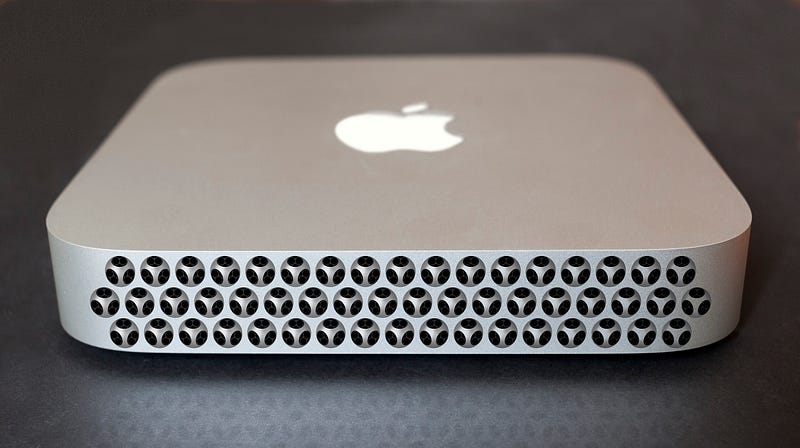
I see your Mac Pro mini and Raise You a Mac mini Pro
Instead of a “Mac Pro mini”, it would make much more sense for Apple to add a “Mac mini Pro” to their desktop lineup. To make the case for this product, let’s look at some of the maximum power consumption and thermal output listings for Intel-based Macs from Apple support pages:
- Mac mini (2018): 122 W and 417 BTU/h.
- iMac (27-inch, 2020): 295W and 1007 BTU/h
- iMac Pro (2017): 370W and 1262 BTU/h
- Mac Pro (2019): 902 W and 3076 BTU/h
Clearly, one thing that prevented Apple from making more powerful Mac minis was Intel’s failure to produce high-end processors that could operate within the thermal limitations of the Mac mini chassis. That technical hurdle has been removed with Apple silicon, which runs at 39 W and 133 BTU/h in the Mac mini. And that’s with TSMC’s current 5nm process. The forthcoming 3nm process will deliver insanely more powerful SoCs while operating with lower power and thermals. But until then, the rumored more powerful 5nm M-series SoCs should have plenty of headroom in the current Mac mini chassis.
Filling in the Gaps
The base Mac mini costs $699, while the base Mac Pro costs $5,999. The only stand-alone display Apple sells is the Pro Display XDR, starting at $4,999 (without a stand). There’s a huge hole in the “headless” Mac lineup where a Mac mini Pro would fit perfectly. Apple already sells a $200 memory upgrade for the Mac mini that is only marginally more powerful than the base configuration and yet is wildly popular (two months after release, delivery dates are still 25 days out). That’s evidence enough that there’s a market for more powerful Mac minis.
A Mac mini Pro starting at $1,999 for a 12 core model, and $2,999 for a 16 core model could easily be paired with a new $1,999 5K display. Maybe the only thing holding Apple back from releasing a $2k monitor is the lack of a mid-range headless computer that could help justify the development expense.
With a Mac mini Pro, everyone wins. Pros on a budget get a lot more power at prices that don’t break the bank and Apple rounds out its Mac lineup, adding a high margin computer (with minimal engineering and customer support expense) that will sell in much greater quantities than a compromised Mac Pro. Are you listening, Tim?


