
Good News Is Bad News For The 2021 Technology Stock Bear Market
5 reasons technology stocks have entered a new bear market

People are getting vaccinated, the economy is re-opening, and the world is hopefully getting back to normal soon. This should be great for stocks, right?
Not necessarily.
Although stocks, real estate, and cryptocurrencies have all benefited immeasurably from stimulus checks, QE to infinity, and interest rates locked near zero, true price discovery is currently next to impossible. Too many investors remain complacent — this is dangerous.
The problem is, as we continue getting more and more good economic news, lawmakers are going to become more and more reluctant to continue pandemic stimulus spending and the Federal Reserve is going to come under more and more pressure to slow down an overheating economy. Unfortunately, without continued stimulus and ultra-low interest rates remaining in place, technology stock prices are likely to crumble.
Today we are going to explore 5 ways good economic re-opening news could ultimately be bad news for technology stock prices in 2021 and why technology stocks have entered a new bear market.
- No more stimulus checks — no more cash to gamble
- Underlying asset performance still isn’t anchored to reality
- Old media is laughing at crypto, meme, and SPACS
- As the economy opens up, inflation pressures will increase
- As infection numbers drop, so will pandemic relief
1. No more stimulus checks — no more cash to gamble
For months and months, there has been speculation that people forced to stay at home due to the pandemic have released their boredom with stock market trading.
Even with a casual glance at social media, this theory appeared to be true. Day trading channels, swing-trading channels, and options trading channels ‘for beginners’ have proliferated all over YouTube and subscriptions have risen briskly. One time real estate investing YouTube channel, Meet Kevin, morphed into a stock-picking advice channel, then a stock/cryptocurrency channel, a live broadcast stock commentary channel, and now Kevin is using his hard found fame to run for Governor of California. Go, Kevin!
To back up the theory small and first-time investors have increased their stock market trading, we also now have more hard data. According to the New York Times —
Analysts at Deutsche Bank recently estimated that as much as $170 billion from the latest round of stimulus payments could flow into the stock market. They conducted a survey of retail traders in which respondents said they planned to put roughly 40 percent of any payment they received — or $2 of every $5 — into the stock market. Traders between the ages of 25 and 34 said they expected to put half of their stimulus check into stocks. — The New York Times
According to Goldman Sachs, small investor trading volume made up nearly a quarter of all stock market trades over the past year. This recent trading volume is far higher than the 1 in 10 stock trading activity small investors accounted for over the previous decade.
We’ve even seen a considerable uptick in the number of new business applications during the pandemic as well. Is this a sign of desperation, relieving boredom, or another example of increased risk appetite?
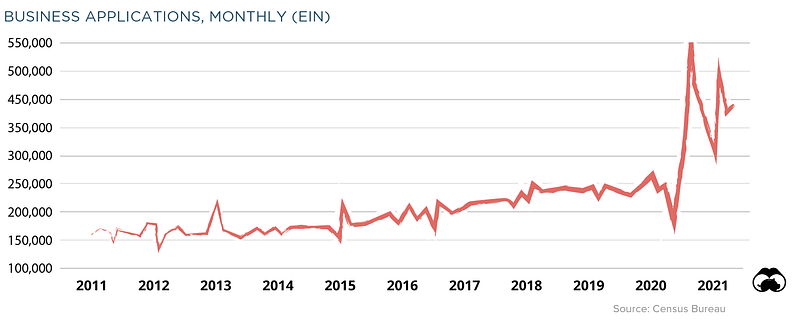
If there are no more stimulus checks to issue, there will no longer be fuel for the fire. Any more positive economic news will virtually guarantee the halting of future stimulus checks. This in turn will place even further downward pressure on recently high-flying technology stocks like Gamestop, cryptocurrencies like Bitcoin, and SPACs like Nikola and the bear market will continue.
2. Underlying asset performance still isn’t anchored to reality
Underlying asset performance largely remains unanchored to reality. Most technology stock prices still remain far ahead of fundamentals. There are many examples to look at but I’d like to single out one of my favourite notoriously difficult to value companies, Tesla.
Although down from nearly $900 a share, Tesla still trades over $600. Tesla bulls insist investors should be buying the dip, but should they really?
It seems like a lifetime ago but in the summer of 2018, Tesla was really struggling financially and Musk was so sick of short-sellers putting downward pressure on Tesla, Musk tweeted —
Am considering taking Tesla private at $420. Funding secured. — @elonmusk Aug 8, 2018
— a 20% premium to where the stock was currently trading. But that was $420 before the 5 to 1 stock split meaning Musk thought Tesla was fairly valued at $84 per share in the summer of 2018.
After claiming in a conference call that using a public offering to pay off debt was a stupid idea, by the Spring of 2020 Tesla share prices had appreciated so quickly, Musk changed his mind and decided to raise cash by issuing new shares. Shareholders loved the idea and bid the shares up sharply. Shares were issued at $767 per share in February 2020 — a 4.6% discount at the time. Post 5:1 split, those shares would have been issued at $154.40.
Prices just kept rising. By September, Tesla opted to issue another $5 billion of shares. Why not? Technology was in a complete bubble with everyone at home during the pandemic. The shares were issued September 1, 2020, and deals were settled by September 9, 2020 — shares closed at $366.28 (5:1 stock split completed August 31st).
On absolutely no other positive news, investors bid up shares to over $900 a share, post the 5:1 split for well over a 10x gain in only 18 months. Now that’s a Cinderella story!
Now that we’ve reviewed the numbers, I’d like to ask investors a serious question. If Musk (hypothetically) had an investor at $84 per share in the summer of 2018 to take the company private, then issued shares to the public at $154.40 and again at $366.28 — both prices Musk presumably thought were ridiculously high — is it reasonable for Tesla’s share price to be valued at nearly 3x the last public offering in only 4 months?
Economic re-opening news and fears of rising inflation have put considerable downward pressure on technology stocks. However, even after a considerable correction technology companies like Tesla, bid up to nosebleed highs during the pandemic, appear to have a long way to go before finding anything close to a fair market value.
More positive re-opening news and inflation fears will only add more downward pressure to technology stocks that are already in a bear market.
3. Old media is laughing at crypto, meme, and SPACS
Recently, Bloomberg Opinion columnist Barry Ritholtz gave his two cents on the recent pullback in crypto, meme stocks, and SPACS. According to Barry, no one should be surprised these high-flying investments have reversed their trend. With the economy re-opening, Barry thinks Robinhood day-traders are leaving their basements to do other things outside and spend money.
Although Barry thinks the pullback in crypto, meme stocks, and SPACs should have been obvious, he also (somewhat oddly) believes the S&P 500 trading near an all-time high is actually bullish. Barry’s thesis is, Robinhood day-traders will continue to leave their basements and spend a lot more money on S&P 500 company products.
Many analysts agree with Barry that there is still room in the rotation trade out of technology and into recovery stocks. If this theory is right, any more positive economic news will only add more downward pressure to technology stocks as money rotates out of technology stock names and into the broader economy.
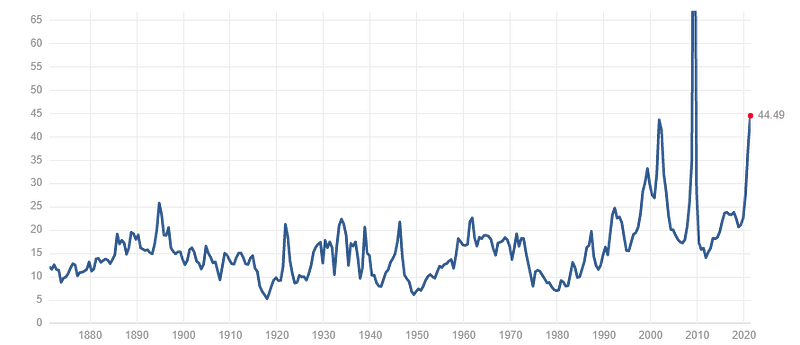
To be fair, there are many reputable economists like Robert Shiller who although uneasy about crypto, stock, and housing prices are also worried about a much wider range of stocks. According to Shiller’s S&P 500 PE Ratio, stocks are as overvalued as they were in 2000 and the ratio keeps rising.
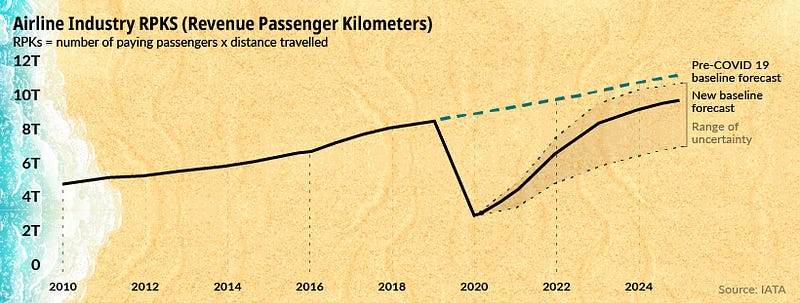
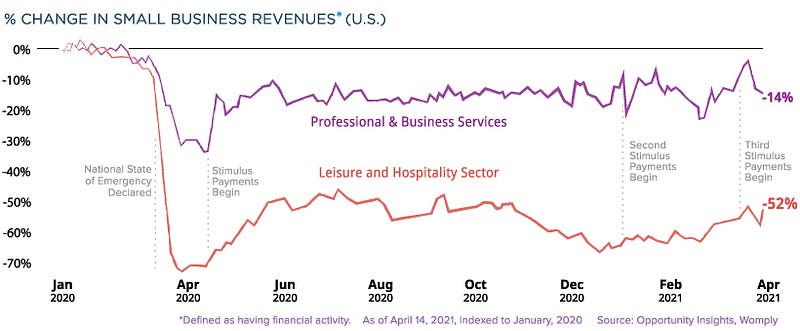
In fact, it’s very possible further positive economic news could put downward pressure on even recovery stocks like airlines. Airline stocks have rallied significantly. In fact, many airline stocks already trade near January 2020 levels. However, industry insiders tell us it may be years for airlines and the hospitality sector to get back to normal. The global airline industry expects losses to hit $47.7 billion in 2021. Ironically, many of these so-called recovery stocks are already priced so high they may also experience significant downward pressure as the economy continues to open and the bear market in technology stocks will continue.
4. As the economy opens up, inflation pressures will increase
You’ve probably already heard a lot about mounting inflationary pressures. In fact, if you’ve recently tried buying a car, or a house, or even went shopping at your local grocery store, you might have noticed prices rising. Inflation is no joke. Runaway inflation has caused some of the worst recessions in history.
If inflation takes off in a serious way due to the reopening of the economy, technology stocks will experience more downward pressure.
You might be wondering why central banks would even bother flirting with inflation if it is so bad for the economy and the stock market. The short answer is, the Federal Reserve has to keep running the economy hot to try to escape the current recession. If unemployment numbers remain too high when the Federal Reserve is forced to start tapering QE or raising interest rates to cool the economy, the economy could easily slip back into recession and a bear market could be triggered.
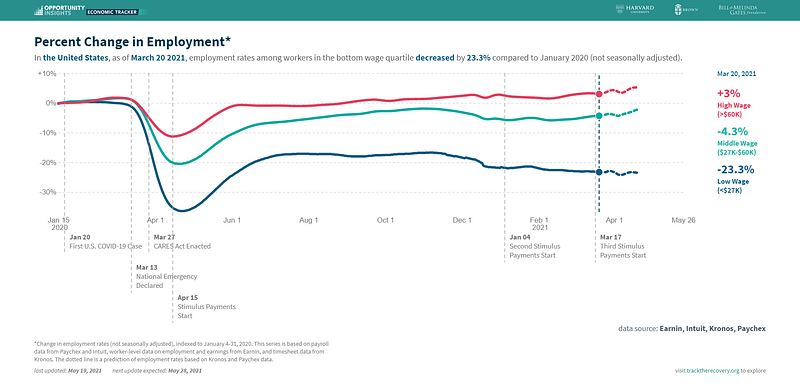
Unfortunately, although employment has mostly recovered for high-wage and middle-wage workers, low-wage workers remain at some of the worst unemployment numbers throughout the entire pandemic.
The Federal Reserve is committed to keeping interest rates low and money supply loose until even the lowest-paid workers are able to rejoin the workforce. At first, this might sound charitable. However, tapering QE or raising interest rates with such a high percentage of low-wage workers still unemployed, could put the economic recovery at great risk and perhaps even drag the economy back into recession and a new bear market.
5. As infection numbers drop, so will pandemic relief
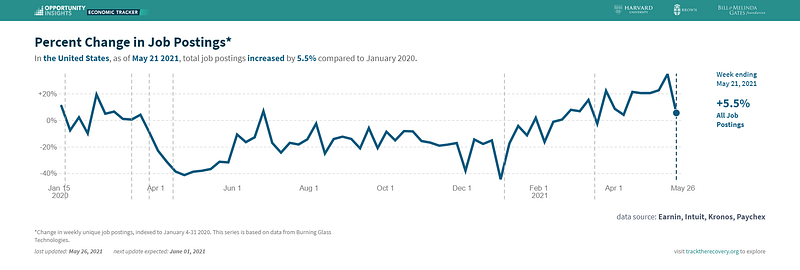
Joe Biden is aware of the low-wage unemployment numbers and hoped a $15 minimum wage would help entice workers currently on benefits, back into the workforce. Without good-paying jobs for workers to go back to, many businesses are struggling to get workers to come back to work as the economy re-opens.
A $15 minimum wage is also pretty popular with voters. A Reuters/Ipsos poll found some 59% of respondents said they supported the idea of a $15 minimum wage by 2025, with 34% opposing it. About 40% of adults say they would benefit directly from a minimum wage increase.
Republicans are firmly against raising the minimum wage and so are some Democrats — which seems strange considering how bad the unemployment rate is for low-wage workers and how popular an increase in the minimum wage is with voters. However, from an economic point of view, raising the minimum wage could be poison for the stock market.
This is an interesting dilemma.
Raising wages could put even more inflationary pressure on the economy by triggering a wage-price spiral. More inflationary pressure would in turn put more pressure on the Federal Reserve to raise interest rates faster than they would like. And if interest rates rise too fast (as mentioned above) stocks could re-enter a bear market and the economic recovery could stall.
On the other hand, if the minimum wage isn’t raised, there might be a possibility low-wage worker unemployment rates remain high. Inflation could take off anyway as the economy re-opens, and as mentioned above, this would force the Federal Reserve to raise interest rates to cool the economy. With unemployment rates remaining so high, this too could drag the economy back into recession and a stock market bear market as significant selling pressure is placed on technology stocks — even as the economy continues to re-open.
It’s going to be very interesting to see how lawmakers and central bankers get the world out of this pickle because either way, the more the economy re-opens, the more the screw tightens.


