
Good News - Global Forest Cover Is Increasing!
In the last week’s issue of Nature — one of the most recognized scientific journal in the world — Xiao-Peng and colleagues showed that contrary to the general belief that forested areas have declined, global tree cover has increased between 1982 and 2016. Thanks to satellite imagery, the authors have evaluated that forest area have expanded about 2.24 million km2 during this period which represents an increase of 7.1%. This could be considered as a good news for biodiversity conservation and carbon sequestration. However even if the quantity of forest cover seems encouraging, it’s important to consider the quality of this forest cover.
Most of the gain in forest cover took place in Europe and North America due to the rural flight of farmers abandoning their land to move into cities. Land abandonment is a good opportunity for the forest to reclaim a space which was hers centuries ago. In the tropics, the forested area was reduced for the sake of agricultural development, oil palm plantation for example.
Obviously these two different regions of the world have different forests and therefore a loss of forest in the tropics may not be compensated by a gain in temperate regions.
Tropical forests are highly diverse, biodiversity is higher than in temperate forests. This is supposedly due to the higher temperature accelerating chemical reactions and speeding up evolution processes in this heterogeneous environment. Therefore the loss of forest cover in the tropics is alarming since most of the world biodiversity and endemic species are located there. The gain of forest cover in temperate ecosystems is a small win for biodiversity. It can even be bad news for some rare species.
In Europe, human settlements are present for more than one thousand years already. Agriculture has helped some species to thrive as they coevolved with human activities. These species are called ruderal species. They have synchronized their life cycle with human agricultural practices: they bloom and bear seeds at the same time as crops and thus are not disturbed by the harvest. These ruderal plants are mainly living on extensively managed fields and meadows. Farmers are actually subsidized to conserve these plants. They must either reduce the amount of sprayed herbicide or make their sheep graze on the meadow. Meadows can also be mowed at precise time for rare species to thrive. For this kind of biodiversity — herbs and grasses — the gain in forest cover and the closing of the landscape is a threat rather than good news.
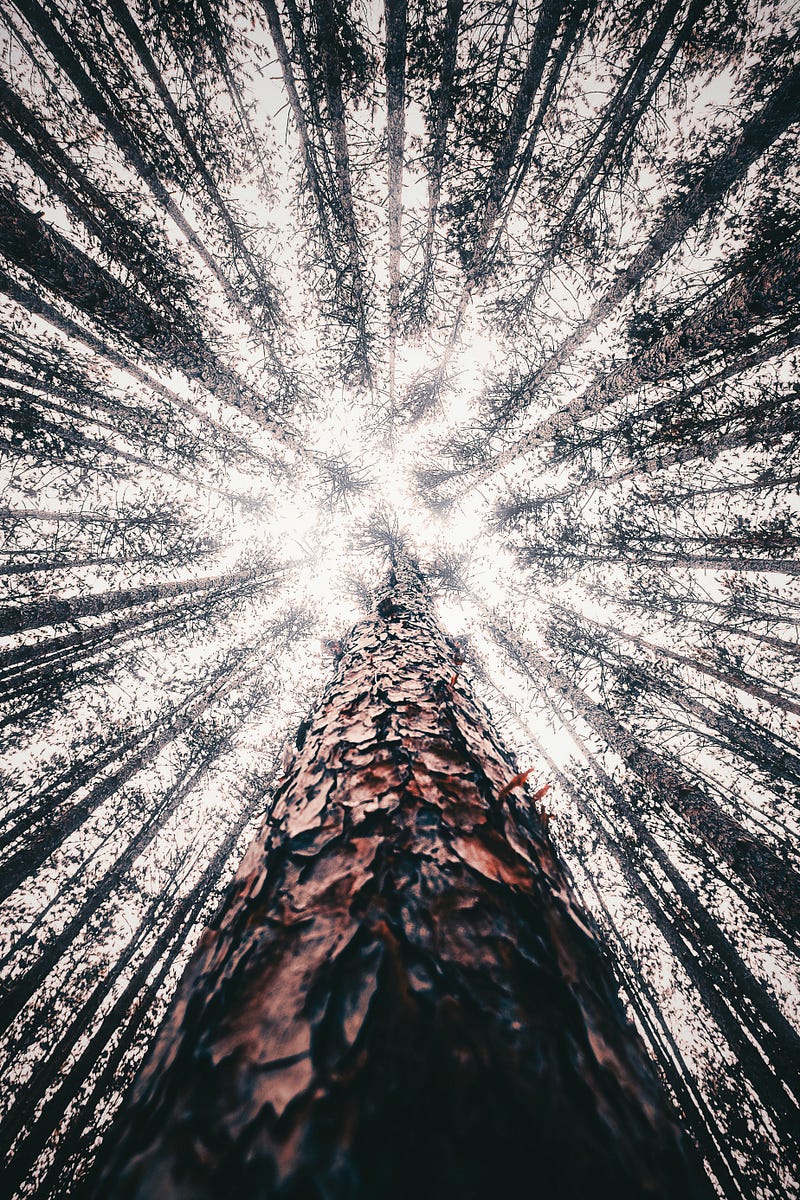
Even if they are tall big and easily visible from space trees are not the only sink of carbon. Other ecosystems are also very efficient to store carbon, for example peatlands and wetlands. The soil is also a large underrated reserve of carbon.
Even if the forest cover is increasing and more carbon is stored in trees, the amount of carbon stored is not as large as in wetlands and peatlands. The increase of forest cover in Europe is due to agricultural land abandonment. These lands are dry and don’t have as much potential to store carbon as a wetland.
It should be a priority to keep wetlands wet and stop burning or draining them for cultivating crops. I am afraid that the few forest cover we gained in the last decades are largely outbalanced by the carbon released while draining wetlands for human use.
The increase forest cover in cold and mountainous area is due to global warming. The growth of these trees might slow down the global warming by storing carbon, however I am more worried about the release of carbon from melting ever frozen permafrost soil in cold region.
In the tropics, the deforestation for planting oil palm also releases large amount of carbon. This is not only due to the burning of trees but due to the burning of peatlands. These peatlands are the result of thousand years of dead moss accumulation and thus they contain more carbon than forests. Burning them to plant oil palm trees is a net carbon loss because oil palm monocultures don’t compensate the peatlands’ carbon emission.
To conclude the increase of forest cover is encouraging but still a lot have to be done to limit further ecosystem degradation and carbon emissions. One degraded ecosystem will take hundred years to store as much carbon as it did before human disturbance. Even if more trees are covering the Earth, the ecosystems are probably not completely restored. The conservation focus should be on strop destroying pristine forests because they are more efficient to store carbon than new planted forests.
An efficient carbon sink forest takes time to grow…