avatarFaisal Khan

Free AI web copilot to create summaries, insights and extended knowledge, download it at here

3490

Abstract

.</p><figure id="212a"><img src="https://cdn-images-1.readmedium.com/v2/resize:fit:800/1*rfQPkK-7jiiB5By9V1y5zQ.png"><figcaption>Figure 1</figcaption></figure><h1 id="156c">How Trust In Business Varies Around The World</h1><p id="eaaf">A survey by <a href="https://www.edelman.com/trust/2021-trust-barometer"><i>Edelman Research</i></a> polled 33,000 respondents in 28 countries about their trust in business from October 19 to November 18, 2020. The research found that people in India and China have the highest trust at 82% and 70%, respectively (Figure 2). The figure was far lower in the United States at 54% while it was lower still in Russia at just 34%. The research also examined trust levels in the government, NGOs & the media. Interestingly, business emerged as the most trusted institution in the survey while it was the only one considered both ethical and competent.</p><figure id="37be"><img src="https://cdn-images-1.readmedium.com/v2/resize:fit:800/1*aoyInscTLzSDJm_20sHi7g.png"><figcaption>Figure 2</figcaption></figure><h1 id="6bec">50 Richest Women in the World in 2021</h1><p id="e3cf">According to a <a href="https://www.wealthx.com/wp-content/uploads/2020/06/Wealth-X_Billionaire-Census_2020.pdf">recent census</a> by Wealth-X, 11.9<b>%</b> of global billionaires are women. Even at such a minority share, this group still holds massive amounts of wealth. <i>Visual Capitalist</i> compiled the net-worth of the 50 richest women in the world using a real-time list of billionaires from <a href="https://www.forbes.com/real-time-billionaires/#7947199a3d78"><i>Forbes</i></a>. The richest woman in the world, Francoise Bettencourt Meyers & family owns 33% of the stock in the French personal care brand of L’Oréal S.A. Alice Walton of the Walmart empire scores a close second (Figure 3).</p><figure id="26a9"><img src="https://cdn-images-1.readmedium.com/v2/resize:fit:800/0*x4-9ItXRS3CuF724.jpg"><figcaption>Figure 3</figcaption></figure><h1 id="ee2b">Overview of Crypto-based crime categories 2018–20</h1><p id="6813">The big story for cryptocurrency-based crime in <a href="https://blog.chainalysis.com/reports/2021-crypto-crime-report-intro-ransomware-scams-darknet-markets">2020 is ransomware</a>. That may sound counterintuitive, as ransomware accounted for just 7% of all funds received by criminal addresses at just under $350 million worth of cryptocurrency. But that figure represents a 311% increase over 2019 (Figure 4). No other category of cryptocurrency-based crime rose so dramatically in 2020, as Covid-prompted work-from-home measures opened up new vulnerabilities for many organizations.</p><figure id="6900"><img src="https://cdn-images-1.readmedium.com/v2/resize:fit:800/0*GNp3kXhJ4fqV7H9Y"><figcaption>Figure 4</figcaption></figure><h1 id="0593">China Returns to Pre-Pandemic Growth in Q4 2020</h1><p id="a6d0">The <a href="https://www.statista.com/topics/5819/key-economic-indicators-of-china/">Chinese economy</a> continued its recovery in the fourth quarter of 2020, returning to a level of growth in line with pre-pandemic growth rates. According to the <a href="http://www.stats.gov.cn/english/PressRelease/202101/t20210118_1812432.html"><i>National Bureau of Statistics of China</i></a>, the country’s GDP grew by 6.5% year-over-year in the three months ended December 31, up from 4.9% in the preceding quarter and 3.2% growth in the quarter ended June 30 (Figure 5).</p><p id="e6fd">China’s economic output had declined by 6.8% year

Options

-over-year in Q1 2020, after the coronavirus outbreak. And while the swift rebound resulted in 2.3% growth for the entirety of 2020, that is still equivalent to the worst result since 1976 for the notoriously booming economy. Nevertheless, the pace of China’s recovery exceeded expectations, as the IMF and World Bank had predicted 1.85 and 2.0% growth respectively for 2020 in their latest economic outlooks.</p><figure id="f81c"><img src="https://cdn-images-1.readmedium.com/v2/resize:fit:800/1*V-YPoUhHwEQklxrygEdPJA.png"><figcaption>Figure 5</figcaption></figure><h1 id="cc77">Snapshot of International Monetary System</h1><p id="ebba">According to <i>Bloomberg, </i>The EU will unveil its plan to strengthen the international role of its flagship fiat currency Euro<b>. </b>The economic bloc seeks to erode the dominance of the U.S. dollar and insulate itself from financial risks, including U.S. sanctions. It will outline how it can fortify its economic and financial resilience by bolstering the single currency’s architecture and through growing markets like green finance. Almost half of the global green bond issuance was denominated in euro in 2019, said the ECB. The dominance of the Greenback is highlighted in the chart below (Figure 6).</p><figure id="2898"><img src="https://cdn-images-1.readmedium.com/v2/resize:fit:800/1*Y_PJN3uvDWeow1aVY-hBrA.png"><figcaption>Figure 6</figcaption></figure><h1 id="13ed">The World’s Top Car Manufacturers by Market Cap</h1><p id="d6bd">Ever since Apple and other Big Tech companies hit a <a href="https://readmedium.com/these-4-big-techs-are-the-exclusive-members-of-the-trillion-dollar-club-d02f1576f03">market capitalization of $1 trillio</a>n, many sectors are revving to follow suit — including the automotive industry. But among those car brands racing to reach this total valuation, some are closer to the finish line than others. The infographic below (Figure 7) uses data from <i>Yahoo Finance</i> to rank the world’s top car manufacturers by market capitalization. It’s clear that Tesla is pulling far ahead of the pack. The electric vehicle (EV) and clean energy company first became the world’s <a href="https://www.visualcapitalist.com/tesla-is-now-the-worlds-most-valuable-automaker/">most valuable</a> car manufacturer in June 2020 and shows no signs of slowing its trajectory.</p><figure id="f9f6"><img src="https://cdn-images-1.readmedium.com/v2/resize:fit:800/0*WIgGayqHXwWdarYZ.jpg"><figcaption>Figure 7</figcaption></figure><h1 id="c447">Previous Edition of GBW</h1><div id="4138" class="link-block"> <a href="https://readmedium.com/global-business-week-the-fantastic-journey-of-s-p-500-in-2020-4ad9d2671f2f"> <div> <div> <h2>Global Business Week: The fantastic journey of S&P 500 in 2020</h2> <div><h3>The state of Financial markets & Economies, Weekly Charts, Business Trends & Statistics</h3></div> <div><p>medium.com</p></div> </div> <div> <div style="background-image: url(https://miro.readmedium.com/v2/resize:fit:320/1*9F9yTXSuQYEuNXVhUV9uTQ.png)"></div> </div> </div> </a> </div><figure id="8fdb"><img src="https://cdn-images-1.readmedium.com/v2/resize:fit:800/1*DWngI2BuTlJgYEFXMnWeuw.png"><figcaption></figcaption></figure><h2 id="4e53">Stay informed with the content that matters — Join my mailing list</h2></article></body>

WEEKLY BUSINESS ROUNDUP

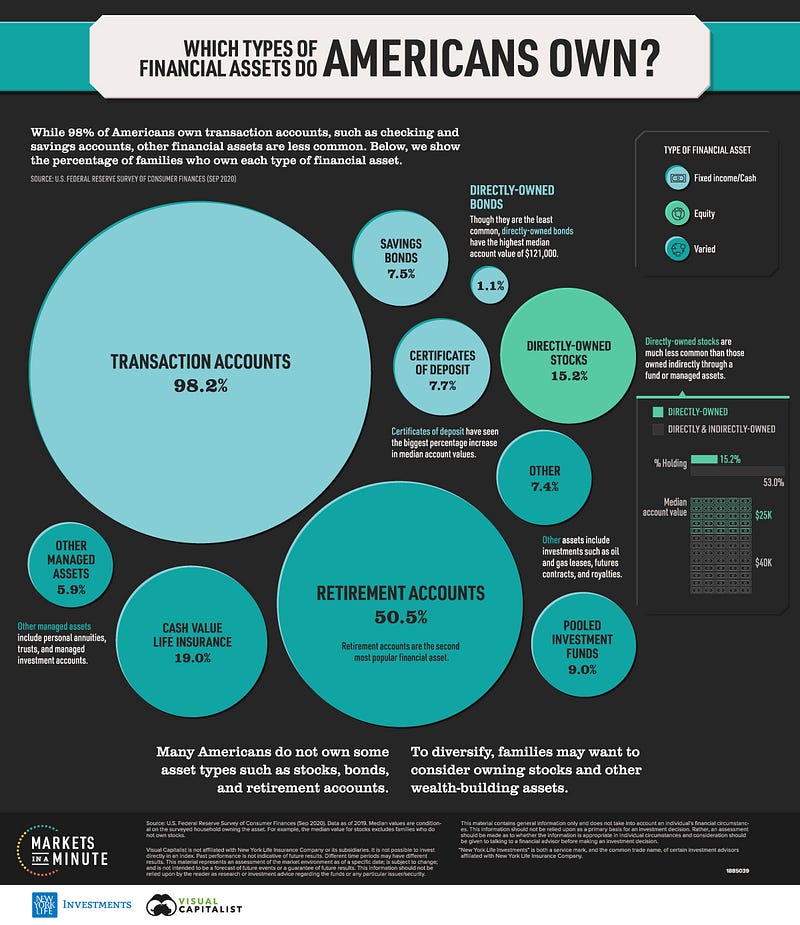
Global Business Week: Which types of Financial assets do Americans own?

The state of Financial markets & Economies, Weekly Charts, Business Trends & Statistics

U.S equity indices took divergent paths on Friday with DJIA and S&P 500 falling while the Nasdaq rallied again, thanks to Big Tech. However, all three major indices still managed to post weekly gains — the Nasdaq jumped 4.2%, the S&P gained 1.9% and the Dow added 0.6%. Dow was dragged down lower by its blue components of Intel and IBM, both of whom fell on earnings debacles.

Overall, the emerging markets have been among the biggest beneficiaries of the flow of funds into equities — the 12th week in a row. Investors are seeing these economies recovering much more smoothly than the EU & the U.S, where stimulus plan doubts and the emergence of a lethal strain of COVID-19 are threatening a double-dip recession.

According to the Institute for International Finance, $360 billion rushed into emerging market equities in 2020 after $90 billion came rushing out in March. Another $17 billion flowed into those markets since the beginning of 2021 as concerns about inflation holding back the U.S. recovery have pushed more money into countries like Taiwan, which has seen its stock market rise 57% in the past year, as well as some of the EAFE markets, including Japan and Israel.

The benchmark Dollar Index retreated this week as equities sentiment swung from one way to another. The Greenback seems to be on a mixed footing ahead of the all-important Fed meeting in the coming week. As the push in the U.S treasury yields stalled, so did the momentum in DXY’s rebound. The largest component of the DXY Index, EUR/USD, added +0.79%, while the resilient post-Brexit GBP/USD added +0.71%. We might be in for another choppy weekly session.

And finally, Cryptos did not disappoint with their heightened volatility. Bitcoin (BTC/USD) notched its sharpest weekly drop since September, after briefly slipping under $30,000 in the Asian session on Friday. However, it has managed to rebound and is trading just above $32k at the time of publishing. Ethereum, on the other hand, has been faring relatively well, as it charted an all-time high of around $1440 this week — trading at $1240 currently. Overall, the crypto market seems to have entered a consolidation phase.

Today’s featured infographic (above) is the Markets in a Minute chart from New York Life Investments, presented by Visual Capitalist. It highlights the finances of the 128 million U.S families — the data collected by the Federal Reserve shows the percentage of families that hold each type of financial asset, along with the median and average values held.

Before we move on to some of the other interesting statistics, here’s a quick look at the financial markets' numbers (Figure 1).
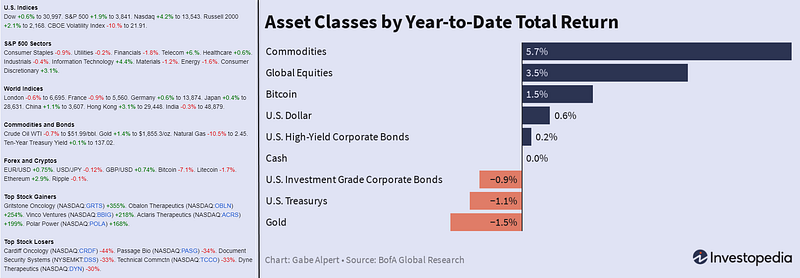
Figure 1

How Trust In Business Varies Around The World

A survey by Edelman Research polled 33,000 respondents in 28 countries about their trust in business from October 19 to November 18, 2020. The research found that people in India and China have the highest trust at 82% and 70%, respectively (Figure 2). The figure was far lower in the United States at 54% while it was lower still in Russia at just 34%. The research also examined trust levels in the government, NGOs & the media. Interestingly, business emerged as the most trusted institution in the survey while it was the only one considered both ethical and competent.
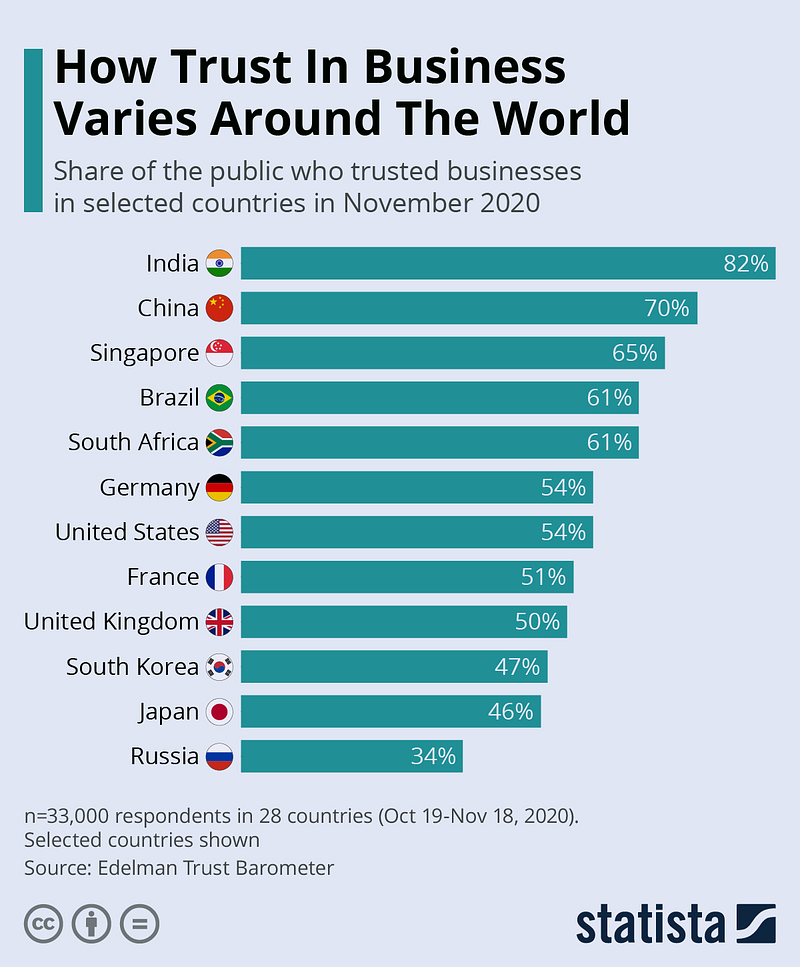
Figure 2

50 Richest Women in the World in 2021

According to a recent census by Wealth-X, 11.9% of global billionaires are women. Even at such a minority share, this group still holds massive amounts of wealth. Visual Capitalist compiled the net-worth of the 50 richest women in the world using a real-time list of billionaires from Forbes. The richest woman in the world, Francoise Bettencourt Meyers & family owns 33% of the stock in the French personal care brand of L’Oréal S.A. Alice Walton of the Walmart empire scores a close second (Figure 3).
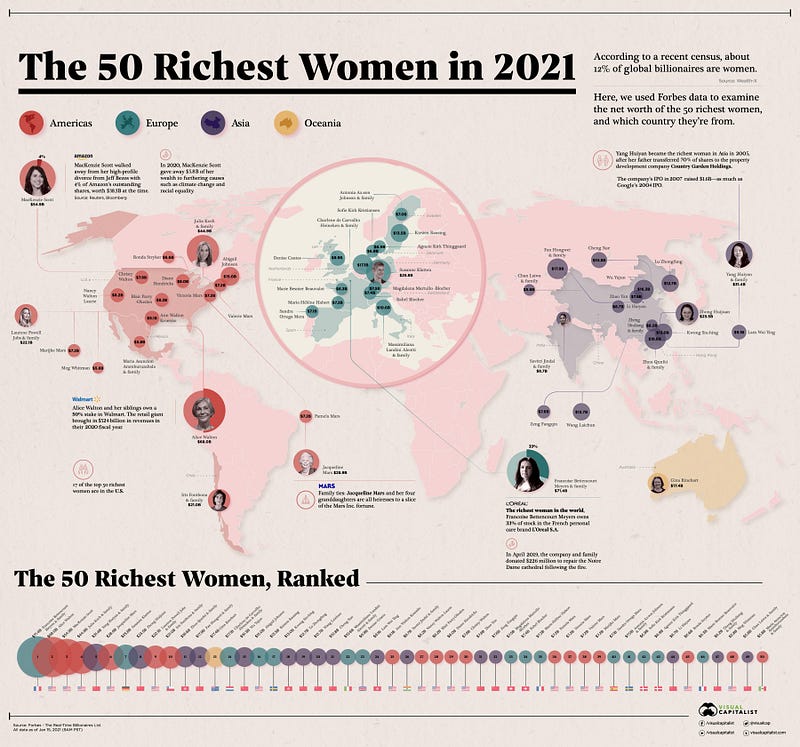
Figure 3

Overview of Crypto-based crime categories 2018–20

The big story for cryptocurrency-based crime in 2020 is ransomware. That may sound counterintuitive, as ransomware accounted for just 7% of all funds received by criminal addresses at just under $350 million worth of cryptocurrency. But that figure represents a 311% increase over 2019 (Figure 4). No other category of cryptocurrency-based crime rose so dramatically in 2020, as Covid-prompted work-from-home measures opened up new vulnerabilities for many organizations.
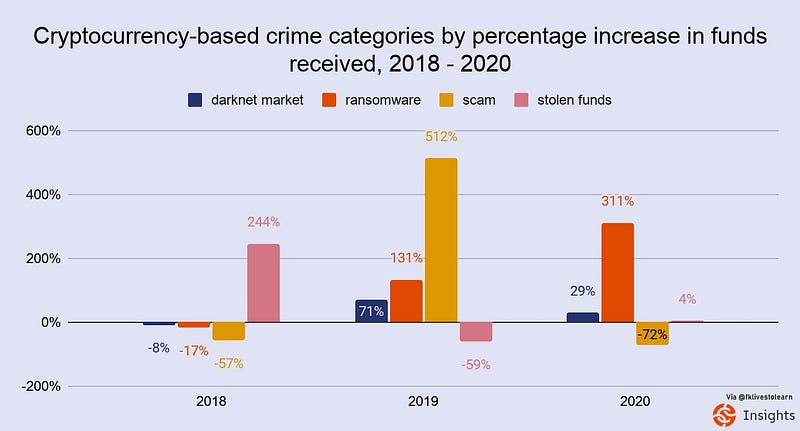
Figure 4

China Returns to Pre-Pandemic Growth in Q4 2020

The Chinese economy continued its recovery in the fourth quarter of 2020, returning to a level of growth in line with pre-pandemic growth rates. According to the National Bureau of Statistics of China, the country’s GDP grew by 6.5% year-over-year in the three months ended December 31, up from 4.9% in the preceding quarter and 3.2% growth in the quarter ended June 30 (Figure 5).

China’s economic output had declined by 6.8% year-over-year in Q1 2020, after the coronavirus outbreak. And while the swift rebound resulted in 2.3% growth for the entirety of 2020, that is still equivalent to the worst result since 1976 for the notoriously booming economy. Nevertheless, the pace of China’s recovery exceeded expectations, as the IMF and World Bank had predicted 1.85 and 2.0% growth respectively for 2020 in their latest economic outlooks.
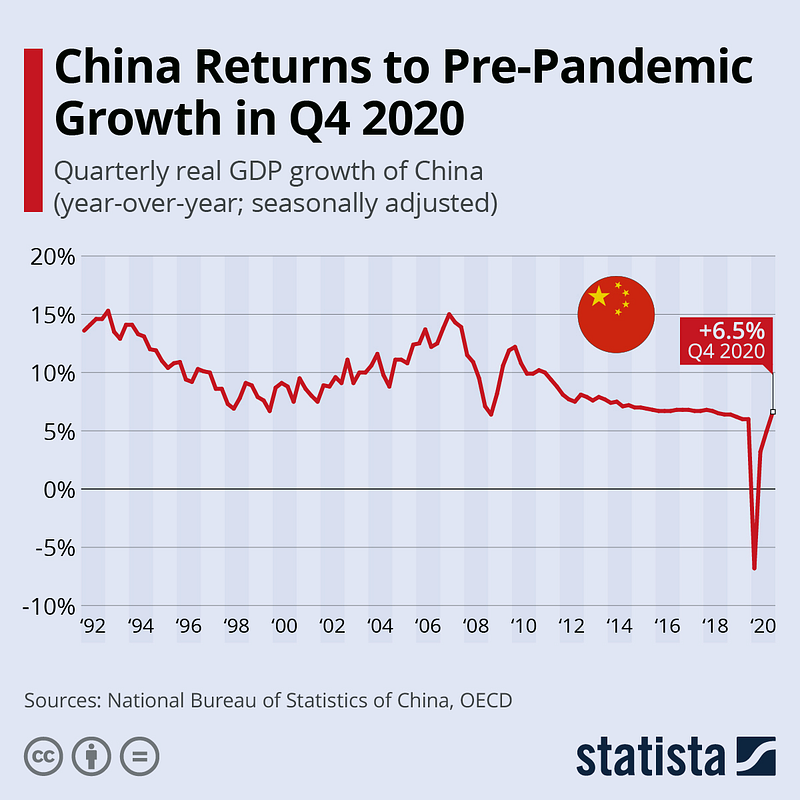
Figure 5

Snapshot of International Monetary System

According to Bloomberg, The EU will unveil its plan to strengthen the international role of its flagship fiat currency Euro. The economic bloc seeks to erode the dominance of the U.S. dollar and insulate itself from financial risks, including U.S. sanctions. It will outline how it can fortify its economic and financial resilience by bolstering the single currency’s architecture and through growing markets like green finance. Almost half of the global green bond issuance was denominated in euro in 2019, said the ECB. The dominance of the Greenback is highlighted in the chart below (Figure 6).
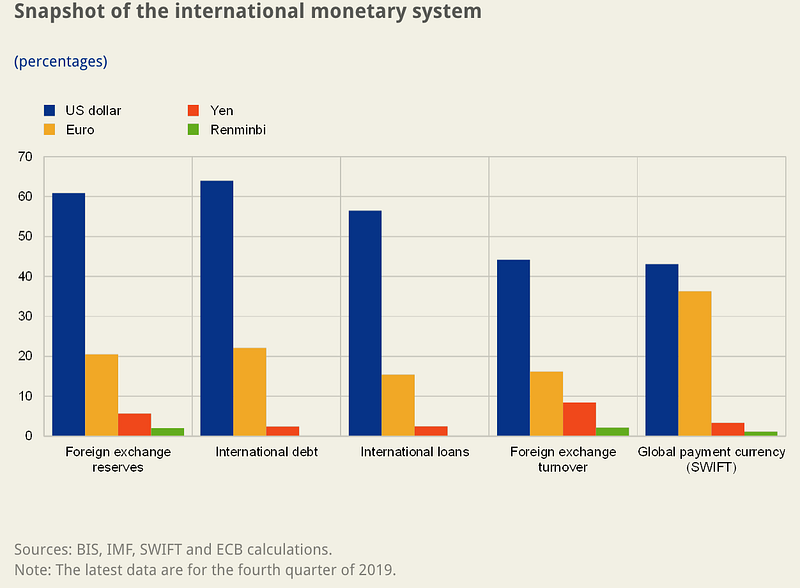
Figure 6

The World’s Top Car Manufacturers by Market Cap

Ever since Apple and other Big Tech companies hit a market capitalization of $1 trillion, many sectors are revving to follow suit — including the automotive industry. But among those car brands racing to reach this total valuation, some are closer to the finish line than others. The infographic below (Figure 7) uses data from Yahoo Finance to rank the world’s top car manufacturers by market capitalization. It’s clear that Tesla is pulling far ahead of the pack. The electric vehicle (EV) and clean energy company first became the world’s most valuable car manufacturer in June 2020 and shows no signs of slowing its trajectory.
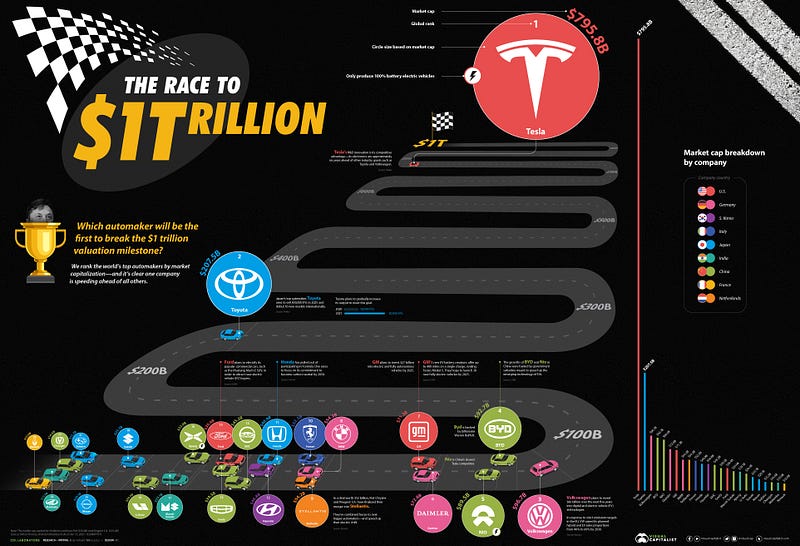
Figure 7

Previous Edition of GBW

Stay informed with the content that matters — Join my mailing list

Finance
Economics
Business
Investing
Bitcoin
Recommended from ReadMedium
