
WEEKLY BUSINESS ROUNDUP
Global Business Week: Phenomenal growth of Crypto assets since 2020
The state of Financial markets & Economies, Weekly Charts, Business Trends & Statistics
Friday’s stock market bounce came after the major U.S indexes suffered their worst month of the year in September amid rising fears of inflation, slowing growth and rising rates. Major U.S. stock market averages began the new month and quarter with strong gains as investors celebrated a potential major breakthrough in the fight against COVID-19. Merck reported positive test results for a pill to treat those sickened by the virus. The news sent its shares up 8%. It was the best-performing stock in the Dow.
The Merck news boosted the stocks of airlines, cruise lines, and other travel-related companies. United Airlines shares gained 8%. Shares of Norwegian Cruise Linerose 6%. Energy company stocks advanced as oil reached its highest closing price in three years. The positive feelings in the market led to a sell-off in bonds, with the yield on the 10-year Treasury note falling to 1.46%. For the month, the Dow Jones was down 4.3%, the S&P 500 fell 4.8%, and the Nasdaq Composite was off 5.3%
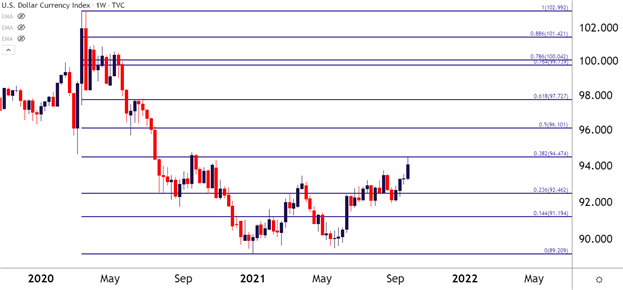
Ascending trinagle formation in the Dollar Index (DXY) led to a bullish breakout with the Greenback leading to fresh yearly highs, closing just above the 94.00 handle. Next week’s NFP report is key as this is the only NFP report that the Fed will see between September and November rate decisions. While the Greenback spent the back nine months of last year selling off, the first nine months of this year were marked by mean reversion as price action retraced about 38.2% of that prior sell-off. As the Fed nears a taper and eventual rate hikes, DXY might be well placed for a major breakout on the upside.
Bitcoin soared more than 10% on comments from Fed Chair Powell on cryptocurrency regulation and El Salvador’s announcement it is using power from volcanoes to mine digital coins. As usual the double digit gains in the premier crypto took the other digital assets higher as well — at the time of writing, BTC was trading just above $48k, while ETH is closing in on $3,400. Technically, bearish trend lines in the top two cryptos signal a possible reversal in the month-old bearish pattern.
Cryptos seem poised for another bull run. On a separate note, Coinbase said at least 6,000 customers had money taken from their account by hackers who broke into the biggest U.S. cryptocurrency exchange. Coinbase explained the criminals took advantage of a flaw in the company’s SMS Account Recovery process in order to gain access to accounts. Then they transferred money to crypto wallets unassociated with Coinbase. The company has apparently updated its system to prevent further attacks, and it is reimbursing customers for what was taken.
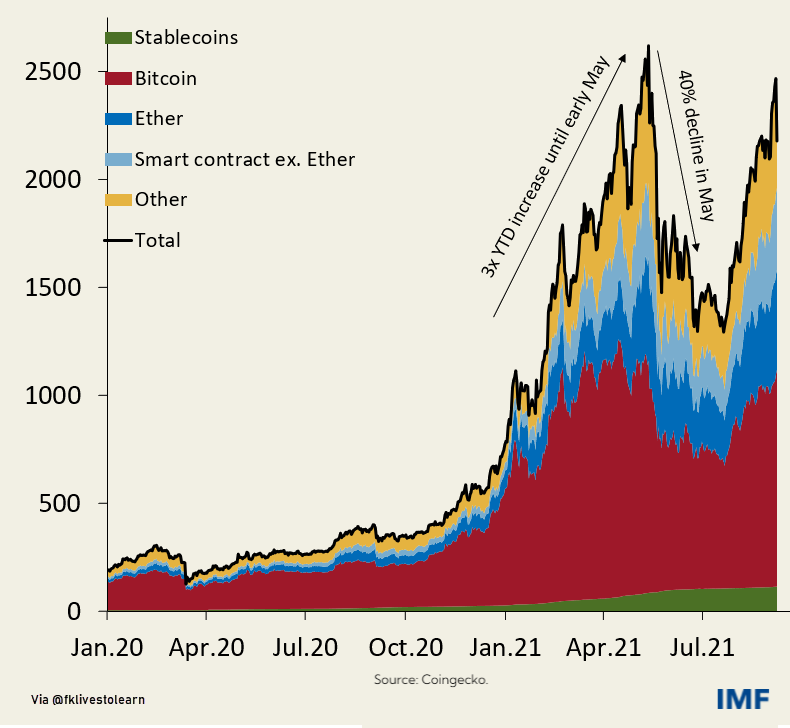
Today’s featured infographic from IMF highlights the phenomenon growth of the cryptocurrencies since the beginning of 2020. The total market value of all the crypto assets surpassed $2 trillion as of September 2021 — a 10x increase since early 2020. An entire ecosystem is also flourishing, replete with exchanges, wallets, miners, and stablecoin issuers.
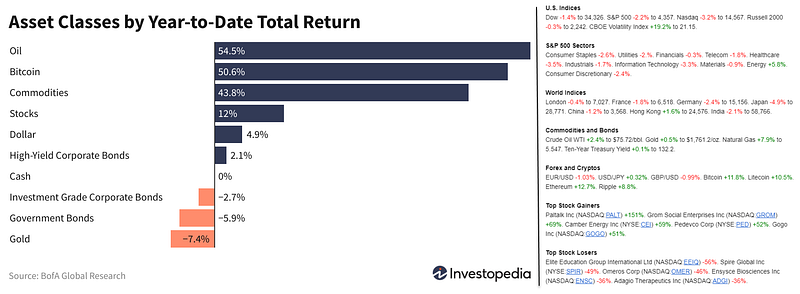
And finally, before moving on to some other statistics, here are the weekly & YTD numbers from various markets and different assets (Figure 1).
The 100- Billion Dollar Club
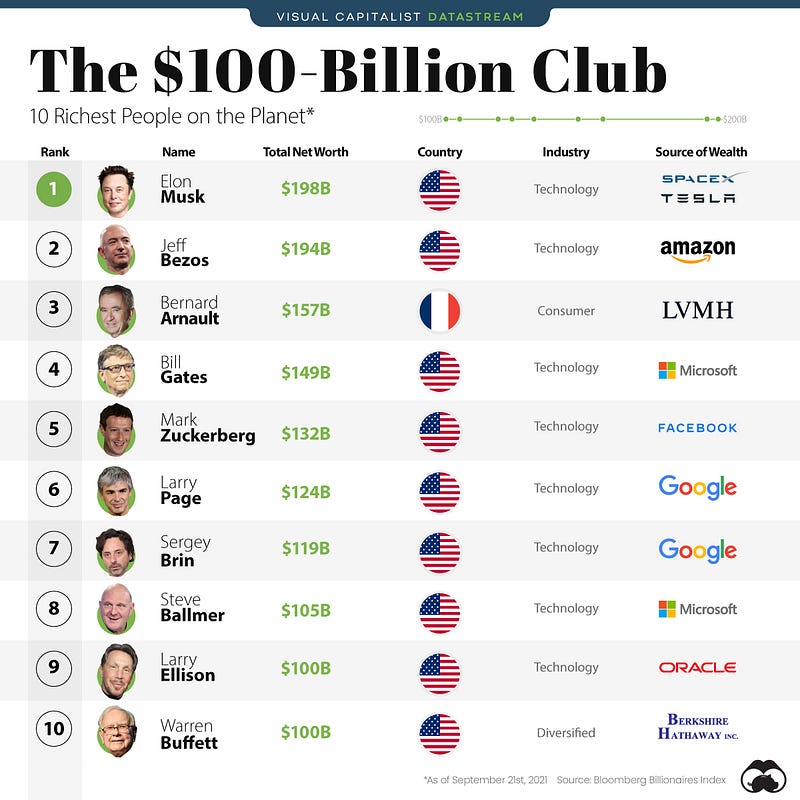
The top 10 richest people on the planet have a combined net worth of $1.4 trillion. For some context, that’s roughly the same size as GDP. Who are these ultra-wealthy individuals, and what’s the source of their wealth? Here’s a look at the top 10 richest people on the planet (Figure 2), and how they’ve made their billions.
World Leaders in Real-Time Payments
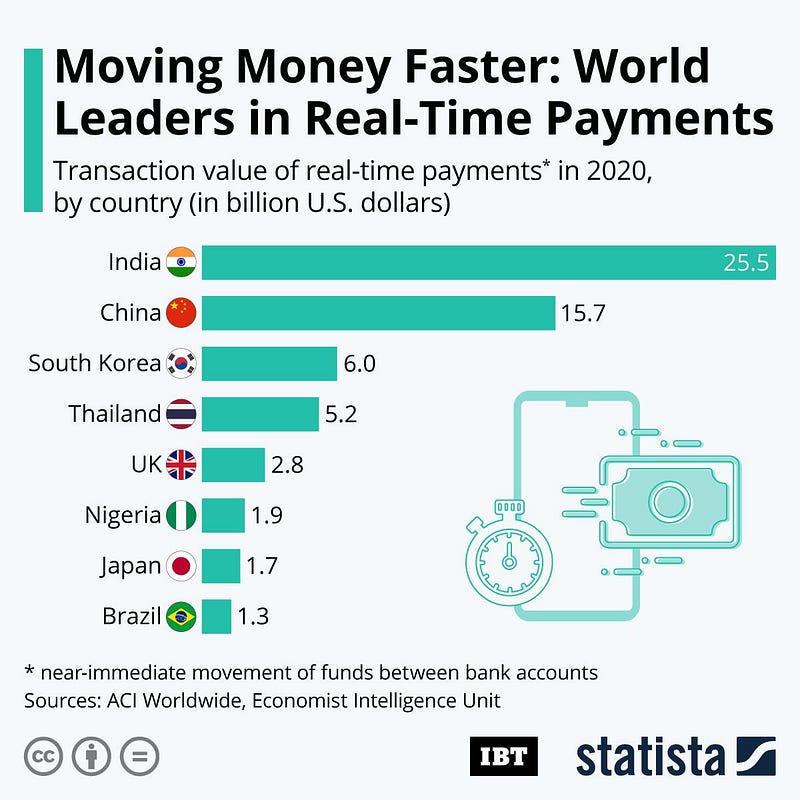
While innovation for these providers is mostly limited to usability and integration, for example into smartphone use, innovation focused on actual payment processing happens outside the limelight. Real-time payments — the near-immediate transfer of funds from one bank account to another are one such example. As data from ACI Worldwide shows, 9.8% of the global electronic transactions were already done in real time in 2020. India was the country with the highest real-time transaction value at $25.5 billion (Figure 3), followed by $15.7 billion in China and $6 billion in South Korea. Thailand beats the U.K. in real-time payments, ahead of Nigeria in rank 6.
China’s Hidden Debt
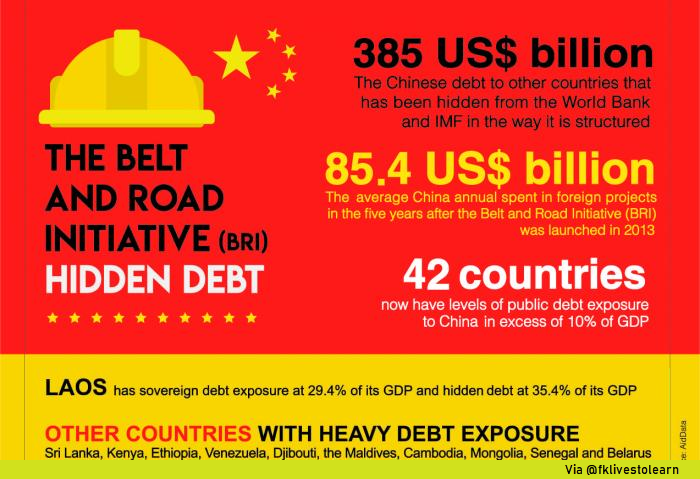
According to AidData, China grants US$ 85 billion a year in aid and loans, charging higher interests than the West. The debt of 42 nations to Beijing is more than 10% of their GDP (Figure 4). BRI partners are unlikely to look at the alternatives offered by the US and the EU. Its report looks at China’s foreign funding, including the Belt and Road Initiative (BRI), the global infrastructure plan launched in 2013 by Chinese President Xi Jinping to boost the country’s a trade and geopolitical role. The study looked at 13,427 projects undertaken between 2000 to 2017 in 165 countries with the support of Chinese loans and aid, worth a total of US$ 843 billion. At least 300 government institutions and state-owned entities funded these projects, turning China into the largest lender of many developing nations.
Bitcoin AUM Share Falls
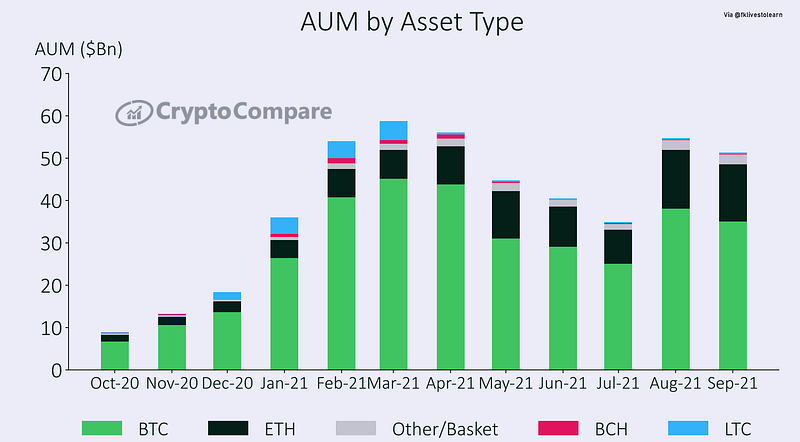
In September, Bitcoin’s Assets under management (AUM) fell 7.8% to $35.1 billion (Figure 5). As a result, it continued to lose market share (now 67.9% of total AUM vs. 69.0% last month) — the asset’s lowest market share in 2021. Ethereum’s AUM fell marginally (3.0%) to $13.4 billion while Baskets also fell 1.3% to $2.8 billion.
Top 50 Green Companies
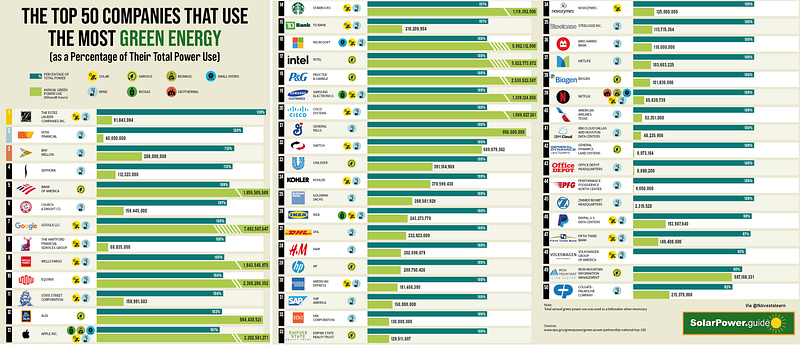
Green energy was once a niche segment of the wider energy industry, but it’s quickly becoming an essential energy source in many regions and nations across the globe. Based on data from the Environmental Protection Agency (EPA), this infographic by SolarPower.Guide shows the top 50 greenest companies (Figure 6), based on the highest proportion of green energy used in their overall consumption mix. As green energy becomes more affordable, some major businesses like Google, Wells Fargo, and Apple are embracing it in a big way.
Terra Biggest Challenger to DAI
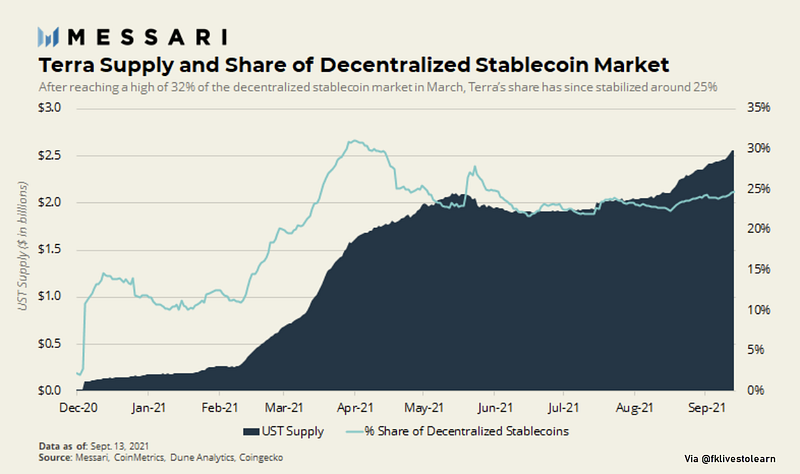
Despite many attempts at challenging DAI for the crown of the leading decentralized stablecoin, all have failed to date. With a set of upcoming upgrades and integrations, Terra’s UST — the fastest growing decentralized stablecoin of 2021 is positioned to give DAI its strongest challenge yet (Figure 7). On September 30, Terra will undergo its highly anticipated Columbus-5 upgrade that will enable dozens of applications to launch as well as enable Terra to expand its reach cross-chain through Cosmos’s Inter-Blockchain Communication Protocol (IBC). In the weeks following Wormhole V2 will also launch support for Terra enabling Terra to import and export assets from Ethereum and Solana. The combination of these upgrades and integrations has the potential to accelerate UST supply growth substantially setting up UST to flip DAI.
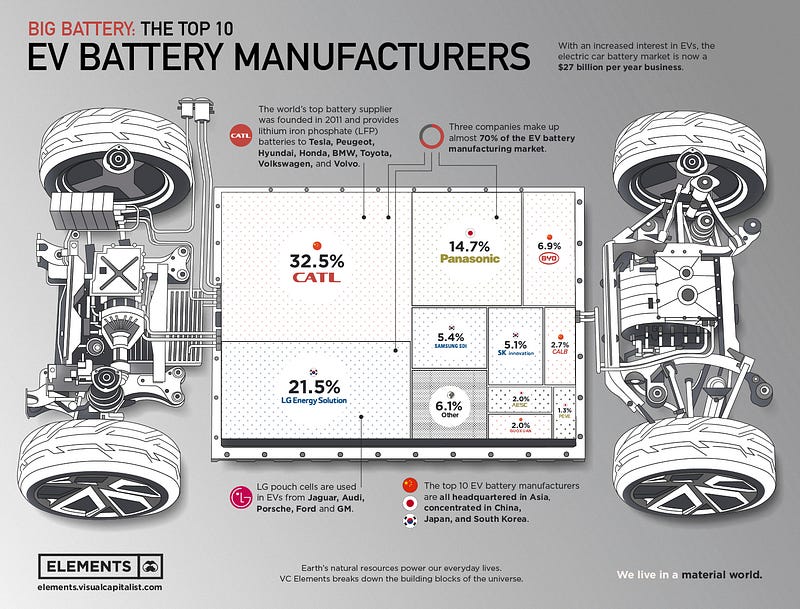
Top 10 EV Battery Manufacturers
With increasing interest in electric vehicles (EVs) from consumers, the market for lithium-ion EV batteries is now a $27 billion per year business. According to industry experts, high demand has boosted battery manufacturers’ profits and brought heavy competition to the market. And by 2027, the market could further grow to $127 billion as consumers embrace more affordable EVs. Besides being a manufacturing powerhouse of vehicle parts, Asia is fast becoming a hotbed for innovation in the battery sector. No wonder, the top 10 EV battery manufacturers (Figure 8) by market share are all headquartered in Asian countries, concentrated in China, Japan, and South Korea.
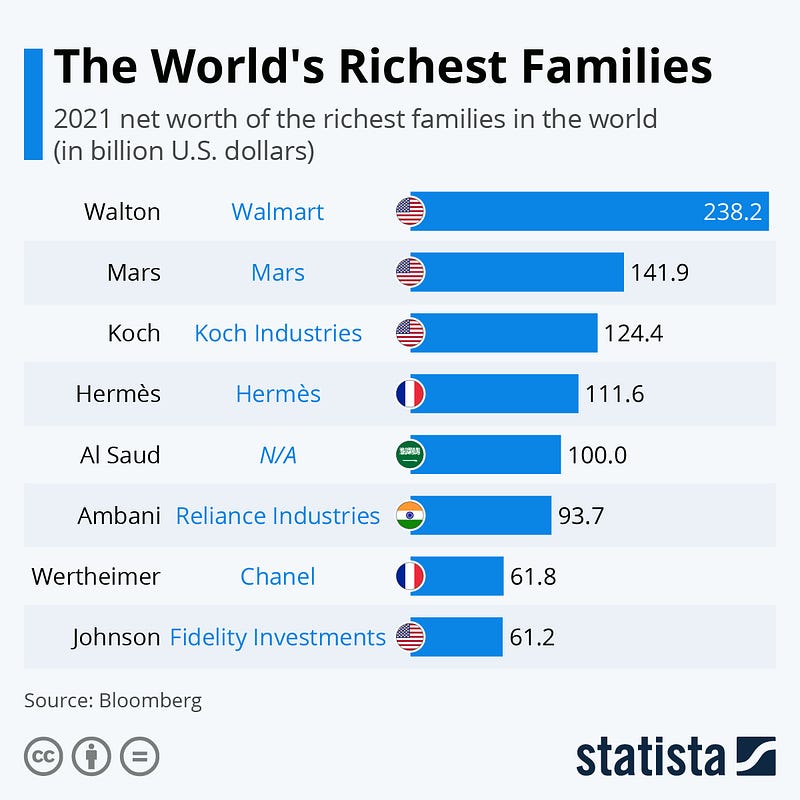
World’s Richest Families
Successful business enterprises are the key to the wealth of the world’s richest families. According to a ranking by Bloomberg, three American families top the ranking of world’s wealthiest. The top 2 — The Waltons and the Mars family — deal in consumer goods, while the Kochs in rank 3 is more of an industrialist clan (Figure 9). The Walton family’s assets come to $238 billion, while the Mars family made a fortune of $142 billion from their empire of brands such as Milky Way, Snickers, M&M’s, Twix, and Wrigley chewing gum. Among the majority of business empire owners, the Al Sauds are the exception. The royal family that rules Saudi Arabia is the richest family of monarchs in the world, largely due to their home country’s massive oil reserves.
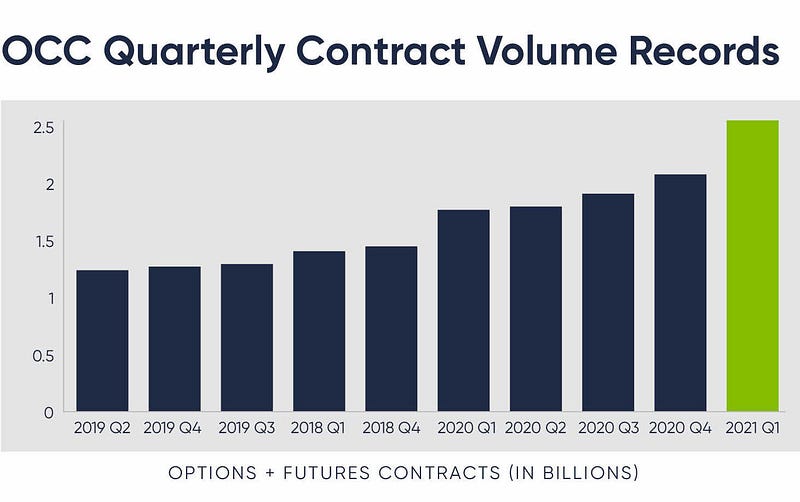
Options Overtake Stocks
Options activity could overtake stock market activity for the first time ever, the Wall Street Journal reported. So far this year, the average value of stock options trading has surpassed $432 billion (Figure 10). That compares to $404 billion for stocks, according to data from the Chicago Board Options Exchange. Stock options worth about $7 trillion have changed hands so far this month, well above the $6 trillion in stocks. This would be the first year on record that the value of options changing hands passed that of stocks. According to the CBOE, nine of the 10 most active call options trading days in history took place this year. Options trading is up over 30% from last year, the highest level since the options market began back in 1973.
EV Sales Soar in the U.S
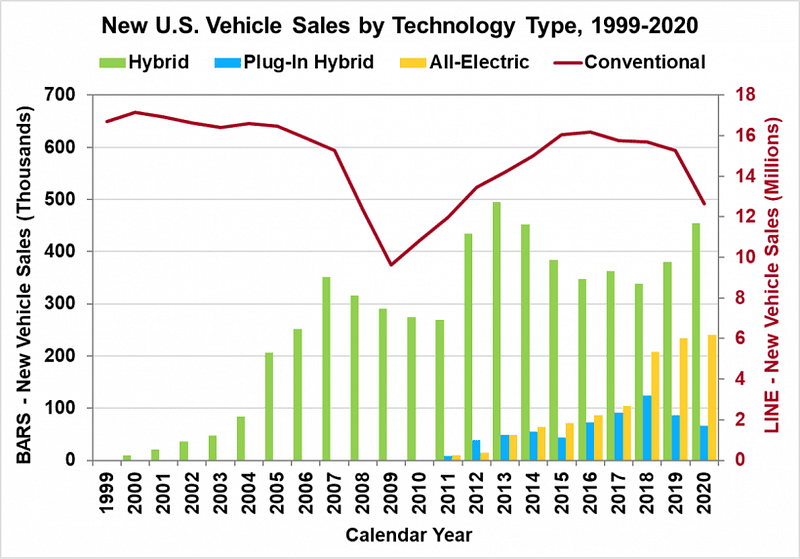
Demand for EVs and hybrids is rising (Figure 11), and Stellantis is battling to keep up with rivals Ford and General Motors in that market. The firm announced in July that 40% of its U.S fleet will be low-emission vehicles by 2030. Ford said this week it now expects that 40% to 50% of its worldwide global sales will be EVs by the end of the decade. General Motors wants 40% of its U.S. vehicles to be EVs by 2025.
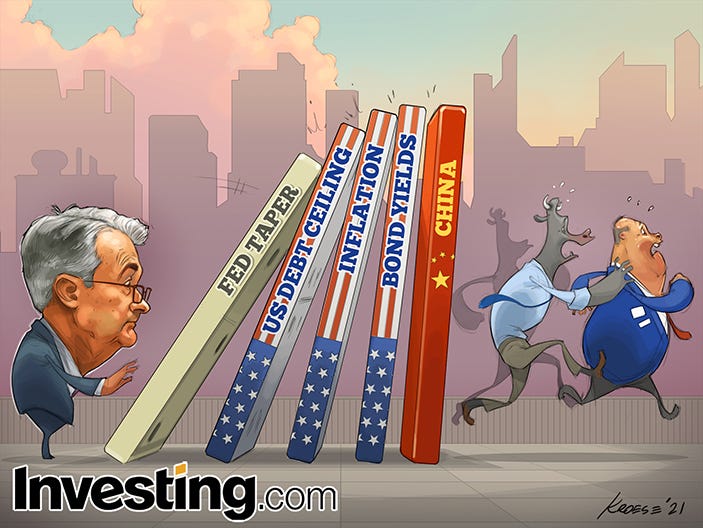
Market Humor: Fed Taper Fears, U.S. Debt Ceiling Drama, China Risks Hammer Stocks In September
Previous Edition of GBW
