WEEKLY BUSINESS ROUNDUP
Global Business Week: America’s debt growing faster than its GDP
The state of Financial markets & Economies, Weekly Charts, Business Trends & Statistics
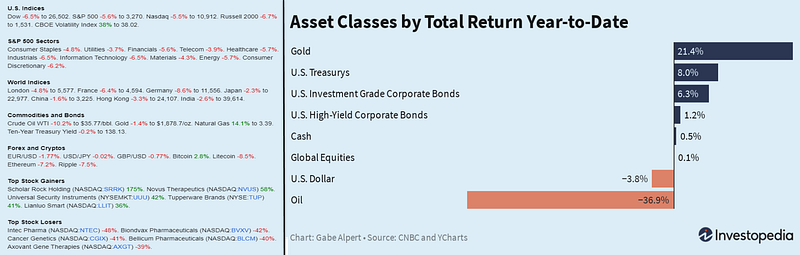
Among the great unknowns that this year has brought, one thing remained the same — the markets ended a truly volatile and historically bad month for stocks on a similar tone. Apart from the small rebound on Thursday, the bears had a firm grip on the trading sentiment throughout the week. Dow did manage to pare some losses towards the end of the day on Friday but still closed in the red. For the week, the Dow Jones average tumbled 6.5%, the S&P 500 sank 5.6%, and the Nasdaq lost 5.5%.
Apart from the failed stimulus deal and a sharp increase in COVID-19 infections across the world & most importantly the uncertainty around the U.S Presidential elections is making the investors really skittish. The volatility index jas jumped the recent highs of June indicating further volatile sessions like this. While this heightened fear and volatility may be with us for some time, it too will eventually pass.
With the massive increase in risk-aversion this week in stocks, money flowed into safe-haven assets like the Greenback. The dollar index reached the highest level in two weeks. With the elections just days away, the money will probably continue to flow towards the reserve currency. Technically speaking, the index seems to be carving a base here as it consolidates above the medium-term low.
Bitcoin has been on a tear and has touched the $14k as we speak. The trade intensity in the premier digital asset has also picked up, with institutional investors sending more money this way. It has certainly been acting as a hedge against the risk lately. With $14k overcome, there is no resistance in the way till at least $17k.
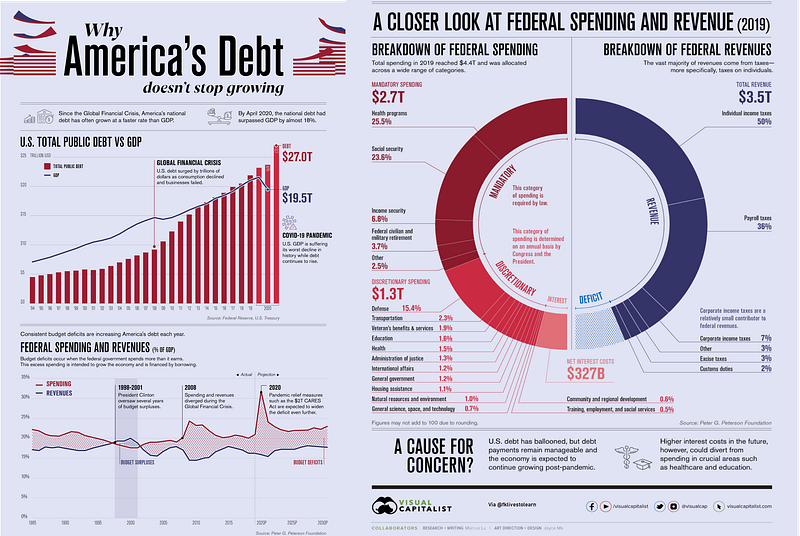
Today’s featured infographic (above) highlights the ballooning U.S debt which spiked exponentially this year, with trillion-dollar packages announced to ramp up the economy. The debt has exceeded 100% of the country’s GDP. Although the debt increase is expected to subside to normal levels in coming years, the elevated levels are going to pose an economic challenge in the future. Before we move forward, here is the weekly & yearly performance of various assets (Figure 1)
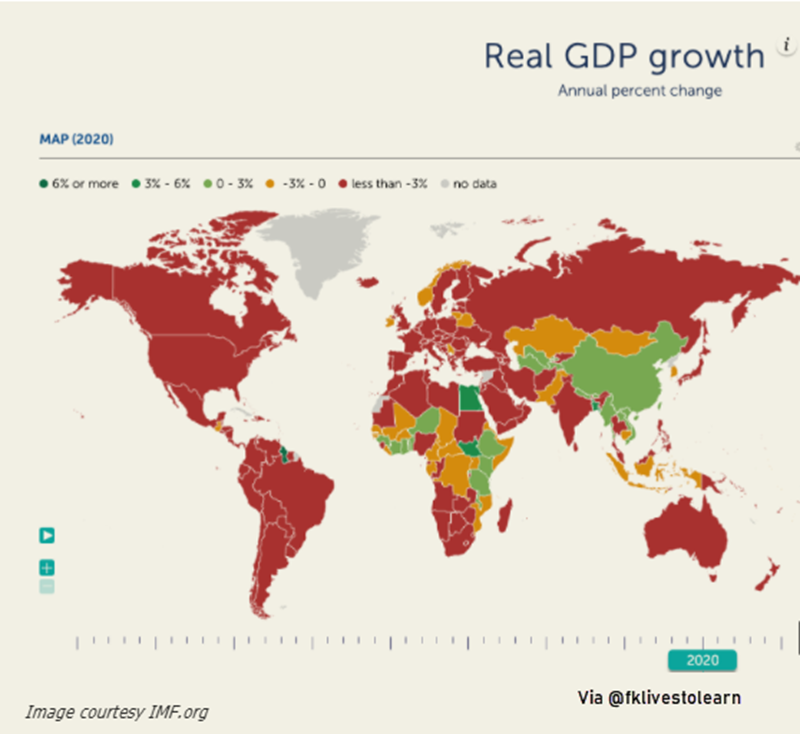
Mapping real GDP growth in 2020
While on the topic of the GDP, there are less than 10 countries on the planet that are expected to see GDP growth in 2020 (Figure 2), and China is number one on that list. The country where the novel coronavirus came from imposed the strictest lockdown measures and has had one of the strongest recoveries to date. The list is dominated by the African countries, where the pandemic has caused less economic disruption.
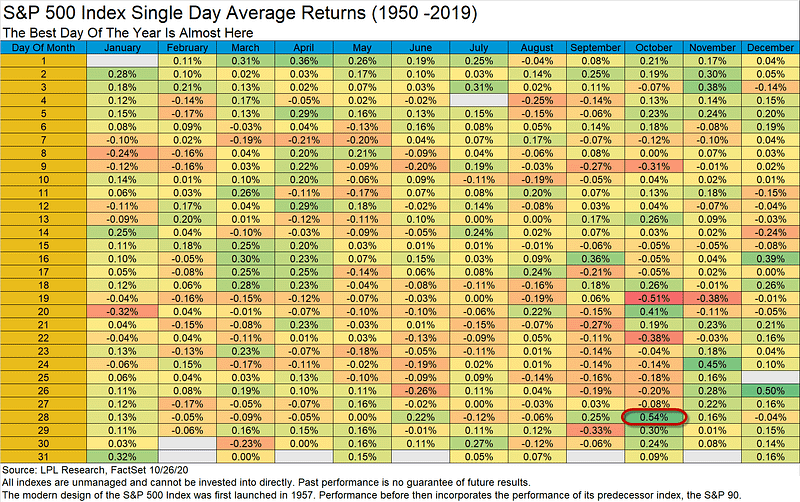
Historical Single Day Average Returns for S&P 500
According to LPL Research, October 28, is historically the best day of the year for stocks, (Figure 3 below) The S&P 500 Index has averaged a 0.54% return on this day, better than any other day of the year — with the day after Christmas the second-best (0.50%). October 19 is the worst day of the year on average (-0.51%) thanks to the crash of 1987. As it turned out October 28th turned out to be one of the worst days this year — so much for averages.
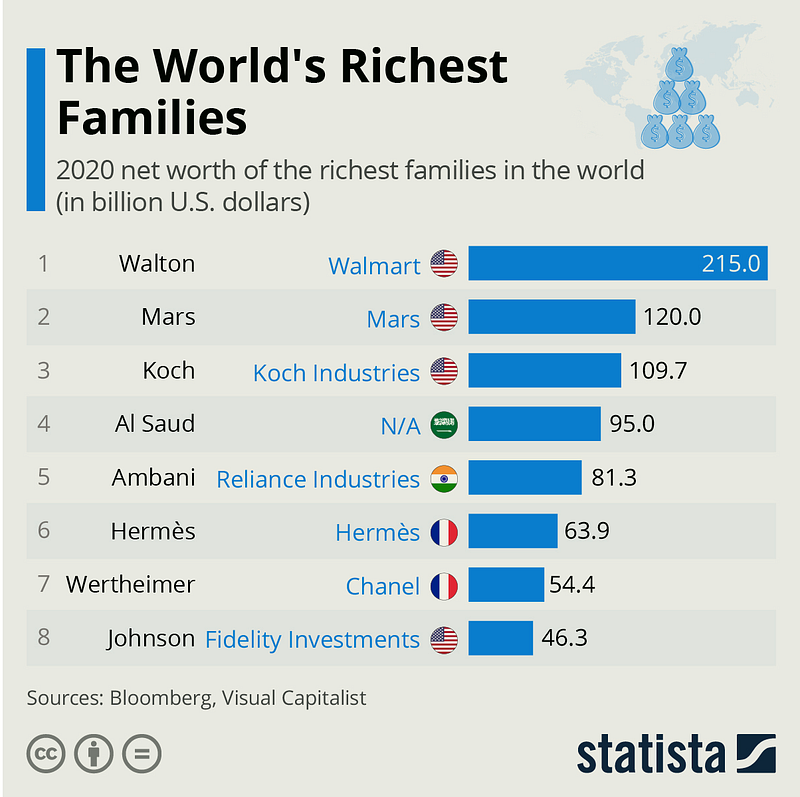
The World’s Richest Families
Bloomberg published data shows three American families topping the ranking of the world’s wealthiest. The top 2 — The Waltons and the Mars family — deal in consumer goods, while the Kochs at №3 more of an industrialist clan. The Walton family’s assets come to $215 billion, while the Mars family made a fortune of $120 billion from their empire of brands such as Milky Way, Snickers, M&Ms, Twix, etc.
Among the business empire owners, the Saudi Arabian Al Saud family is the exception — it rules Saudi Arabia and is the richest family of monarchs in the world, largely due to their home country’s large oil reserves. The Ambanis of India, owners of the Reliance Industries conglomerate, come in at №5 with a fortune of more than $81 billion.
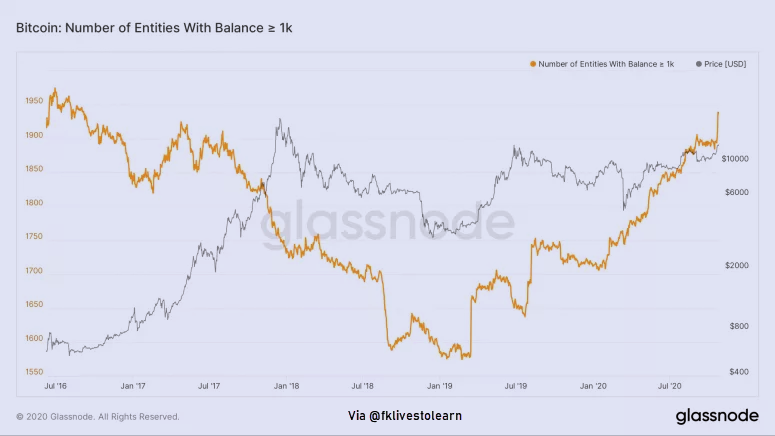
Bitcoin ‘Whale’ Addresses at Highest Since 2016
The number of bitcoin “whales” — large investors with an ability to influence market trends has jumped to four-year highs alongside the recent price rally. The population of whale entities — clusters of addresses held by a single network participant holding at least 1,000 BTC — was 1,939, the highest since September 2016, according to data source Glassnode. The whale entities metric increased by 2.2% last week (Figure 5), possibly adding to bullish pressures around bitcoin’s price.
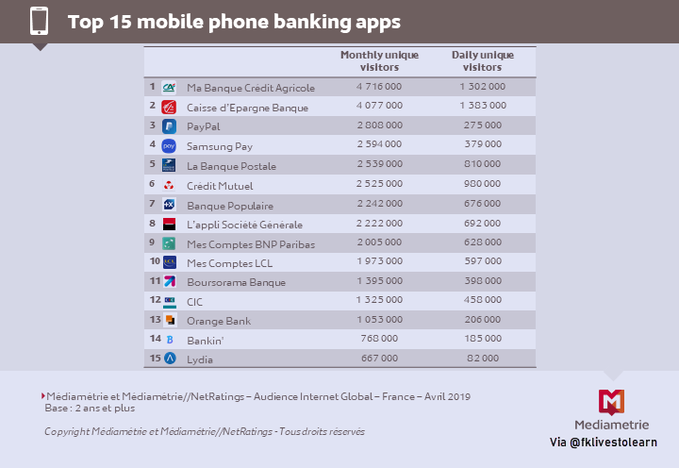
Top 15 Mobile Phone Banking Apps
Increased digitization in the finance industry has received a huge boost with the ensuing pandemic as people rely on digital applications in various industries. The following chart (Figure 6) shows some of the most used mobile phone banking apps in the World.
The Biggest IPOs of All Time
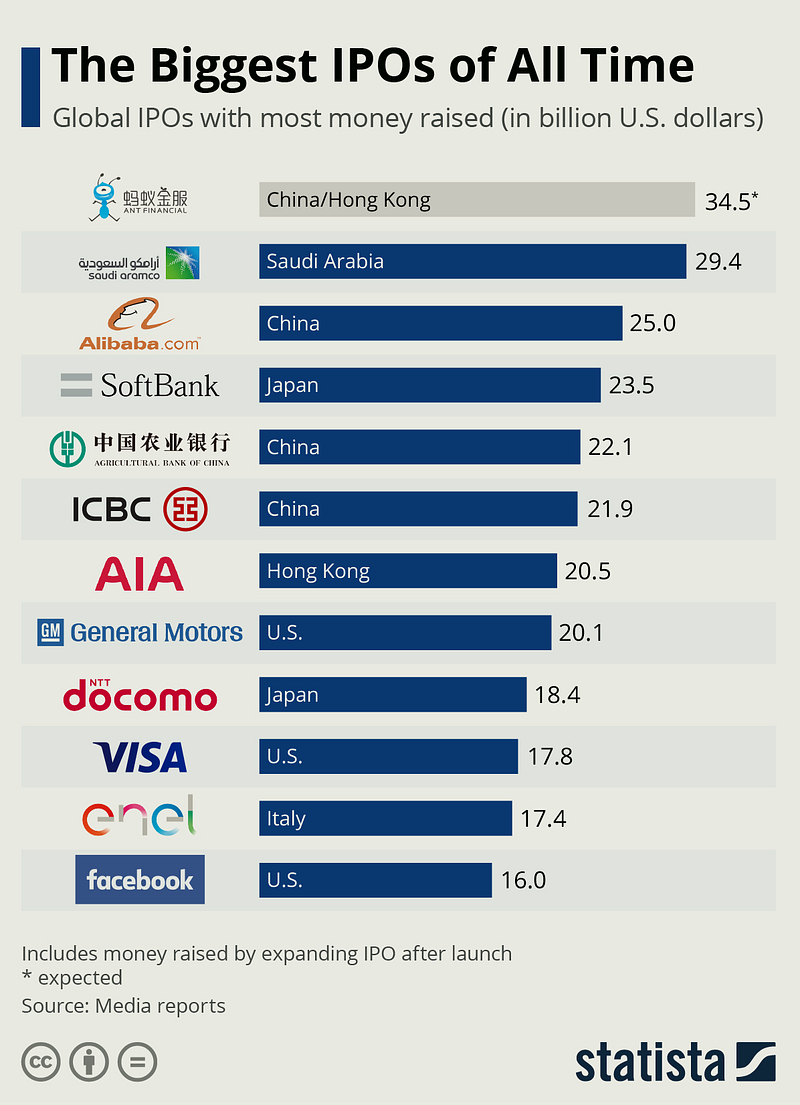
After the record for the world’s biggest IPO was just broken in December when Saudi state-owned oil company Saudi Aramco went public on the Riyadh stock exchange, payment provider Ant Financial is all set to break that record by collecting almost $34.5 billion in an IPO that is taking place in Hong Kong and Shanghai. The maker of top Chinese payment app Alipay will terminate its institutional book building in Hong Kong early, signaling demand is in fact strong enough to reach the expected result.
Saudi Aramco’s IPO brought in a little less — $29.4 billion — after the expansion of the original number of shares. Yet, less than 2% of the company became public in the process, while Ant Financial is going for 11%. The Ant Financial IPO would see another Chinese company added to the list of the biggest IPOs ever (Figure 7). Three Chinese companies are already among the current top 5, while the first U.S. company comes in at №7.
Widening inequality caused by the Pandemic
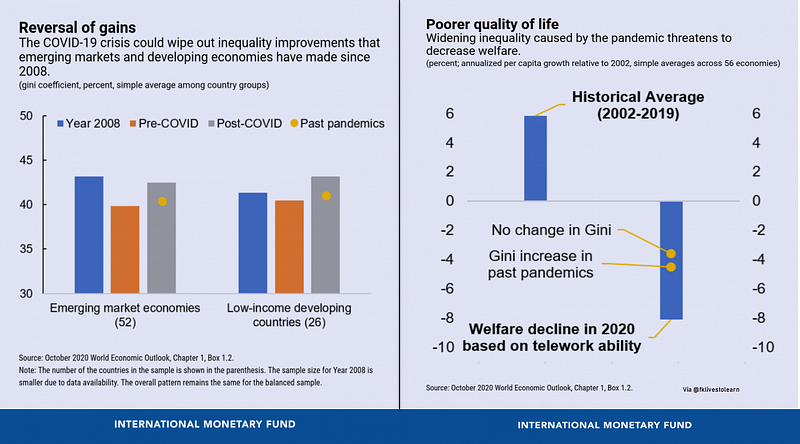
Emerging markets and developing economies grew consistently in the two decades before the COVID-19 pandemic hit, allowing for much-needed gains in poverty reduction and life expectancy. The crisis now puts much of that progress at risk while further widening the gap between rich and poor. Despite the pre-pandemic gains in poverty reduction and lifespans, many of these countries have struggled to reduce income inequality. The pandemic is expected to make inequality even worse than past (Figure 8) crises since measures to contain the pandemic have had disproportionate effects on vulnerable workers and women.
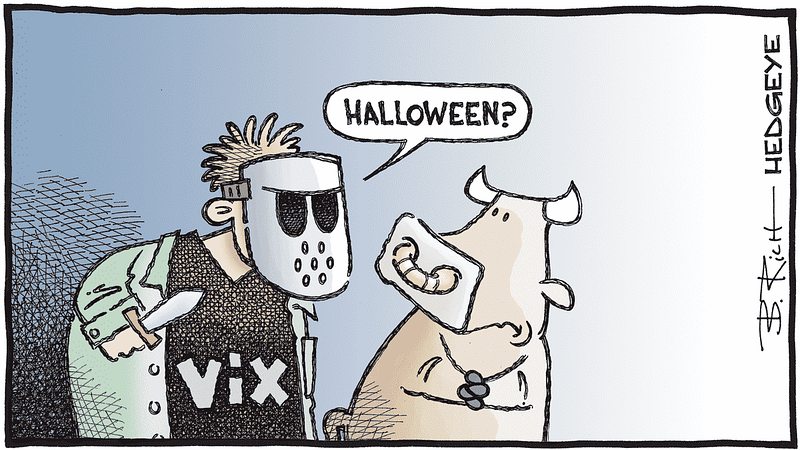
Market Humor: Halloween spooks the Bulls