
WEEKLY BUSINESS ROUNDUP
Global Business Week: A Guide to Investing in the entire Blockchain Ecosystem
The state of Financial markets & Economies, Weekly Charts, Business Trends & Statistics
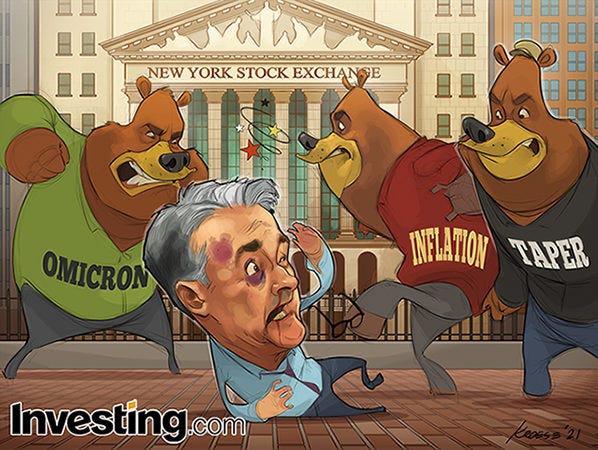
News of the fast-spreading omicron variant and a big miss on the U.S jobs report for November caused the U.S. equity markets to end Friday and the week lower. Along with this, the underlying prices pressure is putting more pressure on the Federal Reserve to do something about the rising inflation. And the indication came in the form of Fed Chair Powell’s testimony where he indicated that the word transitory for inflation should be dropped — the first sign that FOMC is turning hawkish on their monetary policy stance.
For the week, the Dow lost 0.9%, the S&P 500 fell 1.2%, and the Nasdaq finished 2.6% lower. A word that omicron is spreading and may be more contagious than the delta variant sent so-called recovery stocks tumbling— shares of casinos, cruise lines, and airlines declined. However, U.S stocks managed to limit some damage with last-hour buying on Friday. The Dow Industrials have been down four weeks in a row now. Rates tumbled, with the 10-year Treasury yield falling 10 basis points to 1.35%.
The US Dollar finished higher for the sixth consecutive week after November’s non-farm payrolls report crossed the wires Friday. However, US Dollar bulls appear to be easing off the gas despite increasingly strong Federal Reserve rate hike bets. Having said that, the safe-haven appeal of the reserve currency was in full swing on Friday as market volatility increased due to the Omicron variant threat.
DXY weighs the US Dollar versus a basket of currencies, with the Euro, Japanese Yen, British Pound & Canadian Dollar weighing at 57.6%, 13.6%, 11.9% and 9.1%, respectively. That said, looking at the individual movements in the respective pairs shows that the US Dollar’s strength has largely stemmed from the British Pound's weakness this week — dropping over half a percent on the week. DXY closed the week @ 96.15. CPI reading out of the U.S next week would be the key for the next moves in the Dollar.
If there was anything the resembles a crypto crash, it was evident in the premier digital currency of Bitcoin. BTC dropped more than 20% to as low as $42k, before rebounding strongly to above $49.2k at the time of writing. Ethereum, on the other hand, has been the strongest of the crypto lot lately — falling in tandem with its peer to around $3500, it is now trading just shy of $4200. With the exception of Solana, other Alt. coins haven’t really shown this resilience and have been weakening progressively. It would be interesting to see how this divergence plays out as risk escalates in other financial markets.
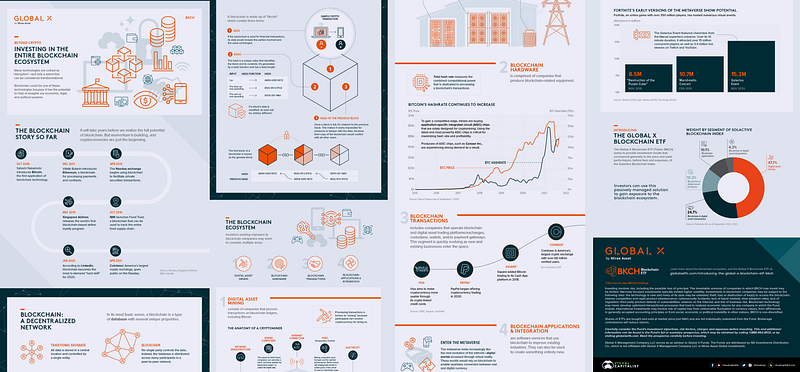
Blockchain is considered one of the “disruptive” and transformations technology with its potential to permanently change our economic, legal, and political systems. Today’s featured infographic from Global X provides an overview of the entire blockchain ecosystem and looks at some different ways investors can gain access to it.
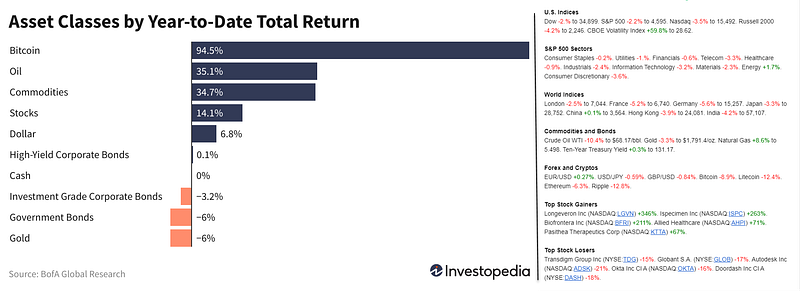
And finally, before moving on to some other statistics, here are the weekly & YTD numbers from various markets and different assets (Figure 1).
UN Humanitarian Aid
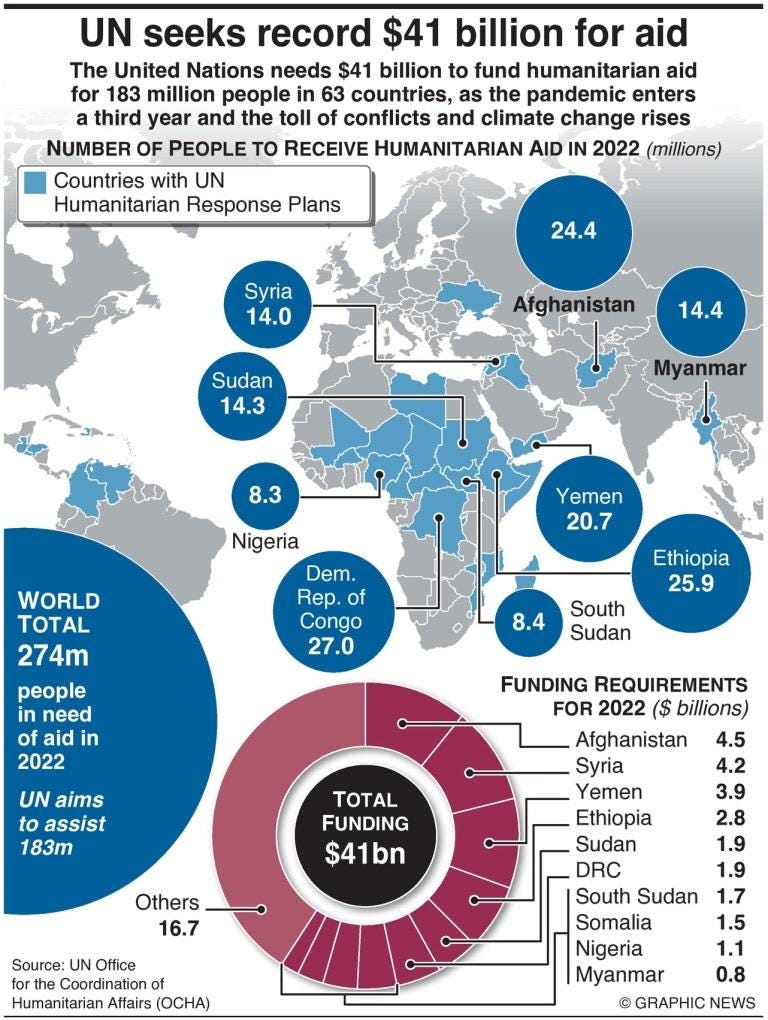
The UN needs $41 billion to fund humanitarian aid to help 183 million people in 63 countries as the pandemic enters the third year (Figure 2). Many underdeveloped countries are struggling under the crushing economic impact of the global pandemic. Millions in poor countries have lost their jobs as a result.
Network Volumes Compared
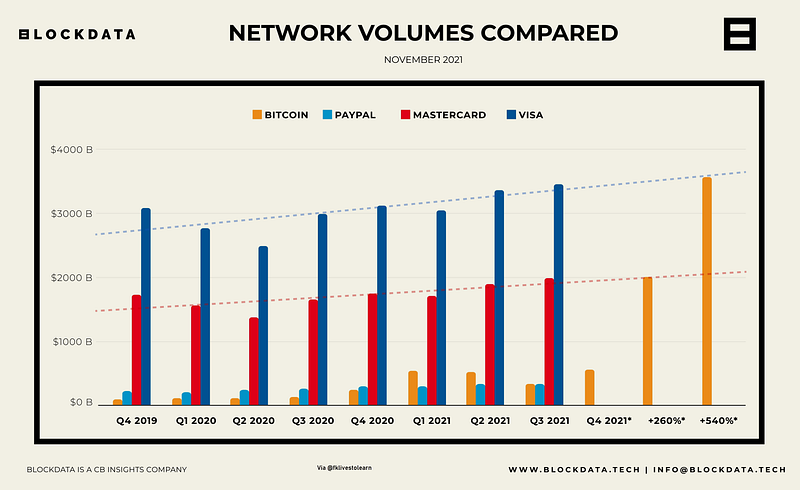
If we look at the data, the Bitcoin network processed an estimated average of $489 billion per quarter in 2021. To put that into perspective, PayPal processed an average of $302B per quarter in 2021, the Mastercard network processed $1.8 trillion per quarter or 260% more, and the Visa network processed an average of $3.2 trillion per quarter or 540% more (Figure 3). It’s impressive how Bitcoin, as a 12-year-old decentralized network, is 27% of the way in terms of one metric (volume processed) compared to Mastercard, a company founded in 1966. Especially when you take into account that this is a decentralized movement. Bitcoin is also a fundamentally different network from Mastercard and Visa. It is more of a “savings technology” than a “spending (more than you have) technology”. Naturally, they appeal to different use cases and audiences.
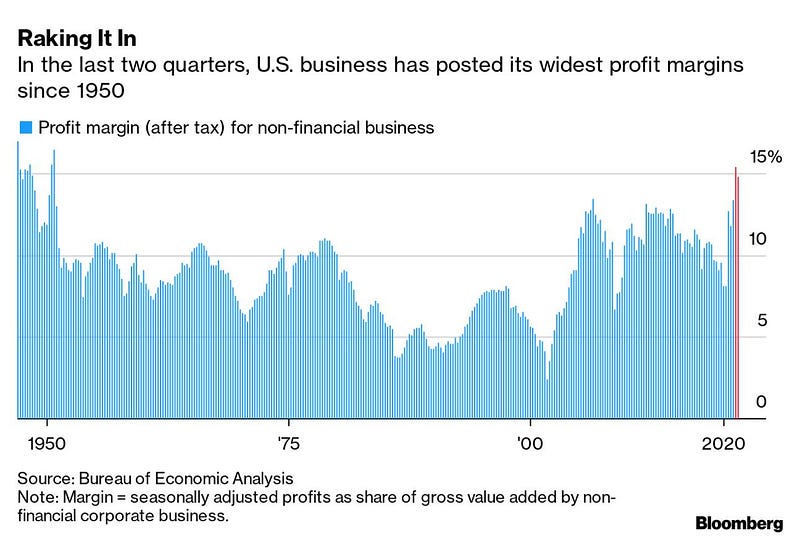
Widest U.S Business Margins since 1950
Yelps of inflationary pain from corporate America should be cries of joy. In the second year of a pandemic that started by wiping out 20 million U.S. jobs, American businesses are doing just peachy. In the past two quarters, U.S. corporations outside of the finance industry posted their fattest margins since 1950. On earnings calls, plenty of executives complain about the squeeze from rising labor and material costs. But overall, profits were up 37% from a year earlier (Figure 4).
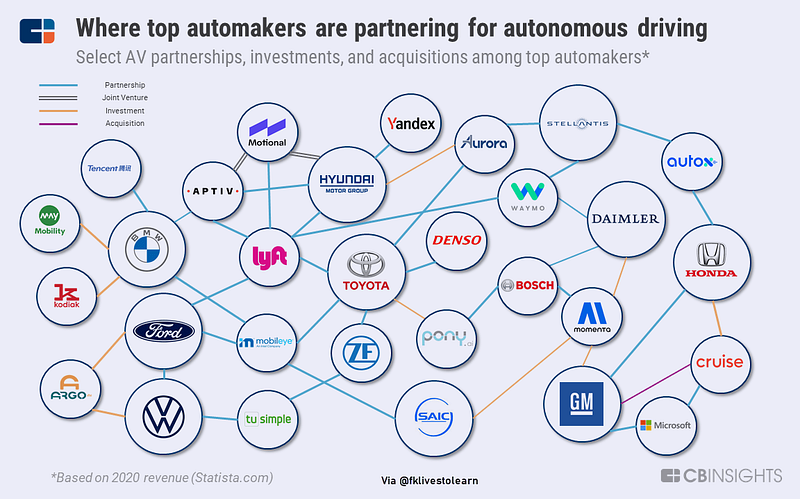
Top Automakers Partners
With autonomous vehicle (AV) tech reaching an inflection point, automakers, suppliers, AV developers, and big tech firms are partnering to bring self-driving solutions to market. Using CB Insights’ Business Relationships data, we can visualize the complex web of partnerships in the space (Figure 5). In addition to partnering with each other, automakers are teaming up with Tier 1 suppliers and full-stack AV developers. AV developers are especially eager to work with auto incumbents, as automakers and suppliers have the manufacturing expertise and capabilities to scale that can help these companies commercialize their technology.
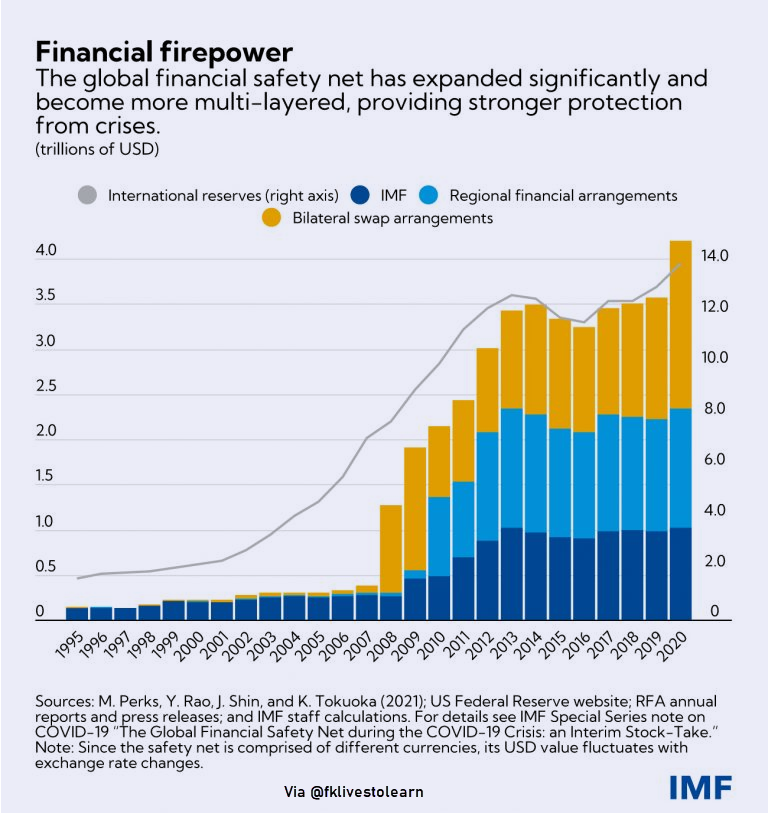
Expansion of Global Safety Net
When economic crises hit, such as the one caused by the pandemic, countries have a number of financial resources, both internal and external, to draw on. The global financial safety net is a set of institutions and mechanisms that provide insurance against crises and financing to mitigate their impact. This safety net has four main layers: countries’ own international reserves; bilateral swap arrangements whereby central banks exchange currencies to provide liquidity to financial markets; regional financial arrangements by which countries pool resources to leverage financing in a crisis; and the IMF.
As our chart below (Figure 6) shows, this global financial safety net has expanded significantly in the past decade and its sources have become more diverse. The chart, drawn from the recent IMF Special Series on COVID-19, shows that since the global financial crisis, the total stock of international reserve holdings more than doubled, reaching about $14 trillion by the end-2020. Other layers of the safety net increased about tenfold, to about $4 trillion.
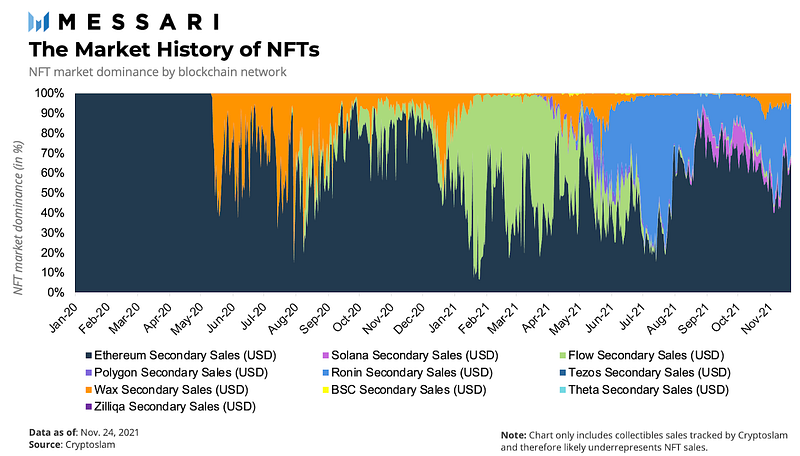
Market History of NFTs
While non-fungible tokens have existed for a long time, the market for such tokens was historically small. Early marketplaces like OpenSea and SuperRare, which were founded in 2017, grinded through a market that was mostly dominated by Ethereum until blockchains like WAX and Flow finally launched offering application-specific chains for gaming and consumer applications. In 2020, OpenSea was averaging $1 million in sales per month and the tail-end of the first Covid-19 year experienced growth (now considered a kindling fire) in NFT art and collectibles sales. December of 2020 witnessed some uptick in NFT chatter (Figure 7) with the growing excitement of NBA Top Shots and early Ethereum card games like Axie Infinity and Sorare. What comes next, you may already know, but let’s break it down by the data anyway.
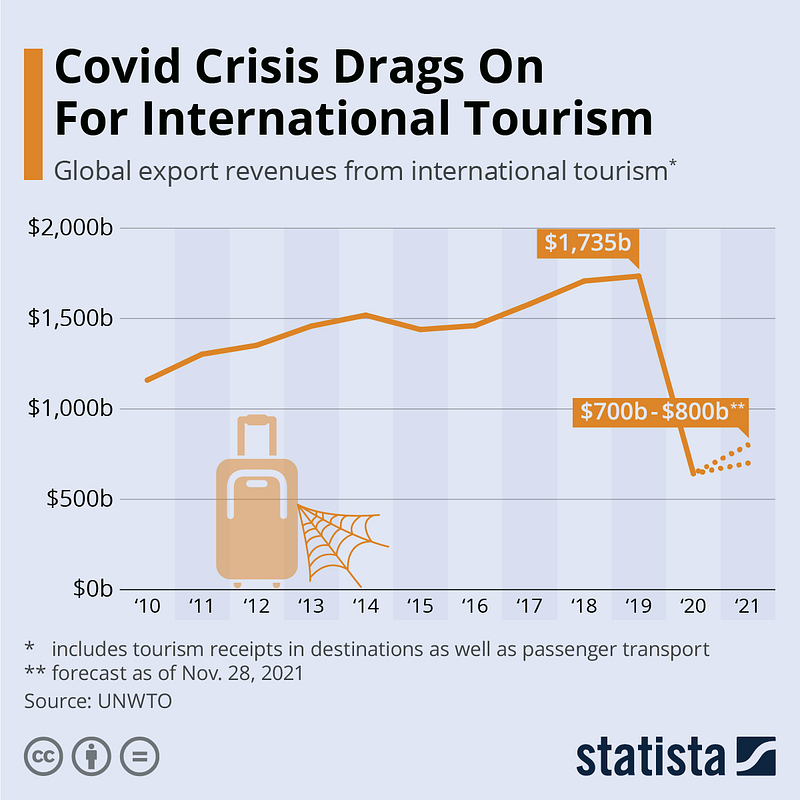
International Tourism Drag Continues
Amid fears that the newly discovered COVID-19 variant named Omicron could disrupt global travel once again, the World Tourism Organization (UNWTO) published its latest update on the state of international tourism on Sunday. According to the latest World Tourism Barometer, global travel activity rebounded sharply in the third quarter of 2021, while remaining far below pre-pandemic levels. International tourist arrivals increased by 58% in the three months ended September 30 compared to the same period of 2020 but remained 64% below 2019 levels (Figure 8).
Looking at the first nine months of 2021, the situation looks even bleaker with international arrivals down 20% even compared to 2020 and 76 percent below pre-Covid levels. While the latest rebound is certainly encouraging, the recovery of the global tourism sector has been going slower than many had anticipated last year. According to its latest forecast, the UNWTO expects international tourist arrivals to remain 70 to 75% below 2019 levels this year. That translates to roughly $1 trillion in foregone export revenues, which amounted to $1.7 trillion in 2019 and are expected to reach $700 to $800 billion this year.
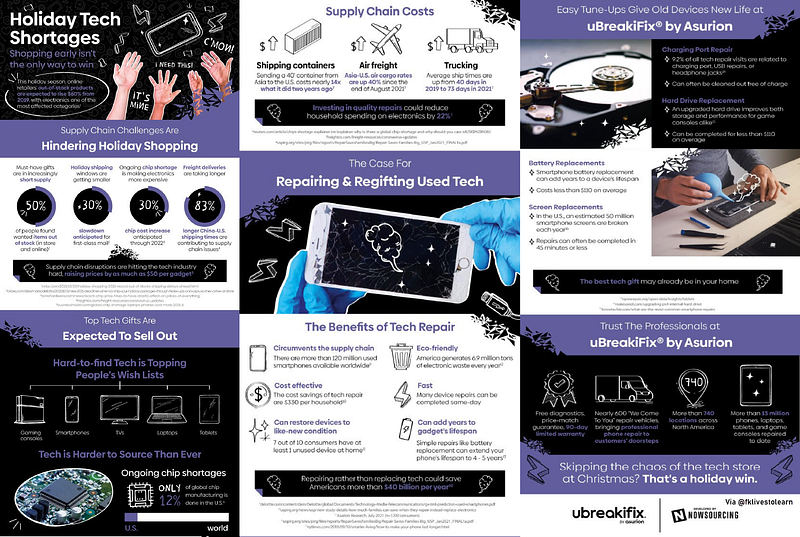
Tech Shortages Due to Supply Chain Challenges
Supply chain disruptions and the ongoing chip shortage are making it harder to score this year’s must-have tech in time for the holidays — but don’t stress. You can still give them the tech they want at a fraction of the cost, and without having to worry about shipping delays. In the infographic below (Figure 9), UBIF breaks down what’s happening with the supply chain, how it’s impacting holiday shopping, and what you can do to beat the holiday tech shortages.
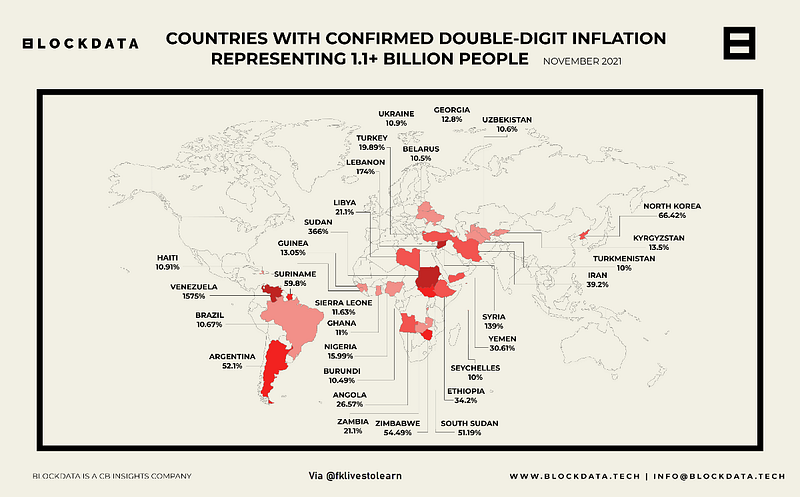
Global Inflation Worries Mount
Over 1B people across 25+ countries are suffering from double-digit inflation of their currency (Figure 10). At the minimum listed 10% inflation, their purchasing power will halve in just 8 years. As many countries experience high inflation, people will increasingly look for another store of value — which may drive crypto adoption.
Market Humor: Renewed Virus, Inflation Fears Rattle Markets!

Previous Edition of GBW
Read more stories like this and others by Faisal Khan on Medium.
Stay informed with the content that matters — Join my weekly Newsletter