
WEEKLY BUSINESS ROUNDUP
Global Business Week: 5 Fastest-Growing Industries of the Next Decade
The state of Financial markets & Economies, Weekly Charts, Business Trends & Statistics
Despite phenomenal earnings with a record number of companies in the S&P 500 beating analysts’ forecasts, investors are erring on the side of caution, as guidance for the current quarter and the rest of the year remains weak. At the same time, sweeping crackdowns across China against tech companies continued to send shockwaves across financial markets. U.S stocks posted modest losses on light summer volume Friday, with Amazon dropping the most in more than a year (7%) after reporting its first quarterly revenue miss in three years and providing disappointing guidance.
Nevertheless, the major U.S equity averages wrapped up a solid month. The Nasdaq and Dow have added 1% and 1.4% respectively in July, while the S&P 500 is up 2.2% over the same period. Utilities, health care, real estate & technology stocks have led the S&P 500 higher for the month, while energy and financials have lagged. That’s the opposite of what was happening in January and February, which is a telling sign that economic momentum is slowing.
The Greenback took a hit after last week’s Federal Reserve interest rate decision. Inflation measures, as well as short-term expectations, have trended higher as the economic recovery gains steam. That sent the US Dollar DXY index to fresh multi-month highs preceding the July rate decision. However, the benchmark index slipped towards the end of the week with policy expectations largely unchanged and instead will have traders looking forward to other high-impact events farther down the road. Next Friday’s non-farm payrolls report for July will serve as the next potentially eventful economic data print.
Moving on to the digital assets, after consolidating for a few days, the rebound that started off the lows reached on July 20th has resumed course — at the time of writing, Bitcoin is hovering around $41.6k while Ethereum has topped $2,500. Rumors about Amazon looking to accept mainstream cryptos & developing its own digital currency — although shunned by the company, it provided further impetus to the rally after the e-commerce giant published a job for a digital currency lead. Technically speaking, both BTC & ETH have broken the descending trend line and also overtaken the recent highs. Things might finally be looking a little rosier for cryptocurrencies.
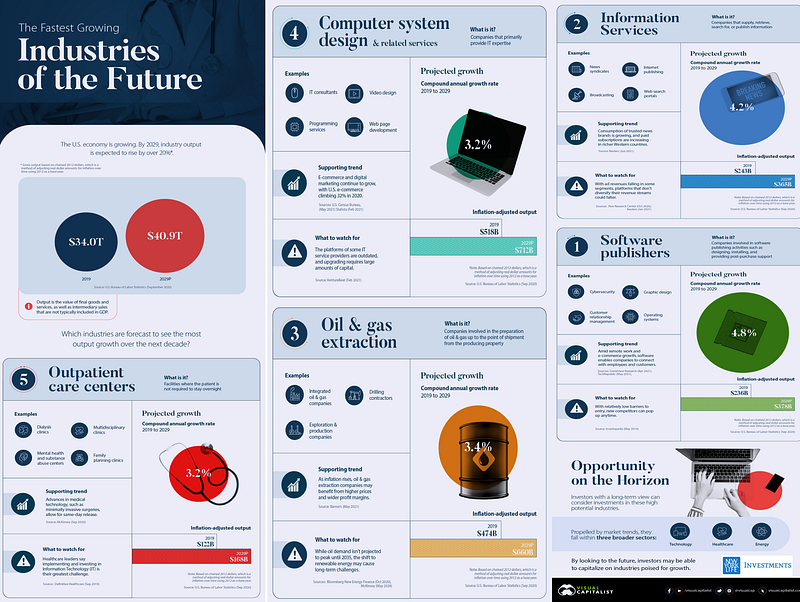
Today’s featured infographic from New York Life Investments looks at the industries projected to see the fastest growth rates over the next decade. Most of the global economy today looks much different than a century ago. The industrial revolution of the earlier twentieth century and the technological boom of the last couple of decades have shifted the dynamics substantially. The visualization tries to answer the question about what will be the fastest-growing industries of the future?
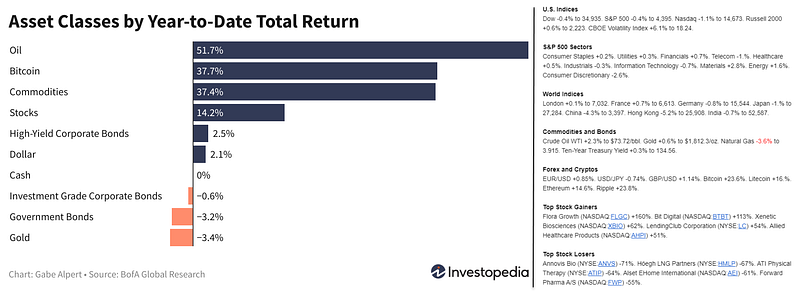
And finally, before moving on to some other statistics, here are the weekly & YTD numbers from various markets and different assets (Figure 1).
Latest Economic Growth Projections
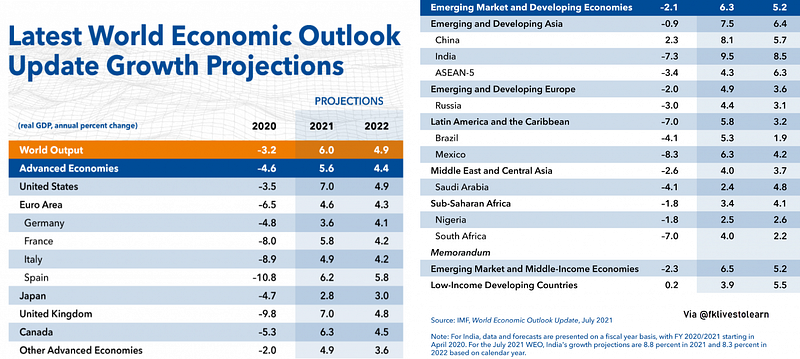
The global economic recovery continues, but with a widening gap between advanced economies and many emerging markets and developing economies. IMF forecasts a growth of 6% for 2021, which is unchanged from the previous outlook, but the composition has changed. Growth prospects for advanced economies this year have improved by 0.5 percentage points (Figure 2), but this is offset exactly by a downward revision for emerging markets & developing economies driven by a significant downgrade for emerging Asia. For 2022, IMF projects global growth of 4.9% up from our previous forecast of 4.4 %. But again, underlying this is a sizeable upgrade for advanced economies and a more modest one for emerging market and developing economies.
Comparing Global Tax-to-GDP Ratios
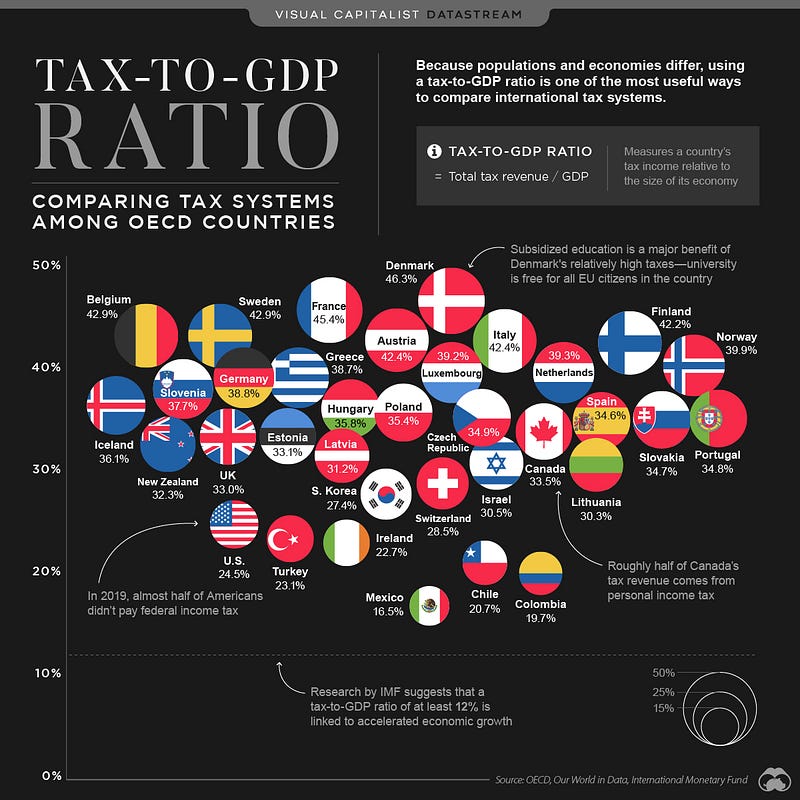
Taxes are an important source of revenue for most countries. In fact, taxes provide around 50% or more of government funds in almost every country in the world. How does each country’s tax system compare to one another? Since countries’ populations and economies differ greatly, measuring total tax revenue is not the best way to compare international tax systems. Instead, using a tax-to-GDP ratio is one of the more useful ways to compare tax systems around the world — it compares a country’s tax revenue to the size of its economy, which in this case is measured by its GDP. According to research conducted by the International Monetary Fund, countries should have a tax-to-GDP ratio of at least 12% in order to experience accelerated economic growth. The countries that are part of the Organisation for Economic Co-operation and Development (OECD) all meet that threshold, with an average tax-to-GDP ratio of 33.8% (Figure 3).
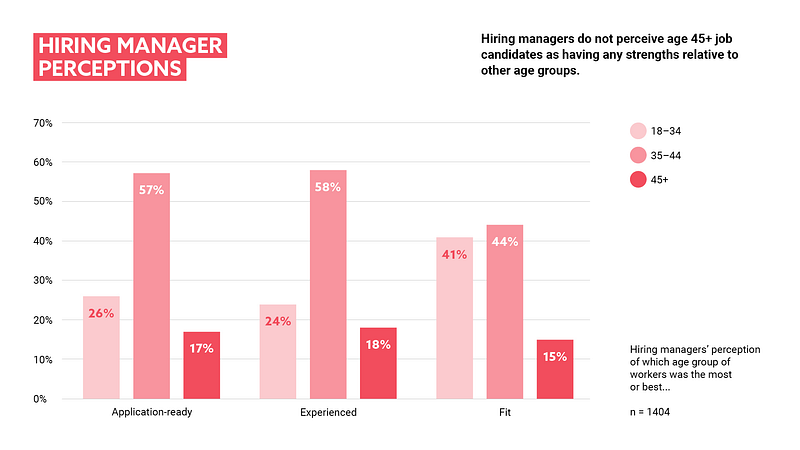
Hiring Manager Perceptions
A new study said ageism is having a big impact on midcareer workers, especially following the outbreak of the COVID-19. The survey by Generation, an international nonprofit that assists people in getting jobs, covered seven countries, including the U.S. and U.K. It found those in the 45 to 60-year-old age group faced persistent and rising pressure in the global job market (Figure 4). The report indicated the difficulties those workers faced have been exacerbated by the rapid adoption of digital technologies during the pandemic, which sped up automation of jobs and increased the technical skills now required by employers. What’s more, those in that age bracket showed a hesitancy to receive training to keep up with the digital advances. In addition, the researchers said they saw a strong perception bias against older workers by hiring managers, who saw them as less desirable than younger ones.
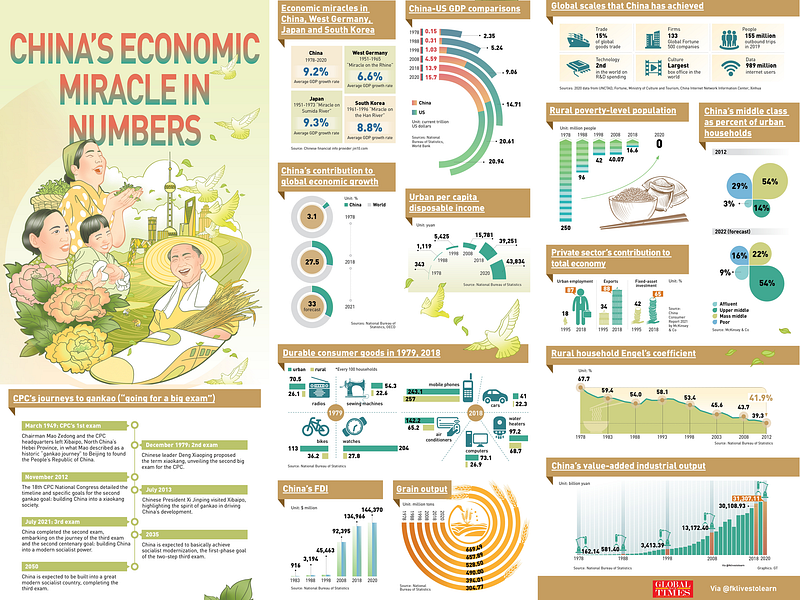
China’s Economic Miracle in Numbers
On July 1, China declared that it had reached its first centenary goal — building a moderately prosperous society, or Xiaogang, in all respects, and it is marching confidently toward the second centenary goal of building China into a great modern socialist country. To decipher what that means in the context of where China is and where it is heading, the Global Times is publishing a series of multimedia products about various aspects of the achievements under the Xiaogang goal. The following infographic focuses on figures and indexes that underscore China’s economic miracle (Figure 5).
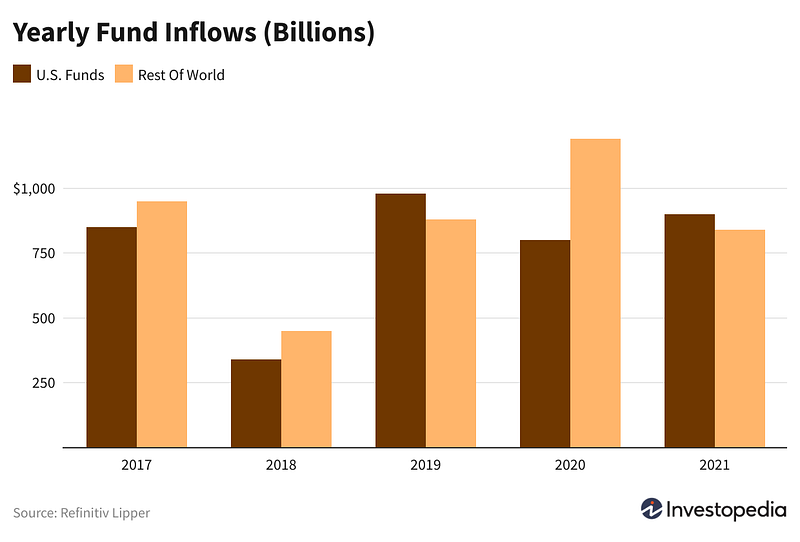
Investment Flows into the U.S
International investors have funneled $900 billion into U.S.-domiciled mutual funds and exchange-traded funds in the first half of 2021, according to Refinitiv Lipper data. $900 billion is a record for first-half fund inflows in data going back to 1992 (Figure 6). It’s greater than the amount invested everywhere else in the world during the first six months of the year. It’s also greater than the U.S.’s fund inflows for the whole of 2020. Data from the last week, however, suggests that equity fund inflows may not continue at their current pace all year — in the U.S. or elsewhere. On Friday, Reuters (a minority owner of Refinitiv and its former parent) reported that global equity funds recorded net outflows for the first time in six weeks in the week to July 21 as concerns about a global resurgence in COVID-19 cases weighed on investors’ economic outlook.
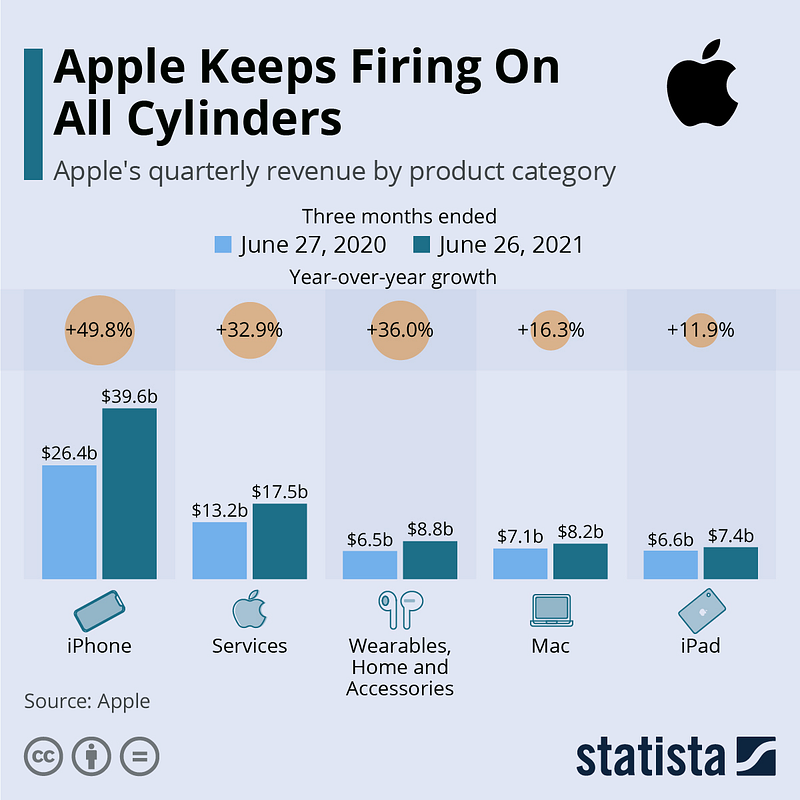
Apple Continues its Strong Growth
Following a strong end to 2020 that saw Apple beat its previous revenue and profit records in the fourth quarter, the world’s most valuable company carried that momentum into 2021. Last Tuesday, the iPhone maker reported yet another blowout quarter that saw revenue soar by 36% to $81.4 billion in the three months ended June 26, the third quarter of Apple’s fiscal year (Figure 7). Traditionally the weakest quarter for Apple as potential iPhone buyers hold out for the new models that typically arrive in September, this year’s June quarter was the strongest ever, nearly doubling the company’s previous record in terms of June quarter profit. Apple posted double-digit growth in each of its product categories, with iPhone, Services & Wearables, Home & Accessories standing out with 50,33 and 36% year-over-year growth, respectively.
Market Humor: Blowout Earnings for Big Tech

Previous Edition of GBW
