
Girthing
Why the Spelling Bee accepted the noun but not the verb is a question that needs a measured answer
Today’s New York Times Spelling Bee letters:
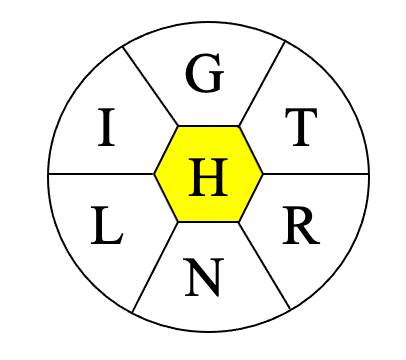
G, I, L, N, R, T, and center H (all words must include H)
Merriam-Webster says…
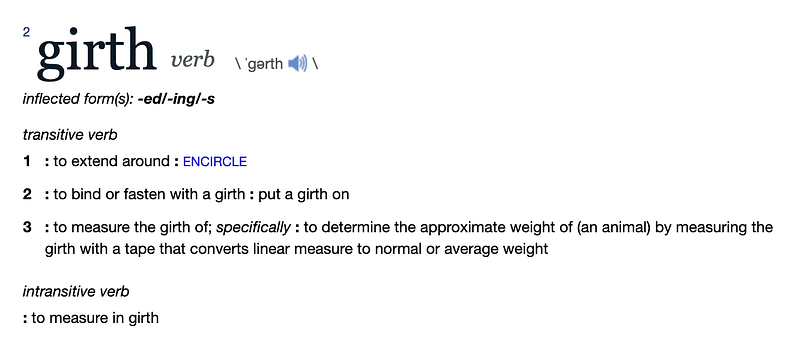
Silly little dictionary! Don’t you know girthing can’t possibly be a word if the New York Times says it ain’t?
For further fascinating facts, check out the Spelling Bee Master.
What’s your favorite dord* from today’s puzzle?
My Two Cents
There have been many instances in which the rejection of a word by the Spelling Bee has befuddled me. Alee is one of those instances, although I have yet to write a column about that word. Hopefully I’ll get to do so before the Spelling Bee stops rejecting it. That way I can pretend to take credit for having convinced them, although I have the feeling they don’t read my articles often… if ever.
Now, today’s game includes the letters I-N-G, which as any regular player knows, means any verb you can come up with you can also add -ing to create its gerund form or turn it into a participle or a noun. For example, r-i-g-h-t gives you the verb right (to do justice) and the present participle righting. Similarly, add -ing to light and you get lighting, which a participle and a noun (as the gerund form).
Then there’s girth, typically thought of as a noun:
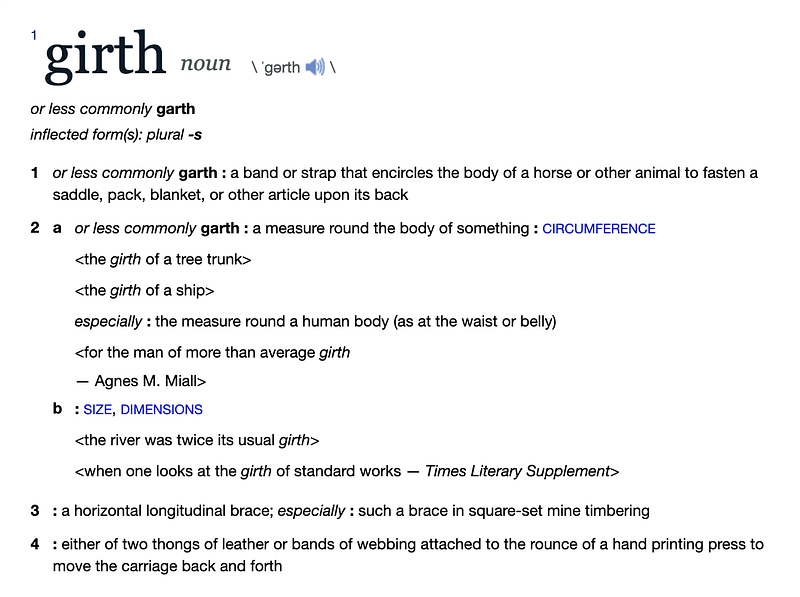
But, as you noticed earlier, it’s also a verb. And Merriam-Webster clearly says that one of its inflected forms is girthing:
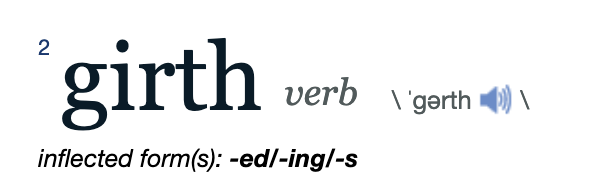
So what’s the deal, Spelling Bee? Why accept only the noun form of the word but not its meaning as a verb? I mean, if I added -ing to girth, I’m sure many other players did, too. What was so hard about giving us that small satisfaction today?
Saddle up, guys
The second definition the dictionary gives for the verb girth is “to bind or fasten with a girth : put a girth on”, and since the first definition of the noun girth refers to a band used to fasten a saddle to a horse, I assume the verb also refers to saddles. And, although I know what can happen when you assume, today I’ll take that risk. After all, horses and asses are related.
Basically, a girth is a piece of equipment used to keep the saddle in place on a horse or other animal by wrapping itself around the chest and attaching itself to the saddle on both sides by two or three leather straps called billets. English and Australian saddles typically use girths, while in the U.S. western saddles have a cinch, which uses a single wide leather strap.
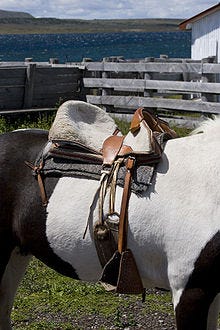
Wikipedia claims the photo above shows a girth on a Chilean saddle, but I’ve never heard of any Chileans named Ealdgyth. Maybe the photographer’s family came over to Chile from Ireland. If you’ve ever been to Chile and have seen this type of setup on a horse, please let me know in the comments.
Wikipedia further claims this:
“Several types of girth are shaped to allow ample room for the elbows. The Balding style is a flat piece of leather cut into three strips which are crossed and folded in the center, and the Atherstone style is a shaped piece of baghide with a roughly 1.5” wide strip of stronger leather running along the center… Fleece girth covers are often used on sensitive horses to protect the barrel of the horse, and some styles of girth come with attached or removable sheepskin liners that perform the same function. A dressage girth, or Lonsdale girth, is shorter than the usual girths used on other saddles... An overgirth or surcingle is often used in addition to a regular leather girth… [and] completely encircles the horse around belly and the saddle’s seat. It is used by stockmen, eventers, polo players, in flat racing, and by steeplechase jockeys to provide more security in holding the saddle in place.”
So there. That’s probably a lot more than you were expecting to learn about saddles today. You’re welcome. I think…
Write like an Egyptian
It’s common knowledge that humanity is on a downwards spiral when it comes to communicating via writing. The proof is in the pudding, as they say. Or, in this case, in the pockets of billions of people who use smartphones on a daily basis.
Humans started writing by drawing pictures; the best-known may be Egyptian hieroglyphs, but there are other examples. Now, after reaching the acme of literary expressions over the past few centuries (so many great writers to pick from!) we are back to sending these types of messages:
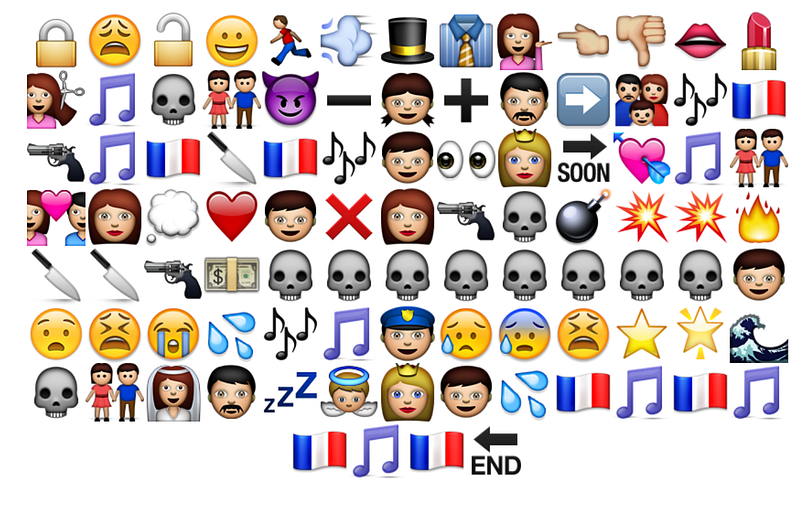
In case you haven’t figured it out, the above is a summary of Les Misérables, by Victor Hugo.
Despite the fact that this sounds like the beginning of a rant, it’s not… or not really. Although I’m not one to go crazy over new tech, I’m also not a Luddite. Just ask my assistant Iva Reztok, whom I give my columns that I typed on my Olivetti Lettera 22 so he can post them here on Medium.
Seriously, though, I think emojis have some advantages, the main one being giving emotional context to messages that may otherwise be misinterpreted. I can’t tell you how many times I’ve avoided trouble by adding a smiley face or a winking emoji to an email or text message. It may not seem very professional, but it’s kept me from losing my profession.
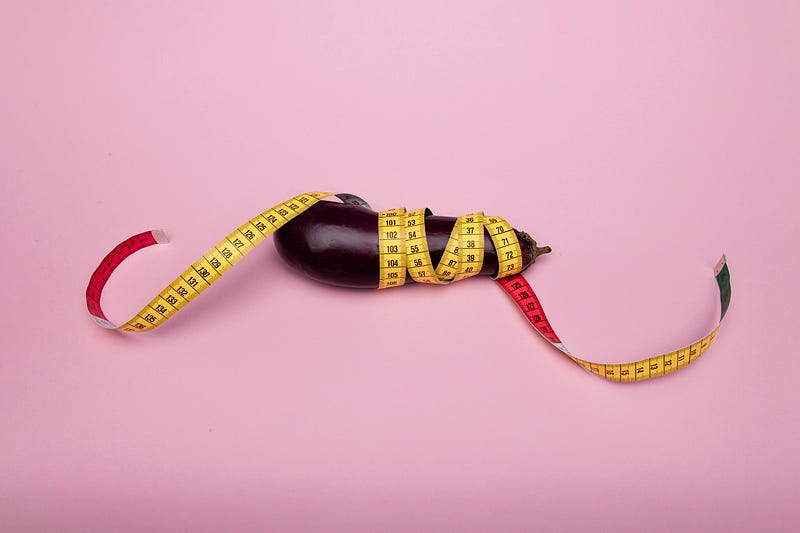
Why am I mentioning emojis in an article about girth? You did see the photo at the top, didn’t you?
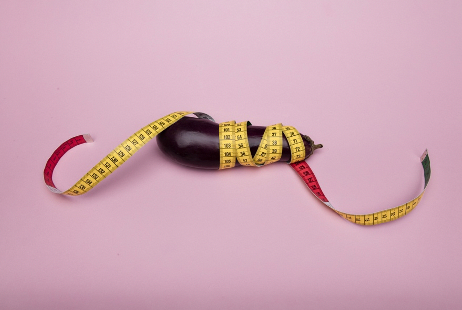
The eggplant has become the 21st-century symbol for the penis, substituting the banana’s run of, well, probably the last three or four thousand years!
How did this happen exactly? Glad you asked! Not because I know, but because firstwefeast.com has some answers.
Emojis were invented by NTT Docomo Inc. (the main cellphone operator in Japan) to get Japanese teens to buy pagers. (Kids, ask grandpa what a pager was.) And because it was designed for kids, emojis were, at first, innocent smiley faces and hand gestures. In 1998 or 1999 Shigetaka Kurita created the first 176 (some say 282) emojis as a way to help Japanese texters clarify messages that could be misinterpreted.
The original set included such food items as a rice ball, a hamburger, a slice of cake, and even a banana… but the eggplant wasn’t important enough to be called up from the emoji “minor leagues”.
Japanese phone companies started competing with their own emoji sets to win over customers. Apple adopted one of these sets for the first official iPhone emoji keyboard in 2008. However, the eggplant did not make its American debut until two years later. Immediately some smart-alecky person decided that this purple plant perfectly personified penises.
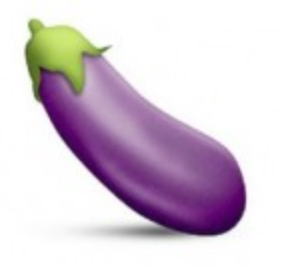
Hmmm… from this angle, I must admit there’s something to it.
As firstwefeast.com explains:
There’s still the question of why the eggplant made the jump to the dark side. Even if we rule out the banana for its grade-school awkwardness, why not the corn cob, the snake, even the Easter Island head? It’s precisely because Americans had no cultural association with eggplants prior to the emoji revolution that it was the perfect euphemism. Corn on the cob is too familiar, too closely associated with teeth; and can you even read the phrase “trouser snake” without hearing it coming from Grampa Simpson? It’s corny as hell. But the eggplant is a vegetal blank slate. How many people have even seen an eggplant — especially the Japanese eggplant, a longer, skinnier variety than the genetically-engineered oddity commonly found in North America — let alone harbor deep personal feelings about them? Add to that the shape, the color (sure, purple isn’t anatomically perfect, but it’s a lot closer than bright orange or yellow), and the triumphant up-thrusting angle, and the emoji eggplant is the perfect conduit for our dirty thoughts.
Now, how is the eggplant emoji connected to the word girthing? Well, duh, I used a photo of an eggplant being girthed. We can title it “Girthing Aubergine”.
That may not be enough to convince the editors of the Spelling Bee, however, who decided that the word girthing is a dord*.
You can check out my previous entry on another dord* here:
*What the heck is a dord, you ask? Here’s the answer: