
Getting Started Writing Fiction On Medium
How to start with the platform and how fiction works here.
A lot of people have asked me about transitioning from writing fanfiction, especially on Ao3 and other sites, to writing original fiction, and where to put it.
I have a Patreon, and I also have a Medium account, and I crosspost most everything to both of them — the thing about Patreon is that it obviously requires a specific sign-up and subscription to you, so you need an established readership already before you start gaining subscribers.
On Medium much of the content is paywalled, but it’s different here.
On Patreon, one subscribes to a specific creator or creator collective, and you pay money into their Patreon for access to whatever exclusive content they might have, whether it’s art, fiction, video, etc.
Medium is an open platform where people post all varieties of written work — the bulk of this is non-fiction.
A lot of people post work about freelancing, editing, self-employment, business, technology, education, and so on on Medium; I personally follow a lot of queer commentators who write essays about queer politics and culture, as well as a lot of film and TV critics.
Medium is not a website devoted to fiction, and fiction writers are a significant minority on the platform — but with that said, in the Fiction tag right now, there are 217K stories and 60K writers.
On Medium, you can choose to post things so that they’re generally available, and readable by anybody on and off the platform.
Once you become a member of Medium’s Partner Program, for which you need 100 followers and to have published at least one story, you can paywall your work to be readable only by Medium members, meaning you can be paid for it. You can stay a member of Medium’s Partner Program so long as you publish something at least every six months on the platform.
For Medium’s paywalled work, which is referred to on here as “metered content”, one has a general Medium subscription for $5 per month. The $5 Medium subscription lets you access any and all work on Medium behind the paywall.
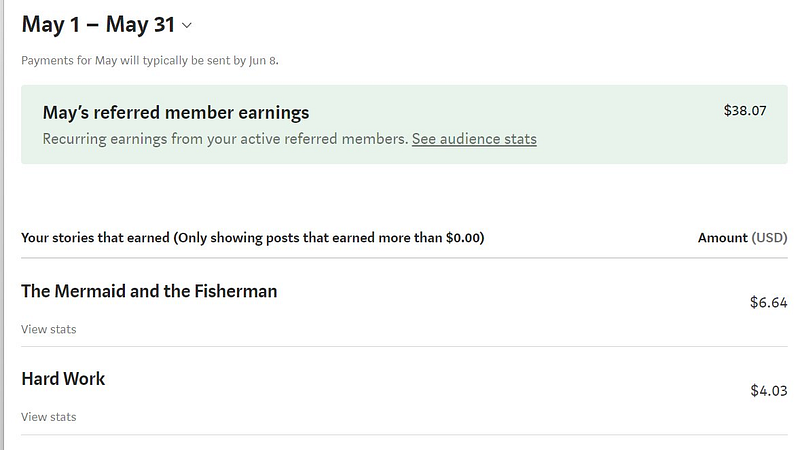
The above is a screenshot of my earnings for May 1–31 in 2023, where overall I earned $129.66 for the month.
You can see that I earned $38.07 for my referred member earnings — on Medium, if someone signs up to Medium’s partner program after being referred from your work, you get a portion of their $5 subscription fee each month. I currently get that $38.07 from 17 referred members, so out of a $5 fee you get about $2.23 each month.
At the bottom of the page, I have a referral link that shows up, and if you click on it it looks like this:
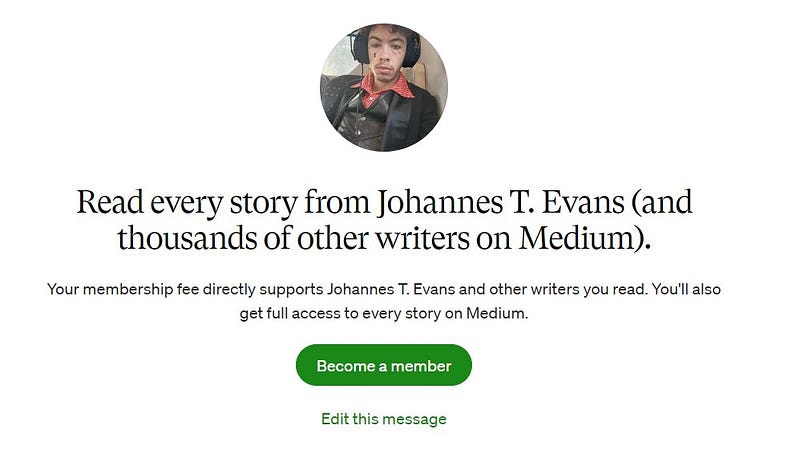
If you want to sign up with my referral, you can click here, but if you’re gonna sign up to Medium and have another favourite creator on here, go check their page and look for their referral link, and that’s another way you can support them. They’ll get $2.23 of your $5 for every month that you remain a subscriber.
The rest of the $91.59 I earned came from reads on my stories — Medium pays you based off the amount of time that’s spent reading each of your stories over the course of the month.
And these were my top earners for May: The Mermaid and the Fisherman, an erotic fiction short, earned $6.64; Hard Work, a romance fiction short, earned $4.03.
I by no means want to present Medium as some sort of huge moneymaker — I typically make about $100 to $130 from Medium a month, primarily from writing fiction.
I’m currently trying to write more non-fiction and do more media commentary — my third top earner on Medium that month was actually the big essay I wrote on homoerotic subtext in Nightmare on Elm Street 2, at $3.97, but the bulk of my back catalogue is in fiction.
I’ve been writing consistently on Medium for about three years now, and my back catalogue of fiction pieces is hundreds strong, which is part of why my earnings are so consistent on the website — people read a new piece of mine, and then if they like it they might read back through the rest of my work.
Obviously to get started in the Partner Program you need to have 100 followers, and you need to have at least one piece published — my goal with the new Trans Erotica publication is to build up a larger base of trans fiction writers here on Medium, because I want more people’s work to read fiction-wise.
I’m hoping that as there’s more of us creating on the platform, it’s going to be easier to build up a following — especially because with more trans erotica writers here on the site doing the same thing, writing different types of erotica and other sorts of fiction, other readers that aren’t necessarily interested in writing themselves will be incentivised to join up and read and comment and engage, as paying subscribers or just as free Medium members.
I’d like to create a network of more trans and queer fiction writers on here whether they’re interested in writing erotica and/or submitting to my publication or not, so I’m hoping this guide will be useful to them and to anybody else.
Especially because I have a background in fanfiction on Ao3 and Tumblr, I get that it can be daunting to come away from writing fanfiction and to start writing original fiction instead, not necessarily because the writing itself is difficult, but because suddenly you have to start finding other platforms or reaching out to new readers, and there’s not the built-in readership that comes with writing in fandom, and especially writing ships.
It can feel terribly lonely, and as though everything you write is just going out into a void, and initially as you start out on a new platform like this one, that will likely continue for a little bit longer.
It takes time to build up an audience, and while submitting your work to publications here on the site and using the tags can put your work in front of more people’s eyes immediately, starting out is always hard, and it can take time to find your stride.
Before we get started, here are the Medium Guidelines, which you should read.
Note especially these policies:
Graphic content We do not allow posting, linking to, or otherwise promoting pornographic images or videos. We do allow erotic writing and non-graphic erotic images.
Erotica is allowed, but note “non-graphic erotic images” — you can post comics here on Medium if you like, but if you want to post smuttier comics, or post smutty art of yours alongside your work, note that it has to be non-graphic.
Exploitation of minors We do not allow content promoting the sexual, violent, or other exploitation of minors, including the sexualization of fictional minors.
With that said, note that on Medium there is no policy against content about sex and sexuality, that erotic writing is specifically permitted, and that Medium also doesn’t have any on-site policies against writing work that deals with taboo or potentially triggering topics, such as rape and sexual abuse, incest, erotic hypnosis, or similar, as Patreon, Ko-Fi, and other sites do.
As with using Patreon or any other website, there’s always a risk that if you do want to write harder or more upsetting topics, it might be okay today and not okay tomorrow, and that can include erotica in general.
If you typically write taboo erotica, that can be even more of a fear, so just bear in mind that policies can change and that whatever you publish, it’s at your own risk. I do know that there are people who write a lot of taboo erotic topics here on the site, such as incest, rape, etc, and if you search in the tags, you can likely find examples.
You will find that many publications — including Trans Erotica — will stipulate that they don’t accept certain topics.
Setting Up Your Profile
First, make your account, confirm your email address, etc.
You do not have to use your real name on Medium if you don’t want to — you can use a pen name, you can use a pseudonym, whatever. If you want, you can even set up multiple accounts and use multiple pseudonyms, there’s no policy against it, so if you want to keep your general work and your erotica under different names, or if you want to make a separate account for darker themes, you can absolutely do that.
If you sign up for the Medium Partner Program, you will have to fill out a tax form and sign up for a Stripe account, and for those you’ll need your real name and ID info, but none of that information will be displayed publicly.
Click on your icon in the top right-hand of the Medium screen, and from the drop-down menu, select Profile.
To the right-hand of the screen will show your profile, and an option that reads Edit Profile. Click this.
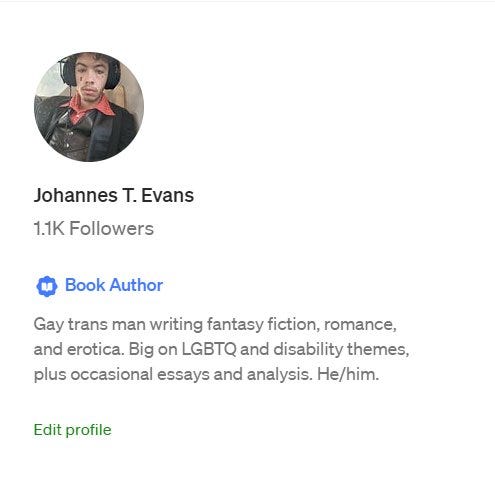
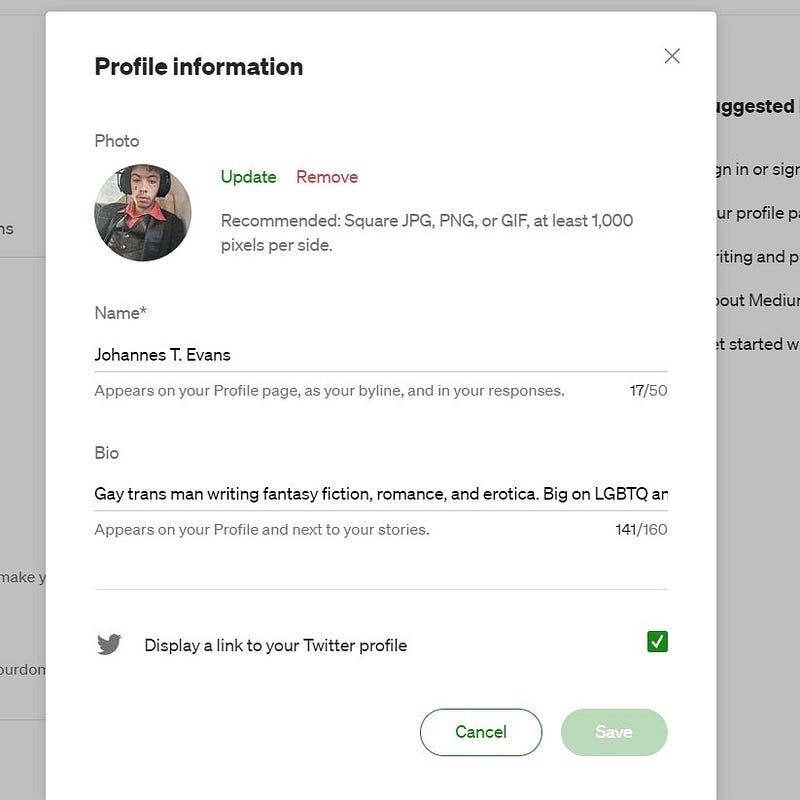
Edit your profile information.
Your profile image does not have to be a photo of yourself. You can put in your favourite Picrew, a picture of your cat, a picture of your book cover if you’ve got one, etc. Just make sure it’s an image you’ve got the rights to and go ahead.
Your name has 50 characters in it, and I would generally recommend keeping it neat and clean, to just your name or pseudonym, with your pronouns if you’d like to include them there. You don’t need to fill up the whole 50 characters just because they’re there.
Your bio is 160 characters, and as well as appearing on your profile, it will appear if someone hovers over your name around the website, and also in your by-line as the bottom of any stories you write.
I know it can seem like a chore, but having a profile picture and a bio means you’re more likely to be assumed to be legitimate on the website, and not just a bot or spam, especially once you start submitting to publications.
You can get that little Verified Author badge if you’ve published a book that has an ISBN number — you don’t need to be a member of Medium’s Partner Program, and you don’t need to be a paying Medium member either. Just go to the below page and sign up:
As well as getting the cute little badge, when someone goes to your profile, they’ll see your book featured on your profile page!
Also under Profile, click your About Page, and write more stuff in there. It can be the same as your 160-character bio, or it can be more extensive, it can include hyperlinks, pictures, et cetera.
Adjust Account Settings
Under Account:
- add a subdomain if you want to — this just means your profile will appear as username.medium.com instead of medium.com/@username
- go into Profile Design and change the accent colours and fonts on your profile if you feel like it
- if you have a custom domain, you can set this up here, although you need to be a Medium member
Under Publishing:
- allow readers to leave private notes on your stories — this will enable publication editors to give you feedback on anything you submit to them, and a lot of publications will ask that you have private notes turned on for this purpose
- add a tip jar if you have one — you can add your Patreon, you can add your Ko-Fi, etc.
- share your subscribe page — this lets people get your stories directly to their email inbox, and they can read from their email.
Under Notifications:
Edit these as you please.
I just hate receiving emails from websites and I always forget to turn them off, so if you want to do that, do that! Otherwise, pick and choose the emails you want to receive and which you don’t.
Under Security and Apps:
Connect your Mastodon, Twitter, and/or Facebook if you would like to. If you’re a Medium member, you can set up a Mastodon under Medium’s Mastodon instance if you’d like to do that.
Do I have to be a paying Medium member to publish on here?
Nope.
You don’t have to a Medium member to write things and publish them on the website; you don’t have to be a Medium member to join Medium’s Partner Program and get paid by Medium.
There are many free, unmetered stories on the website, and Medium will also allow you to read a certain number of metered stories for free per month before it prompts you to sign up for the $5 fee — I think it’s still 3 free articles per month, although you do need to be signed into your Medium account.
If a story isn’t metered, a writer can’t get paid for it, so most writers who are in the Partner Program do meter all their stories — I personally meter the vast majority of mine, except for blog posts I repost straight from Tumblr, my weekly updates on my work, and a few articles here and there, like this satire piece about questions people ask me as a gay trans man.
Apart from accessing all the metered stories, you do need to become a Medium member if you want to:
- listen to stories with Medium’s speech-to-text function
- join Medium’s Mastodon instance
- set up a custom domain for your profile
- create a Medium publication
But none of those things are needed to use the site, and I don’t use most of those features personally, bar the publications — I mostly use my Medium subscription to read on here.
If you cannot afford it, don’t think that you’d reliably use it, or want to play around on the website before you commit to paying, I would absolutely recommend you do that.
If you want to sign up for one month to see how you go, but are worried you’ll forget to cancel it, you can sign up, pay your $5, and cancel it immediately — Medium won’t cut off your Medium benefits until the end of the billing cycle, which will be a month after you paid.
How do Topics work?
So firstly, go to the homepage of Medium. On the right hand side of the page, you might already see some Recommended Topics — click on See more topics, and you’ll be shown the Explore tab.
Here Medium will give you a big list of general topics, many of which have sub-headings underneath them, and you can also search directly for tags.
Tags on Medium are not like they are on Ao3 (nowhere’s tags are like they are on Ao3, and I weep about it every day) — each story only has 5 tags, so while it can be good to be economic and to go for more specific ones, most people utilise broader, more sweeping tags that will show up in searches and recommendations.
Bear in mind as well that Medium is not just a fiction website, as I said before, so if you search for the Spanking tag, for example, it will be a mix of discussions about spanking as a form of domestic abuse, guides to spanking as a kink or discussions about it in sexual play, and also fiction that features it.
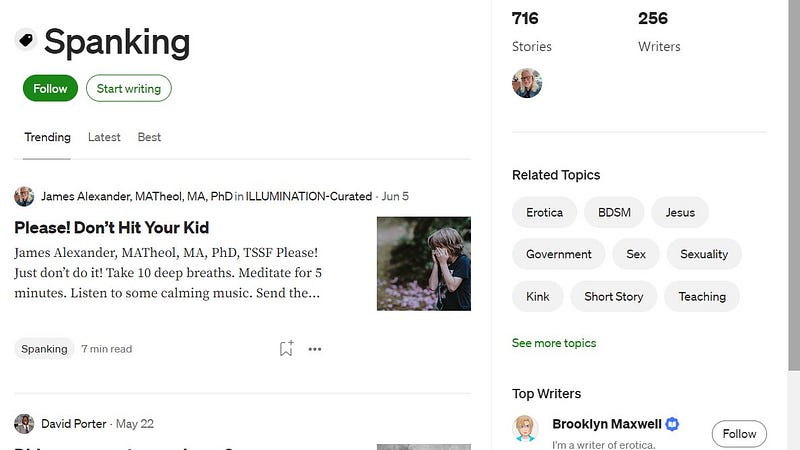
When you search for a tag in the Explore tag, the URL will look like this:
https://medium.com/tag/spanking
And then it will come up with a few options — you can Follow that topic, so Medium’s algorithm will put new things featuring that topic on your central feed; if you click Start Writing, Medium will start a new story for you, with that tag already attached.
You can then see on the page related topics — see how some of them are things like Erotica, BDSM, and Short Story, but others are ones like Teaching, Jesus, and Government?
Most topics obviously don’t have that sort of wide range in the related topics, which is why I wanted to use this one as the best example.
You can see Top Writers in a topic, so you can click through and see if you want to follow any of them in your favourite tag — and then as you can see, the stories in the tag will appear with three tabs: Trending, Latest, and Best.
Trending will be any stories in this topic that have currently been Boosted by the algorithm or are otherwise currently getting a lot of attention on the site; Latest will be the most recent stories posted with that topic; Best will show the stories in a topic that have been most popular over all time.
Searching in the Explore bar gives you specific Topics, which is Medium’s word for tags, thus the URL having /tag/ in it — searching in the general search bar is a bit different, and gives you a URL that looks like this:
https://medium.com/search?q=spanking
When you search for a term in the general search bar, it shows you Stories, People, Publications, Topics, and Lists.
Stories will show you the top, most relevant things tagged with the search term you’re searching for — they’ll generally be the most popular of all time mixed with any currently trending stories in that topic.
People and Publications will show you individual writers and publications that have that search term in their names or in their bios.
Topics can be helpful from a kink perspective — it will show you related topics, some of which might be nonsense, but some of which might be relevant.
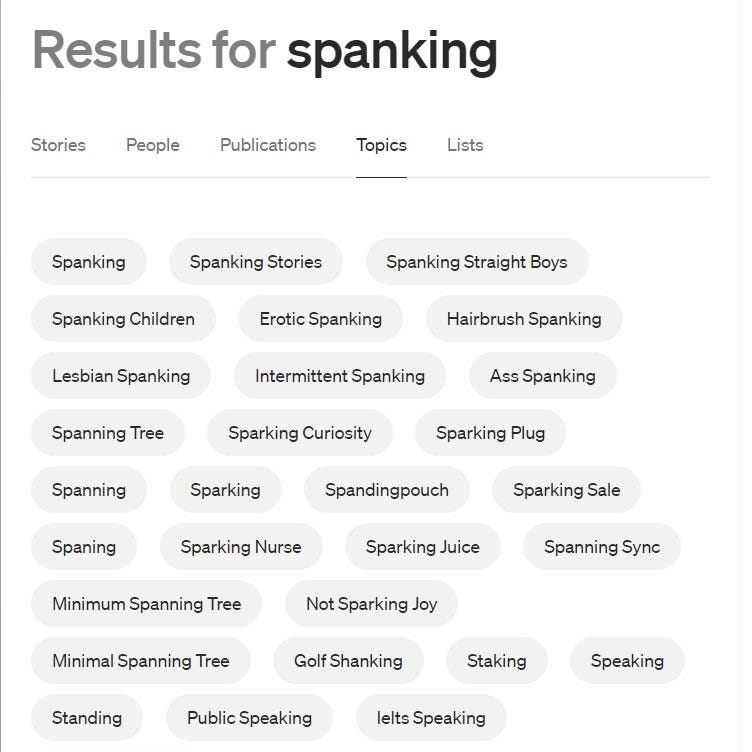
And then if you search through Lists, it will show you lists people have made with the search term in the List name or description — in this case, most of the people who are using the word “spanking” will likely have curated articles about or short stories about it in a kink context.
How do I find people and publications to follow?
The obvious from the above is to look through some favourite topics, whether that means to find fiction you like, or whether it means to look at some interesting non-fiction topics.
By searching through the topics, even if you don’t find authors you immediately like from the search results, you might find relevant publications.
A publication is like a Medium-based magazine — they’ll collect articles together under that publication heading. Some publications are run by and for just one person, and are just a place where they keep their stories; some publications will accept submissions from other writers and might even have a full editing team like a more traditional zine.
Some favourite fiction and non-fiction publications I would recommend are:
- Prism & Pen — This is an LGBTQ publication that publishes fiction, non-fiction, and poetry.
- Gender From The Trenches — This is a trans-centric publication that primarily publishes non-fiction.
- An Injustice! — This is a non-fiction publication that centres on different works on activism and social justice.
- Lit Up — This is a general fiction publication.
- New North —Another general fiction pub.
And obviously, if you plan to write erotica and erotic romance, and you’re trans or nonbinary, I’m making this guide in mind for people who’d like to write for Trans Erotica:
How do I get followers?
Gaining followers is as simple as it is on any other platform:
- Publish good, well-written work, whether that be fiction, non-fiction, poetry, etc.
- Submit your work to publications, so that people who already follow those publications can see your work, engage with it, and possibly follow you for more. Some publications will only have a few followers, but some will have tens or hundreds of thousands of them, and that can of course impact the reach your story has if accepted and posted by them.
- Use all 5 Topic slots and tag relevant topics to each piece.
- Follow others and engage meaningfully with their work — respond to other people’s fiction or essays with commentary, saying things you enjoyed or things about the work that made you think.
One nice thing about Medium is their Highlight option. If you highlight a line of text you particularly like, a little box will come up — the first button shows a highlighter, which you can click to just highlight the line or word to say you particularly liked it, or that you thought it was especially impactful; the second button shows a little speech bubble, which you can click to reply directly to that line and quote it in your response!
You can also click the Clap button, which is Medium’s equivalent of a Like — you can Clap up to 50 times for each work or reply; and then you can respond to the piece and leave a comment at the end of it.
Don’t spam people’s comments. Don’t say things like “if you follow me, I’ll follow you back!”, or “Please follow me xoxo” or whatever in people’s comments. It’s dick behaviour, and all it will do is get you (rightfully) blocked.
What do I write?
Short answer: mostly whatever you want.
Obviously, based on the guidelines I linked in the first part, no underage and no graphic sexual imagery; depending on the publication you’re submitting to, they might set their own restrictions on topics, length, etc.
You cannot charge for fanfic of properties that are not part of the public domain if you don’t have the legal right to use them commercially — Medium is not a fanfiction platform, and I would advise for people to keep fanfiction generally to fanfic platforms, such as Ao3.
Fanworks, sequels, or works inspired by stuff in the public domain might be different, though.
If you’re stuck for inspiration and you’d like to work from a particular piece of guidance or prompt, many fiction publications post prompts for writers to work from.
I’ve found that I have audience for a variety of fiction — Horror, Fantasy, Romance, Erotica, and Erotic Fiction — both from readers who are already on Medium, and those that come onto Medium just to read my work when I promote it off-site, such as on Twitter or Tumblr.
Different genres, lengths, and tones, I might submit to different publications, but I obviously write a pretty big variety of things and swap between different topics and vibes — if you tend to be more consistent, it might be easier for you to find specific tags that work for you.
In self-publishing, especially in romance and erotica, some people will tell you that you have to write the same sort of thing and create an extremely consistent vibe, and that if you want to do different things, you shouldn’t have it under the same name and identity.
I have never subscribed to this notion, personally, as it’s always struck me as advice better suited for those who are better at creating marketing “content” rather than writing art.
In any case, on Medium, you are not punished by Medium’s algorithms or, in my experience, by readers, for writing a wide variety of topics and tones and vibes. You’re not expected to funnel everything to highly specific niche in order to stay afloat — you can play around, you can experiment, and I would encourage you to.
If you already have original pieces on Ao3, Literotica, Tumblr, or elsewhere, like on your own blogs or Patreon, you can probably just cross-post them straight over — if you have a significant back catalogue, it might be worth scheduling them to stagger their posting over a period of time, rather than posting a bunch of work in one go where individual pieces can just be lost in the rush, especially if you have a significant back catalogue.
How should I format my work?
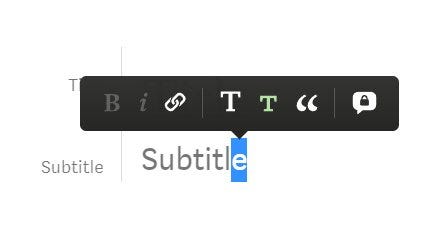
At the top of your work, you should have a Title, and just below it, you should have a Subtitle.
For the subtitle, make sure the text is formatted in H2, like below — just highlight the text below your Title, and click the T highlighted in green in this cap:
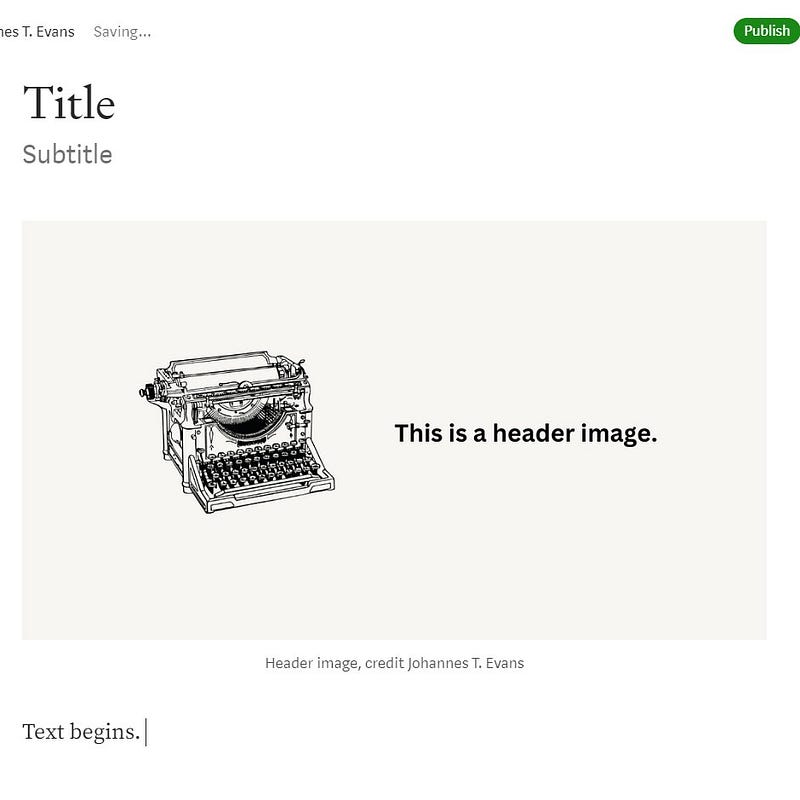
Generally, it’s good practice to include an image in each piece you post — landscape / horizontally oriented images are best, as these will be part of the preview for the piece when it appears around the site.
All images you post should include a credit as to where they’ve come from — if it’s your own photo or art, you can just say “credit to author” or similar; otherwise, you can find public domain images on a site like Unsplash or Pexels.
You can put your image at the top of the text, like I showed above, or you can embed it in the middle of the text if it feels like it suits better there and is relevant to your story — and you can use more images than one if you’d rather.
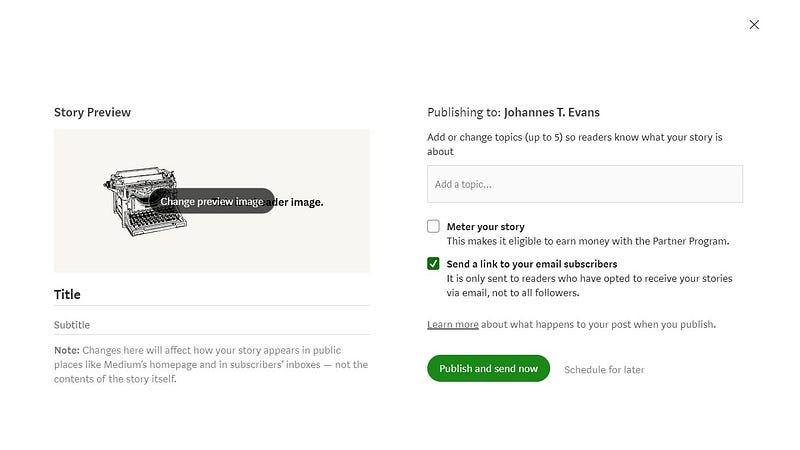
When you click Publish, this is what comes up — the Story Preview. You can change your title and your subtitle, you can select your preview image, you can add up to 5 topics, and you can tick the boxes to meter your story in the Partner Program, and send a link to email subscribers.
Notice the grey text that reads Schedule for later? That can be really valuable for if you have a lot of work you want to publish, but you don’t want to publish it all at once.
How do I submit to a publication?
It depends on the publication!
Read their submission guidelines to find more info about how to submit to each one.
Here’s a list of Medium Publications currently accepting submissions:
Some will have you write up a draft and then submit the draft link to them via a Google form or email, which you can get from the top-right drop-down menu while you’re editing the your draft — others will have you email them or reply to a post to be added as a writer.
Once you’ve been added to a publication as a writer, you can just sellect Add to publication from the same drop-down menu.
Can I cross-post my work to other platforms?
Of course, Medium does not demand exclusivity.
From Medium’s Terms of Service:
You retain your rights to any content you submit, post or display on or through the Services.
Several of my stories are here on Medium and on my Patreon, and a selection are also posted on Ao3, Tumblr, and Literotica, or they might be in publications and magazines and so on.
I will note that many magazines and other publications will consider self-publishing a short story as it having been previously published, which might mean you can’t then submit something you’ve published on Patreon or Medium to them — with that said, if you’ve had a short story in a publication and it’s at the end of its exclusivity clause, you can always republish it on Medium or your own websites etc, and say, “this was originally published in x” and link back to it.
Bear in mind that if you plan to enrol your work in Amazon’s KDP program, Amazon requires exclusivity, and having your work published on Medium will mean it is not exclusive.
Some Medium publications will ask that your work not be previously published anywhere else, but generally will not require exclusivity once they accept and publish the work.
With that in mind, you can publish each piece to Medium once. As per Medium’s own guidelines, you can’t repost the same story several times in different publications — your piece can go in one publication or just be posted to your own profile, and should not be reposted to Medium multiple times.
Do not link your Medium on your Ao3. Ao3 does not allow you to link to sites where you can make money, so even if it’s original fiction, do not link your Medium on your Ao3 profile or any of your Ao3 works.
How do I make money on Medium?
To make money on Medium, you have to sign up to Medium’s Partner Program. Their guidelines on this are here:
You need to have at least 100 followers to show that you’re not a bot or spamming, and you need to have published at least one piece on Medium. To stay in the Medium Partner Program, you need to publish something at least every six months.
In order to get paid your Medium earnings, you will need to sign up to a service called Stripe.
A Stripe account is free, but the Partner Program is not available in every country. It’s currently available in these, according to the Stripe FAQ in Medium’s help section:
Australia, Austria, Belgium, Canada, Czech Republic, Denmark, Estonia, Finland, France, Germany, Greece, Hong Kong, Ireland, Italy, Japan, Latvia, Lithuania, Luxembourg, Mexico, Netherlands, New Zealand, Norway, Poland, Portugal, Romania, Singapore, Slovakia, Slovenia, Spain, Sweden, Switzerland, United Kingdom, United States
While you can use any name or pseudonym you like on Medium, to sign up for Stripe, you will need to use your legal name and you will have to verify your identity with some form of legal ID; you will also need to fill out tax documents on your income from Medium.
As I said before, your legal name won’t be posted publicly and won’t be available elsewhere.
Again, if you don’t want to use the Partner Program or can’t because you don’t meet one or more of the requirements, you can still add a tip jar or similar in your settings.
What does it mean if my work was Boosted?
Medium has some info about this here:
The basics of it is that publication editors might like your work and suggest it to be Boosted by Medium’s algorithm, it is reviewed by some of Medium’s employees, and then if the Boost goes through, your work is pushed in front of more readers on Medium, and might be more likely to be shared and engaged with.
Boosts don’t just apply to new work — they can be applied to work of any age, and as with your earnings on a story, the age of the story doesn’t come into it.
Further Resources:
I would recommend these videos from Zulie Rane:
From me, I’ve written a few pieces that will be relevant from a publishing and writing perspective:
- Publishing F.A.Q. — 3k. Just a little master post of frequently ask questions about how I publish and write. On Medium.
- Writing Dialogue: A Technical Primer — 2k. A technical primer denoting some rules and conventions. On Medium.
- Who said that? Dialogue Guide — 8.5k. Crafting unique, distinctive voices for each and every character. On Medium.
If you have any further questions, specifically about publishing here on Medium, or just about making the transition between fanfiction and original fiction, just write them in the responses, and I’ll get back to you as soon as I can.


