
The Straight Male Gaze on Pretty Male Gays
How does it feel when straight men want to fuck us?
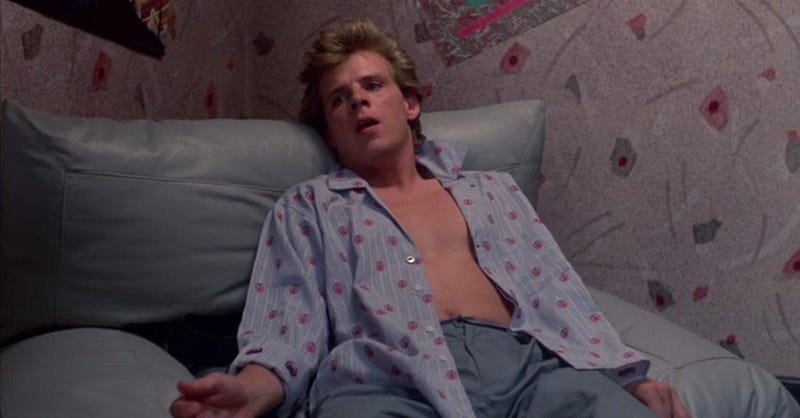
A quick little intro — I went ham on this one. I watched A Nightmare on Elm Street 2: Freddy’s Revenge and it just gave me a lot of feelings.
Warnings throughout this piece for discussion of the film’s gore and violence, the homophobia both in- and out- of universe, sexual violence, homophobia in general. I use a lot of slurs in this one because I self-identify with a lot of them, and a lot of this piece is about the ways in which queer identity is weaponised and not weaponised against us.
Bon appetit.
When we talk about the gaze of the camera in film and cinema (and TV) we’re often talking about 2 things in concert.
- The camera-stylo or camera pen, which comes from auteur theory.
- The male gaze, which comes from feminist theory.
The camera-stylo or camera pen is when an auteur (a director who so influences the style of their films that they might be viewed as an author of that film) directs a piece of cinema, and we see the camera working as their pen.
Its particular pen strokes, where it stops or lingers, the style of its movements, all of these come together to form the director’s “handwriting”, and this handwriting might be recognisable from film to film.
You might not be familiar with guillermo del toro’s body of work for example, but if you watched EL labertino del fauna (2006), The Shape of Water (2017), and Pacific Rim (2013) back to back, you might see a lot of shared visual language between the three despite how different their genres and stories are. The way we see larger-than-life creatures or robots, the way these monsters dominate a screen or lurk in the shadows — or, in line with Del Toro’s love and identification with these monsters, the way those shadows might be used and seen as a place of safety and refuge.
The director’s unique viewpoint and perspective can heavily influence a body of work for better or worse — much of the time this is in an auteur’s oeuvre like. Wes Anderson, Taika Waititi, Ari Aster, Greta Gerwig, these are all contemporary directors who you might recognise by visual style alone, just from GIFsets on Tumblr or fancams, because their particular visions are so distinctive and memorable.
Recently, Quentin Tarantino said that he doesn’t like sex scenes in his movie — this is not a surprise, because tarantino is infamously a foot fetishist, and is also really into choking. We already see sexual scenes from Tarantino, or at least, we see scenes that get him off — they’re just not literal sex scenes. instead, we see lingering movements over the arch and ball of someone’s foot, or we see someone choking and struggling on screen, see the way they gasp for breath. The camera often draws in really tight for this stuff so that the feet or someone’s constricted neck and struggling face dominate the screen.
When Tarantino says that sex scenes aren’t part of his vision of cinema, he’s obscuring the fact that his sexual desires are nonetheless part of his vision, and that’s part of why the discourse bodied him so hard in the aftermath with just screenshots of people’s toes.
The gaze of his camera and the movement of his camera-pen reveal things that he himself does not — we can interpret in that implicit, non-verbal language what isn’t textually stated.
And what about the male gaze? What do we mean when we say that?
Jean-Paul Sartre wrote about the power of gaze when exploring his perspective on existentialism, and he specifically talked about the power and subjectivity of the gaze as a force enacted on others — to be gazed upon is to be perceived, and to be perceived means to be subject to that person’s unique perspective and thus, their biases, their world view, their assumptions of you. The gaze is a projection of values, and to be gazed on is to have these values projected onto you, but it’s not just personal — to exist in the world is to be gazed upon and to be perceived, even if that gaze is non-specific and/or anonymous.
You’re probably also familiar with the theory of Michel Foucault’s Panopticonism. Jeremy Bentham first described and designed the idea of a panopticon, a sort of “perfect” prison where, due to the design of the prison and a central viewing platform, prisoners never know whether they are being surveilled by a guard or guards or not — and because they never know if they are being surveilled, they will always act under the suspicion that they are. Foucault’s commentary on the work was that the idea of the panopticon espoused in itself a desire to make all people docile and obedient, that it’s only imagined and desired by those who seek to create obedience in other human beings before their humanity.
Laura Mulvey coined the term “male gaze” in an essay that’s broadly Freudian analysis of cinema and particularly about the imbalance of power between men and women, especially men as active viewers and women as passive subjects of their viewing them — this is the crux of the male gaze in cinema.
The male gaze is not just when a man looks at a woman in a movie, or when a male director directs a film — the male gaze is in itself an exercise of power, and a societally dominant power at that. Mulvey’s analysis explicitly defines the male gaze as partly based in heterosexual desire by men of women, and that’s noteworthy here, even though sexual desire and satisfaction are not the limits of a male gaze’s influence.
When we talk about cinema through the male gaze, it often feels as if the camera expects you to be titillated or pleased by depictions of sexualised female bodies, but it goes beyond that — violence against the female form is accepted as normative and even in itself titillating, because that violence represents the natural power of men over women. It doesn’t even register in some people’s analyses of film that under the male gaze, outside of certain genres, women are frequently the subject of other character’s emotion but rarely treated as valuable originators of it; that in many films women are not just given little dialogue, but are themselves passive in the entirety of their character. It’s often treated as a flaw of that woman, that character, rather than a way they’re written and portrayed in the film, and the limitations that come with the sin of being a female character rather than a male one.
There are all kinds of jokes and analysis about the way women are treated in cinema — obviously the Bechdel-Wallace test, named for a funny comic from Bechdel’s comic strip, is the most striking of these:
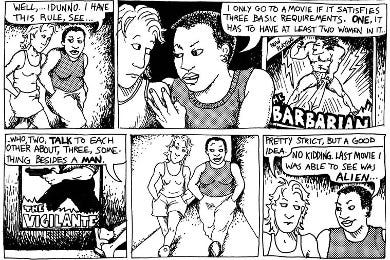
One thing that always strikes me as someone who typically loves historical and historical fantasy film and television is the quintissential brothel scene — the male characters talk and have their serious dialogue, and in the background and foreground are a great many naked whores giggling and feeding each other grapes and looking pretty. They’re set dressing — they’re not characters.
I not infrequently get frustrated watching a lot of the above shows as someone who’s not attracted to women and is attracted to men, because so many women are constantly being objectified and demeaned on screen, and to what end? Because it’s certainly not for my titillation or enjoyment, and it’s not for theirs either.
Cisgender heterosexual men as a broad class don’t tend to desire women the way that women desire women, and that shows in the typical male gaze: the male gaze never finds divinity in a woman that it does not desire to punish or besmirch; the male gaze never finds power in a woman it does not desire to punish and destroy; the male gaze never finds autonomy or sexual empowerment in a woman it does not desire to subjugate. The male gaze, as I said, is not merely about sexual desire, or if it is, that sexual desire is entirely bound up in the male gaze’s desire for power over women and particularly women’s bodies.
And what of this typical male gaze’s depiction of men’s bodies? Because that’s not fucking attractive either.
Cishet men don’t know what being attractive is. The ideal of masculinity to a lot of cinema’s classic male gaze films is so far from my type he’d be unfuckable to me even if the essence of a lot of these action figures wasn’t to be a rapist with a machine gun or a clenched fist — a muscle man with 0 bodyfat, visibly dehydrated so you can see every curve and crevice of his musculature pressed flat against his body, a carved jaw, a cleft chin, a heavy brow. These men are allotted autonomy that no female character would be allotted because they are ever the protagonist of life, they are permitted to be active rather than passive, but they are often denied the full breadth of humanity, because to be too human would undermine their masculinity.
The typical cishet male protagonist of many action films is moved around like a sort of Action Man (GI Joe): he’s carved of hard plastic, chiselled, cold, because he has to be the man.
No softness is alloted them because to be soft is to be weak, and therefore effeminate — any vulnerability must be covered up with anger or violent brutality, or must occur only with/to the woman who exists to serve his emotional unburdening: a girlfriend, fiancée, or wife, who may or may not be fridged in the course of the narrative, either as punishment for expecting him to have feelings, or as the catalyst for his expressing them.
As a gay man, that sort of masculinity holds no sway over me. This is a sort of hypermasculinity that is not just undesirable and unfuckable — not only because of the typical action star’s physical appearance, but because of the implicit sexual and bigoted violence this sort of character represents — but also utterly removed from the masculinities I look up to, the masculinities I surround myself with.
My own community is made up of bears, lesbians with square shoulders, fat old men with pear-shaped bodies and pretty hands, otters, butch dykes, leather gays, twinks, femboys — these are all forms of masculinity, in men, in women, in others, I surround myself with, and the extent to which they cross over with the action man’s masculinity is virtually nil.
So when I see many films through the male gaze, I very rarely see myself as included in the active viewership — I don’t look at women the way the male gaze expects me to look at them, and I don’t look at men the way it expects either.
You see, the action man is often shot as a powerful, masculine man who works his way against the hardships that face him — he fucks chicks, he shoots a gun, he drives a fast car. All of these things represent his masculinity, and they’re meant to make him desirable, not just to women, but to other men — as a role model, as a cool buddy, etc.
Obviously, action movies have a specific hypermasculinity that’s different to many other genres of films, but what I find is similar from movie to movie is the treatment of masculinities like mine, or those of my friends.
This gaze cannot conceive of a man’s body as being desired in the way a woman’s body might be desired by a man.
From a cishet male ideological perspective, desire for a woman is never just about her body or her touch or her personality — those things may even be detractors. To fuck a woman is to subjugate her, to own her, to have won her, to carry her as a trophy. It’s not important whether she comes or not — and if she does orgasm, then the performance of that orgasm should be entirely for his pleasure and titillation. That’s why it doesn’t matter to him if she fakes it or not, and why he never learns to know the difference.
How could a man look at another man like that?
That’s frightening talk for the man who idolises the hypermasculine action man. That’s scary. Are the gays looking at him like that? When your perception of sexual desire is mired in sexual violence and an act of subjugation, which is in part so perpetual and inescapable because your gaze does not treat women as fully human, and therefore not truly capable of experiencing violence as you are, how can you concieve of a man’s desire for you, or any other man, as anything but the same?
And when the typical male gaze is turned upon masculinities by mine, upon men like me, it is often with revulsion. There’s often an undercurrent of humour, because these men often express their disgust and horror at queer desire and queer expressions of sexuality by mocking them (as a way of attempting to continue their dominion and power over them), but this is often based in some insecurity. The male gaze is often fascinated by our bodies even though the creators and arbiters of this gaze wouldn’t admit to it — many guys who would call themselves cis and straight (or not call themselves anything because even calling themselves cisgender and straight instead of normal is too close to being queer) might harbour desires toward gender nonconformity, to queer femininity, to transfeminity, although they’ll want to stay DL or subtle about it. They might want to fuck a twink or a femboy or a pretty boy, but to admit to it is too much, right? Looking at another man the way you’re supposed to look at women is two sins at once — firstly, you’re not looking at and fucking women, which is your expected purpose as a man, and secondly, your desire is to subjugate and fuck another man, which is wrong, because he’s a man and he doesn’t deserve it.
Or… Hmm, I don’t know, maybe he does deserve it. He’s not really a man, so you can fuck him. He’s a faggot, so you can fuck him, he’s like if a man was a woman (it’s no wonder these people don’t understand what being transgender is)— but don’t catch anything!
As a gay man talking to straight men, a lot of the time the first thing they’ll say is, “Oh, just so you know, I don’t swing that way!” or they’ll joke about not wanting to turn their back on you. Cishet men, as I said, often cannot concieve of sexual desire that’s mutually consenting and respects the mutuality of both (or more) parties bodily autonomy.
As a transgender man, I knew that I was completely passing when other comedians at comedy events started making homophobic jokes about my present rather than misogynistic ones.
But as a transgender man, like… People know when they meet me than I’m a faggot. I’m a homo, a sissy, a fruit. Even very straight people know it, even those that aren’t very connected to queerness and don’t really know much about what queer men look like or how we act. I’m clocked as a gay man even by old people who don’t know how to tell the time — but as a trans man? I’m pretty invisible, actually. Even other trans people are surprised when they see me shirtless and suddenly I’ve got tits.
I was talking recently with some friends about how one of the things they experienced on transitioning is that sometimes they’ll be walking along and women will cross the street, or avoid getting in a lift with them, or similar, because they don’t want to be alone with a strange man.
And I said, you see, that’s interesting, because I don’t think I’ve ever experienced that.
In fact, several times I’ve been sitting alone in a place, on my phone or just loitering, and women on their own have approached me to ask me for directions or to ask me for help — one friend said to me when talking about this, “well, yeah, people can tell by looking at you that you’re safe for the girls, gays, and theys”.
I bring this up because even without knowing that I’m also transgender, many men who ID as cis and straight, or cis, bisexual, and down-low/discreet, want to have talks with me about gender and sexuality, they want to have talks about desire. A lot of them want to be physically intimate with me, emotionally or sexually, in private — in public? No, no, no.
Here we come to the panopticon: to gaze on me and to desire me in private might mean to explore and play with desire for a man, and not just a man, but a pretty man. Absolutely, a man, hairy, dominant in many ways, but also a homosexual, also pretty, also effeminate. Fuckable. Potentially hot to be fucked by.
And in front of others, this sort of desire for me, a homo, would have to be couched in either a lot of jokes or an undercurrent of revulsion — cishet men are obsessed with being tricked into fucking a man, and their violent response to their own desires and to violently correct ourselves is so societally accepted that in some places it’s seen as a defence for murder.
And, God, like… The thing about that is that that’s a real life gaze, right? It’s a real life interaction with and expression (or inexpression) of desire.
And I so, so rarely see it depicted in film and cinema, because like, to depict it would be to admit the desire, right? And when queer men within queer communities depict this sort of desire for men like me, it can be a lot of things — it can be celebratory, it can be extremely horny, it can be loving, inquisitive, but like…
It’s quite honest about what it is — and it knows what it is.
Queer men who are in community with other queer men know what it is to desire and be desired by other men. Part of the reason seeking out community is so important for many of us is because we grow up in a world that implicitly and explicitly tells us again and again that what we are and what we want is wrong, monstrous, disgusting, horrifying, revolting, frightening, and that it will destroy us, that we will destroy others with it. When we find community with other queer people, what we discover is often that this sort of destruction is a choice.
Your desire for another man does not have to destroy him, nor his desire destroy you. To desire another is not to subjugate him — to be desired is not inherently to be entirely subjugated. And maybe a little bit of subjugation — and a little bit of being subjugated — can be pleasurable, desirable.
Perhaps it can be play.
But it’s very difficult for us to develop these attitudes, for us to harden our skins to all the trauma that have come before us, and all the traumas that threaten us today — many men are still down-low and discreet because to be outed would destroy their lives and their connections to their communities. To be openly gay, to even be accused of homosexuality, would be to make them anathema to their communities and loved ones.
To be gay would be to be tainted.
One of the things that makes these sort of conversations so different between mine and younger generations and the older generations of men who love men is the impact of the AIDs crisis and the number of people it took from us. HIV ravaged our communities, and public response to it in the UK and US most notably amounted to genocidal — the response to an illness killing queer people, devastating queer communities, en masse was delight and glee.
A HIV diagnosis is no longer a death sentence, but especially when we look at a lot of stories and explorations of queer men’s desire, like…
It’s a horror concept, and one that frequently recurs in queer horror. The fear of carrying this disease with you, the fear that you could be infected by it at any moment or infect a man you love, to see all of those around you dropping dead with so little warning, or be reduced to corpses wasting away in their hospital beds, ignored and neglected by nurses and doctors so consumed by their own bigotry they refuse to treat them, let alone treat them as human.
Another historical fear in our communities, and one that still lingers today, is not of disease, but of people themselves being false, being betrayers — homosexuality wasn’t decriminalised in the UK until 1967, wasn’t decriminalised in the Republic of Ireland until 1993. In the USA, homosexuality was decriminalised in Illinois in 1962, with different states following suit in the 60s, the 70s, and into the 80s and 90s. The Supreme Court didn’t overturn Lawrence v. Texas to decriminalise it in the remaining states until 2003.
Part of the reason men’s queer communities have so often been semi-closed, why they’ve been underground, why they’ve been hidden and kept secret, why we’ve used codes and encoded language, cants, and so on, is because outside agents would enter our communities with a desire to blackmail us, to get us arrested, to get us killed.
Cops historically would go undercover in cottages to lure gay men into soliciting sexual favours from them, or solicit them themselves, so that they could then charge those men. Oh, sorry, did I say “historically”? Cops still do that shit now. ACAB.
Within queer men’s communities, shared language and communication was often developed to discuss vulnerabilities, to discuss safety, to create and utilise community — but when I say “community”, like. That in itself was dangerous to have.
The reason that cottages and other forms of cruising developed the way they did, and why cruising today using Grindr and other hook-up apps has such a distinct culture, is because the anonymity of those hook-ups was your way of staying alive. You weren’t in with “the gays” — you were fucking anonymously, namelessly, facelessly. You’ll never be associated with gay people or gayness itself. You can fuck, you can “get it out of the system”, but it won’t ruin your life to be perceived as gay.
Unless you got AIDs. Unless you recognised a partner in public and they outed you. Unless you got blackmailed. Unless you got arrested.
If you could pass in the first place.
If people could believe you were straight. If people didn’t meet you and know something was off about you — that you were a confirmed bachelor, that you were a little light in your loafers, that you dance at the other end of the ballroom, that you play for the wrong team, that you were a friend of Dorothy.
For trans and queer people, many of us experienced in childhood the sense that the people around us knew what we were, even if they didn’t know that they knew. We were called accurate slurs, bullied in ways that would be accurate to our later identities.
At seven years old, you’ve never had sex, you shouldn’t yet have concieved of sexual desire you’re so prepubescent, and yet somehow, other boys in the playground know that you’re a fag and they call you a fag — and they call you a fag where they wouldn’t call the other boys one. How do they know? What is it about you that makes you obvious, that tells them what you are? Who taught them the word and what it means? Who taught them to recognise it in you? Who taught them you should be punished for it?
The adults around you know that there are things subtly “wrong” or “off” about you, they clock you for what you are — and there are certain stereotypes about like, boys wearing their mother’s shoes or their sister’s clothes or playing with Barbies, or girls dressing like tomboys and wanting to play with trucks or wanting to play sports, or whatever, but like… It goes deeper than that.
There are plenty of boys (and children who were not boys and would be women later on) who never dressed up and never played with dolls, and people still clocked them anyway. If not actively labelled as gay as little boys, they might be called delicate, or soft, or sensitive. Momma’s boys, too, obviously — to be close to one’s mother is gay, after all. Real boys hate their mothers, just like they hate all women, right?
And they call those boys girls as an insult.
And if they have the audacity to say they’re a girl later on, or even if they just dress in drag, that’s perceived as terrible, and suddenly, they are boys, actually, and for them to call themselves a girl or dress up as one is terrible.
Children, when they call other children slurs and bully them for being gay, are just copying the revulsion and disgust modelled for them by adults around them — as teenagers, that disgust and revulsion is their own, that they’ve developed, has been cultivated in them. They look for queerness and nonconformity and they desire to punish it themselves, to be violent toward it, to stamp it out.
Especially for young men who are in the burgeoning and developing stages of their sexuality, who are overpowered by and confused by their own feelings, their own desires, it can be terrifying to be struck with the realisation that the bullies were and are right. You are indeed a faggot. How did they know?
It becomes vitally important to grab hold of the signs of what you are and hide them for your own survival — stop cocking your hip, stop holding your wrists so limp, stand up straight, stop lisping, stop swinging your feet, stop talking so gay, stop sashaying your hips, don’t sing so much, stop being so camp. Get butcher. Be more manly.
But that’s just the outer signs of who and what you are, isn’t it?
What about what lies underneath, within? The desires inside you? The desires that may destroy you, and render you worthy of destroying? Because, after all, when the bullies call you what they are, they’re punishing you for a transgression — they’re right to punish you, because the transgressions are still there. You’re just hiding the signs so that you won’t be such a target.
And the thing is, like —
Particularly when boys and young men punish other boys and young men for these transgressions, it’s not just about the revulsion. For some of them, it’s also about desire, and desire that they can’t and will not express or reveal. It’s not even just about being covert — maybe later they’ll ID themselves as gay or bi or queer later on, and maybe they won’t. Maybe they’ll want to fuck men either way.
There are stereotypes of the bully who’s secretly gay, that he violently attacks other men because it’s the only way he can be intimate with them, the only way he can touch them. That he lets out his feelings at the disgust of what he is because he has an acceptable outside outlet — a fruit as a punching bag.
I’m not a fan of when straight people cite this stereotype, and I don’t like it when people describe any bully or homophobe as secretly gay, because like… The thing that bothers me about it is that it’s often a way to shift the onus of homophobia onto the queer community, with the implication that homophobia is invented and enforced by other secretly queer people, and not by cishet society which is disgusted by us.
But like… Many down-low and discreet men would respond to accusations or implications of their homosexuality with violence. That’s what a real straight man would do were his reputation besmirched in such a way, because it is a besmirching.
To be described as gay is basically like being described as a woman, and to be emasculated. Can’t have that!
So why the fuck am I talking about all this? About what it is to be gay, to be seen as gay, to be perceived as gay?
I mentioned that because a lot of films and TV are shot with the straight male gaze in mind, they frequently linger on the bodies of girls and women, they often treat these women’s bodies as set dressing or objects, or with more complexity like… There’s often a sense of a woman being desirable as a sort of a trap for men — women are intentionally being desirable to trick men into doing something stupid as they foolishly follow their sexual desires, for which they should suffer.
And the thing is, as a gay man?
I experience that attitude from time to time.
Not as a trans man. Sure, when I’m labelled up front as a trans man, absolutely some men who ID as straight or curious will desire me and claim that it’s because I’m trans and that I’m a woman who’s tricking him into desiring a man or masculinity, but they’re typically making that up to avoid what the truth is — that they are attracted to a man who is pretty. There are specific violences that are aimed at trans men and transmasculine people, many of which are based in our gender nonconformity, our sexual ambiguity, and most of all in our social disempowerment, and I’m sure at some point I will write and talk about those violences as I’ve experienced them, but this is a subtly different thing.
But without having the remotest idea I’m trans, as a feminine gay man, as a pretty gay man, as a man with big eyes and pink lips and grabbable hips and a narrow waist and delicate hands, like… A man who is a man, but is in various ways an effeminate man, and is described as pretty as much as I’m described as handsome, some men look at me, would gaze on me, the way that straight men look at women.
Some of them are men who would ID themselves as queer, but others wouldn’t — and in fact I’d say that like. When I experience this sort of gaze from other queer men, it does feel wholly different.
Because when a queer man wants to fuck me, a queer man who’s involved in the queer community, to some extent, he is more comfortable, more confident, in what it means to be a queer man, what it means to desire and be desired by other men. I’m not saying that all queer men are perfect or that they’ve unlearned every horrible thing they’ve internalised, but like…
Being outwardly and openly gay, and being in community with and around other queer men, you know and recognise what straight men struggle to know and recognise about women — that the other man is a person too, that he has autonomy too, that he’s not an object or a passive target of your desire and sexuality, but a whole other person. You can still objectify other men, sure, but it’s not quite the same.
For cis straight men who desire a man, like… They’re not going to admit to it publicly, but I think that part of the desire for a pretty man is made accessible, or can only be accessed, by thinking of it as they would a woman. Or, even, thinking of that man as less than a woman — an entirely acceptable target to fuck, and even be violent in their sexuality toward. But to admit that to other men, to straight society, would be impossible, right? Because you’d be revealing yourself as a homo.
I often see the straight male gaze directed to women with desire. I infrequently see the queer male gaze directed to men with desire. I very rarely see the straight male gaze directed to men with anything but revulsion.
But tonight, I watched The Nightmare Before Elm Street 2: Freddy’s Revenge.
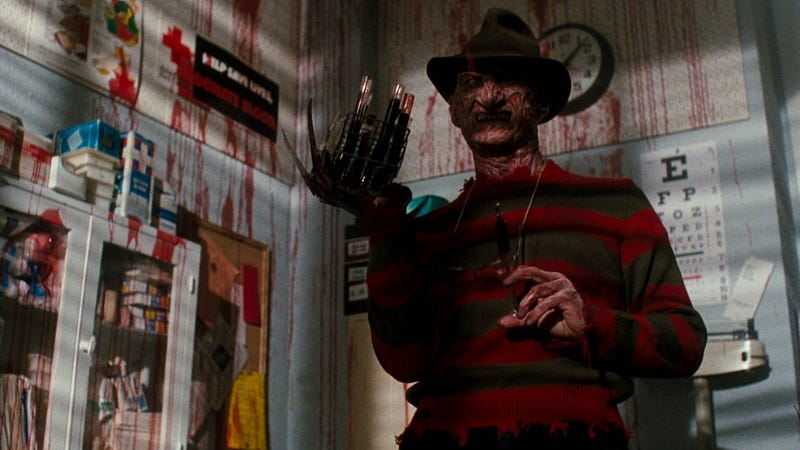
If you haven’t seen the film before or you’re not familiar with the franchise, it’s a fantasy-horror series centred around the infamous Freddy Kreuger.
In the first film, a young woman finds herself and her friends plagued by nightmares and increasingly violent visions of this monstrous man, Freddy Kreuger — a child murderer who was released from prison on a technicality, Kreuger was killed by a gang of concerned parents, who set him alight in the boiler room where he used to lure his victims. The sexual undertones of Kreuger’s violence toward the teenagers in the first film, A Nightmare on Elm Street (1984, dir. Wes Craven) are plain throughout.
In one of the murders of the first girls, she’s naked and is violently thrown about the room, blood spurting everywhere as she screams and calls for help, and it obviously evokes themes of sexual violence; there’s a tendency of Kreuger to caress his victims with the steel tips of his blade-fingered glove; there’s a moment where the protagonist of the film is in the bath, and repeatedly, Kreuger’s blade-gloved hand comes up from out of the water between her spread legs. Each time it happens, seeing those knives so close to her genitals, you wince at the implied violence.
I knew that the second film would play with similar themes, and I also knew that the second film was infamously gay.
I was not remotely prepared for how much, and the ways in which it is gay.
A lot has been said about the queer subtext and text of Freddy’s Revenge by far better film commentators than me, and the thing is like… What really interested me, looking at it, was not just the meanings and implications of the film itself, or even the actors’ performances.
It was that the film was made the way it was made, and had the feel that it had.
I’m going to be talking about two sources at the same time as I talk about this, so first is the film itself, A Nightmare on Elm Street 2: Freddy’s Revenge (1985, dir. Jack Sholder, wr. David Chaskin), and also Scream, Queen! My Nightmare on Elm Street (2019, dir. Roman Chimienti and Tyler Jensen), which was a documentary starring Mark Patton, discussing the queerness of the film, but also the impact of homophobia on Patton’s life and receptionof the film.
Queer commentators have said of Freddy’s Revenge that Jesse Walsh (Mark Patton) is put in the position of a final girl (a horror trope centred on the last girl or woman to survive the ordeal of their story), and he plays a sort of final boy. He’s shot in the film like a girl would be. The camera moves over his body as it would ordinarily only move over a woman’s, and I’m fascinated by the extent to which a lot of the team said they never realised the gay undertones of the film at first.
Mark Patton relates a story about starting out in acting, how he knocked on an agent’s door and said he wanted to become an actor, and they basically said, okay, come later in the day and we’ll set you up. He talks about them seeing his face, saying how good he looked, and immediately going, yeah, we want you, because we know we’ll be able to do a lot of good advertisements with you.
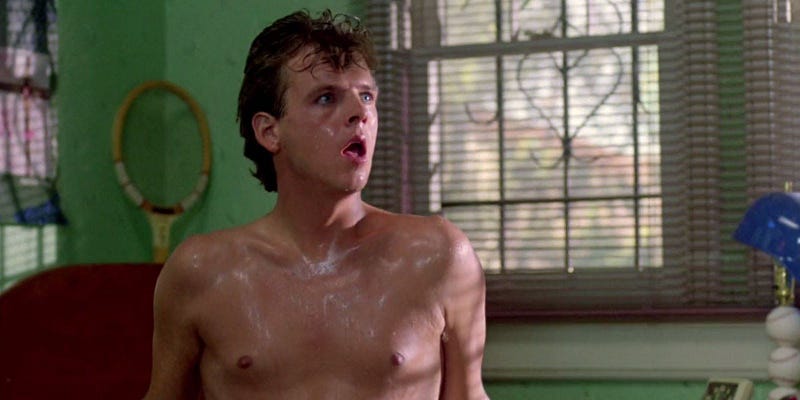
As an actor at the time, he was a twenty-five-year-old young man, he was queer and he was trying desperately to hide it, because it was 1985, some ways into the beginning of the AIDs crisis. But he was beautiful. I mean, Mark Patton can absolutely still get it, I’m not saying he’s aged badly, but in this film like… Oh, they go all out showing how beautiful he is, frequently undressed and stripped down to his underwear with his bulge on show, showing a lot of shots of his ass, his chest glistening with sweat.
And that’s just when it’s Patton on screen himself, that’s not even talking about the interactions between Jesse and other characters, including with Kreuger himself.
Watching the film, like… It was quite plain to me that part of the diegetic reason Jesse’s character was being depicted the way he was on screen, often naked, often glistening with sweat, gyrating etc, was because we were implicitly viewing him through Freddy’s eyes, with want, with desire, for his body.
But the extradiegetic reason?
In the Scream, Queen! documentary, Jack Sholder, the director, is repeatedly mentioned as not necessarily realising there were gay undertones to the film, or that it wasn’t fully intentional — he even downplays that they shot one of the film’s scenes in a gay bar, and initially claims he didn’t realise it was a gay bar before going, “Oh, yeah, we scoped it out”.
I don’t know how Sholder identifies, I don’t know if he’s gay or bi or straight, if he fucks men, whatever — it’s not my business, it’s no big deal either way.
But what’s striking to me about this film is that it shoots an entire film full of desire for this beautiful young man, full of sexuality, the camera’s gaze moving over him hungrily and doing similar to other men, and like… It’s a very queer movie, but it doesn’t feel like a queer movie made by queer men. Jack Sholder and David Chaskin have both basically talked about the queerness in the film being unintentional or incidental, which really validated my feelings on it.
This is not a feeling that I think I’ve ever seen in film before — there are pieces of TV and cinema that have really felt relatable to me as like, the hungry and visceral, sometimes violent way that men have desired me: season one of The Alienist is a very uncomfortable watch, but its treatment of the boy sex workers made me feel oddly seen in ways that are hard to define; Food of Love (2002, dir. Ventura Pons) is a film that’s very explicitly about the cycle of exploitation within M/M relationships in the art scenes, especially with age gap relationships; Mysterious Skin (2004, dir. Gregg Araki) is very artfully done, and its portrayal of DL men’s desire for a barely legal twink is painfully accurate.
But Freddy’s Revenge hit different.
There’s something genderfucky about the whole thing — I call it a straight male gaze instead of a bisexual gaze, because it does not feel like the camera’s gaze is based in queer desire. It just feels like the typical straight male gaze, but directed at a pretty boy instead of a girl. It’s not because I think bisexuality doesn’t exist or I’m trying to push bisexuality aside, and nor do I feel anyone should feel an obligation to use a label they don’t want to— I suppose the difference I’m seeing here, talking about, is cultural?
I meet a lot of men who fuck men but don’t ID as bisexual — they refuse any lablels, or identify as straight but curious, or straight but flexible, or just straight and we don’t need to talk about it, but the weight of their gaze feels different to a lot of other men’s. Plenty of men want to fuck you and bend you over, but most of them don’t need to think of you as a girl or less than a girl to do it.
There’s a specific disposibility that young, pretty twinks are sometimes treated with — twink death was trending a little while ago, and I don’t care particularly for the term, but like… That’s a real thing, right? Beautiful young men are loved and desired and fucked, and then they’re not young or beautiful anymore, and as with young women growing older, the idea is treated with revulsion and disgust.
Food of Love is quite explicit in saying that young gay men should hurry to get older partners while their youth still makes them marketable and desirable because once they’re older, they may not be cared for in the same way, let alone desired as a trophy, as a sex object, etc.
And the thing about twink death when viewed from a nominally heterosexual man’s perspective is that like… The further away you come from twinkness as you grow older, the less deniability he has. The hairier you become, the more you bald, the way your face changes — age makes you more masculine in different ways, makes you less “pretty”, and therefore, it’s harder to fuck you while thinking of you as interchangeable with a girl.
A lot of these guys are happy to fuck twinks and femboys in the 18 to 25, or 18 to 30 range, and not any older, and that’s why.
And so here’s a whole movie that says, hey, this fuckable young twink is so pretty, he’s so fuckable, he’s desirable in so many ways — wait, you thought this was a gay movie? For real? No, it’s just that the main dude is so effeminate and gay, it’s not like we actually want to fuck him or anything.
That’s how Freddy’s Revenge feels. It’s wild.
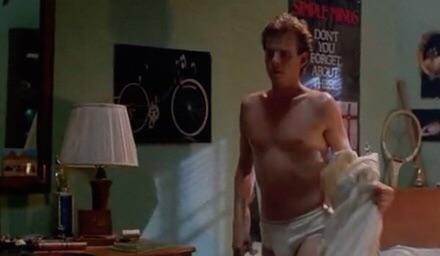
I often find that men who are really into the idea of me as a hairless twink are disappointed when I mention or when they see how hairy I am — I started growing a beard in December, and although I keep it thin and very tightly sculpted, it’s hairy enough that not quite as many people assume I’m always smooth all over. I thought about that a lot watching this film, about how hairless Mark Patton is, and how much in the post-nightmare scenes that’s really emphasised by the gleam of sweat on his skin. It just emphasises his youthfulness that much more.
In these scenes where he’s stripped down to his pants, we’re often seeing the bulge in his underwear, too, and at least once he reaches in to adjust his balls.
He’s not girlish, but the way that the camera settles on his body in these scenes treats him as something we might want to stare at, pretty to look at, attractive… But for example, the way that we see Jesse in the initial scene where he’s woken up, he’s reclined back in such a way as to maximise the amount of his chest we’re seeing, right down to his navel. The focus is not merely on his face, but on the expanse of his body, too — ditto these full-length shots once he’s up and wandering, it’s all about witnessing the whole of his body at once.
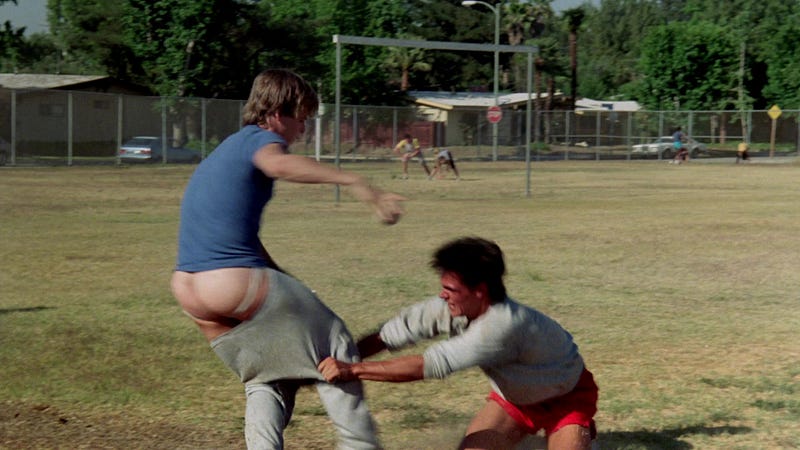
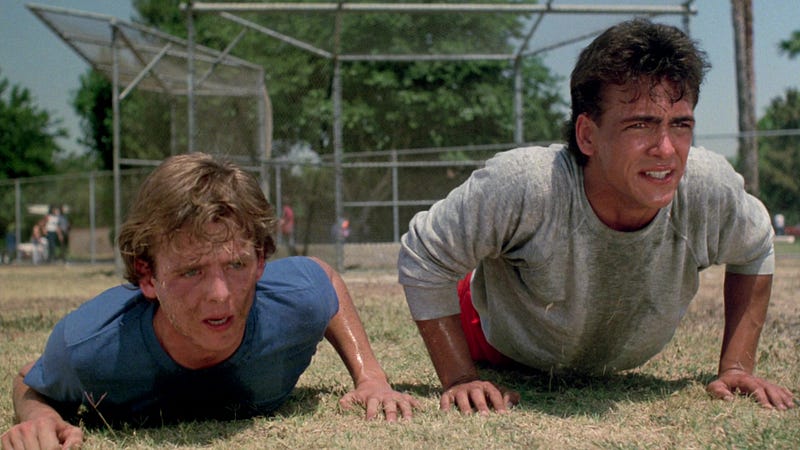
I mean, come on. Every scene between Jesse and Grady is shot like something out of a porno.
Firstly, there’s the wrestling in the dust on the baseball (softball?) field — the act of pulling down Jesse’s pants in order to show off his ass, but particularly his ass while he’s wearing a jockstrap, is all about getting access to his body, baring his body to his and the gazes of everyone else. In the gay community, a jockstrap effectively amounts to lingerie, and while I’m aware that straight men might not realise the extent of the appeal, like…
Nonetheless, this is like a nip slip, right? It’s the baring of flesh, and straight men love when they get a glimpse at somebody’s body when it’s a violation — a lot of OnlyFans models pretend to leak their own photos, because when it’s perceived as a leak and not something the model has consensually and intentionally shared, it gets a lot more hits and engagement. In Mulvey’s essay when she first describes the male gaze, she even mentions the extent to which the power of gazing can develop to fascination with looking, for example with Peeping Toms.
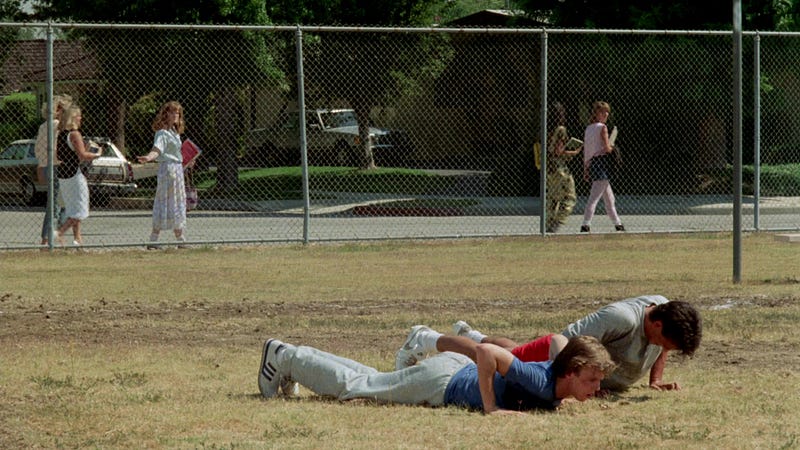
Anyway, the push-ups are homoerotic. Here are two beautiful young men thrusting against the ground, their hands braced on the grass, in a way that’s analagous to missionary position, the two of them braced in place and looking forward toward the camera; when viewed from the coach’s perspective, we see the two beautiful young men from an angle, so we can see the curve of their arses through their shorts and joggers respectively.
Even their dialogue, the way that they speak while doing push-ups together or when they’re in the locker room — the sexual tension between them, Jessue saying “You got a problem with me?” after Grady asks about his sex life is typical insecure queer dialogue but it’s also typical porn dialogue, like, the whole thing of the two of them fighting and being catty with each other is obviously going to be something a man like the coach will find titillating.
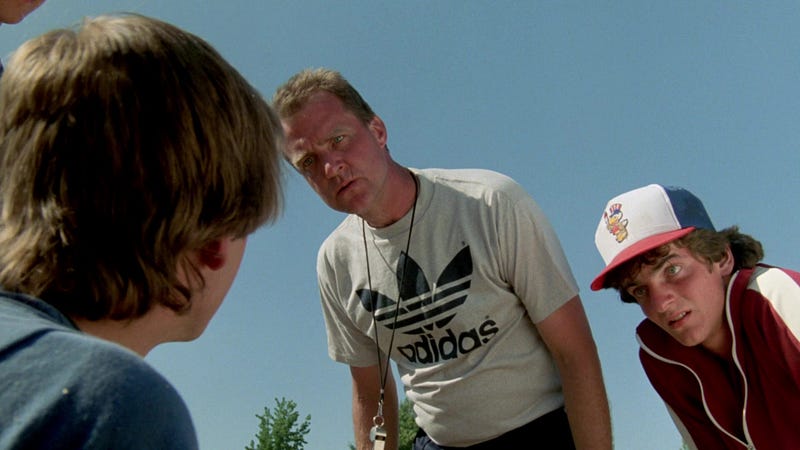
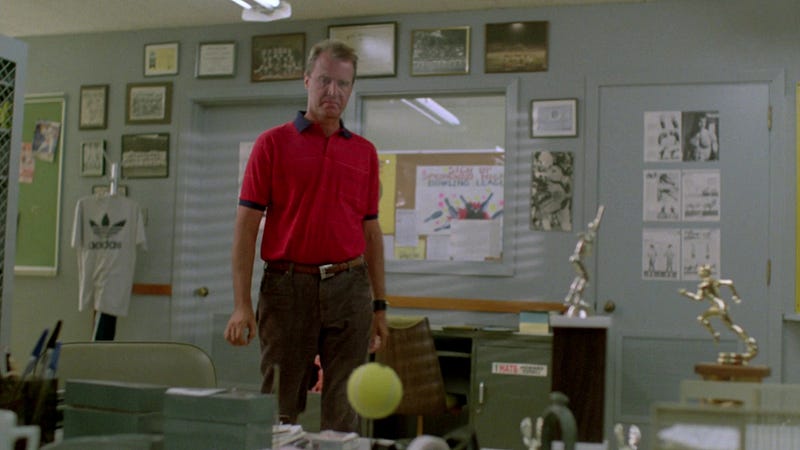
Coach Schneider (Marshall Bell) is frequently shot from a downward angle so that the camera is looking up at him, and it’s interesting contrasting those shots of him as someone who textually wants to fuck these young boys with their positioning on the ground or otherwise in positions where they can be admired.
The young men are shot as sexual objects upon which men should/are projecting their desires; Schneider in these scenes is a sexual aggressor, a powerful authority figure who will act upon them as soon as he can.

In the shot in the classroom when Jesse’s asleep and the snake is placed around his neck, the camera inexplicably jumps to an over-the-head shot — the other shots in the classroom are straight across, because they’re from the perspective of the other boys looking at Jesse in class.
This shot is from above, the better to show off the snake around his shoulder and his body, and extradiegetically, I understand that they wanted a good angle on the snake, and the snake itself can obviously be read as a phallic symbol, especially because this is a film about violating a sleeping boy and not just how irrestistible he is in sleep, but how he is not able to resist.
But in terms of the camera’s gaze?
If a man is looking at me from this angle, staring down at me, either his cock is about to be in my mouth, or it already is. It’s an angle that brings with it a great deal of potential sexual dominance, with the subject of your desire literally beneath you.
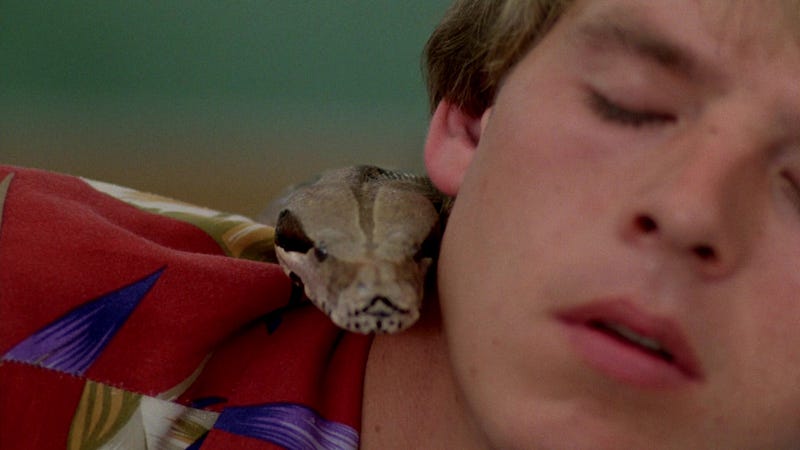
Look at Jesse’s face here. Face relaxed, jaw slack, lips parted, look how pink his lips are, how perfect the cupid’s bow in his upper lips is, how we can see the texture of his eyelashes, how clear his skin is, how hairless his jaw and lip are.
The camera is brought in tight for this shot, and again, this is an intimate shot, you’d have to lean right in and be only a few inches from his face to look at him like this. And while he looks so beautiful sleeping, this phallic representation slides real close to his cheek, because he’s unconscious and he can’t resist, can’t tighten up like he would awake.
The dance scene, then.
I think Mark Patton’s hands are pretty when we see them on the radio, but the scene itself isn’t massively obectifying at first, especially because it’s a wide angle shot where we’re seeing the whole of the room as he cleans it.
Except that he dances and he wiggles his ass, gyrates it, and it’s so cute, but especially the moment where he nudges the drawer closed with his ass, like… The camera follows his ass so fucking closely as it jumps up and down, because it wants to show his ass bouncing.
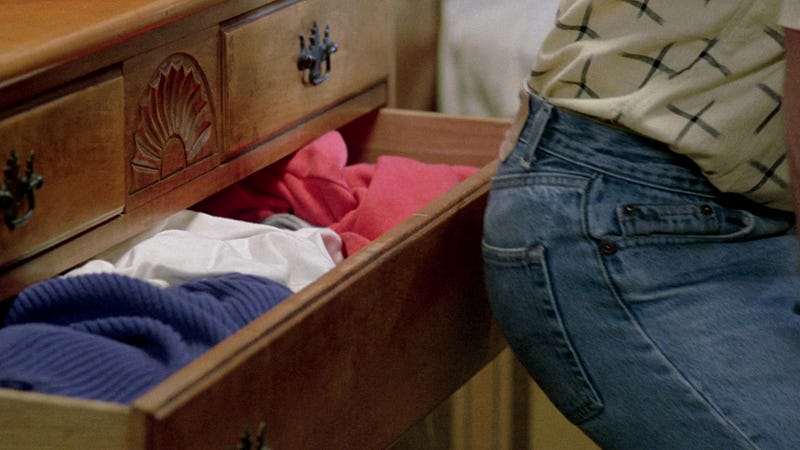
And then, of course, we get to the crotch rocket. That’s the moneyshot, so to speak, the vision of this beautiful young man posed so artfully on his bed, up on his knees, back arched, cock grasped in both hands, jeans tight against the muscle of his thighs.
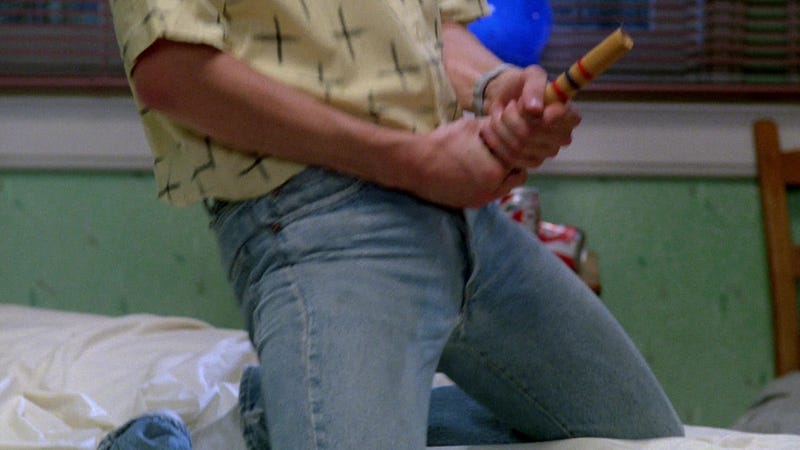
Were Jesse actually a girl, maybe he still would have nudged the drawer shut with his ass — except instead of gripping his cock metaphor like this, he’d probably be pushing up his tits with his hands while looking at himself in the mirror.
It’s really interesting in the scenes with Lisa (Kim Myers) because like… In the scene where she walks in here and basically every other scene, she’s shot super normally. Because the camera is really interested in what it would be like to fuck Jesse, it’s not trying to make us want to fuck Lisa. Even when she’s in a swimming costume and getting out of the pool, she’s not treated as a piece of meat, we’re not forced to sit through lingering shots over her thighs or ass or tits. All of that attention is reserved for the boys.
It’s no wonder so many straight men were uncomfortable watching this film, because this is what they’re afraid it’s like, and that’s what this movie does. Like, that’s the crux of many straight men’s homophobic fear of gay men, it’s in being objectified, in being gazed upon, in precisely the way this film gazes on Jesse and to a lesser extent, Grady and the other boys.
They might not be able to put their finger on what precisely is different, or what precisely is wrong compared to other films.
Anyway.
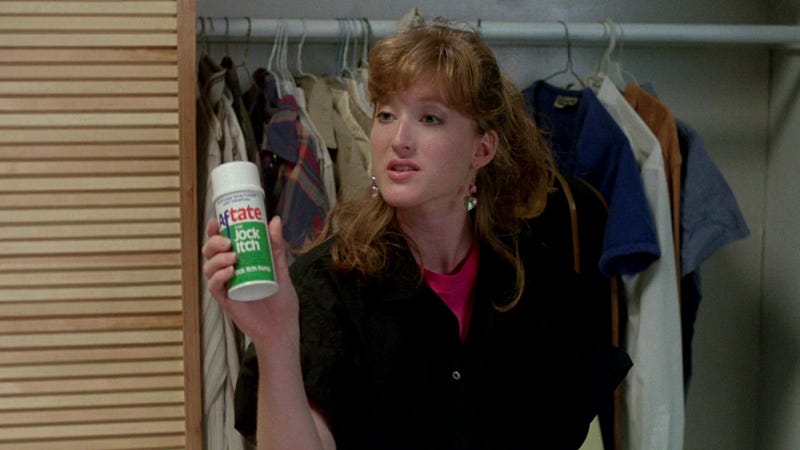
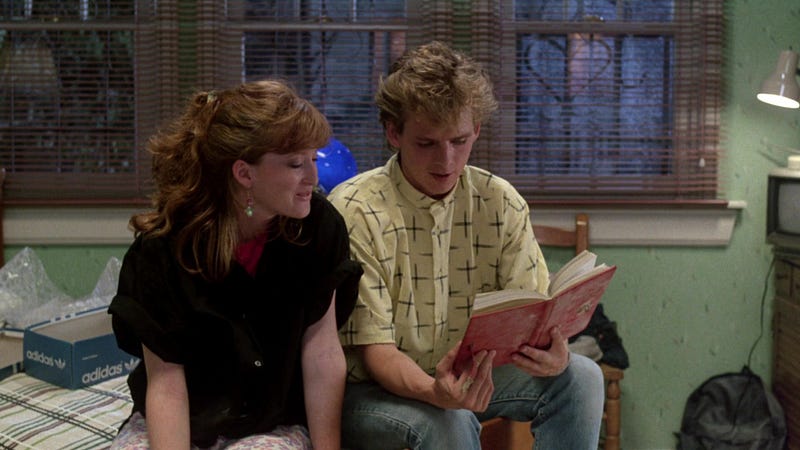
It’s really interesting, this scene of Lisa holding an aerosol for Jock Itch, because in many films I think this would be more drawn out, either as a beginning of flirtation (ooh! the girl is holding a thing that’s related to the boy’s cock, which is hot!) or as emasculating (ah! the girl is holding an embarassing thing that’s related to the boy’s cock, which is not hot!), and in this film, it’s just a small moment. It’s awkward, but it’s also like, so casual.
They kiss later on, but this causal moment that’s a bit awkward between the two of them, coupled with the two of them hornily reading the diary entries about sex dreams about a man afterwards? Like. Fag hag vibes. Big respect, Lisa.
But even the shot in that scene like… You see how they’re both sat on the bed, shoulders touching, an intimate position, but the two of them with their crotches angled away from one another, their legs up with their feet braced, the two of them focused on the book? Lisa has every opportunity here to lean in closer, to put her cheek on his shoulder; Jesse has every opportunity to put an arm around her neck, or wrap around her…
And they don’t do that.
Here, on screen, they’re phsyical equals, right down to the amount of screen space they’re both taking up. This is how I sit with my friends, and I really like seeing that with the two of them.
We see Jesse a while later walking in the rain and going to “the queer S&M joint” that Schneider is referenced as frequenting:
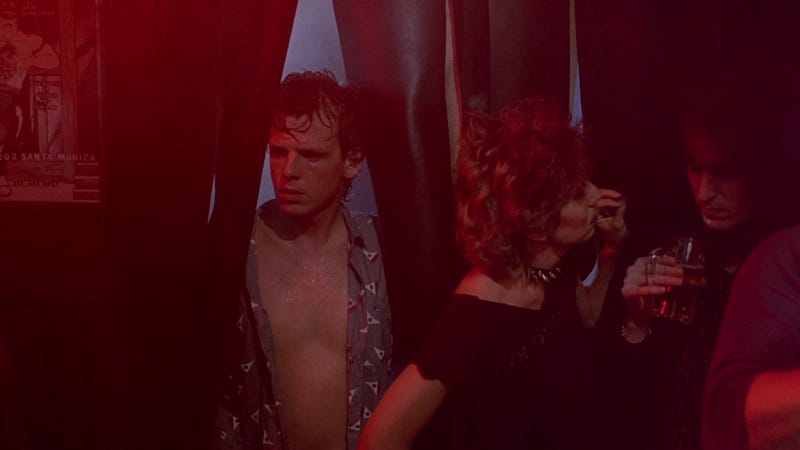
Again, this young man gleams with sweat! Obviously we get the slow exploration of the club and all the strange, interesting people with it, the implications of drag, of queerness, of sadomasochism, all of that is present in a dark, tightly crowded, dark environment.
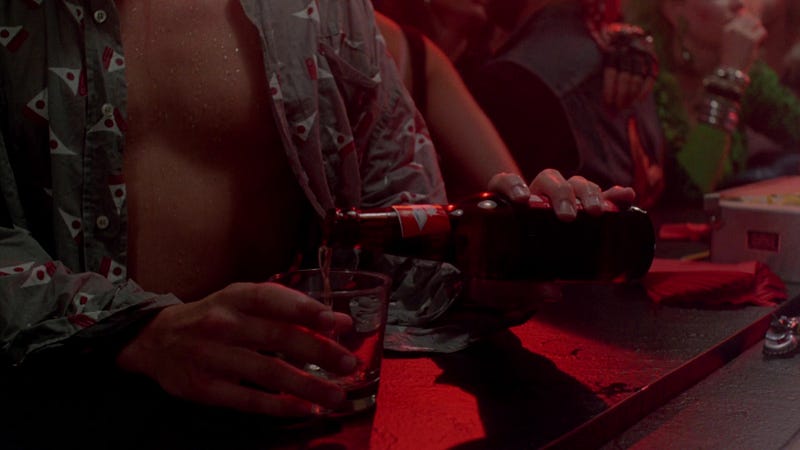
And then, fuck.
This shot and the way it segments Jesse’s body, the way we see the shadow under one o fhis pecs and his nipple just carefully obscured by his pyjama short, the valley between his pecs, the way we can see sweat gleaming on the skin and slowly drizzling down. Look how carefully and delicately he’s holding the beer bottle and think about the implications of him holding the beer bottle like that in a space full of men who want to fuck him — thumb braced on the underside of the bottle, his fingers seeming almost shy on the shaft of the bottle.
Who’s this shot for? How do you imagine this boy holding a cock in his hand?
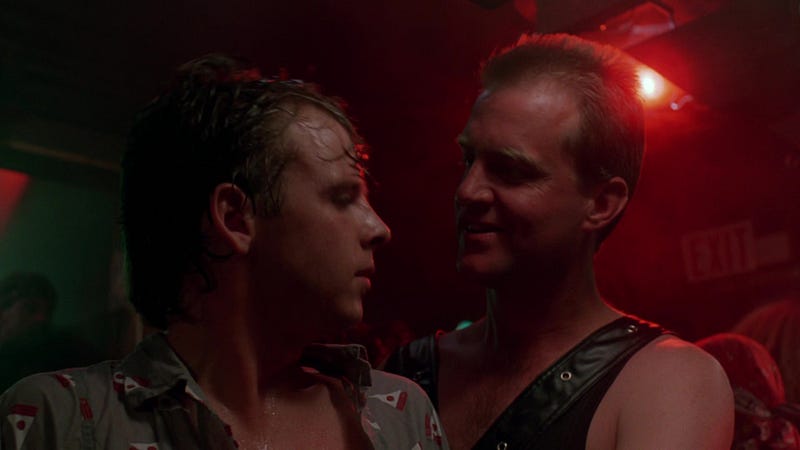
Here’s how Schneider appears a moment later, clad in a leather vest, also sweaty, leaning into Jesse’s body while the froth is still clearing from his just-poured beer, barking orders, leering over him.
How do you imagine him holding a cock now?
When we talk about the language of the camera and the movement of the camera-pen, there’s a few moments that stand out most — what the camera follows, so what movements or moments the camera will move to keep its gaze on, or what rooms and scenes that the camera pans to keep onscreen; what the camera focuses or zooms on, especially if we see the camera change focus so that part of the scene comes into focus rather than being blurred; and lastly, what the shot shows and what its limitations are.
I’ve talked several times about how much this movie makes use of wild angle shots,, especially when we’re in Jesse’s bedroom and observing him alone — the thing about this sort of wide angle shot that captures an entire room at once is that it doesn’t feel incredibly intimate in itself, but it mimics the placement of a surveillance camera, right? The camera is placed at a careful vantage point and its gaze is hungry — it doesn’t want to miss a single movement of its subject, so it’s carefully positioned so as to take in the entire room at once.
This is our stand-in for Freddy’s gaze when Jesse is alone in his room, positioned as though he’s peeking at the room from a corner, stalkerish, a Peeping Tom. We don’t see the exact same positioning in other rooms in the house, such as the kitchen or the living room — there are a few moments in the living room, especially during the bird scene, where we see the room from a higher angle where the camera’s up in a corner, but these shots are dynamic and are cut with other shots and angles.
When we get that wide angle shot and it remains static , we’re put into the shoes of a static viewer who’s surveying the scene — as it does when Jesse is moving about his bedroom; as it does when Coach Schneider is looking out of his office window and we see the static shots of the field where he’s watching kids play and run; as it does in the locker room; where the static camera is set up to fully take in that whole corridor of lockers, so that we can see all the boys changing in it at once, and see as much of their bodies as possible.
This is so different to the general movement of the camera and its positioning in the gay bar scene, which would not have the space for this sort of surveillant angle. As we see Jesse move through the gay bar he is struggling to pick his way through the crammed-in crowds of people in the cramped, smoky environs — were we to have that wide angle, static shot in this scene, it would be like a game of Where’s Waldo, or given the subject matter, one figure moving through a scene from Hieronymous Bosch.
In a room of unique figures, each of them in different ways a sexy or sexualised body, Jesse wouldn’t necessarily stand out in that sort of wide shot. Thus, we have the camera track him through the room, move with him — and as the camera follows him, it always shoots him from the waist and the chest up. The whole time, we have a good view of his shining, vulnerable belly, the peek of his pecs under his open shirt, tantalising in the way that women’s cleavage is often treated.
This is not the gaze of a surveillance camera, nor the gaze of a distant prison guard who is viewing the whole of a scene at once. The gaze of the camera is initially looking at some of the other figures in the room, and as soon as Jesse enters via the curtain, like a young man coming onto a stage, he is the sole subject of the camera’s attention. It follows him as someone’s gaze might, focused on his face and also his bare chest, hooked onto him as he moves to the bar.
But once he’s at the bar, we see the camera drop, right?
One of the things that depersonalises and works to objectify a person on film is the way in which their body is segmented and pieced apart, how much the camera lingers on these specific segments of the body. It’s most notable in the male gaze on women’s bodies — we see a focus on the mouth, particularly the lips, we see a focus on the breasts, the legs, the waist. Often a bare back, if a woman is naked, and particularly the divot of her spine leading down to her backside.
The face isn’t necessary. The personhood isn’t necessarily. What the camera does is to piece apart the desired body into its most desired parts, the details that are the most titillating, satisfying. If you’re Tarantino, it’s feet; if you’re Jack Sholder, it’s apparently Mark Patton’s little mosquito bite twink tits, and listen. He’s got a point.
But the way in which the camera settles on him, like… It’s just so similar to how a camera ordinarily settles on a female character’s bosom, feels objectifying in the same way, and with the same implicit power dynamic.
And that thread is then completed when Schneider appears right behind him, the stand-in for the viewer in this case — the big man that’s appeared to punish this twink, who interrupts the camera’s gaze settled on Jesse’s body.
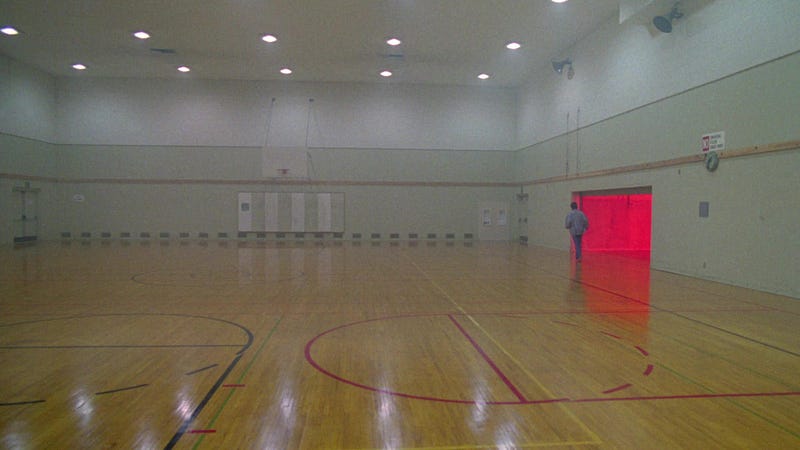
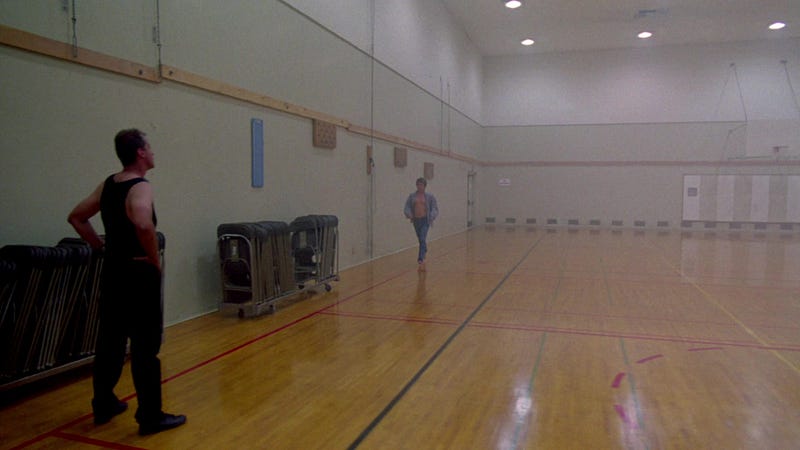
When we go to the gym, we go back to the wide angle surveillance shot, and especially in the gym where Jesse’s doing laps, he seems incredibly small, which is the point of this punishment: making him feel small, making him feel powerless. Schneider desires to entirely dominate him, and it wasn’t enough to remove him from the S&M environment where anybody might want to fuck him — he has to instead bring him to his own domain, the gym, and satisfy his own sort of sadomasochism, which is based in the language and imagery of the gym and exercise.
What I love about these scenes and the way they made me feel, the way that Schneider’s gaze and the camera’s gaze when potentially representing Schneider feels on Jesse’s body, is that like… As a young pretty man, you experience that gaze. You experience that your image is being exploited, that someone’s getting off on you, and particularly when it’s an authority figure like a teacher or coach, or just an older man in your community, there is a sense of entitlement in doing so.
When you’re too obvious a faggot, it is seen as the right of some straighter, more masculine men to fuck you and to get off on you, because by being too obvious, you’re demoting yourself to the same or similar position as a woman. If a more masculine man treats you as a fucktoy or a fuel for his sexual fantasy, he’s fucking another man, yes, but it’s the man’s fault for acting like a girl and being so fuckable, by seducing him into doing it — and also, by treating you as a fucktoy, he’s showing you what you’ve earned. If you were a bit butcher, if you weren’t such a fruit, then you’d not be faced with the exacting punishment of another man’s desire for you.
Jesse feels like he’s a girl from a perspective of the camera’s gaze in this film, because it feels like he doesn’t or isn’t supposed to enjoy the fucking that’s inevitably coming to him. He is going to be fucked, he is going to be used, and his pleasure is not just unimportant irrelevant, but actively like… A potential detractor.
Much of the horror genre punishes expression of sexuality and sexual desire, especially in young women, as an infraction worthy of death if not torture, but even the act of being attractive, of being desired, can itself earn the same punishment. If a man finds you attractive as a young woman, you are soliciting his attention — you can be called and punished as slutty just for the act of being. When we think about the straight male gaze and we’re talking about the one-sided power dynamic of that gaze, we’re talking about how a gaze projects onto its subject, and this is the implicit violence of that gaze.
The straight male gaze lands upon a young woman, it desires her, and because of the one-sided nature of that power balance, because he has autonomy and she only has the autonomy his gaze sees fit to project onto her, she must be punished for his desire for her.
The gaze as it lands on Jesse treats him as a final girl, and subsequently, it feels the same — he never says he wants to be fucked, never is fucked, but the act of being pretty and desirable by the men who would fuck him is enough that perhaps he should be punished for it.
And Schneider wants to punish him for it. He wants to fuck Jesse, and he wants it to hurt, he wants Jesse to sweat, for Jesse to suffer, for Jesse to be small and powerless as Schneider utterly overpowers him. Because of Schneider’s sadism, it’s not important that Jesse should enjoy what Schneider does and will do to him, and if Jessie did enjoy it (with the implication that because he’s gay, he would), that would be just another transgression to punish him for.
The thing about this film as a possession horror is that Freddy Kreuger is two things at once — he is the pervert in the shadows salivating over Jesse’s body, over his desire to brutalise him, to fuck him, to rip him to shreds, lusting over him in the same way he did over young girls; at the same time, Freddy Kreuger is the monster inside Jesse. He’s the monstrous desire threatening to “come out” of him, to rip its way out from under his skin. Jesse’s dynamic with Freddy represents the horrible double-sided blade of Jesse’s homosexual desire: to desire men is a monstrous and disgusting desire, and the flipside of this is to be desired by men in the same monstrous and disgusting fashion.
The language of cishetero culture when discussing male-on-male sexuality in this period, even before getting into the language of the disease-ridden, the plagued, the punishment of sickness ordained by God that comes alongside the AIDs crisis, gay sex itself is seen as brutality, as violent, as a transgression. It’s sodomy. It’s next to bestiality. It’s a perversion against the natural order. It is not just filthy or dirty, it is not just sinful, it is a violation of natural law — and it is explicitly considered to be inherently violent. Anal sex is an invasion of the body, a plundering of it, a destruction of it, and this sex is all the worse because it is performed by and against men — and if you’re going to desecrate a body, it should be a woman’s body, because women were made by God to suffer and to experience men’s violence. For a man to invite that attention is unthinkable.
Especially for anal sex, because of microabrasions and tears, being a bottom was associated with higher risk for contracting HIV than being a top, because HIV is spread through contact with blood. Tops could absolutely still contract HIV, but the penis is prone to less potential injury than the rectum, so it’s not always as common. So bottoms see a risk of disease — and thus face a hatred — that tops don’t necessarily, especially because of the projection of the male-female binary onto the imagined binary of tops and bottoms.
Freddy represents this fascination with the male body and his own burgeoning sexuality and desires, but also his disgust with and horror with it, so it’s fitting that he punishes Schneider the way that he does.
The whole dream logic of the situation, like… Jesse does not necessarily desire Schneider, but Schneider is someone in his life whom Jesse is aware of as a man who desires him, who wants to fuck him. Yes, hurt him, but also, fuck him. And if fucking him is inherently hurting him, because sex itself would be violation and a kind of harm, then isn’t the reverse also true? Isn’t to hurt him, to humiliate him, to debase him, a sort of fucking in itself?
Jesse asks Grady at one point if he remembers his dreams, and Grady says, “Only the wet ones.” Every dream is a wet one when you sweat as much as Jesse does, but also like — This dream logic is sexually charged. It’s complex victim fantasy of many a young man who’s trying to work out how he feels about the gaze of older men on him, the ways in which they desire to hurt him, to debase him, and how they make him feel.
A male authority figure takes you aside to punish you like he does at school or in the library or wherever else you know him from — but it’s late at night. He’s found you in an adult place. The people who saw Schneider take Jesse out of that bar won’t be thinking “Oh, he’s fucking one of his students,” they’ll think he’s taking a beautiful boy home from a bar. Why else would a boy like that go to that bar except to get fucked?
No one knows where he is. No one knows they’re at the school.
Schneider is punishing him in the same way he does during school hours, but crucially, it is not during school hours. They are alone in the school halls. Schneider makes him run laps while he watches, maybe Schneider thought about making him skip with that jump rope, maybe he thought about making him do push-ups, and now he’s making him hit the showers.
It’s all the same, except they’re alone. It’s all the same, except they’re unobserved. It’s dark outside. No one knows where they are — no one at home even knows Jesse’s gone out.
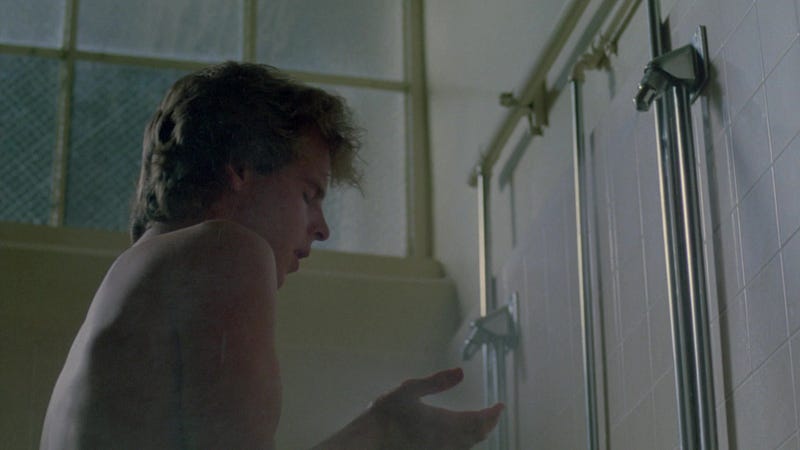
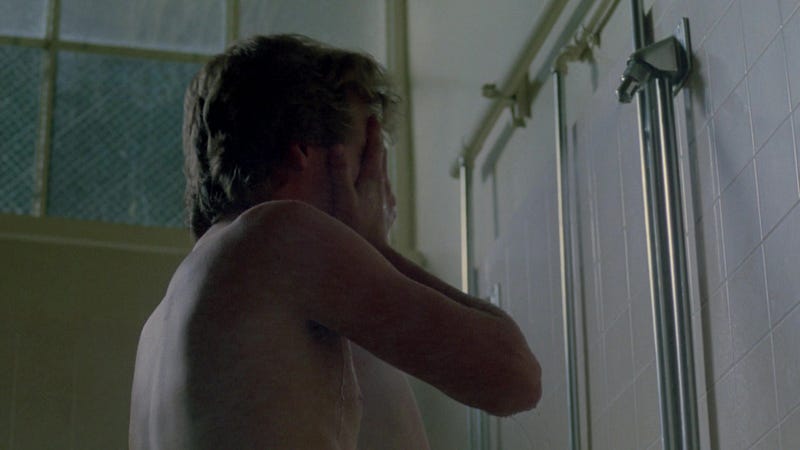
Schneider can do whatever he wants to Jesse here, and Jesse is keenly aware of it as he showers. There he is, facing forward, breathing laboured, soaked to the skin and knowing that the hot water won’t make him feel clean when he can still feel Schneider’s filthy gaze on his body. His back is to the shower entrance.
Is Schneider going to walk in? Is Schneider going to come in behind him? Bend him over? Press him against the tiles? Would Jesse dread that, or welcome it? How similar are dread and desire when you know that the natural aftermath of your desire is death?
Notice how the camera angle is different here than in the bar? In the bar, we were looking at Jesse through Schneider’s eyes, the eyes of someone who wanted to fuck him, but here, there’s a subtle difference.
Jesse is naked, but suddenly the camera is actually higher than it was when he was in the bar — it starts at his upper torso rather than his mid-section. See how he’s subtly angled away from the camera, so that we can’t see his nipples, can’t see the slight swell of his pecs? Notice how the camera is angled slightly upward toward his face, subtly empowering him rather than looking down at him?
Have the tables turned?
As Schneider has his moment in the office, as Kreuger’s heat begins to encroach on him, as we see the wires on the tennis racket burn and pop, as we see Schneider the close subject of the camera, the shadows all over him so he seems nervous and claustrophobic, we have Jesse in the shower intercut with him.
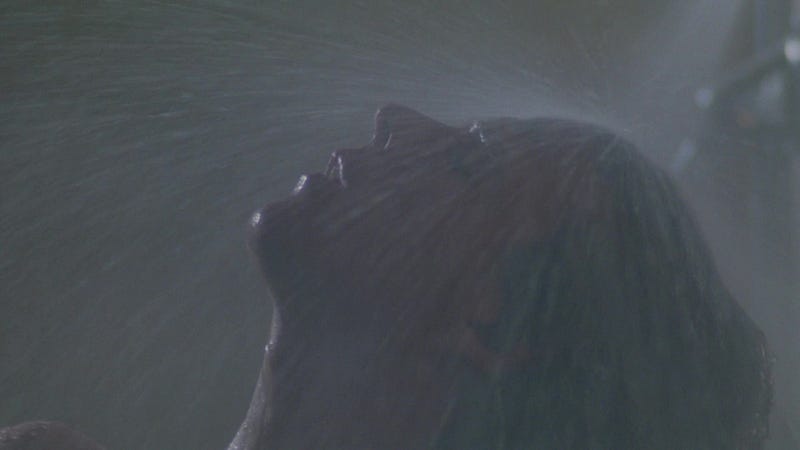
Here’s Jesse getting clean, washing off the filth of having exercised for Schneider’s sexual gratification, here’s him tossing his head back in ecstasy — it’s hot and horny because he’s naked, it’s a bukkake shot to the face as he enjoys the hot water, but literally, he’s getting clean.
And what happens as Jesse gets clean, as the camera’s focus comes to be on his face and not on his cute twink tits or his naked body, or the sweat on his skin? What happens as he wahses off the sweat and the filth of Schneider’s exploitative gaze?
As Jesse cleans up and becomes empowered by that act of becoming clean again, Coach Schneider is disempowered. Kreuger encroaches on him, renders him frightened and fearful. Schneider’s sacred space, the seat of his power, turns against him. Balls literally smacks him in the face.
Schneider is no longer gazing: he is now gazed upon.
He does not enjoy it.
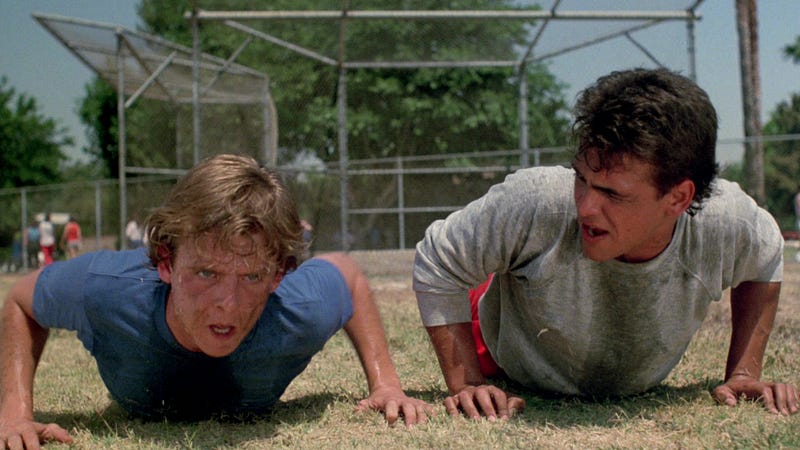
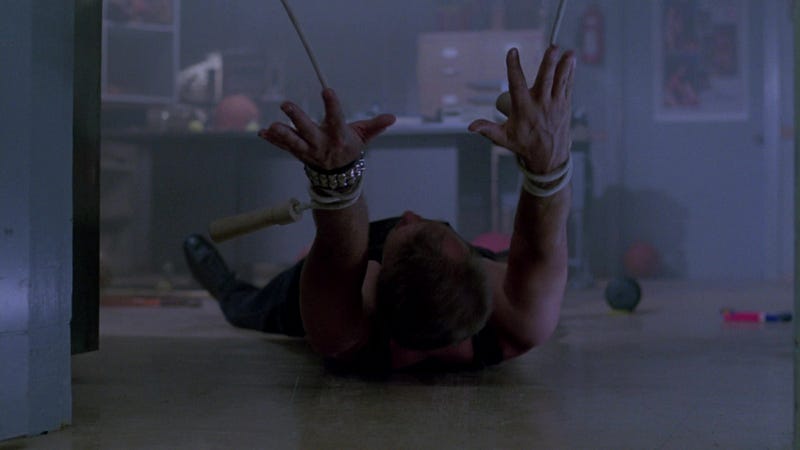
He’s bound by the skipping rope and dragged from the room, and even the way that he’s flat on the ground with his arms outstretched above his head and his legs apart is a mirror image of Jesse and Grady’s positioning when he was making them do push-ups — he could slot underneath one of them for them to fuck him, easily.
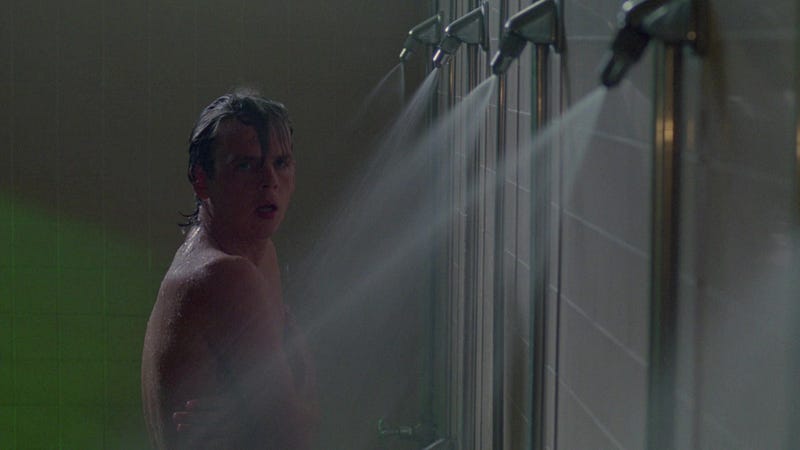
I just need to mention how similar to a movie girl’s this behaviour is, the covering of his chest with his hands, but like… The reason women cover their chests is because it’s the most commonly shamed and fetishised part of their body, and through the gaze of this film, Jesse’s chest is treated with the same fetishistic desire. He’s right to cover his modesty by covering his chest.
And right after, he gazes on Schneider’s chest.
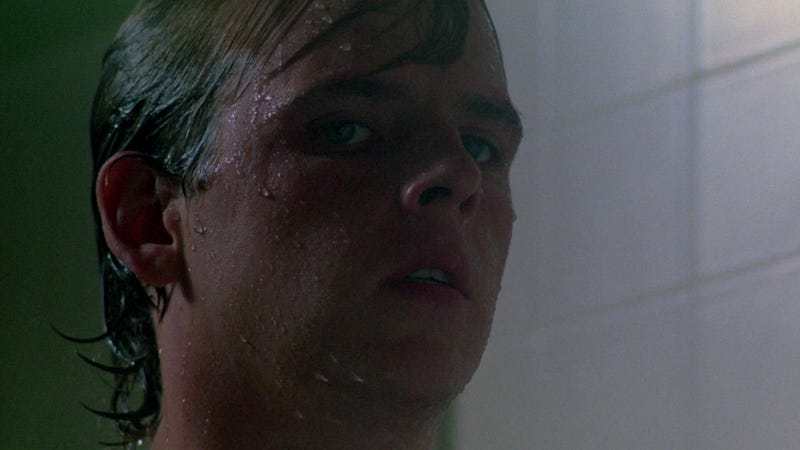
Schneider is dragged in, through Jesse’s gaze, and boom, we’re looking up at Jesse, Jesse is looking down at Schneider, at Schneider’s chest, particularly. How’s that for role reversal?
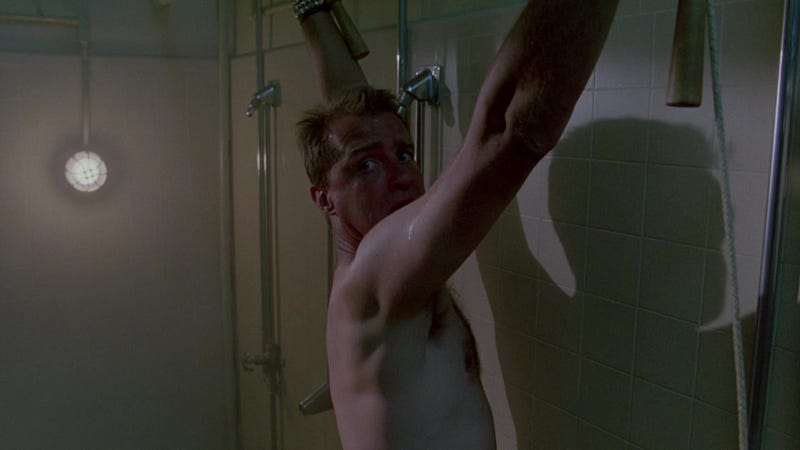
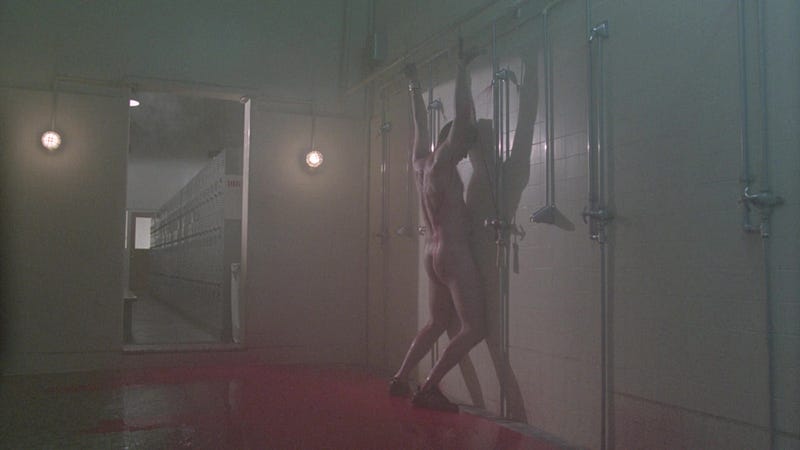
Everything about this scene is Schneider being further disempowered — he is stripped down to nothing, he is tied with his arms above his head to give someone else full access to his ass, right? The way that his clothes are stripped from him is violent, and when the towel is brought to slap violently against his ass, so violently that he bleeds, like —
This is a reversal of Schneider’s fantasy. Schneider’s desires are based so much in the language and symbology of his workplace and his calling, and here they are being used against him. Schneider is being tied by jump ropes after being pelted with balls, Schneider is bound in the showers for anybody to see or use him, Schneider is slapped with a towel on the ass.
It’s an escalation of his fantasies, obviously, because he’s being punished for them with bloody violence, but — Yeah.
He’s slashed and shredded and killed, and here is the reveal:
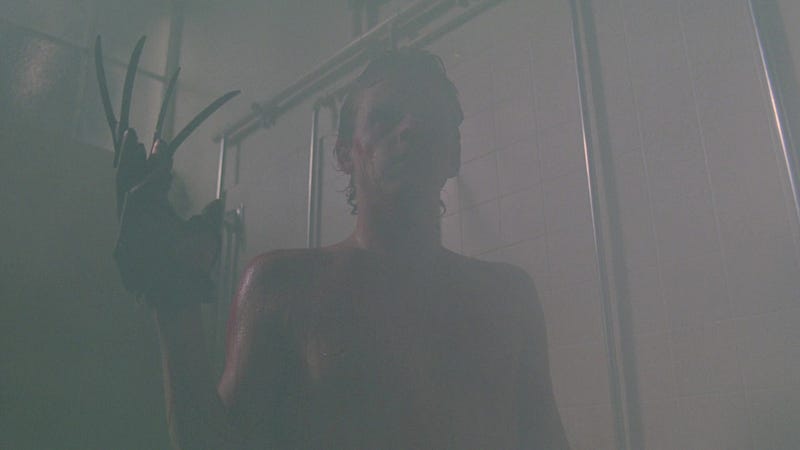
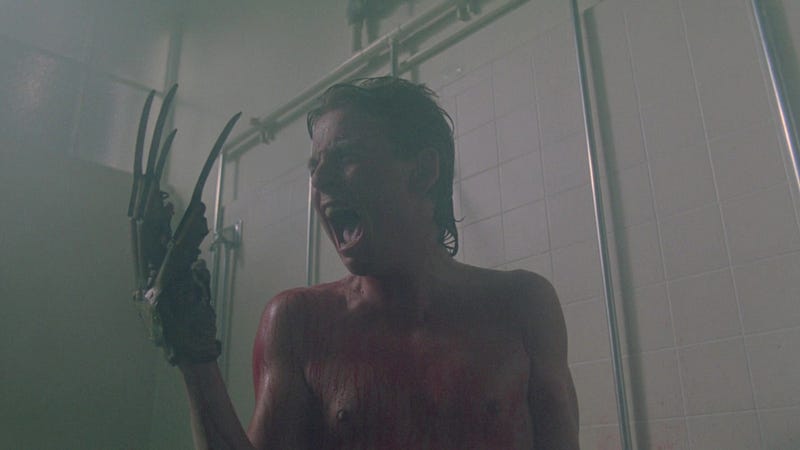
We’re looking up at Jesse-Freddy. Jesse with the steel glove. Jesse surrounded by fog, because these first fumblings and experiments, these first explorations of desire and need, aren’t they so often done in the dark, where the gaze is obscured?
We can see the evidence of what he’s done. We can see the evidence of what he is. We don’t need to see him in action. But he’s still horrified by what he’s done.
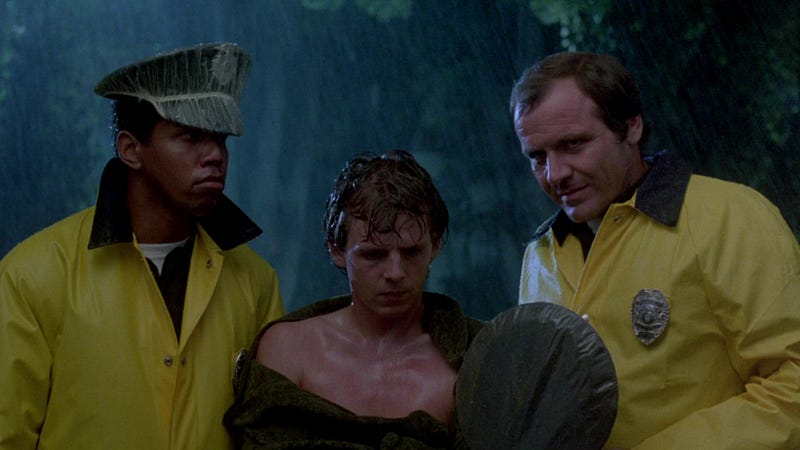
So here’s Jesse disempowered again — look at how tiny he seems compared to these cops. He takes up half the screen that they do, and the towel is barely covering him, we can see the wetness on his collarbones, and we can see the upper part of his “cleavage”. His modesty is barely covered here, and he’s got these two big authority figures on his either side, both of them dry (unmarred by male desire) while he’s soaked to the fucking skin.
Let’s skip forward. A new night, a new wet dream.
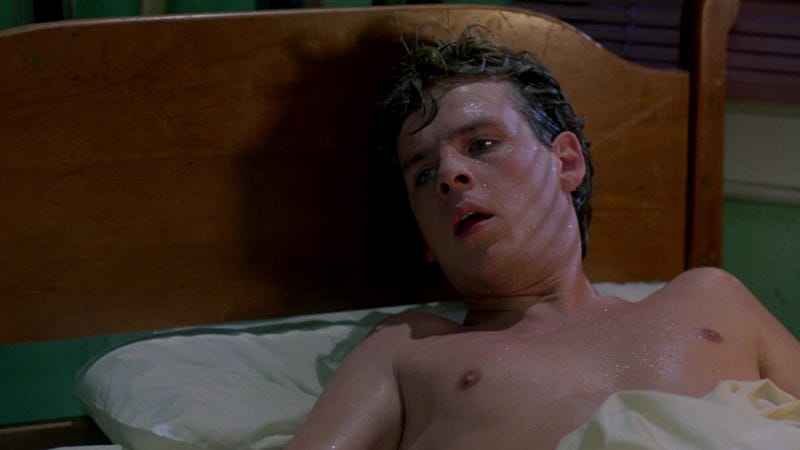
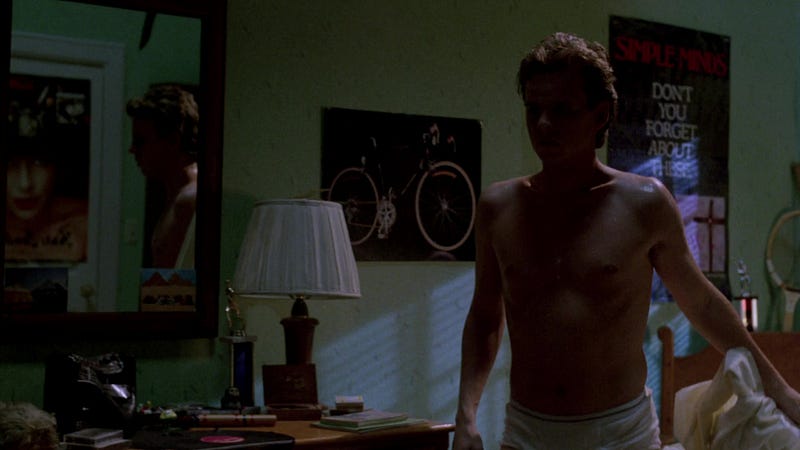
Jesse wakes from another dream, and this time, we’re not using that whole room surveillance shot. We cut in close on his face, and then we slowly come out with him as he stands to his feet, the camera zooms in on his face and not on his chest, and then the camera slides down…
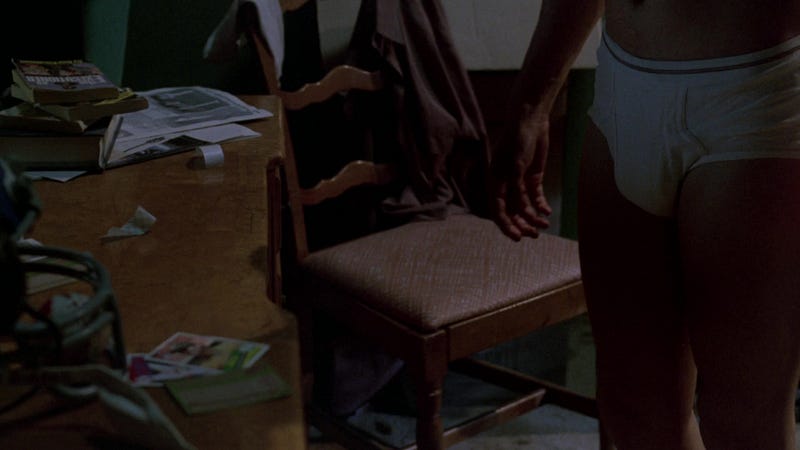
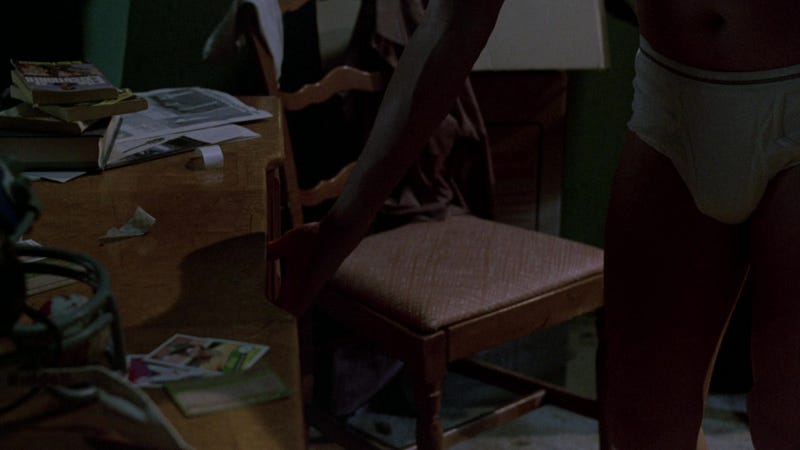
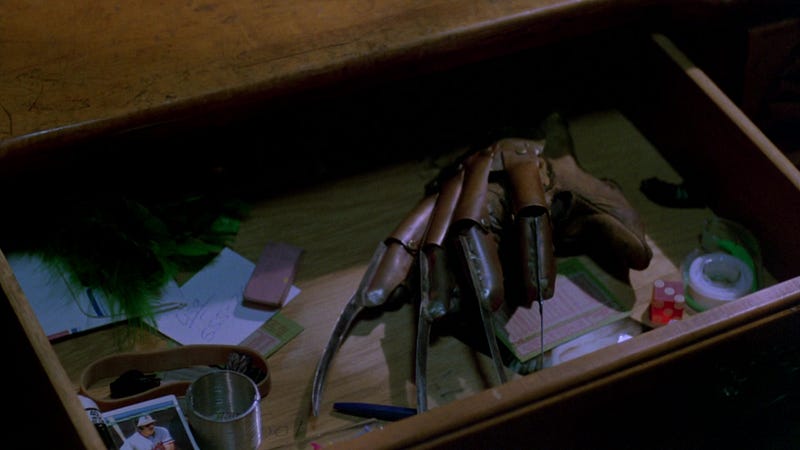
It’s bulge time. And, what’s that, boy? What do you see?
Oh, so Freddy’s glove is the tool by which you’ll exercise your sexuality. Yes, Freddy’s glove is a tool of bloody violence, but at least it just slits people open — with your cock, you’d fuck people, and not women, but men. Yikes! Better to have the glove, right?
It’s interesting to see like… So firstly, we cut to Jesse outside of his bedroom, wearing the glove on, but also clothed — he’s wearing jeans, he’s got his shirt on, but the shirt is open. And what does he have a vision of in his dreams?
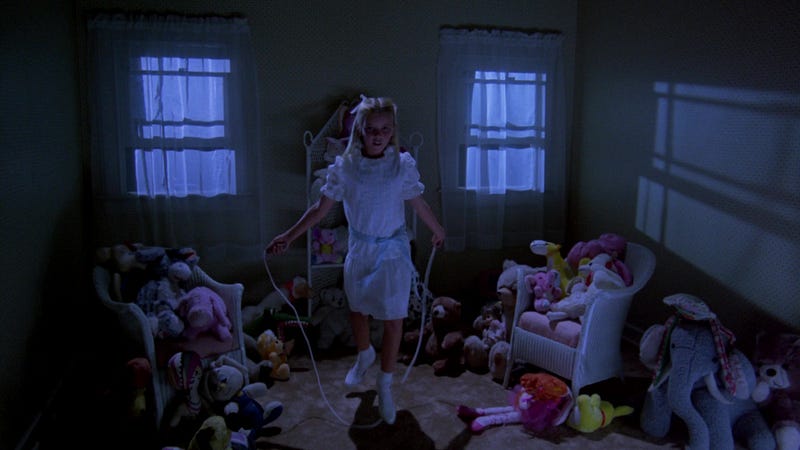
His little sister. With a jump rope.
It’s interesting because like, the stereotype of queer desire as being paedophilic, especially a violation that’s most frightening because it might be directed toward little girls in white dresses, who are the purest manifestation of innocence.
The fact that male desire for other men is pretty explicitly, you know, aimed at other men, is irrelevant. To be a faggot is to transgress against natural law, and to be inherently violent, which means you’re a threat to children.
The thing is like… This movie keeps implying that his desires are not something that he can control, that he acts on them whether he truly wants to or not, and repeatedly he looks at his little sister and then closes the door like he does here. He even says, “Freddy tried to make me hurt her,” but Jesse vetoes it — Freddy is a child molester, but Jesse isn’t. It’s Freddy’s desire that has him open the door and look in, and it’s Jesse’s lack of desire and love for his sister that has him close the door and turn away, again and again.
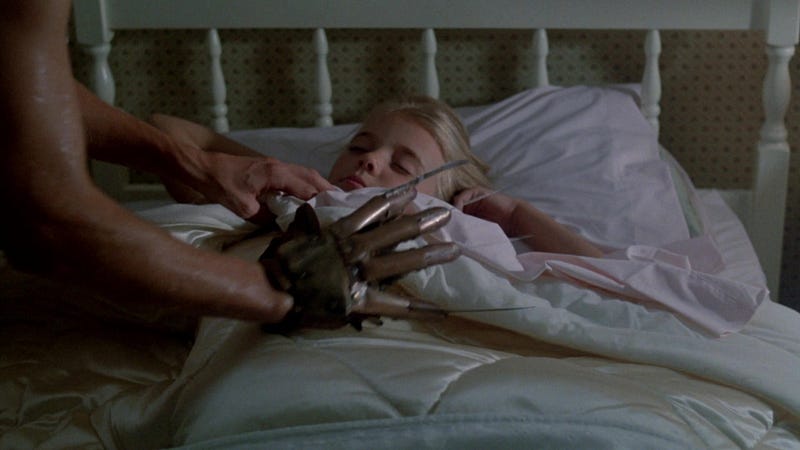
Even wearing the steel glove, he gently tucks his sister in.
He carries with him a violent desire, or at the least, a desire he believes to be inherently violent, but its violence is not indiscriminate — so long as Jesse’s in control. We obviously then see him taking pills to make sure he doesn’t sleep and that Freddy can’t possess him.
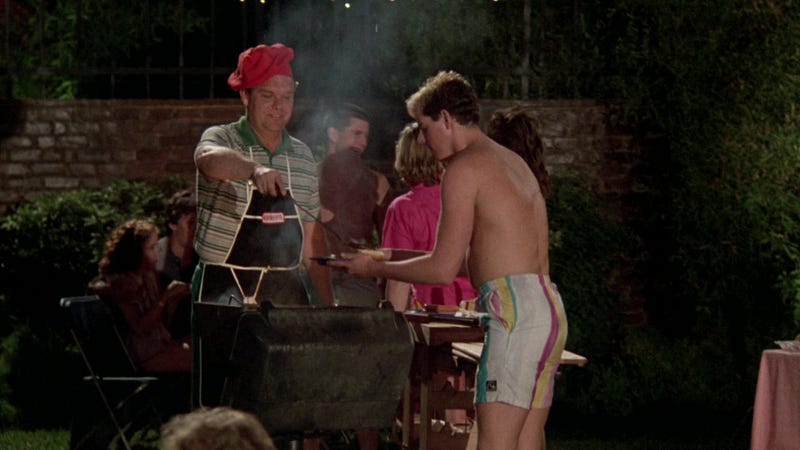
The BBQ party is an interesting contrast with many horror movies because it does the reverse of what we tend to expect from a film like this. While there are indeed young girls in swimsuits, the central scene is a shirtless man being fed meat by a BBQ dad.
The thing about Jesse and Lisa’s DMC once they go into the little summerhouse together is so interesting because like. Jesse desires comfort from Lisa, right? He desires comfort from her, intimacy — up until now, when on screen together, their body language has lacked intimacy beyond the friendly.
They mentioned in the Scream, Queen! documentary the idea that like, he would be saved from his homosexual desire by the “love of a good woman” which is obviously nonsense, but like… It’s not just nonsense, but that didn’t come off as the intended meaning of the text.
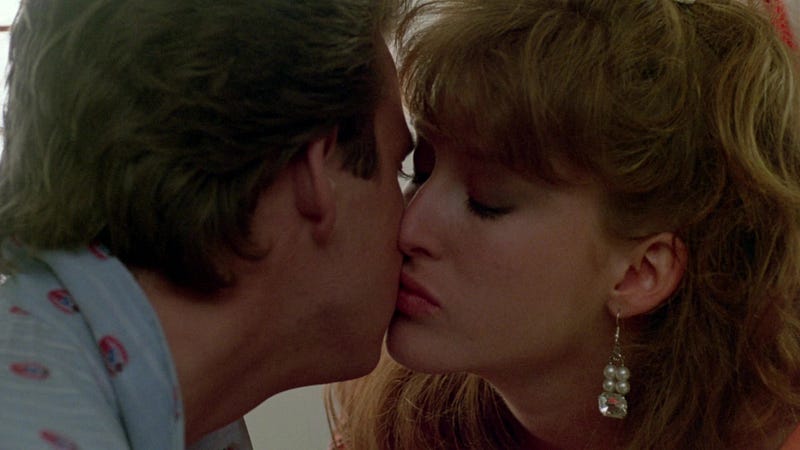
The thing is, I’m pretty sure Lisa knows what Jesse is. They hang out together, they drive to school every day together, they sit together and read filthy diary entries. He doesn’t make overtures toward her, and he’s safe.
But the thing about a lot of women’s desire for gay men is that like… The fantasy is a man who will look at her without evoking the straight male gaze. That gaze is exploitative, it’s implicitly violent, and it doesn’t see a woman like her, or any girl or woman, as a real, autonomous person.
If she could just fix him, if she could just turn him over to desiring her instead of desiring and be desired by other men, she could be with a man that doesn’t hate her. That doesn’t want to punish her with sex or for the existence of sex, but might want to have sex on equal terms.
He leans in and she closes her eyes and she thinks, maybe, just maybe, she’s done it. Maybe he’s changed. Maybe he’s not gay after all, like she suspects, like people suspect — maybe he’s just a good guy, one that’s available to her.
And then he kisses her and it’s not on the mouth, but on the side of her mouth. It’s affectionate, but not sexual, not romantic. But it’s a start, right?
You can see Jesse thinking, fuck, maybe I can do this. Maybe I can be with her instead. Maybe I can push aside my horrible, violent, homosexual desires and be fixed by her — maybe I can be normal, natural, straight. Jesse craves the safety and certainty of desire for and a relationship with a woman in a society that will never accept his desire of and for men; Lisa craves the safety and relative lack of desire a gay man will have for her, because she lives in a society where violence against her by straight men in their desire of her is not just accepted, but seen as natural and normal, even celebrated.
They both want security. They want to be able to rely on each other, take solace in each other.
So he kisses her. So she kisses him back.
The kiss is shot like a love scene between a boy and girl in another movie, and is even cut with a scene of Lisa’s parents in bed together, as if to say, see, this is what they could have. This is what they could be. Instead of being a horrible, violent killer doomed to horrible violent death by his perversions, he could be like this cute BBQ dad who definitely doesn’t enjoy it a bit too much when his daughter’s hot young friends come take burgers and hot dogs from him at the party. He can hang up his perversions of actually wanting sex or violent desire (itself a form of sex; sex a form of violent desire) and just satisfy himself with enjoying the young men around when his own children have parties.
That’s better, right? Better to swallow down what he is. Better to be a non-practising version of the monster he is. Better to be emasculated this way than emasculated the other.
Back to Lisa and Jesse kissing. They’re even in missionary, echoing back to the push-ups. He could have been kissing Coach Schneider like this if he didn’t get himself executed by being such a fruit.
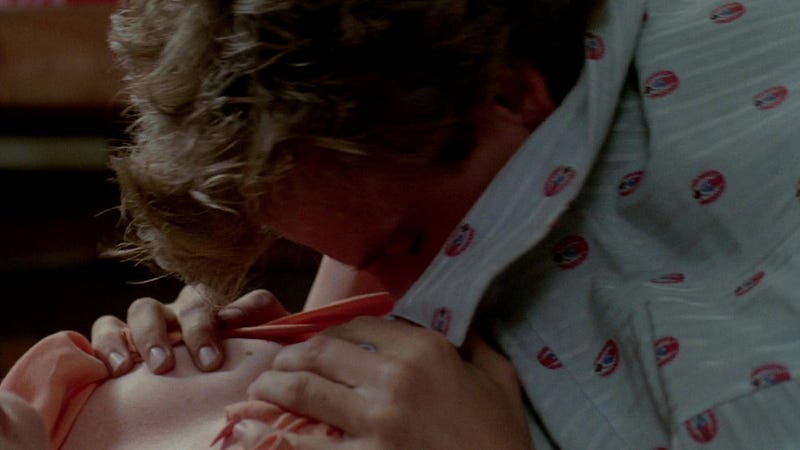
Jesse pulls back from kissing her and goes down to her breasts, buries his face in them like everybody has been wanting to do to his chest this entire movie… And what pops out? What rips its way out of him?
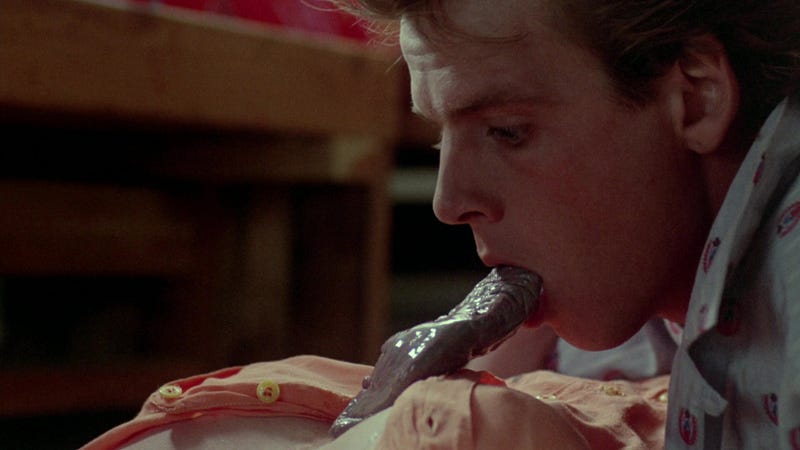
Like, that’s phallic as fuck, right? On the one hand, you can absolutely read this as Freddy bursting out of his body in response to his sexuality with a young woman, a sign that his desire is bringing Freddy out, etc.
On the other hand?
If as a young repressed twink you start to get hot and heavy with a girl your age, and you’re interrupted by the thought of a man’s six inch long appendage in your mouth?
That’s a sign!
Jesse obviously quickly shoves the metaphor for Freddy Kreuger’s cock back into his mouth and makes a hasty exit — hey, no judgement. We’ve all been there.
He “Can’t catch me, gay thoughts!”es his way all the way over to Grady, which
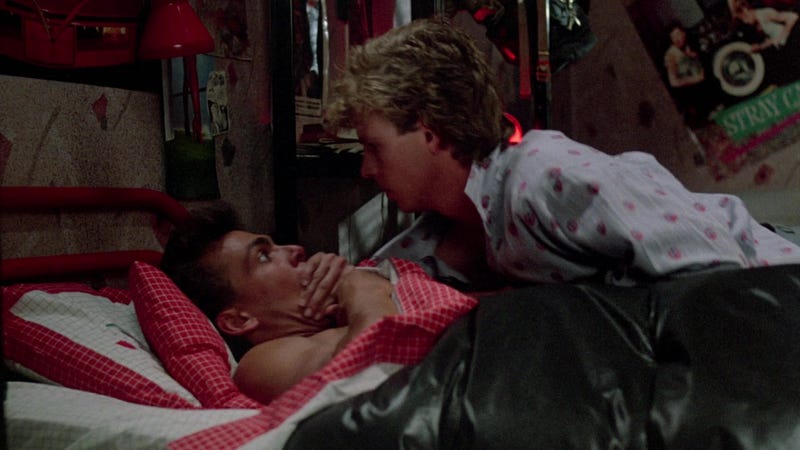
Oh, this position is far more intimate, no? The hand over the mouth like the hand over his own mouth a second ago? The physical dominion over Grady’s body and the way he’s pinned beneath him? The way he’s literally snuck into Grady’s bedroom? Where is his other hand resting, dare I ask?
I love how the camera is positioned here too, because we’re almost in the bed with them, the blankets obscuring our view.
The thing about this movie is that like… So I’ve referred to it being shot in many ways through the straight male gaze, right? I’ve talked about how Jesse is shot the way a final girl is.
Now, through the process of getting herself a weapon or turning weapons on the killer / monster, a final girl often empowers herself. She empowers herself by giving herself a sort of representative phallus, according to Freudian readings, and with this representation she’s able to defend herself against the men and masculine figures that would harm her.
She survives by maintaining and defending her purity (we often see the final girl in her last scene in a white dress or shirt that represents her innocence), often by fighting back against the men or representations of masculinity who would harm her with their own phalluses, represented or otherwise.
She genderbends, a bit. She gives herself some masculine things in order to empower herself with them, because to be closer to masculinity is to be empowered — because women are a gender made up of prey, whereas men are a gender made up of predators.
What say we, then, to the femboy? To the pretty twink that men just want to fuck so bad?
Because this whole movie is all about Jesse realising that he is desired and thus desiring, but he doesn’t desire to be fucked. His desires aren’t about Freddy Kreuger bending him over, or necessarily about Schneider bending him over — many of his desires aren’t about bottoming, they’re about topping.
For a straight man who wants to fuck a pretty boy or a twink, there’s a sense of the ticking timebomb, as I said before. The older the twink gets, the more masculine he may appear. His youth fades, his hair might go, he might look more masculine, as I said before. You can no longer deny that you mistook him for a girl, or that fucking him in the ass was the same as fucking a girl from behind.
But this twink was put on this earth looking like that and acting that way so you could fuck him guilt-free, right?
He’s woman-aligned, or woman-coded, or something like it. You can fuck him like you’d fuck a girl, and you don’t even have to pretend to want to marry him or get him pregnant. He’s God’s perfect fucktoy.
How dare he be a fucking top?
If he’s gonna go against the natural order by being a faggot, the least he can do is take his new place in the natural order, right? The least he can do is be a sexual object free to be acted upon.
Under cishetero patriarchy, their perspective on immutable, binary gender includes certain sexual roles. The man fucks, the woman is fucked. The man abuses, the woman is abused. The man is a predator, the man is prey.
They tend to project similar gendered roles onto gay relationships because their brains are utterly rotted by this ideology, and subsequently there’s a desire to see “topping” as the act of the male, masculine partner, and “bottoming” as the act of the female, feminine partner. There is no such thing as non-penetrative sex or switching positions because cishets are uncomfortable when non-cishet dynamics aren’t exactly the same as theirs are. It makes them worry that maybe it’s not all about biological imperative after all.
Cishetero people like to talk about these things as being based in biological imperative or instinct — this way, when a man rapes somebody, they can say that it’s natural. It’s a way of victim blaming, but also a way of holding up and enshrining sexual violence in society. If men only rape women because it’s natural, then, hey, boys will be boys — it’s the women’s fault for letting themselves be raped. Cishet men only have bodily autonomy and rationality when it’s convenient, not when they want to perform an act of sexual violence.
When a man is emasculated — for example, by being a homo — then his place in the natural order shifts. He is below the masculine man. His predation might be upon other men, which is unnatural, as opposed to the masculine straight man’s predation on women, which is natural.
But if he’s a bottom, then… Okay. If he’s a bottom, that’s a good place in the order, right? Because his existence serves the sexual needs of cishet men higher in that order.
I just love the idea that this film is a sort of exercise in the mind of a straight man, like. To begin to accept the fuckability of a twink, you must first concieve of the way in which that twink might fuck other men — might fuck you! And that’s super scary. It’s basically the same as brutal murder.
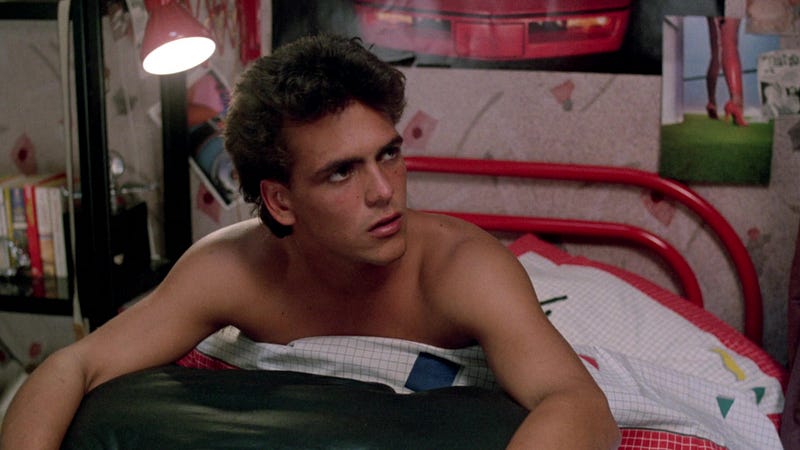
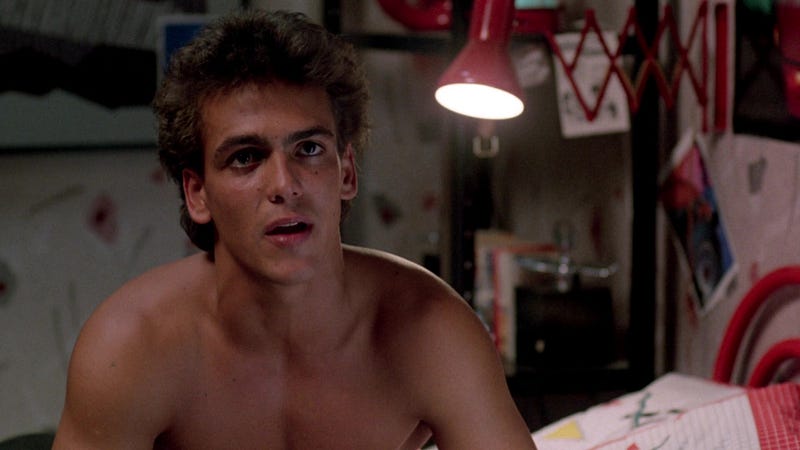
What’s interesting about this scene is that this is Jesse’s top moment with Grady, he’s on top of him, Grady is undressed, but where Grady is in bed, we’re not seeing his tits the way that we’ve frequently been seeing Jesse’s in similar scenes.
We see his strong shoulders, we see the upper part of his pecs, but they’re covered by the blankets as he reclines in bed, and then when he sits up, the shot still doesn’t extend to his nipples. His modesty is protected — we’re watching the two of them have this conversation, these two beautiful young men, we’re watching the homoerotic tension between them. We’re watching Jesse who’s having a crisis over his desire to top slash his desire to commit murder.
But Grady is top-coded, no? He’s got dark hair. He’s more muscular than Jesse is. He’s handsome, whereas Jesse is pretty.
Jesse can’t top him. And we, the viewer, shouldn’t and wouldn’t look on Grady’s body the way we might Jesse’s. It sets an uncomfortable precedent, no? It’s wrong. The only way we can possibly accept homosexuality is if we project the worst parts of the cishet gender binary onto gay men, because otherwise, gay men have a way out of the suffering cishet society has decided must be universal, because it’s natural. Or natural, because it’s universal.
It’s definitely not invented or constructed or artificially enforced. Nuh uh.
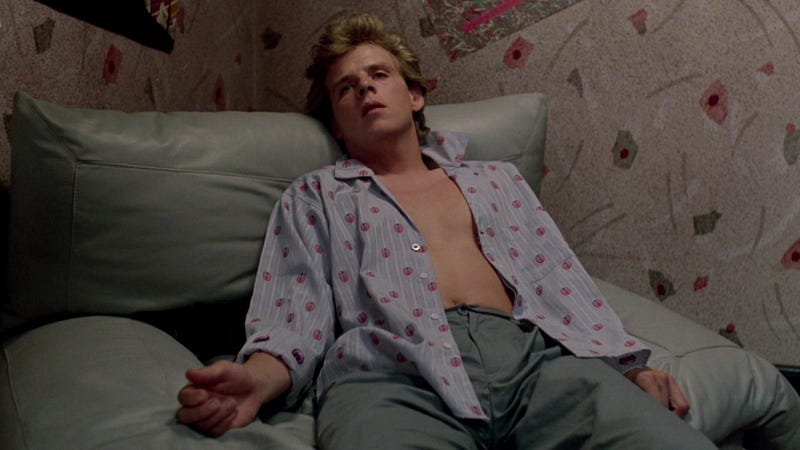
I mean, come on, look at this fairy behaviour. Look at how he leans back to show his chest and his navel and his pretty slender neck. We can’t see his nipples here but the promise is there — he’s tantalising, he’s slutting about and showing off in a way that Grady isn’t. Here is a body that’s begging to be fucked, whether it knows it or not.
How could a man in such a body want to fuck, instead of be fucked?
We only see Grady’s nips when Jesse is asleep and won’t be able to objectify him. It’s interesting, though, like… When we see Jesse asleep before, in class, etc, we saw the angle of him from above, the tight shot in on his lips, and so on.
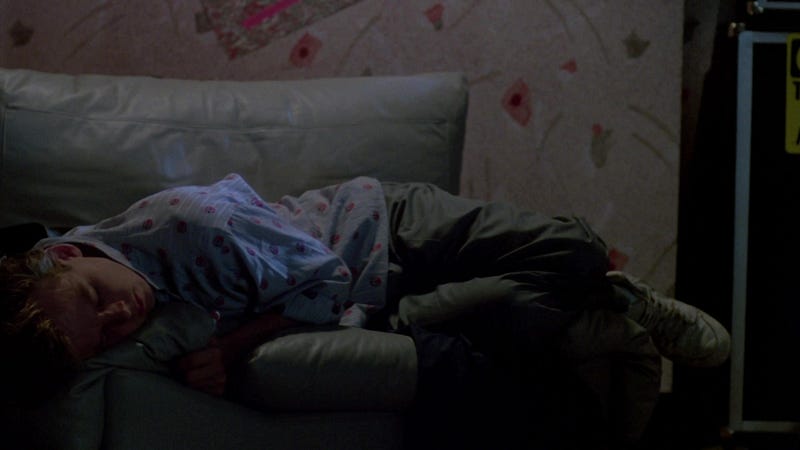
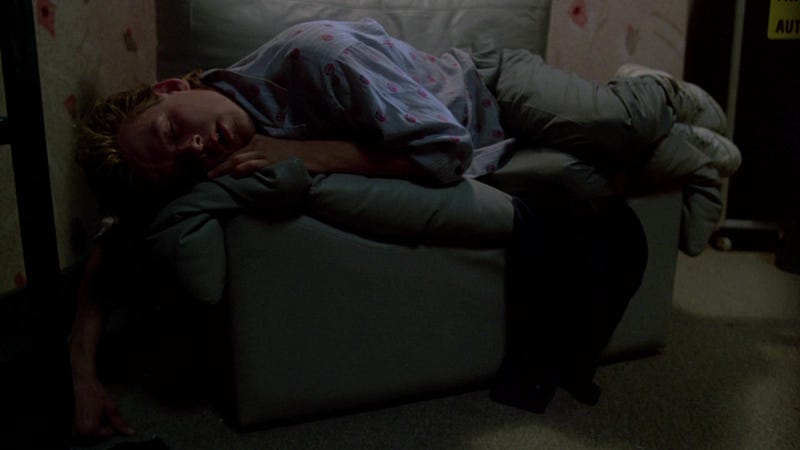
Here, in Grady’s bedroom, he just looks sweet. Innocent. Not sexualised. There’s no hint of chest to sexualise or objectify, he’s curled on his side, we’re seeing his whole body and not in a suggestive position — it’s almost the foetal position.
Grady isn’t looking on him as a fuckable object, but just as one of the guys. He’s not like Jesse is. He doesn’t project anything onto him.
And then obviously Jesse wakes, sobbing, in tears, and we see Freddy literally come out of him, literally burst out from under the skin. It’s monstrous, it’s horrific, it’s visceral, it’s ugly. It’s a hundred times worse than your average twink death.
Then there’s a lot of the Freddy stuff, I’ll be honest, I don’t really care about that for this piece. This shot is interesting though!
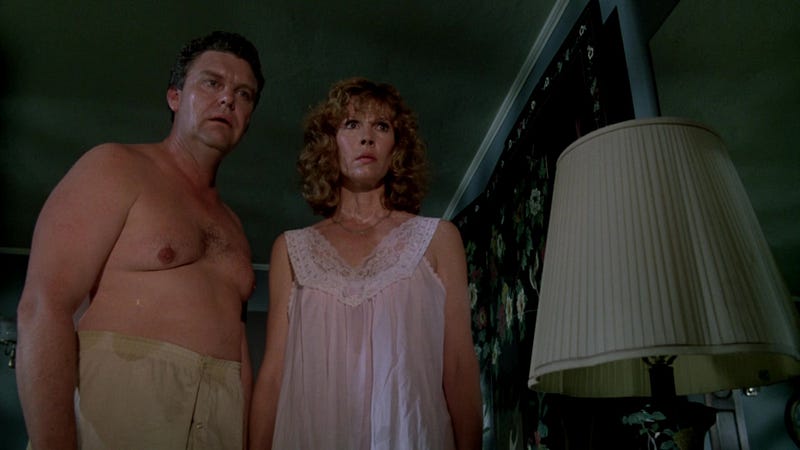
I love tits. I love these tits. Great shot.
This is obviously Lisa’s parents looking out in the yard as the horror unfolds — I just think it’s interesting that when the film spends all this time hiding the naked chests of tops from us, like how we never see Schneider’s nipples, only his back, or how Grady’s nipples aren’t shown to us until he’s backing away from Jesse and Jesse is about to kill him, like…
Mr Webber’s tits? Oh, we can see those. No covering, no modesty. Just two fat DILF tits. Where (queer) men in this film are treated the way women usually are, I just think it’s really interesting that in this little moment we see Mr Webber’s bare chest, particularly given the parallel that was drawn between the potential Jesse and Lisa and the actual Mr and Mrs Webber as an ideal of marriage.
Cishetero marriage as a sort of antidote against societal transgressions is a common theme to a lot of their ideology, but we can still see Mr Webber for what he is, even if he’s non-practising.
Jesse is utterly consumed, now, possessed entirely by Freddy, has been subsumed by Freddy — by a manifestation of his violent desire. So we transition to Lisa as the protagonist of the film for now, we follow her as she seeks out Freddy to attempt to tame him, to bring him back to the side of good, repressed desire, and quiet domestic misery — you know, marriage.
But when they embrace, she hugs him, holds him, grips at him. She can save him from his desires, but that’s not the same as making him desire her.
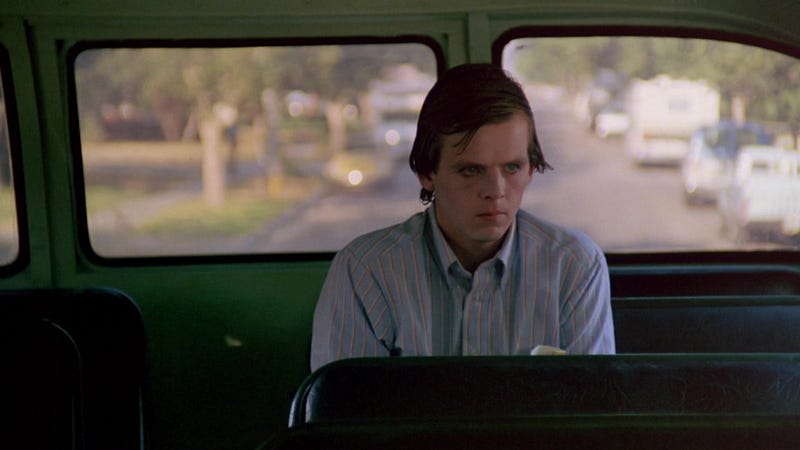
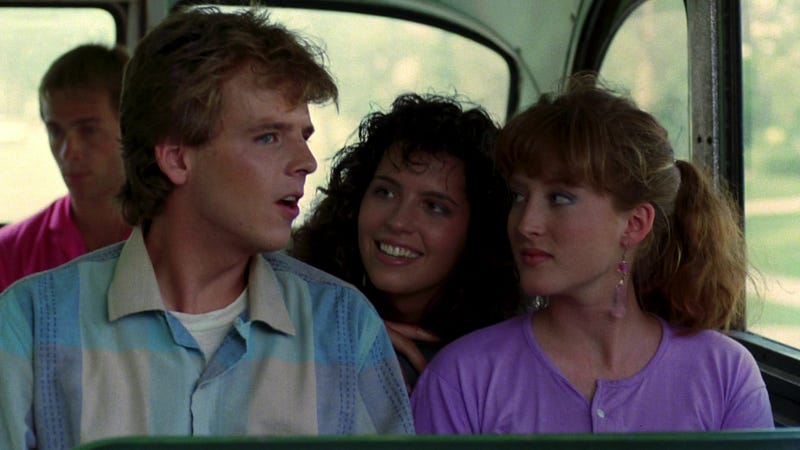
Let’s contrast the Jesse of the introductory sequence with the outro. On the left, we see a typical homosexual — look at those dark eyes, that greased hair, that sour expression. Look how small he is, look how unconfident he is. He’s a sensitive boy. An obvious homo.
But, oh, look at Jesse on the right! Look at his fluffy hair and his bright blue eyes, with no shadows under them! Look at his confident posture, and how open his shirt collar is (but don’t worry, he’s wearing an undershirt so we don’t get a look at his tits!).
I think in the Scream, Queen! documentary David Chaskin talked about the love of a “good woman” in this movie playing out like an advert for conversion therapy, and like… Yeah. That’s the vibe.
But Jesse doesn’t get what Mr Webber gets, does he? It doesn’t matter how closeted he is. It doesn’t matter how invisible his faggotry is. He still is what he is. We still know what he is — and Freddy still knows what he is too. The love of a good woman doesn’t save him — either way, the bus is driving to Freddy town. Either way, he dies, and not just a twink death.
It was so wild watching that documentary and like… hearing Jack Sholder and Dave Chaskin respectively say, oh, we didn’t mean to make a gay movie, oh, that was just incidental, and then Chaskin particularly blamed the queerness of the film on Mark Patton’s acting.
And when he said it, he meant, like, oh, well, because Mark Patton is so gay, we shot him as a gay man. He came off as a gay man. His gay rubbed off on the movie. It was a shitty thing to do, it’s horrible, all that shit has terribly affected Mark Patton.
But also, like.
They didn’t just shoot Mark Patton’s character as gay. They shot him as beautiful, and fuckable. Pretty and desirable.
Did Mark Patton make Jack Sholder do that? By being so pretty he was just irrestisible? And then by being so pretty he was irrestisible, he ruined a perfectly good movie by making it gay?
Huh.
Gay boys, like women, we just can’t win, can we? No matter what, it’s all our fault.
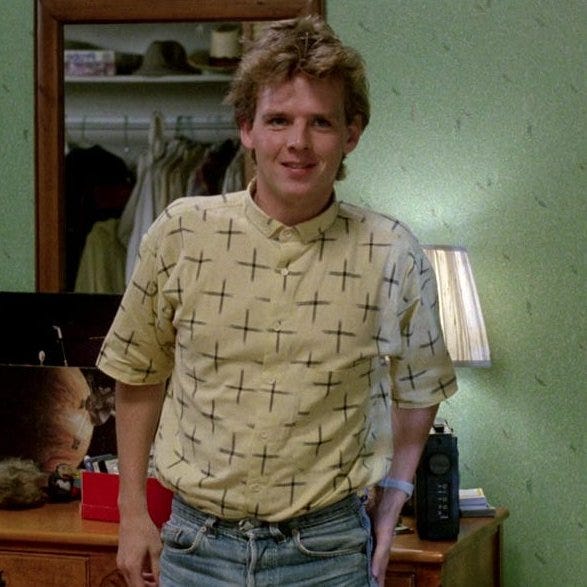
I feel like this film permanently rewired parts of my brain. It’s great.
Thanks to Mark Patton and to Mark Patton only for helping me unpack some thoughts and feelings about being sexualised by straight men and straight-aligned men, I guess. What a fucking world we live in.
Anyway, watch Scream, Queen!
References:
- The birth of a new avant-garde: La caméra-stylo by Alexandre Astruc
- Introduction to “The Future of Cinema” by Alexandre Astruc, by Adrian Martin
- Guillermo del Toro and the hallmarks of a modern day auteur from The Guardian
- Quentin Tarantino Dips A Toe Into Movie Sex Scene Discourse, by Dani di Placido
- Being and Nothingness: An Essay on Phenomenological Ontology by Jean-Paul Sartre
- “Panopticism” from “Discipline & Punish: The Birth of the Prison”, by Michel Foucault
- Visual Pleasure and Narrative Cinema, by Laura Mulvey
- The Forgotten History of Gay Entrapment by George Chauncey
- A Nightmare on Elm Street 2: Freddy’s Revenge (1985), dir. Jack Sholder
- Scream, Queen! My Nightmare on Elm Street (2019), dir. Roman Chimienti & Tyler Jensen