avatarJeff Hayward

Free AI web copilot to create summaries, insights and extended knowledge, download it at here

2432

Abstract

flag.</p><p id="3584">But now we have ChatGPT, which can carry on scarily convincing conversations. I am on a waitlist to access it, but I’ve read several articles about its power. It can literally write short stories based on a prompt. They’re not perfect, but as I noted, are more coherent than some of the human exchanges I’ve had.</p><p id="b0dc">However, the real danger is in the unsolicited interactions that phish for information.</p><h2 id="4289">…But AI will mimic humans better than some humans</h2><p id="6c9d">Imagine scammers harnessing the power of AI to mimic a human. Not just any human, but one that you know. Suddenly, bad actors from anywhere in the world can craft coherent, convincing messages to flood your DMs. The phisher would also be able to use the AI technology to generate responses, further convincing unsuspecting users that they’re real.</p><p id="70e0"><i>Ah, but I can just ask the person for a pic if they’re real</i>, you say. Well, here’s the thing. If a hacker has access to a social media account, they likely have several images of the person you’re supposedly talking to. If you ask them for a specific photo for proof, they can simply generate one using an AI generator. All they need is a <a href="https://www.artnews.com/art-news/news/does-lensa-ai-use-your-face-data-for-selfies-1234649204/">reference photo</a> to manipulate.</p><p id="80aa">So now you have this familiar account, messaging you and sharing pics (or even video) using AI. I’d like to think I’d still be able to distinguish what’s real based on my knowledge of how a friend speaks. But who’s to say the algorithms can’t be tweaked to mimic someone’s language patterns? Like, if someone uses “like” a lot in your usual text convos, the AI can incorporate it.</p><figure id="95ba"><img src="https://cdn-images-1.readmedium.com/v2/resize:fit:800/1*FdAx4in1aWwc1ySQligkWA.png"><figcaption>An AI bot will pretend to like you — and then steal your soul. (Image from author using using Midjourney AI)</figcaption></figure><p id="4f2b">Oh, and there’s another possible dimension to the trickery. Apparently there’s something called <a href="https://www.euronews.com/next/2023/01/10/after-chatgpt-and-dalle-meet-vall-e-the-text-to-speech-ai-that-mimics-anyones-voice">VALL-E</a> that can mimic a person’s voice from a brief sample. If a social media user has posted a video of themselves talking, it’s all it would need to send

Options

you a rather convincing voice clip. Combine this with <a href="https://www.unite.ai/best-ai-video-generators/">AI movies</a>, and phishers might even trick you into complying with realistic video clips.</p><h2 id="73c7">AI can be abused like any other tech</h2><p id="7556">I’m not saying programs like ChatGPT are inherently unethical (but apparently they’re <a href="https://www.forbes.com/sites/barrycollins/2022/12/02/i-interviewed-an-ai-about-the-ethics-of-aiand-it-lied-to-me/?sh=25b2b3206253">capable of lying</a> — or at least bending the facts.) I’m sure there are ways (or there soon will be) to make AI language processors behave more like a particular person — like one of your followers on Instagram, for example.</p><p id="a3b1">Then, BOOM! You’re convinced they’re real, and you e-transfer some money to a crook, or click on a link that steals your data.</p><p id="2a37">I’m still a fan of AI in general, but like any technology, it can be used for less-than-noble purposes. The sheer power of AI makes it much easier for scammers to make unsuspecting people part with their money. It can even be used to make <a href="https://www.forbes.com/sites/lutzfinger/2022/09/08/deepfakesthe-danger-of-artificial-intelligence-that-we-will-learn-to-manage-better/?sh=3c7d5f3a163a">deepfakes</a> that can potentially be used for extortion.</p><p id="6b49">There’s software being developed that can apparently detect AI content, but it’s still not perfect, as outlined well in <a href="https://betterprogramming.pub/detectors-for-ai-written-prose-are-here-8d2d994b175d">this article</a> from <a href="undefined">Clive Thompson</a>. So don’t depend on it to determine whether the person you’re chatting with is real. (Besides, even when these detectors improve, the scammers will probably find a way to circumvent it, and so on.)</p><h2 id="9b12">Do a reality check</h2><p id="24c9">My suggestion going forward is to always call or text a friend to confirm who is requesting something from you online. Obviously, if you don’t know the person messaging you, disregard it. (If they open with the word “dear,” and don’t usually speak like that, look out.)</p><p id="15ba">In the meantime, I’m going to keep toying around with AI images to add to my stories. When I get access to ChatGPT, I’ll run some more experiments that I will post about here.</p><p id="a716">Thanks for reading this post (from a real human)!</p></article></body>

Get Ready: Online Scams Will Soon Become Much More Convincing

AI is going to take phishing to the next level with human-like texts, images, voice, and even video

An AI scammer phishing for your money. He’s not real — I mean, count the fingers. Oh, and his eyes are glowing with evil intentions. (Image from author using using Midjourney AI)

For the most part, online scams are easy to spot. I regularly get emails and text messages from random sources telling me to claim money supposedly owed to me by clicking some nefarious link.

These messages are almost always sloppy in both formatting and language, and not difficult to dismiss. But I believe this is about to change with incredibly sophisticated AI now on the scene.

By now you’ve probably heard how AI images and language processors are taking the tech world by storm. A simple prompt can create a lifelike picture, while AI chatbots can follow an online conversation better than most humans. While I have written much on the potential benefits of AI, it’s also important to look at the potential harm.

Current scammers are fairly easy to detect…

Most of the scammy messages come to me from Instagram. Some account I’m barely familiar with tries to initiate a conversation, undoubtedly to build trust and get something from me. Some of these messages are from people I follow, whose account has been hacked, so there’s a moment of hesitation before I hit delete.
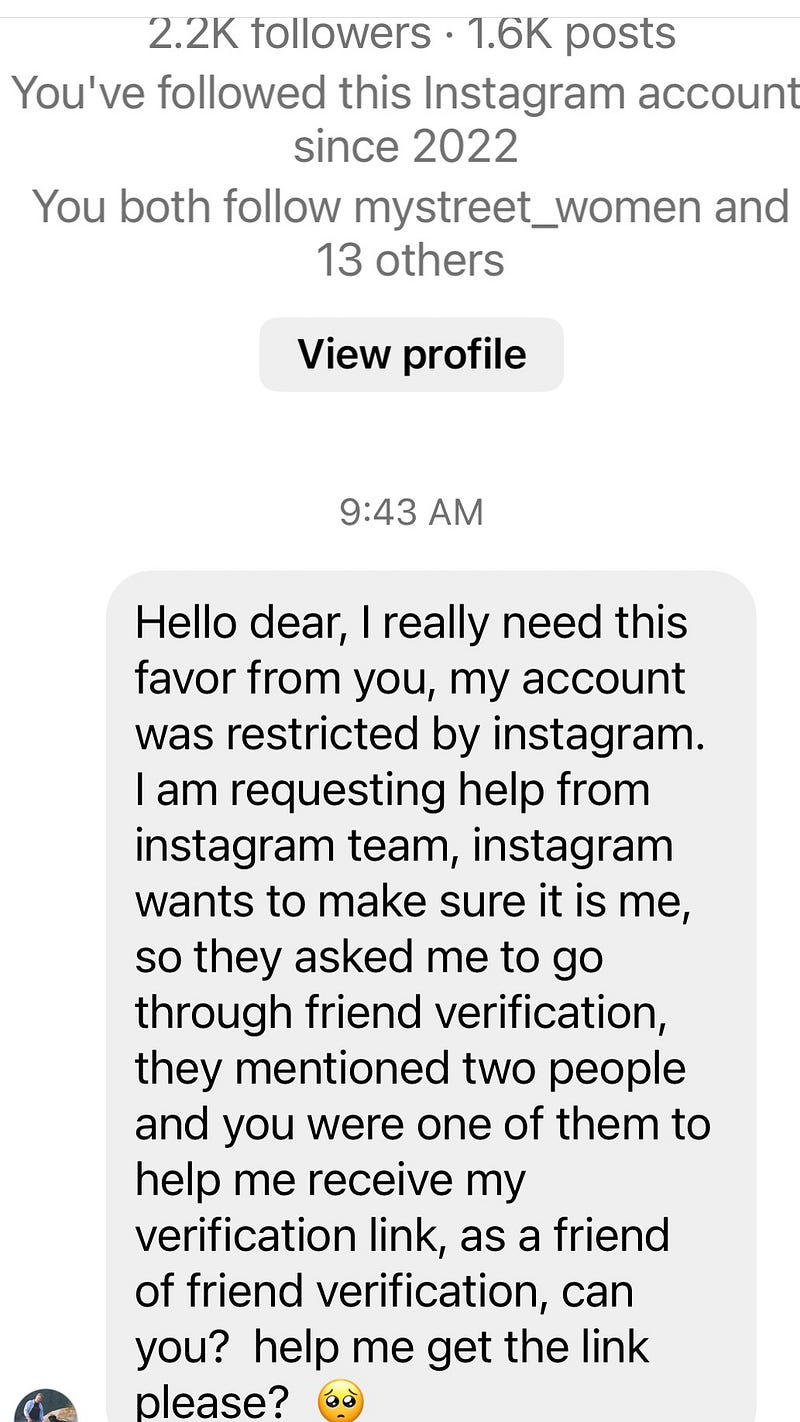
This scam text came from someone I follow, who has 2.2k followers. But since we’ve never interacted before…

I have tried responding to these types of messages as an experiment. I usually get a response like, “this account is real!” or something like that. But whoever or whatever is on the other end is not overly sophisticated. The grammar is bad, the message nonsensical. There’s usually some kind of urgent help being requested to spawn action, which is another red flag.

But now we have ChatGPT, which can carry on scarily convincing conversations. I am on a waitlist to access it, but I’ve read several articles about its power. It can literally write short stories based on a prompt. They’re not perfect, but as I noted, are more coherent than some of the human exchanges I’ve had.

However, the real danger is in the unsolicited interactions that phish for information.

…But AI will mimic humans better than some humans

Imagine scammers harnessing the power of AI to mimic a human. Not just any human, but one that you know. Suddenly, bad actors from anywhere in the world can craft coherent, convincing messages to flood your DMs. The phisher would also be able to use the AI technology to generate responses, further convincing unsuspecting users that they’re real.

Ah, but I can just ask the person for a pic if they’re real, you say. Well, here’s the thing. If a hacker has access to a social media account, they likely have several images of the person you’re supposedly talking to. If you ask them for a specific photo for proof, they can simply generate one using an AI generator. All they need is a reference photo to manipulate.

So now you have this familiar account, messaging you and sharing pics (or even video) using AI. I’d like to think I’d still be able to distinguish what’s real based on my knowledge of how a friend speaks. But who’s to say the algorithms can’t be tweaked to mimic someone’s language patterns? Like, if someone uses “like” a lot in your usual text convos, the AI can incorporate it.
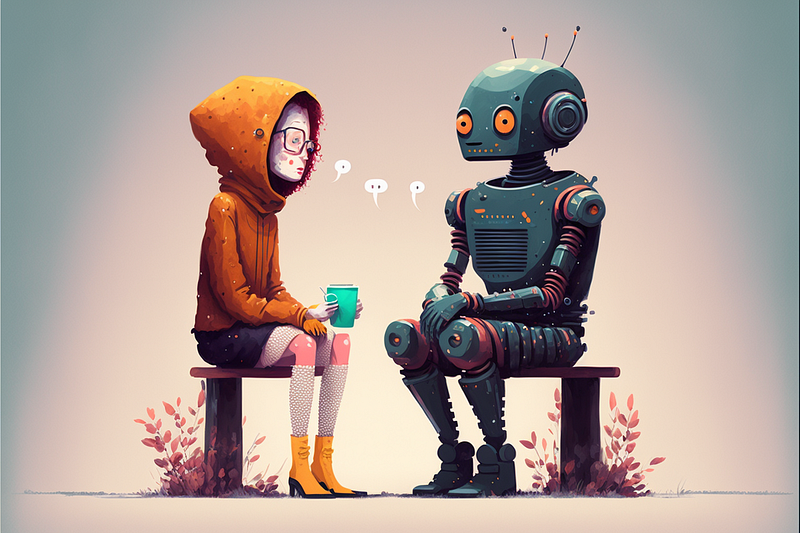
An AI bot will pretend to like you — and then steal your soul. (Image from author using using Midjourney AI)

Oh, and there’s another possible dimension to the trickery. Apparently there’s something called VALL-E that can mimic a person’s voice from a brief sample. If a social media user has posted a video of themselves talking, it’s all it would need to send you a rather convincing voice clip. Combine this with AI movies, and phishers might even trick you into complying with realistic video clips.

AI can be abused like any other tech

I’m not saying programs like ChatGPT are inherently unethical (but apparently they’re capable of lying — or at least bending the facts.) I’m sure there are ways (or there soon will be) to make AI language processors behave more like a particular person — like one of your followers on Instagram, for example.

Then, BOOM! You’re convinced they’re real, and you e-transfer some money to a crook, or click on a link that steals your data.

I’m still a fan of AI in general, but like any technology, it can be used for less-than-noble purposes. The sheer power of AI makes it much easier for scammers to make unsuspecting people part with their money. It can even be used to make deepfakes that can potentially be used for extortion.

There’s software being developed that can apparently detect AI content, but it’s still not perfect, as outlined well in this article from Clive Thompson. So don’t depend on it to determine whether the person you’re chatting with is real. (Besides, even when these detectors improve, the scammers will probably find a way to circumvent it, and so on.)

Do a reality check

My suggestion going forward is to always call or text a friend to confirm who is requesting something from you online. Obviously, if you don’t know the person messaging you, disregard it. (If they open with the word “dear,” and don’t usually speak like that, look out.)

In the meantime, I’m going to keep toying around with AI images to add to my stories. When I get access to ChatGPT, I’ll run some more experiments that I will post about here.

Thanks for reading this post (from a real human)!

AI
Artificial Intelligence
Phishing
Technology
Design
Recommended from ReadMedium