
George Floyd: Two Years Later
How the evening of May 25, 2020 altered our social discourse forever
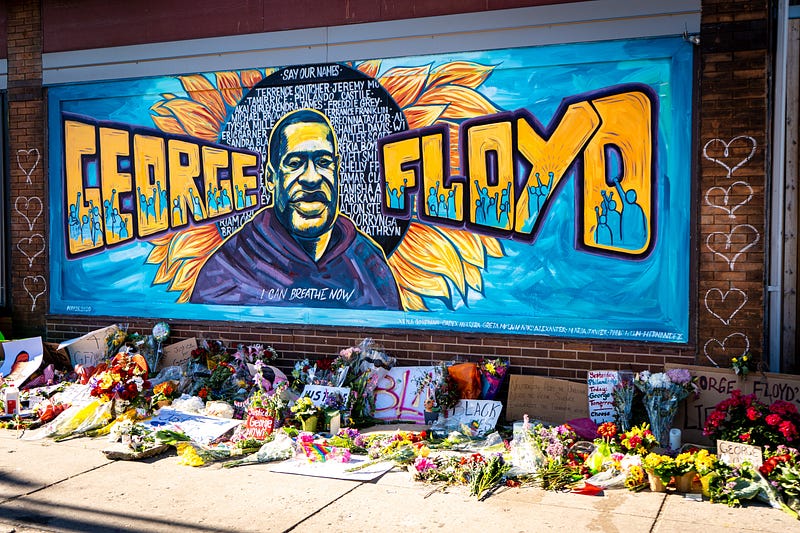
It’s been exactly 24 months since the world was shaken and appalled by the murder of George Floyd. On that fateful night, two years ago, the Minneapolis security guard had his neck crushed by the knee of police officer Derek Chauvin.
As civilian onlookers begged for Chauvin to release his hold on Floyd, officers Thomas Lane, J. Alexander Kueng, and Tou Thao assisted Chauvin while keeping the angry crowd at bay.
Due to the diligence of seventeen-year-old Darnella Frazier recording footage of Floyd’s slow-motion incapacitation and death, via her cell phone — the entire planet got a firsthand glimpse of the brutality arising from systemic racism.
Millions of protestors took to the streets, marching collectively against racial injustice.
Amidst a global pandemic, this movement exposed the ruthless underbelly of our broken criminal justice system, white privilege, racial profiling, and inaction from lawmakers.
But it also opened the floodgates to so much more.
Many of the conversations elicited were long-overdue.
Other conversational details, however, have gone completely off-the-rails.
In Chapter 5 of his 2021 autobiography entitled Man Enough, actor and filmmaker Justin Baldoni recounts how the vivid death of George Floyd motivated him to educate himself on concepts such as systemic racism, white privilege, white fragility, and microaggressions.
Unfortunately, much of his self-flagellating commentary reads like talking-points lifted from a Tim Wise manifesto:
Baldoni’s almost wide-eyed innocence upon broaching self-education in racial justice is apparently symptomatic of the learning process experienced by so many White people. This gaping, pupil-bulging, and pearl-clutching seems all too common when many folks learn about the harassment and brutality endured by too many Black and Brown people, day-in and day-out, within America’s corrupt systems.
As a White person, I’ve never personally endured racial profiling (at least, not that I’m aware of). However, as someone who began actively seeking out literature on white privilege and systemic racism ever since my freshman year of college, I was already well-aware of how such tyranny runs rampant on a daily basis in the United States.
Sadly, I wasn’t at all surprised at what I saw, when I first watched the footage of George Floyd getting his airway crushed.
Frankly, I was surprised that such footage hadn’t gone viral much earlier than 2020. Because there have certainly been thousands upon thousands of George Floyds persecuted across the unforgiving American timeline.
What made me angry about George Floyd’s senseless death was this…
These solutions to push back against systemic racism should have been enacted a long time ago.
I’m glad that Chauvin and his accomplices are going to have to face justice and reckoning for their sins. But what about the millions of past occurrences involving hate crimes, racial profiling, and inequitable punishments?
And what about all of the future ones?
The George Floyd Justice in Policing Act was first introduced mere weeks after Floyd’s murder. Unsurprisingly, although it passed the Democratic-controlled House, it died in committee while stalled in the Republican-controlled Senate. And, even if Democrats had controlled the U.S. Senate in June 2020, it’s doubtful that then-President Donald Trump would have actually signed it.
The 2021 version of this bill was reintroduced after Democrats took back the U.S. Senate majority by a razor-thin margin. It once again passed the Democratic-controlled House (although with fewer votes, due to Democrats having lost some U.S. House seats in November 2020), but it fell apart in the Senate when negotiators couldn’t settle on language that would be able to overcome the Republican filibuster.
Although many Republicans claim that Democrats are unwilling to compromise on the issues of qualified immunity and a national police misconduct database — it’s extremely questionable whether Mitch McConnell would allow *ANY* meaningful police reform to have moved forward for President Joe Biden’s signature, as long as the filibuster is in place.
The only way to enact this type of police reform legislation into law is by adding more Democratic U.S. Senators who would be willing to create a “carve-out” to bypass the filibuster.
And that isn’t even addressing the other areas where racial disparities need to be rectified.
Equitable funding of school districts?
Race-consciousness to end health care neglect?
Eliminating bias through fair housing rules?
Providing foreign aid, asylum, and sanctuary to more non-European nations?
End racist gerrymandering and guarantee all citizens their right to vote?
For how long will 41 or more Senate Republicans be allowed to keep our nation held hostage to the whims of police chiefs, health care CEOs, loan sharks, real estate moguls, and professional fascists?
People marched. Activists chanted.
But while BIPOC communities pleaded for solutions, a certain segment of White America insisted on having a drawn-out, whiny, pompous, overly-sanctimonious group therapy session.
Right out in public view.
During a presidential election year.
With the tacit encouragement from SOME people of color.
Days after Floyd’s murder, Ellen DeGeneres shed crocodile tears on her daytime talk show — which, at the time, was filming out of her private home due to the pandemic. Her executive producer, Andy Lassner, droned on about how White people needed to be silent or deferential during this conversation (all while standing outside the glass windows of DeGeneres’s home, clad in a creepy facial covering).
Then, Van Jones came on and glibly recommended that White people read Robin DiAngelo’s White Fragility.
Gag me.
And I thought I liked you, Van…
Weeks later, A&E aired a virtual roundtable special entitled The Time Is Now: Race and Resolution. Most of its panelists were Black, Indigenous, & People of Color with important things to say about the fight against systemic racism.
But, of course, How to Get Away with Murder’s Matt McGorry was in attendance during the televised Zoom session to speak as the Token Guilt-Ridden White Guy whose self-anointed job was apparently to lecture all of the White viewers with canned talking-points on how…
“It’s our job to fix racism.”
and
“We [White People] have to be prepared to lose things.”
and
“Racism is ‘a White person problem’.”
Um, no…inanity is “a Matt McGorry problem.”
This purported “white ally” example was emulated by penitent White people all across social media, who plastered their Facebook and Twitter accounts with various slogans in the vein of…
“I Will Shut Up and Listen!”
Or, the Rev. Dr. Clint Schnekloth’s go-to admission of…
“I’m a racist.”
Meanwhile, Robin DiAngelo is laughing all the way to the bank.
My point, here, is that what happened to George Floyd should have resulted in a rallying cry for us all to demand specific administrative and legislative actions.
Instead, we got a rancid buffet of virtue-signaling and performative allyship from the hyperwoke Greek chorus.
Rather than employing a smart slogan such as…
#PoliceAccountability (i.e., We don’t have it, but we need it!)
We got twisted gems such as…
And the politically-correct unwillingness to modify that narrative was wielded against Democratic candidates up-and-down the ballot in November 2020.
During all of this time you hyperwokesters have spent attempting to unilaterally redefine racism…
…you could have been actually heeding the words of leaders such as Val Demings and Keisha Lance Bottoms during that Summer of 2020. They tried to explain…the first step was raising awareness — but, in short order, there needed to be a list of demands.
But, no…in lieu of focusing on solutions and plans for implementing them — we get treated to the Jane Elliotts of the world lecturing White people about how morally inferior we inherently are.
This got reflected within pop culture, in different directions. Many of my favorite TV shows tackled racial justice in their episodic scripts. A handful of them did this quite well. Between 2020 and 2022: The Equalizer, A Million Little Things, NCIS: New Orleans, This is Us, Zoey’s Extraordinary Playlist, All Rise, In the Dark, Superstore, Magnum P.I., Queens, American Auto, and the Black-led remake of The Wonder Years all churned out some powerful storylines with strong dialogue and characterization confronting systemic forms of racism.
On the other hand…
We saw some downright terrible scripted episodes that awkwardly planted a bunch of “Mary Sues” into their scripts in order to deliver a vicarious dressing-down to viewers.
As a substitute for nuance and multifaceted discussion, TV series such as Grownish, Supergirl, The Unicorn, Good Trouble, The Goldbergs, and Station 19 shoehorned in one-sided narratives on race relations that, quite frankly, would insult the intelligence of any rational person.
You may try to gaslight me by accusing me of “tone-policing.”
But George Floyd’s death should have been a wake-up call to all of us.
It should have motivated everyone to come together and develop a game plan for equality.
But what are we stuck with? Two extreme sides talking past one another on the debate over Critical Race Theory…
With one side trying to censor and prohibit any form of teaching multicultural history to students…
…and the other side trying to indoctrinate students with a one-size-fits-all philosophy dolled up as “antiracism” (because WHO WOULD POSSIBLY DARE TO OBJECT to something with that moniker???)
Shame on those of you who’ve learned all of the wrong lessons from what happened to George Floyd.
Some of you attempt to make it seem anecdotal, as a way to deny that systemic racism and white privilege actually exist.
Others of you lay the piety on really thick, trying to thought-police the masses into groveling for redemption.
If George Floyd was looking down on you from the afterlife, what do you think he would make of your glib, smug, egotistical sentiments?


