AB414: The CRT Battle Comes to Wisconsin
We know what the Right is trying to do, and we know how the Left wants to react. Let’s nip it all in the bud!
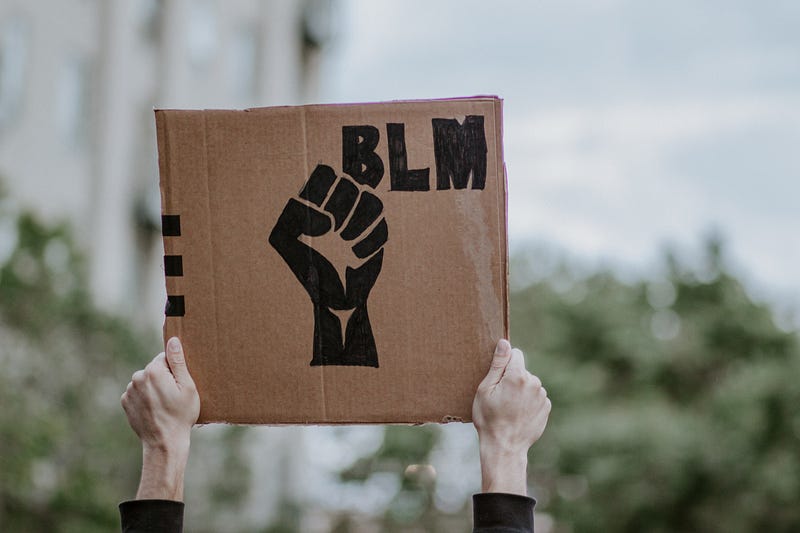
For anyone living under a rock, Critical Race Theory (CRT) has become weaponized as this year’s political wedge issue du jour. Although formal CRT teachings are rarely part of K-12 curriculums, some of the ancillary concepts espoused by CRT supporters can still make their way into elementary, middle, and high schools. For the adults, they can also be folded into training sessions mandated by workplaces to address diversity, equity, inclusion, and cultural sensitivity.
In response, numerous state legislatures are introducing a wide range of anti-CRT bills aimed at curbing exposure to anything resembling Critical Race Theory in schools, corporations, businesses, or public agencies.
As Frederick M. Hess writes in his piece “5 Takeaways for Education From Virginia’s Governor Race,” many centrists have seen through specific attempts to package some forms of ideological dogma under the Kafka-esque moniker of “antiracism.” In a follow-up piece entitled “Media Coverage of Critical Race Theory Misses the Mark,” Mr. Hess illustrates how journalists try to dodge honest analyses of K-12 affinity groups or exclusive definitions by, divergently, focusing on a fallacious idea that parents want to eliminate slavery or historical racism from being taught in school curriculums.
Mark Rosenbaum approaches it from a different angle. In his Medium piece “CRT in Elementary Classrooms,” he points to scientific reasons supporting age-appropriateness when discussing race relations with students. Mr. Rosenbaum suggests that at least some of the parental outrage we’re seeing could be legitimately grounded in — GASP! — actual science. Similarly, Dave Smith writes in “How Schools Can Help Neutralize Racism” that educators should consider teaching young kids the objective scientific reality of melanin, the idea that race is a historical social construct, and basic psychology pertaining to how all people can learn to overcome their cognitive biases.
The Center for Innovative Teaching and Learning recommends educational techniques such as outlining discussion goals ahead of time, analyzing evidence, criticizing ideas rather than individuals, asking follow-up questions, and linking conversational points to a given subject matter. EducationWorld’s Ted Glanzer offers facilitation methods for contentious topics that involve trigger warnings, validating feelings, anonymous (written) participation options, and actionable brainstorming through student “microlabs.”
In my own words, the takeaway that I’d circulate amongst American educators would be some variation of:
“Yes, let’s teach accurate depictions of history from multiple angles or perspectives, and discuss their systemic ramifications in age-appropriate ways…but we can still do all of that WITHOUT the guilt, shame, and culpability exercises getting invoked by individual educators. How does that sound, teachers of America?”
The problem, in my view, isn’t the hypothetical exploration of CRT itself. Rather, it’s the tendency of individual educators or session leaders to project their own narratives and agendas onto these educational curriculums. When they are given broad discretion for how they do this, it can sometimes be problematic.
Whether their sentiments promoting “group blame” or “culpability via identity” happen to be subtle or blatant, they can distract from the overarching objective of making sure schools and workplaces stand for fairness, justice, collaboration, and productive learning experiences.
As for the right-wing forces who are driving the bandwagons to keep CRT enshrined within society’s vernacular as a dirty acronym: I don’t believe they actually care about the well-being of students or public employees. I think they are seizing upon this discord as part of an electoral strategy to eventually turn America into a one-party authoritarian state presided over by Republican lawmakers.
Here in Wisconsin, sixteen Republican members of our state assembly have introduced AB414 (with three Republican state senators cosponsoring its senatorial counterpart, SB411). This bill would restrict the extent of CRT-adjacent content that can be taught in Wisconsin schools and workplaces. Its text can be read HERE.
While there is mixed speculation as to whether AB414 will actually pass both chambers of our legislature, the clear intent here is from statewide Republicans who hope to use this bill as a cudgel against any Democratic candidates who oppose it — including Democratic incumbent Governor Tony Evers. If this bill reaches the desk of Governor Evers, and he most likely vetoes it, Wisconsin Republicans will inevitably lambaste Evers for his veto during his 2022 reelection campaign.
I’m going to take key excerpts from AB414 and analyze them in terms of intent. These are my assessments of what the bill’s authors and cosponsors are backhandedly trying to achieve.
“…a political subdivision or state agency is prohibited from requiring an employee to attend a training that teaches, advocates, acts upon, or promotes race or sex stereotyping.”
This prohibition is written in an open-ended way that, in theory, could be abused by extremists from either end of the ideological spectrum when lacking additional nuance. The failure of AB414 to provide such detailed nuance is what sets the stage for this legislation to become manipulated by citizens with ulterior motives.
For further clarity, read on…
“Among the concepts that are prohibited from being taught under the bill are the following: that one race or sex is inherently superior to another race or sex and that an individual, by virtue of the individual’s race or sex, bears responsibility for acts committed in the past by other individuals of the same race or sex. Political subdivisions and state agencies are required, with some exceptions, to post on the Internet site of the subdivision or agency all training materials that are not required to be kept confidential.”
Okay, pretty reasonable, here. It establishes that no group automatically deserves to be regarded with racial, sexual, or gendered superiority. It also insists on full disclosure of all educational training materials being used during publicly-funded trainings, seminars, and academic courses.
But, keep reading…
“…if the Department of Revenue determines that a political subdivision has violated the sex and race stereotyping in[-]training requirements and the political subdivision fails to come into compliance within 10 days of being notified of the violation, the political subdivision’s shared revenue payment for the following year is reduced by 10 percent. However, if DOR determines that a political subdivision has later come into compliance with the requirements, DOR must pay the political subdivision the full amount of the shared revenue payment.”
By bringing the Wisconsin Department of Revenue into it, AB414 is using a sleight-of-hand to set the stage for defunding public agencies. A ten-day compliance period is logistically-dubious…almost begging for failure to comply. It invokes the hypothetical suspension of — and theoretical restoration of — funding payments for state-run agencies if they are found to be in violation of the statutes.
This is essentially a subversive tactic to discourage teachers or diversity trainers from even broaching the subject matter of systemic or cultural problems, from the get-go.
Ironic, isn’t it? Many of the same voices who (rightfully) reject literal calls to “defund the police” will turn right around and proceed to, simultaneously, create backhanded ways to “defund education.”
“The bill also allows a local employee to file a complaint with DOR regarding an alleged violation of the bill…”
Again, in theory, this is a good thing on its face. An important part of transparency is allowing public employees and students to be able to register complaints when an authority figure (including seminar trainers) appears to be strong-arming them into subscribing to specific dogma. So a formal complaint process SHOULD be available for everyone.
But, again, this otherwise-reasonable provision can become mangled when juxtaposed alongside of bureaucratic overreach.
“…to file a civil action seeking declaratory or injunctive relief regarding an alleged violation of the bill. If the employee is successful in the civil action, the court must award the employee attorney fees. Also under this bill, if the Department of Administration determines that a state agency has violated the sex and race stereotyping in training requirements and the agency fails to come into compliance within 10 days of being notified of the violation, DOA must withhold 10 percent of the funding for all positions in the agency for the following year. However, if DOA determines that an agency has later come into compliance with the requirements, DOA must release the full funding for the positions.”
This gobbledygook is basically encouraging frivolous or excessive litigation. In the same fell swoop, it reinforces the legislation’s intent to find excuses for “defunding” public education and/or other secular agencies that are involuntarily supported by taxpayers.
“A political subdivision shall not require employee of the political subdivision to attend training in which the political subdivision or a contractor hired by the political subdivision teaches, advocates, acts upon, or promotes race or sex stereotyping, including any of the following concepts:
(a.) One race of sex is inherently superior to another race or sex.
(b.) An individual, by virtue of the individual’s race or sex, is inherently racist, sexist, or oppressive, whether consciously or unconsciously.
(c.) An individual should be discriminated against or receive adverse treatment because of the individual’s race or sex.
(d.) Individuals of one race or sex are not able to and should not attempt to treat others without respect to race or sex.
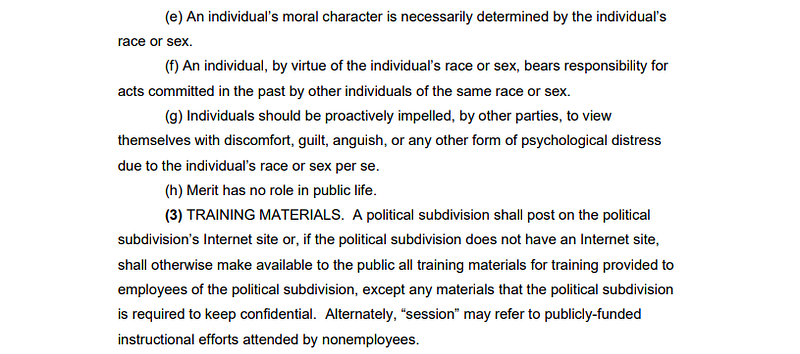
(e.) An individual’s moral character is necessarily determined by the individual’s race or sex.
(f.) An individual, by virtue of the individual’s race or sex, bears responsibility for acts committed in the past by other individuals of the same race or sex.
(g.) An individual should feel discomfort, guilt, anguish, or any other form of psychological distress because of the individual’s race or sex.
Okay, I’m onboard with these tenets. Opposition to those divisive statements expressed in Points A through G sounds fairly reasonable, upon first glance. My only real qualm is with the references to “discomfort” or “anguish” in Point G, which could be interpreted somewhat loosely. However, I’ll address that in short order.
(h) Systems based on meritocracy or traits such as a hard work ethic are racist or sexist or are created by individuals of a particular race to oppress individuals of another race.
Here’s the rub: Point H is trying to preempt educators or trainers from teaching how systemic racism/sexism can be pervasive when hidden behind the cloak of “meritocracy.”
This doesn’t mean that ALL meritocracy is invalid by definition.
Rather, it means that we should be able to examine whether a purported “meritocracy” is actually a true meritocracy in practice. But, somehow, I doubt the authors of AB414 are supportive of such thoughtful examinations.
(3) TRAINING MATERIALS. A political subdivision shall post on the political subdivision’s Internet site or, if the political subdivision does not have an Internet site, shall otherwise make available to the public all training materials for training provided to employees of the political subdivision, except any materials that the political subdivision is required to keep confidential.
Again, this chunk of the proposed statute is mostly good. It allows working parents to read up on their child’s curriculum amidst their potentially busy work schedules (whereupon they might be otherwise unable to go down to the school and visit with a teacher in person). As far as professional trainings and seminars within a public workplace, it strives to keep the educational leaders themselves honest and ethical in their instruction.
It also places the burden of proof on anyone who is potentially making a complaint against an educator or trainer. The complainant would have to demonstrate how the person against whom they’re airing their grievances has actually manipulated a curriculum in any predatory or unsavory ways.
But, keep reading…
(4) VIOLATION. (a) If the department of revenue determines that a political subdivision has violated sub. (2)
Once again, this is where we get into the defunding of public agencies (or, at least, the pretense for doing so). What happens when a gubernatorial administration that is hostile to public education (*cough!* Scott Walker *cough!*) chooses to abuse these newfound statutes as a cutesy way of transferring and diverting revenue beyond its intended purpose?
You may squawk “elections have consequences.”
Sure. But “deception has consequences,” as well.
(2), the department of revenue shall notify the political subdivision of its violation.
Again, here is another fair point embedded within the overall deceit. Any public employee found to be in violation of legal statutes should have a grace period during which to review the allegations and respond to them.
But is ten days really that “reasonable”? Does it take into account medical emergencies, personal hardships, technical snafus, or postal delays?
(b) If a political subdivision fails to comply with sub. (2) within 10 days of receiving a notification under par. (a), the department or revenue shall reduce the amount of the payment to the political subdivision under s. 79.02 (1) in the following year by 10 percent.
Again, why only ten days? Why not twenty or thirty days? It seems as though the authors of AB414 are setting up an intentionally narrow window for recourse that’s designed to fail more often than not.
This would make it easier for the state to confiscate a public entity’s revenue, and then an overly-litigious path is provided if a falsely-accused person wishes to reclaim those withheld payments.
The rest of the bill is a textual redux. You get the point…
As I’ve written in my recent op-ed piece entitled “How I Define Political Correctness,” uncomfortable conversations are an important part of education. The distinction, however, is separating actions inflicted by historical oppressors from the sheer existence of their descendants. Students or employees who have Black, Indigenous, Latino(a), and Asian heritage aren’t going to benefit from empty platitudes.
Repeatedly, the Right crows about how White students might feel “discomfort” or “anguish” if they learn that any of their ancestors were responsible for systemic oppression.
In response, the Left whines how it’s “long overdue” for White students to feel uncomfortable…and how that’s apparently the only way to uplift Black and Brown voices.
Because…whiteness.
Or their “whiteness” per se.
I reject both of these extremes. If I was interacting with students in a classroom, and a random White student expressed how he or she felt guilty learning about the objective facts of history, my response to them would be something along the lines of:
“Well, the fact that you feel bad learning about historical atrocities simply is a positive reflection of your own humanity. YOU aren’t responsible for THEIR actions. But if you personally feel disturbed by learning about what they did, the question is: what are you going to *DO* about it?”
Meanwhile, the students without guilt-ridden tendencies can simply acknowledge the truths of history — but, rather than holding themselves personally culpable for those past actions of ancestors, instead, participate in discussion on how society as a whole can proactively avoid repeating those same mistakes.
This is just a snippet of my own worldview on the multitude of controversies surrounding Critical Race Theory. And I’ll be writing a lot more extensively about these issues in the coming months.
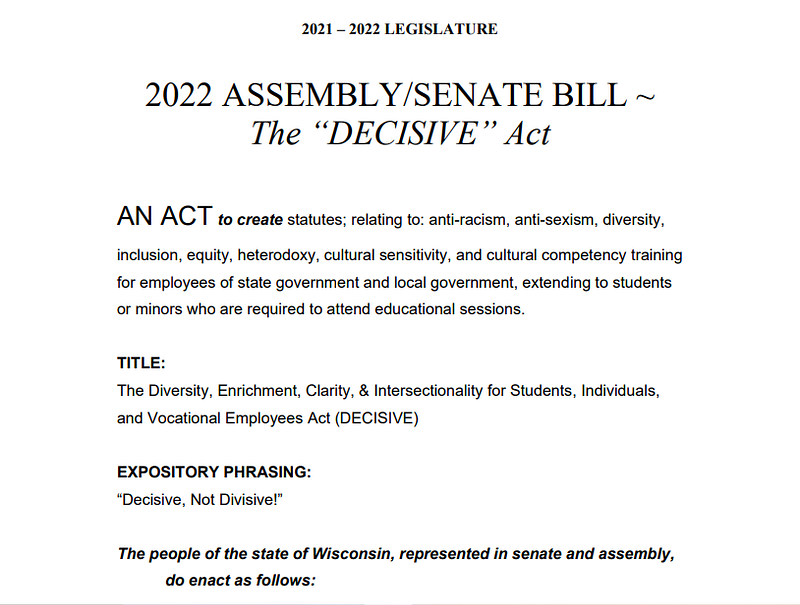
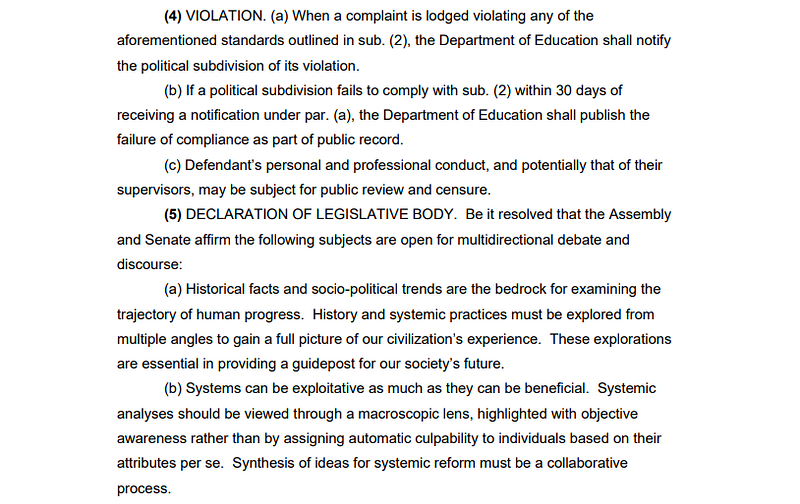
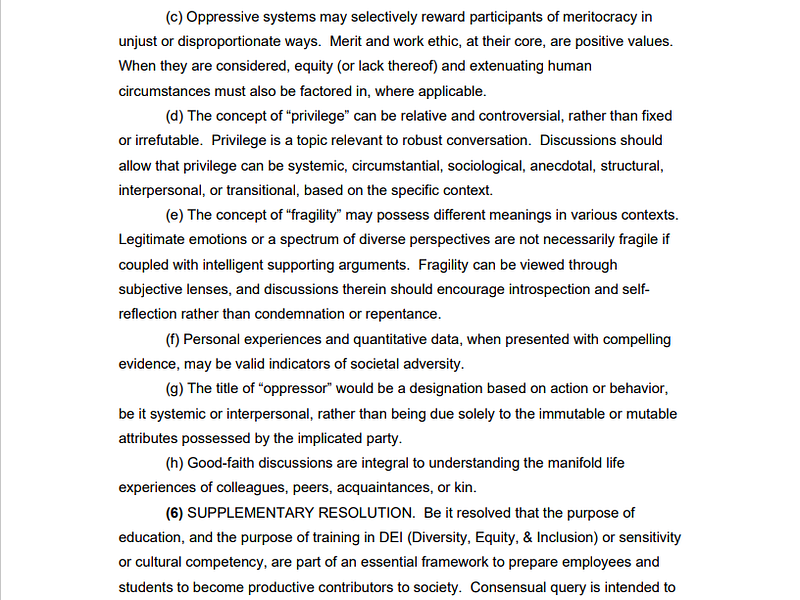
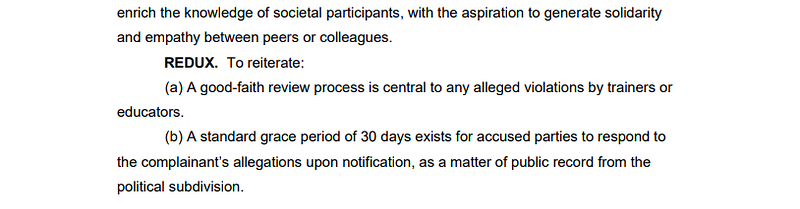
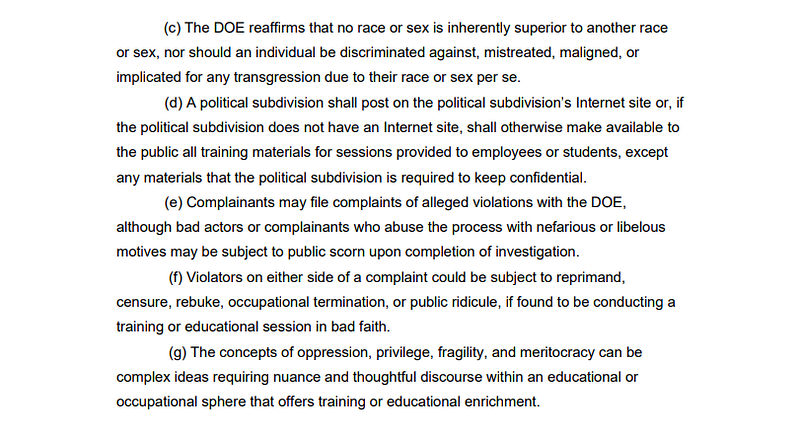
But, for now, I’ve created my own sample draft of legislation in response to the proposed statutes contained within AB414.
I call it The DECISIVE Act (Diversity, Enrichment, Clarity, & Intersectionality for Students, Individuals, and Vocational Employees).
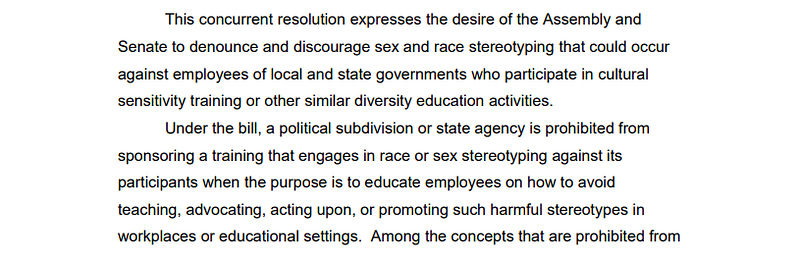
My intent is to extract and preserve the standalone components from AB414 that truly respect individualism and personal behavior. At the same time, THE DECISIVE Act incorporates the following values:
- Disavowing the premise of anyone’s racial or sexual superiority/inferiority
- Acknowledging how oppression can be frequently, but not exclusively, systemic; and how to distinguish systemic and structural “-isms” from social and cultural “-isms”
- Promoting humane and respectful interpersonal treatment, regardless of one’s identity or demographic affinity
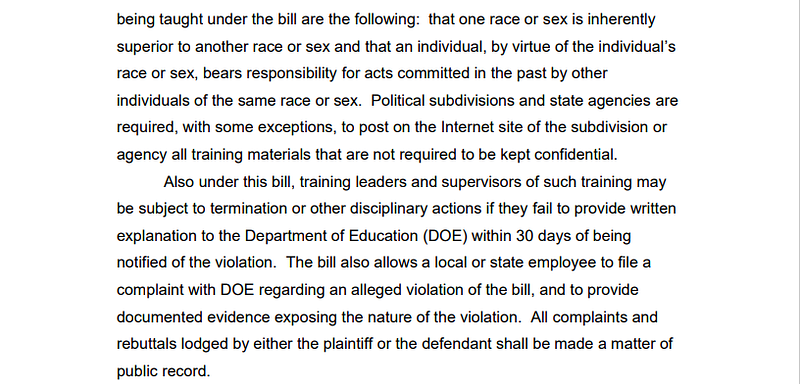
- Recognizing the concepts of privilege, meritocracy, fragility, and oppression as being fair game for constructive and thoughtful discussion
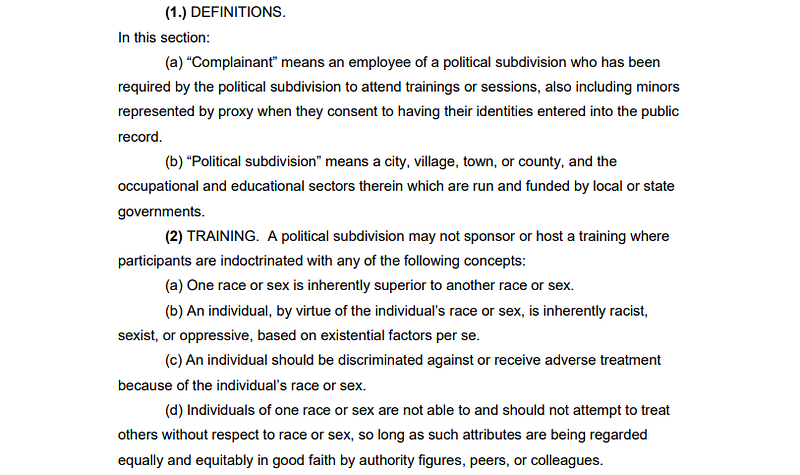
- Deemphasizing frameworks of guilt and shame in favor of personal action and universal responsibility
- Disincentivizing groupthink, intimidation, or power abuses from instructors or participants on any side of a given debate
We can find ways to teach about white privilege without telling White students/employees they are inherently “oppressors” or “colonizers.”
We can educate others about structural forms of misogyny without lecturing male-identifying students/employees that they must become self-loathing or automatically deferential to women in most facets of life.
We can empower Black, Indigenous, & People of Color to become assertive leaders when learning from history to hold our current society accountable for exploring and implementing equitable solutions.
We can make sure that the voices of people who are female, nonbinary, and LGBT+ will be included and become instrumental in shaping beneficial new policies that promote everyone’s right to fair treatment.
And all of this requires leeway for good-faith discussions, compassionate learning techniques, and intellectual nuance amidst participants’ dissent or analysis.
The template for it is enclosed below. I invite you to share it with other educational instructors and academic minds within your professional or social circles.