
Recursive Automation
Genesis of our Automated Life
Create Goals, Activities, and Tasks like professionals to help plan your automated life
Artificial Intelligence conjures up an image for every single one of us. For me, its JARVIS of Marvel fame. The opening scene from The Avengers is what I want my automated life to be like. As Iron Man flies across the screen you see him land on top of the Avenger’s Tower and JARVIS tells him that Colson is at the door. As he progresses through his penthouse, his suit is removed without him doing a thing. Tony’s security system, work station, and living space is augmented by an interactive voice assistant. He doesn’t have to think about what he wants to do, JARVIS simply works.
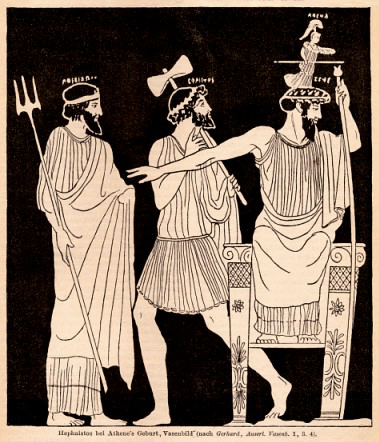
What part of that interests you? The voice-activated communication with the outside world? The entrance routine that is started when he lands in a certain manner and with certain characteristics? The fact that his work can be hidden when he’s flirting with Pepper Potts? Or that it all works seamlessly? The answers to these questions are our own personal automation goals. This system didn’t come into being, as Athena was born from Zeus’s head. JARVIS evolved over trial and error and over time.
Use the below questions to refine your goals and turn them from abstract thoughts to achievable steps.
- What would our ideal system look like (right now and in the future)?
- What tasks can I automate that would help me the most?
- What do my other stakeholders (partners, children, guests, etc.) need or want?
- Is there something that can bring me joy when it happens?
Product Design
To help us refine our goals, we need to understand what makes a great product. The theory of product design can be a little daunting, so if you’re interested in a little bit more of the theory, may I suggest:
- This article on Jobs to Be Done by Alan Klement is a great way of looking at product design.
- inc. magazine has a great article on Amazon’s product design philosophy that can also help you organize your process.
Feel a little bit more educated? Great! Let’s answer the questions above for ourselves and those that we co-habitat with.
Measure Twice and Cut Once
When I first started my automation journey I was single and lived alone. I thought it was great that my house spoke back to me wherever I was and turned on the TV on a schedule. My partner is not as intrigued by it and requested that I make the house a little less … “creepy”. In all product design … it’s important to know your audience.
Let’s break down our goals (or stories in the Agile Methodology parlance) into activities (or epics in the Agile Methodology parlance).
- What would you like to happen regularly without you thinking about it or intervening?
- What information do you need “Just in Time” of your day?
- What do you have a hard time remembering to do?
- What safety features are you looking for?
Remember we are looking for activities that provide an ROI, or a Return on Investment. To determine the cost of both time and material, we need to know what those tasks are. So let’s break our activities down into tasks.
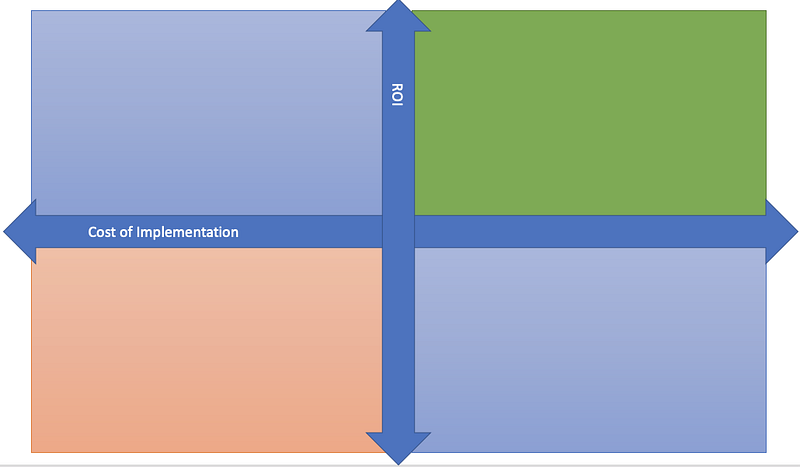
In my day job, we take the results of the previous exercises to build out an opportunity quadrant. This chart helps define our activities in relation to each other. We place our activities that have a lower cost of implementation to the left of the graph and we place those activities that have a higher personal ROI closer to the top. This allows us to compare activities to each other, helping us to focus more on those activities that have a high ROI and a low cost of implementation.
- Place your goals on the vertical axis according to how you value the outcome. Don’t forget to include your stakeholders in determining their value!
- Evaluate your tasks and how much they are going to cost in materials and/or effort. Use this to move the goals along the horizontal axis.
I would suggest that you create this in a digital format as you’ll be coming back to this often. Don’t be afraid to move things around as you progress through your implementation. This planning is designed to evolve as your needs and goals do.
I’ve done this already so, let’s take a look at mine:
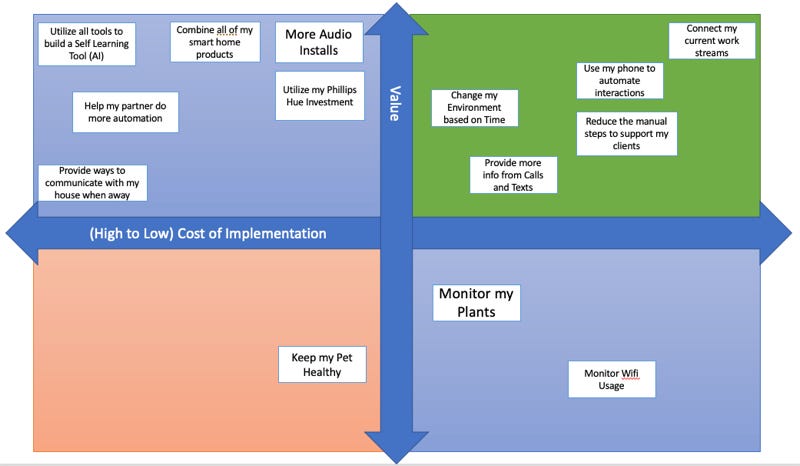
Now that we have our goals broken down into quadrants, we know what we want to focus on! The ideal targets are in the green and blue quadrants.
When I do this exercise for a client, we focus only on the top-right quadrant at first. This allows us to show value quickly and at a low investment. In this sort of self-directed project, this allows us to build confidence and our “stake-holders” can see immediate value.
Remember, we are iterating over our goals, so don’t forget to add new goals, or move our current activities around the quadrants. Remember, approaching these tasks recursively assumes that we will refine along the way. To do this, you want to plan some time every so often to revisit your chart. The Agile Methodology refers this to a “retrospective”. You should use this time to add, delete, or augment your goals and activities.
Here’s a quick example of a goal broken down into tasks.
We have now turned an abstract idea (“I want important information”) to a series of activities (“Let me know when I have an important call”) and tasks (“Detect when I have a call”, “Flash my lights”).
What do we do with this information? I like holding myself accountable, so I use a task management system like Trello. Trello is a very simple tool, often called a Kaban Board. Trello allows you to separate your tasks into different “lists of lists” to help you organize your project. If you don’t already use one, please feel free to accept my invitation to create your own Trello account. Write out your stories, activities, and your tasks onto individual cards and organize them in a way that makes sense for you. You can easily move cards around as your work on them, as well as add new information along the way.
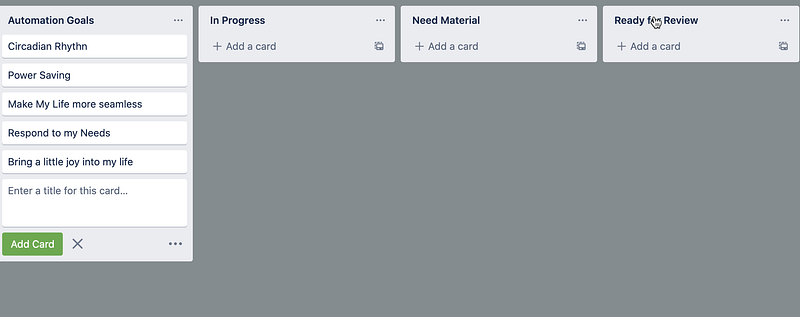
Some things you may want to do with your Trello Cards:
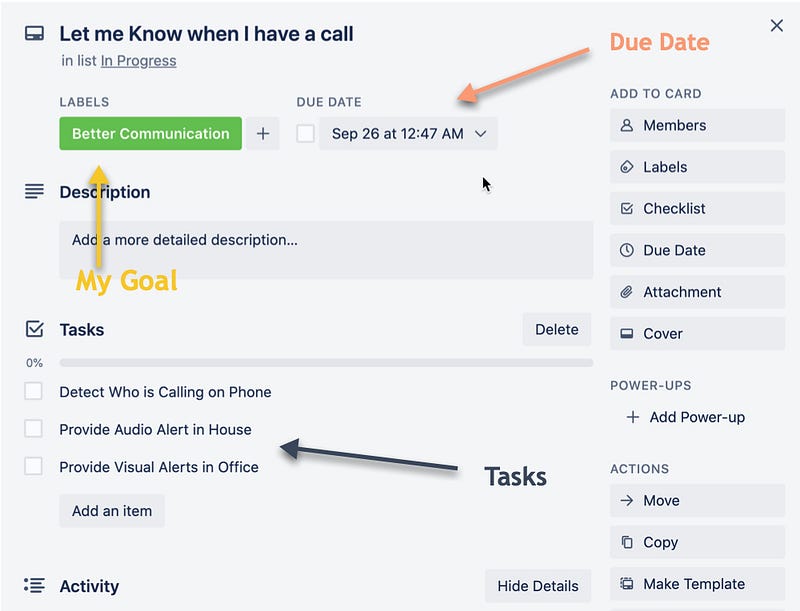
- Color Code your Tasks so you know what everything is tied to
- Build Lists for Inspiration, In Progress, Testing, Done!
- Create Due Dates to hold yourself accountable
- Link to online resources so you have everything that you need on hand when you start
Now you have something in one place to inspire you as well as to remind you what you’re trying to do.
Measured Twice! Bring on the Saw!
Congratulations you have:
- Identified our goals
- Identified the Value of those goals
- Broken down the goals into stories or activities
- Broken down the stories into tasks
- Created an organized method of tracking your tasks
Some caveats before you start your implementation:
- Don’t worry too much about planning exactly what the tasks are for future goals, you’ll refine that as you progress through your journey.
- Don’t commit to an over-engineered system! Remember, flexibility and versatility as an overarching mantra. You’ll be happy when you can adapt your system based on new goals or discoveries.
- Always keep your goals in focus. If something becomes more expensive in time and energy than you expected, don’t be afraid of putting it aside and re-assessing its position on your opportunity quadrant. Technology is as much about learning as doing. When something isn’t working the way you want it to, don’t be afraid to pivot.
Here’s a great case study on how an initial automation evolved to further enhance the author’s Home Automation Goals:
In upcoming posts, we’re going to cover some possible technology options, systems, and tools for you to use to make your life easier. Before you read those posts, make sure that you take some time and decide what your goals are. After all, this is your automation journey, not mine.
Get Inspired
“Good Writers Borrow from Other Writers. Great Writers Steal from them Outright”
— Aaron Sorkin
In that vein here are some authors to consider stealing from:
- A Full Home Automation System designed for a Family, very thought out and extensive with a lot of great components.
- Michael Teeuw’s Site. Michael Teeuw is the original developer of the MagicMirror project and one of the other projects that I like is MusiCubes, which is a great showcase of merging the “real” world with our digital lives.
- Interested in enhancing your Media Consumption? How about an Ambilight for your TV?
- Hoping to promote better sleeping habits for you or your kids? Check out this article on using Home Automation to promote the usage of the Circadian Method.
- Finally, a great Home Automation tool, that we will be spending a lot of time with over the next months, is Home Assistant. This is a great repository of automation possibilities you can achieve with that software.
- A couple of options to track your Pomodoro Work System
This article is part of the Recursive Automation Publication, make sure to follow for regular updates.