
Gender Indoctrination Begins At Birth
Children are exposed to norms and stereotypes right from the beginning

It is difficult to determine for certain how much of gender expression is nature and how much is nurture. We cannot study people completely removed from their socialization although we can track and analyze what the messaging is and notice how it begins to noticeably affect children at different times of their lives.
Children spend their entire existence being told how to appropriately express their gender. Sometimes this begins even before they are actually born. The gender reveal party is a kind of baby celebration that first started in 2008 when blogger Jenna Karvunidis wrote about a party where her child’s sex was revealed. The idea caught on like wildfire and gender reveal parties are now ubiquitous, announcing to family and friends whether It’s a Boy or It’s a Girl!
From there, gender indoctrination continues, even when parents work hard not to have that be the case. Children are constantly bombarded with gender-based expectations from society and from the media, and they are reinforced by both peers and adults alike. Sometimes that reinforcement is coercive and comes in the form of teasing or bullying for failing to comply with norms. Boys are more likely to be subjected to this kind of censure, sometimes with terrible consequences. A study by the Center for Disease Control (CDC) found that “20% of gender non-conforming students reported attempting suicide compared to 7% of gender-conforming students.
The data is bad for both sexes, but it seems to be worse for males.”
Because gender norms start at birth, even very young children know what is expected of someone like them. “Research done in 2007 among three to five-year-olds found that at an early age, these kids were able to identify “girl toys” and “boy toys” — and predict whether their parents would approve or disapprove of their choice. In 2011, an American study of children aged between six and 10-years-old found that the stereotype that “maths is for boys” starts quite young.” (1)
Media exerts a lot of influence in maintaining gender norms and stereotypes, beginning in childhood, and continuing throughout life. “One study we looked at found that the more TV children of both sexes watched, the more likely they were to believe that “boys are better”. For little boys, watching television appears to reinforce their already positive self-regard, while for girls, watching television appears to dampen it. This is concerning given that there are more than twice as many male characters as there are female characters on kid’s TV shows.” (2)
A primary way in which media distort reality is in underrepresenting women. Whether it is prime-time television, in which there are three times as many white men as women (Basow, 1992 p. 159), or children’s programming, in which males outnumber females by two to one, or newscasts, in which women make up 16% of newscasters and in which stories about men are included 10 times more often than ones about women (“Study Reports Sex Bias,” 1989), media misrepresent actual proportions of men and women in the population. This constant distortion tempts us to believe that there really are more men than women and, further, that men are the cultural standard.
There is also evidence that toys are now more divided by gender than they were 50 years ago. This is concerning because certain types of toys like Lego and other construction toys typically marketed to boys are thought to build skills that help mathematical reasoning. This may be a part of the reason that women are underrepresented in fields related to math and science.
In a 2011 study of math gender stereotypes in American elementary school children, two findings emerged. “First, as early as second grade, the children demonstrated the American cultural stereotype that math is for boys on both implicit and explicit measures. Second, elementary school boys identified with math more strongly than did girls on both implicit and self-report measures. The findings suggest that the math-gender stereotype is acquired early and influences emerging math self-concepts prior to ages at which there are actual differences in math achievement.” (emphasis mine) (3)
Constant exposure to dated concepts of gender roles and norms in the media starts before preschool and continues from there — concepts like: Boys are smarter than girls; certain jobs are best for men and others for women; and even that girls are responsible for their own sexual assaults. This was the finding of the 2017 Common Sense Media report Watching Gender: How Stereotypes in Movies and on TV Impact Kids’ Development.
But even in countries where media is not a factor or much less of one than it is in the US, there are still deeply ingrained ideas about what it means to be a boy and what it means to be a girl. These norms further gel when children reach puberty.
We found children at a very early age — from the most conservative to the most liberal societies — quickly internalise this myth that girls are vulnerable and boys are strong and independent,” said Robert Blum, director of the Global Early Adolescent Study, based at Johns Hopkins University. “And this message is being constantly reinforced at almost every turn, by siblings, classmates, teachers, parents, guardians, relatives, clergy and coaches.
The researchers found that gender-based restrictions rationalised as “protecting” girls actually made them more vulnerable by emphasising subservience and implicitly sanctioning even physical abuse as punishment for violating norms. They say that in many parts of the world these stereotypes leave girls at greater risk of dropping out of school or suffering physical and sexual violence, child marriage, early pregnancy, HIV and other sexually transmitted infections.
Children are straitjacketed into gender roles in early adolescence, says study
And although much of this societal messaging is that males are more competent, independent, and worthy of holding power, strict gender norms hurt boys and men as well. The Global Early Adolescent Study, based at Johns Hopkins University, concludes that due to these gender norms, “they engage in and are the victims of physical violence to a much greater extent than girls; they die more frequently from unintentional injuries, are more prone to substance abuse and suicide; and as adults their life expectancy is shorter than that of women. Such differences are socially not biologically determined.”
“One paper compared young people’s attitudes in China, India, Belgium and the United States. It was more acceptable for girls to push against the gender boundary than it was for boys.
In all four countries, it appeared to be increasingly acceptable for girls to engage in certain stereotypically male behaviours, like wearing trousers, playing sports and pursuing careers. But “boys who challenge gender norms by their dress or behaviour were by many respondents seen as socially inferior,” said the researchers. Both boys and girls said the consequences for boys who were perceived as adopting feminine behaviour, like painting their nails, ranged from being bullied and teased to being physically assaulted.” (4)
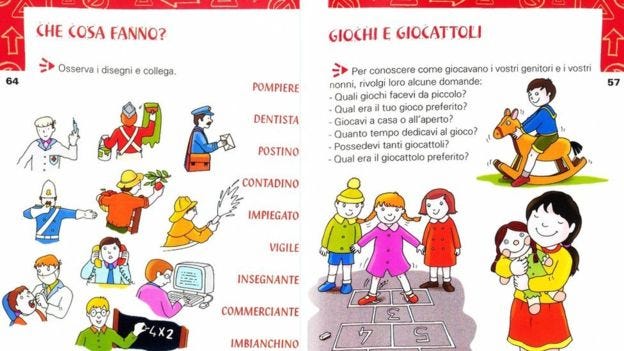
Indoctrinating children around who they should be and how they should act in order to meet gender norms and stereotypes is destructive for both girls and boys. Bringing it more fully to our collective attention allows us to begin to challenge the concrete ways that this indoctrinating is taking place. In addition to movies and other media, books aimed at children, including textbooks, quite often foster gender binaries and stereotypes.
Gender bias is rife in primary school learning books and can be found, in a strikingly similar form, on every continent, various experts say.
It is a problem “hidden in plain sight”.
“There are stereotypes of males and females camouflaged in what seems to be well-established roles for each gender,” says sociologist Rae Lesser Blumberg. Prof Blumberg, from the University of Virginia, has been studying textbooks from around the world for over a decade, and says she has seen women systematically written out, or portrayed in subservient roles.
100 Women: ‘We can’t teach girls of the future with books of the past’
The United Nations education agency Unesco says that messages undermining girls' confidence and expectations of life are so prevalent in educational materials worldwide that they present a “hidden obstacle” to gender equality. In their 2016 Global Education Monitoring (GEM) report, they noted that “women are often portrayed in domestic tasks, from cooking and washing to caring for the children and elderly.”
In many cases, women are also portrayed as passive and submissive. “There was one textbook about scientists I particularly remember, and the only woman in it was Marie Curie,” says Prof Blumberg.
“But was she shown discovering radium? No, she was timidly peeking over her husband’s shoulder as he spoke to somebody else, a man who looked elegant and distinguished.”
Progress is slow, because replacing things like textbooks is expensive, particularly in places where universal education is not a given. However, nothing can be improved if it is not first noted. American media is slowing coming around to offer at least some more balanced depictions of women and girls as people and not just as stereotypes.
Disney’s Moana and Frozen, as well as Pixar’s Brave, all did well at the box-office, shattering the trope that girls are primarily interested in pursuing a love interest and that girls will watch a movie about boys but boys won’t watch one about girls. In fact, Frozen 2 is the highest-grossing animated movie of all time. The Star Trek universe is now solidly populated with strong, interesting characters who just happen to be women with both Picard and Star Trek Discovery.
Beginning to challenge gender stereotypes and norms helps the spiral to begin to turn in the right direction. Boys and men quite often find that they do actually enjoy stories made about girls and women, and then due to their success at the box office, more such movies will be made. Positive, non-stereotyped depictions of women in the media also helps to counter the patriarchal precept that things that are coded as feminine are not as good as things that are coded as masculine, which in turn gives greater permission for some boys to be more of who they naturally are.
Despite the problems that it often attracts, for many young people conforming to gender norms that don’t feel true to who they are is an even worse option than enduring the harassment and bullying that they may face. The issue is not with traditional elements of either masculinity or femininity; it is with being indoctrinated and policed into maintaining these norms and the heavy toll this often exacts on children.
Instead of pushing children towards a particular expression of gender, allowing them to determine for themselves what they like, what they wear, and how they behave as healthy human beings would be a much less destructive path on many levels.
(1) Breaking Gender Stereotypes Early
(2) Breaking Gender Stereotypes Early
(3) Math-gender stereotypes in elementary school children
(4) Children Are Straightjacketed Into Gender Roles In Early Adolescence, Study Says


