
Moana: Exploring Feminine Power
Fighting isn’t the only way to prevail
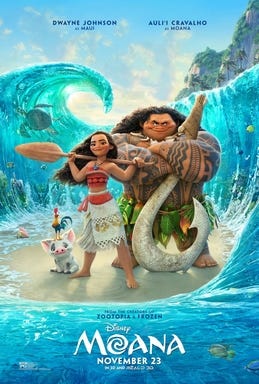
The other day I was telling a friend who had never seen the movie Moana about it. It’s one of my favorite Disney movies, perhaps because I lived in Hawaii as a child. It’s also one of the few Disney movies where the parents don’t die in the opening scenes. Spoiler Alert — key aspects of the plot will be discussed here. I sent my friend the clip I’ve linked at the end as a kind of teaser. It’s the climax of the movie, where Moana restores the heart of Te Fiti, and as I watched it again, it struck me how this scene, in particular, clearly demonstrates the difference between masculine and feminine power.
It’s been great to see more women as superheroes and action stars in recent years. Lara Croft Tomb Raider, which came out as a movie in 2001 was one of the first ones that really showed a woman as a badass, and it started a trend. Angelina Jolie did a great job of embodying the title character made famous in the video game, but in doing so, she was essentially a male character with breasts. There’s nothing wrong with women being tough and strong, but being able to kick ass as good as the boys isn’t the only way to exhibit power. Feminine power is just as important even though it is largely undervalued.
A healthy society is one that has a better balance of Yin and Yang, the properties of masculine and feminine energies, that may be embodied in both men and women. Our androcentric culture tends to value only masculine strength, as demonstrated by toughness, aggression, control, violence, and the ability to make somebody bend to your will by force. Every action movie ever made is about using superior strength and will to compel others to comply with your wishes. Those movies can be a lot of fun, but that isn’t the only path to triumph.
In the climax scene of Moana, we get the opportunity to see feminine power not only in play but as actually more effective than trying to bring about a desired result through force. Demigod Maui prepares to fight; Moana prevails through displaying vulnerability and a real desire to connect. Her show of feminine power is what ultimately saves the day.
Te Fiti is a goddess of the islands. Her heart has been stolen by Maui, and she becomes Te Kā, a demon of fire and magma. Moana has convinced Maui to return the heart to Te Fiti so that the blight that is plaguing her island can be healed. They do not yet know that Te Kā and Te Fiti are the same goddess in different forms.
As the action reaches its apex, Maui performs a haka to demonstrate his might and prepares to face off the wrathful Te Kā, who is about to hurl a ball of fire at him. This is where Moana steps in, showing Te Kā that she is in possession of the heart of Te Fiti. She realizes that the goddesses are one in the same and asks the ocean to part and let Te Kā come to her. Up until this time, the barrier of water between then has been the only thing keeping Moana safe, but she forgoes this safety.
Te Kā snarls and hurls herself forward, bent on annihilating Moana, while Moana walks calmly toward her, singing. Her belief that she is doing the right thing to help heal Te Fiti is the only protection she has. Moana tells Te Fiti, “I know your name. They have stolen the heart from inside you, but this does not define you. This is not who you are. You know who you are!” She leans forward and touches foreheads and noses with the goddess, in a traditional Maori greeting, known as a hongi, which is also a show of unity.
As Moana replaces the heart, Te Fiti is transformed back into herself — the goddess of creation and life. Gone is the demon of lava and fire, and everything she touches springs forth with new growth and greenery. The task that Moana and Maui set out to do is complete, and it was not achieved by force. Instead, it was achieved through feminine power.
I am moved every time I watch Moana calmly walk towards the snarling Te Kā, trusting in the power of giving, and of connection. One young girl standing firm against a giant demon of fire, with only the faith in her power to bring healing to defend her. She achieves something that Maui and all his might could not.
Sometimes a sword and a strong hand to wield it is what is called for, but not every time. Might does not always make right and sometimes what has the most impact is the power of relationship and healing. I hope to see more movies being made in the future that remind us of this. If you’ve never seen Moana or you haven’t seen it recently, this 3-minute clip is worth watching.
© Copyright Elle Beau 2020 Elle Beau writes on Medium about sex, life, relationships, society, anthropology, spirituality, and love. If this story is appearing anywhere other than Medium.com, it appears without my consent and has been stolen.


