
Galena
One ore, two towns

Today’s New York Times Spelling Bee letters:
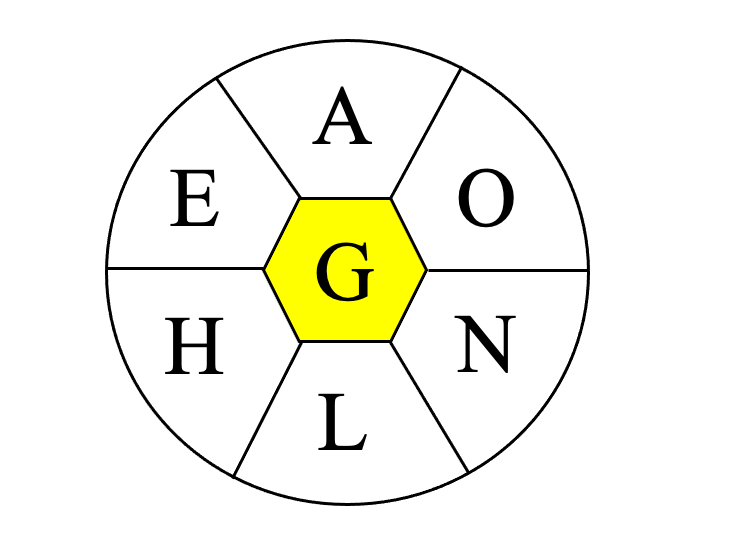
A, E, H, L, N, O, and center G (all words must include G)
Merriam-Webster says…
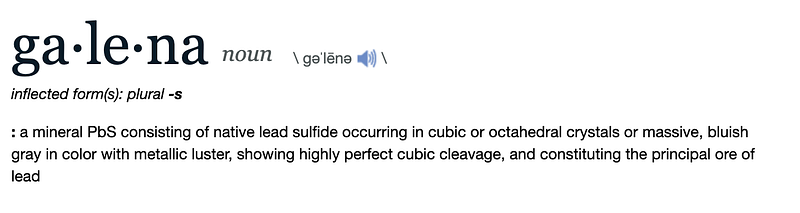
Silly little dictionary! Don’t you know that galena can’t possibly be a word if The New York Times says it ain’t?
For a complete list of rejected words, check out the Spelling Bee Master.
What’s your favorite dord* from today’s puzzle?
My Two Cents
If you read the dictionary’s definition of galena, you’re probably wondering why there’s a picture of a doctor at the top of today’s column. And even if you’re not wondering that, we’ll tell you. We’re generous that way here at Silly Little Dictionary!
As a Spanish-speaker, the words galeno (male) and galena (female) ––Spanish nouns usually have gender–– are synonyms of “physician”. The origin of the term is a Greek physician and philosopher who lived in the Roman Empire in the second and third centuries. A lot of his work in anatomy and physiology went unchallenged for more than one thousand years… mainly because people weren’t allowed to dissect human bodies in order to study them.
Galen’s name came from the Greek adjective galenos, meaning “calm”. And that is another meaning of the word galeno in Spanish, typically used be sailors to describe winds.
In English, galen is not a synonym for doctor. However, the ancient physician’s name can be made into an adjective, according to Merriam-Webster:
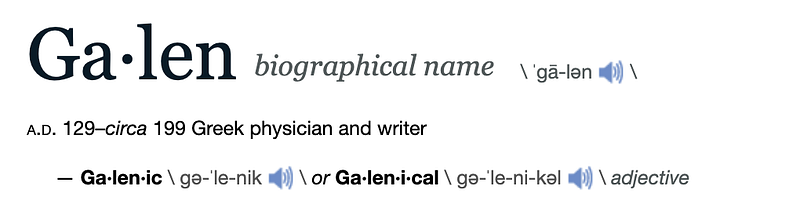
Because these words are capitalized, though, they would not be accepted as per the rules of Spelling Bee game.
That’s it for your free Spanish & English lessons today. You’re welcome. Now on to our daily dord*.
Ore you looking for lead?
Our friends at Merriam-Webster tell us that galena comes from the same Latin word meaning “lead ore” or “dross that remains after melting lead”.
Indeed, humans have used galena to obtain lead since ancient times. The useful chemical element can be extracted from the ore using regular fires without needed specialized smelting tools.
Galena is quite abundant and found all over the world, with the largest lead-zinc deposits on the planet located in Missouri, U.S.A. However, today’s leading miner of lead is China (almost half of the planet’s production), with Australia coming in at a distant second.
The 1911 Encyclopedia Britannica describes the ore thusly:
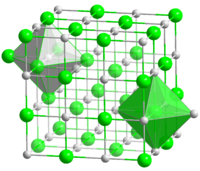
GALENA, an important ore of lead, consisting of lead sulphide (PbS). The mineral was mentioned by Pliny under this name, and it is sometimes now known as lead-glance (Ger. Bleiglanz). It crystallizes in the cubic system, and well-developed crystals are of common occurrence; the usual form is the cube or the cubo-octahedron (fig.). An important character, and one by which the mineral may always be recognized, is the perfect cubical cleavage, on which the lustre is brilliant and metallic.
Then they provide this cute illustration…
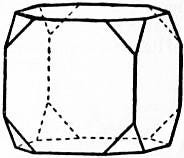
…which reminded me of napkin doodles I used to make in order to perfect my three-dimensional art skills. (Spoiler: they didn’t really help.)
Wikipedia offers a modern version of the above image:
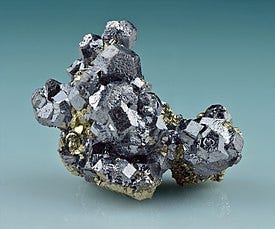
Galena itself, in macro size, is a bunch of those cubs clustered together:
The ore is a semiconductor and was used in the early days of radio… as a radio! Have you ever heard of “crystal radio receivers”? No? Ask grandpa or grandma.
In the late 19th century, Indian physicist Jagadish Chandra Bose (no connection to the modern audio company) first used a galena crystal as a radio wave detector. In 1901, he filed a patent in the U.S. for “A Device for Detecting Electrical Disturbances”, mentioning the galena crystal. The patent was granted three years later.
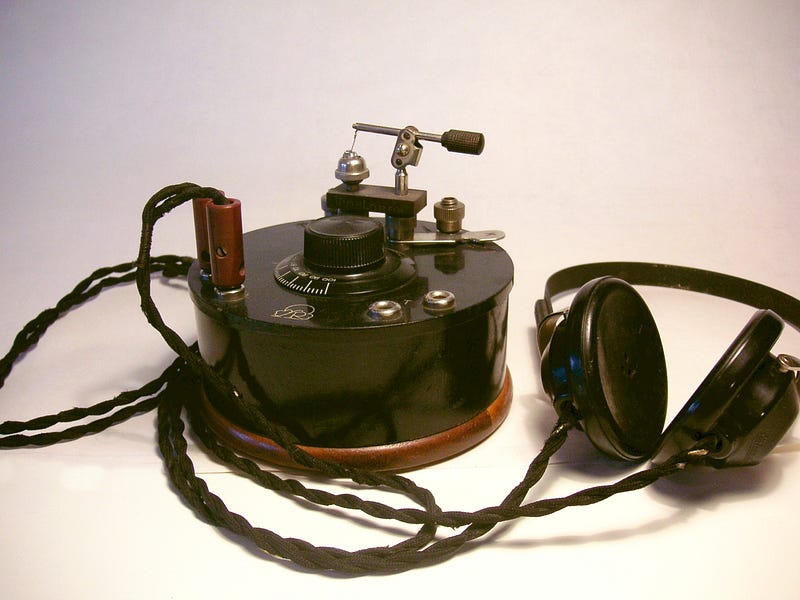
In the above picture, the galena crystal is in the silver thingamajing that looks like a desk bell. The wire connecting it to the tip of the rod is known as a “cat’s whisker”.
Three states in the U.S. claim galena as their official mineral: Wisconsin, Kansas, and Missouri. Which brings us to…
Mining towns
One of Missouri’s nicknames is “the lead state”. Despite that fact, neither of the two towns named after the galena ore are in Missouri. One is the neighboring Kansas, however.
Galena, Kansas (Cherokee County), was founded in 1877, when lead was discovered in the area. With a railroad already in place, the town’s population boomed to over 10,000 by the year 1900. After the mines closed in the 1970s, the population dropped sharply. Current estimates place it around 2,600 people, give or take.
This is the downtown area circa 2008:
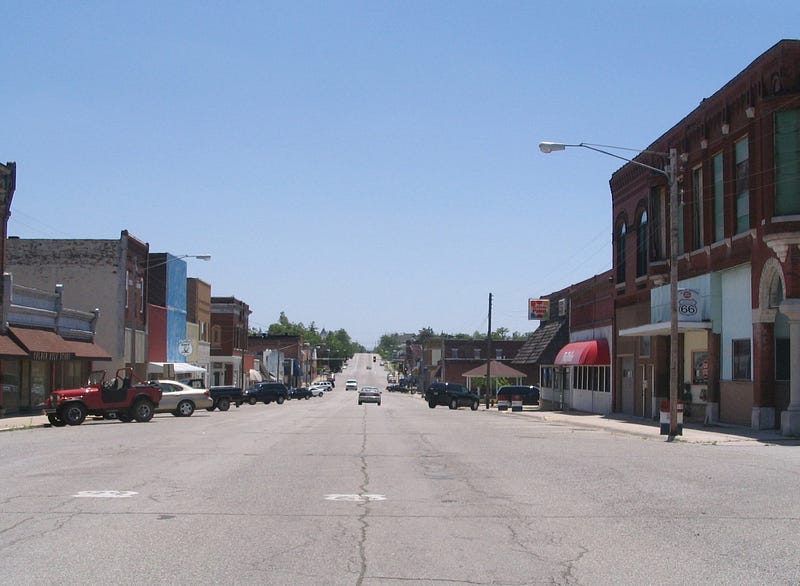
Yep, that’s a Route 66 sign hanging from the lamppost on the right. That’s because the famed highway passed through that corner of Kansas way back when.
The Kansas Galena is the birthplace of George Grantham, a second baseman who played in the Majors for thirteen seasons, mostly for the Cubs and Pirates. With the latter team he won the 1925 World Series but lost the 1927 contest against the Murderer’s Row Yankees.
On its website, Galena, Illinois, bills itself as one of America’s “Top 10 Best Small Towns”. Also one of “America’s Prettiest Towns” and “Top 10 Great Places in America”. Its population may be just over 3,300, but they do make a lot of noise, apparently.
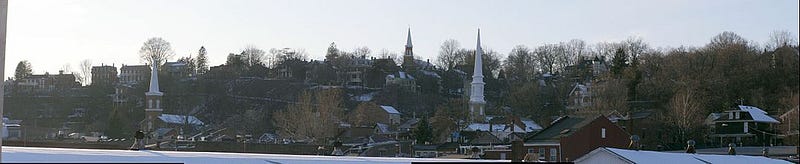
The residents may have a point, though, considering over a million people visit their town every year. (The Galena Historic District is listed on the National Register of Historic Places.) Galena can boast of being home to general Ulysses S Grant after the Civil War and before he became President.
The city was settled in the mid-17th century by French explorers who were enticed by lead deposits nearby and named it La Pointe. The U.S. acquired the land in 1803 via the Louisiana Purchase, and Galena was officially founded and named in 1826. Like its Kansas namesake, this city’s population also dropped sharply after demand for lead decreased.
This is one view of the city, from Main Street:
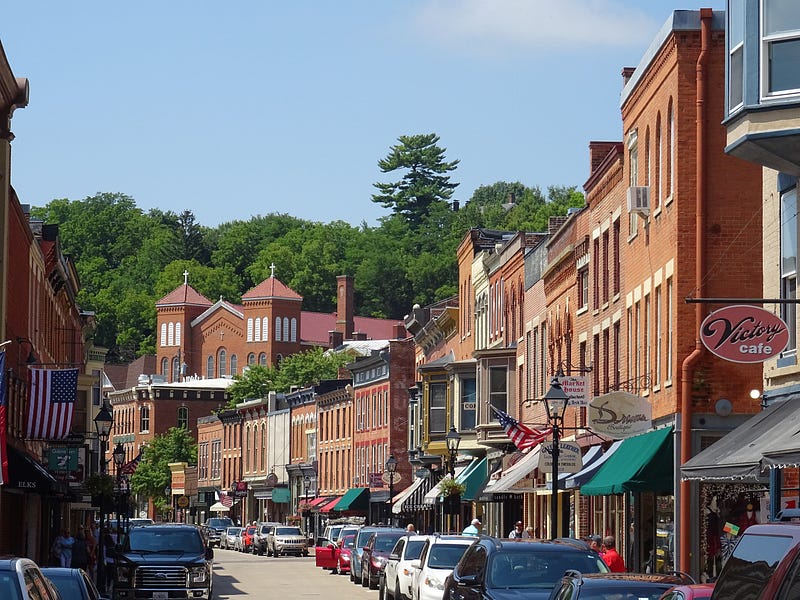
Radio personality Don McNeil, creator and host of the long-running radio show The Breakfast Club, was born in Galena, Illinois, in 1907. Here he is, in a 1948 broadcast.
Now you know. Next time you’re in Kansas or Illinois, try to swing by their Galenas to buy some galena. You may have a hard time convincing the locals that this ore exists, however… because the editors of the Spelling Bee decided that galena is a dord*.
You can check out my previous entry on another dord* here:
*What the heck is a dord, you ask? Here’s the answer: