
Future-Proof Your Income and Learn These 3 Skills
Building a sustainable income is more simple than you might think. Here’s how.

I started writing this about a month ago, got waylaid by other commitments, and picked it up again this morning. This is the first thing I had written:
“The future is a scary place. I know I spend more time than necessary worrying about things that are ultimately out of my control.”
Wow. That was in the period where the SARS-CoV-2 virus was starting to make its way around its world.
I could’ve never known how true that statement would be, and how important the rest of this article is going to be. So I picked it up today and decided to have a proper go at this.
This article includes lots of:
- Examples
- Tricks & tips on how to build these skills
- Step by step processes
If you’re wanting to future-proof your income, in an uncertain world, here are three skills to start with that will get you started on the path to financial security.
Ready? Let’s dive in.
Writing
Starting with my favorite of the three, because I know you’re more likely to read this section and skim the others (but, please don’t?). And I’m a bit biased, but who isn’t?
No matter what happens in the world, people will always need to sell things. If you want to sell someone something, you need to convince them to part ways with their precious money. One of the best ways to do that is through cleverly written copy.
Sure, images are great, but they don’t show the buyer who they’re buying from. People want to feel a connection. And you can achieve that with the write (haha) words.
To write clearly and persuasively is to be able to get your message across to others.
In doing that, you can convince them of your opinions, ideas and align them on the same trajectory as you. When you’ve got people on your side, you’re ready to move mountains.
“Writing is thinking. To write well is to think clearly. That’s why it’s so hard.” — David McCullough
One of my favourite quotes of all time. It is so true. If you’ve ever tried to explain a complex problem to someone through writing (maybe an email, or letter), you’ll be familiar with that pensive feeling where you look at your computer screen and try and search for the right word that illustrates what you mean clearly and succinctly.
Its that moment of intense concentration where you have to think, “How would a normal person understand this”, where you get a clear picture of the problem or topic you’re trying to get across.
The Basics
Mostly, when people think of writing, they think long novels and stories. The truth is, there are so many different ways to make money with writing that it would be hard to find one that you’re not half-decent at. Here are just some:
- Website copy
- Website content and blogs
- Short form copy for adverts
- Online/digital copy for ads
- Scripts (TV, Radio etc.)
- Technical writing
- Public Relations (press releases etc.)
- Print media (magazines, newspaper etc.)

Good writing is defined as being:
- Easy to understand,
- As short as possible, while still getting your message across,
- Holds the readers attention
- Conveys the intended message clearly
How?
The best way to get a feeling for what good writing is, is to consume good writing, then write, and keep writing — and then publish!
I started officially writing online about 4 years ago, and only started publishing my work properly about 9 months ago. I’ve seen a much bigger improvement in these 9 months than I did in the 3 years prior.
Why? When you publish, you’re forced to take a bit of pride in your work. By knowing that other people are going to be reading your work, you force yourself to level up.
Expected Income
This ranges hugely. Don’t misinterpret this, being good at writing is massively different from being a great writer. And great writers are the ones that consistently get high-paying clients.
And when you’re great, you’ll get rewarded handsomely. Big brands recognise the value in great copy. If you can deliver something that moves the needle for them, they’re going to value your work.
I can hear you saying, “But how do I get there? It seems like a long, winding and uphill road to bringing home thousands of dollars for short pieces of advertising copy”. And you’re right. It does take work.
Start small and work your way up. My first pieces of paid writing were for a steel-drum manufacturing company. Exhilarating stuff. They paid me $100 for some website copy. It made me realize that, Hey, I’ve got a skill someone is willing to pay for here. I can do this.
As you go, you build up confidence, your writing gets better, and you learn from your mistakes. People start to sit up and take notice as your work generates income for the companies you’ve worked for.
The bottom line is this: If you can create value (revenue, usually) for a company, they’re going to (should) reward you with a proportional amount of money.
Simple, more value = more money. And being able to create more value comes from experience. And experience comes from starting somewhere and then growing.
Coding
It’s a great complement to writing, and easier than most people think. Don’t let the colorful words and symbols intimidate you — they’re not that scary.

Coding seems like one of the most intimidating things to try and get into — which you absolutely should.
I constantly hear people saying things like, “I just don’t have the brain for it”, or “I’m not a maths person”. Both are the perfect reasons you should start coding.
Whether we like it or not, automation is going to be a big part of our lives going forward. You have people like Elon Musk already talking about a universal basic income while the robots do all our work for us.
The thing is, if you want to stay ahead of the curve — and not be replaced by one of those robots — you have to learn how to control them. And to do that, you need to have some programming knowledge.
But with that premise in mind, it’s so hard to get started. How do I go from 0 knowledge to making a machine work on its own? Same as writing — you start somewhere.
But What Is It, Actually?
One of the biggest hurdles for people getting into coding is not understanding what it is and how it works.
What are these codes you speak of?
Coding (or programming) are just words used to describe a string of numbers, letters, and symbols that are connected together in a type of language. The difference is that its a language a computer can understand, using a compiler.
Using that language, we are able to control the behavior of a computer. There are mini-computers in most things. Code is what runs those computers and tells them how to act and react to inputs from a user.
Code is the software behind the hardware.
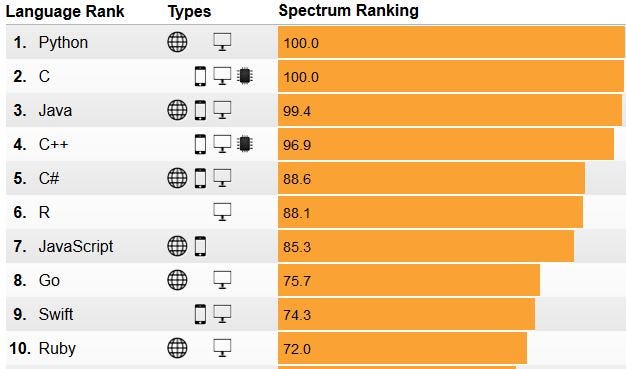
You get lots of different types of languages all made for different purposes. C is one of the early stage basic languages. Python — a very popular language today — is used to build web applications and is specifically good for data handling. Javascript is possibly one of the most widely used languages and controls dynamic elements within a web browser. Most little popups and interactions you have with a web page are built using Javascript.
So, you now know what it is, but how do you even start?
Where To Begin?
The first programming language I used was C. It’s a great starting point because you’re introduced to most of the fundamental syntax that you’ll see recurs through a lot of the other languages, with small variations.
I’d highly recommend taking a short course in C (even if you don’t ever plan on building anything for yourself). Not only does it give you a good foundation to build your coding skills, but it also teaches you an analytical, process-controlled way of thinking.
You might want to start with something that is a bit more front-end (i.e what the user see’s). It’s really rewarding starting out this way because you can immediately see what you’re building.
You could start with the basics of web development. You’ll start with HTML, then CSS, Javascript and possibly PHP and MySQL. If you know those four, you’re well on your way to building web applications.
PS: If you’re going to hone your writing skills, it is a great combination to have these simple web development skills up your sleeve. It turns you into a ‘full-stack writer’ which can also handle media and a little bit of front-end dev.
Career Opportunities
Well, if you’re a well-trained developer, the world is your oyster. Starting developer salaries often begin at $3000 per month gross. As you become more experienced and specialized in a niche, your skills become more sort after, and you’re remunerated accordingly (aka very well).
To get to this level of knowledge requires time though.
I learned C (my first coding language) in roughly 6 weeks, to about an intermediate level. I understood all the syntax well and knew how to build programs that could run and were useful. I do have a very logical brain and have always been good at process-thinking. I also grew up building websites and have had some good experience teaching myself the way machines interact with humans.
You might take a bit longer, or shorter. And that’s completely fine. Ease yourself into it and don’t get overwhelmed. Trying to tackle too much too quickly is a sure way to get demotivated.
The goal here is to create a skill that can help you in a future world that is moving largely towards automation. Let that future-thinking guide you. Is it really worth trying to cram all that knowledge into your head over the course of four weeks? Probably not. Start slow, build great foundational knowledge and then build your coding house brick by brick on top of that.
Leadership
The first two were quite practical skills that you can start learning to write (haha) away. Leadership is not something where boxes can be ticked and you can obviously level up and build your skill base. It’s a bit more conceptual than that. That doesn’t mean it's not important to build your leadership skills, it’s one of the most essential tools of successful people.
But, why?
Many Hands Make Light Work
As you enter the working world, the fact that there are only a certain number of hours in a day becomes a stark realization. The fact is, one person can only do so much.
Sure, some people are better at making the most of their days than others. They’re more productive, more effective and hold more influence which allows them to get more done. The fact remains though, one person can only achieve so much.
To move mountains, you need a team. An effective team is only as good as its leader.
A good leader is like a magnet around iron-filings. They align all the energy of the people around them in one direction. Without direction, all that energy has the potential to nullify itself, causing chaos with very little output. A leader congregates people and aligns them on the same trajectory so that the many hands can indeed move mountains.
What Makes a Good Leader
- Confidence The people you’re leading need to know you’re confident in your ability. If you’re not, why should they be? One of the biggest things here is your body language. Believe in yourself, or no one else will.
- Big picture-thinker As a leader, you’re managing people, which are essential resources that need to be deployed effectively. To know where you need to spend your resources, you need to have a big-picture of your trajectory. Whether it's a company or family, you need to provide direction so that all the resources align effectively towards your goal.
- Recognizing skills and deploying them effectively To effectively deploy your resources, you need to understand them correctly. People are good at doing what they like. Identify their strengths and passions and use them as pieces to fill in the big-picture puzzle.
- Emotional intelligence Human beings are complicated things with complicated emotions and hormones that govern the way we act and interact. To be an effective leader, you need to have a good understanding of how these things affect the way we operate. Emotional intelligence means understanding those around you and acting appropriately. It is perhaps the most important skill of an effective modern leader.
Actions to Becoming A Better Leader
- Ask for leadership positions You don’t know without trying. The only way to get better at something is to get on the bike, fall over and then try again. Maybe start with the training wheels on, but start anyway.
- Get feedback Often this comes in the form of criticism. Learn to accept that and use it to your advantage.
- Practice speaking in public Its often required and if you can do it effectively, its something that will quickly get people on your team.
- Practise self-awareness Meditation is the tool I use for this. You need to be in touch with your emotions so that you can understand that the lens you’re viewing the world through is a different hue than everyone else’s. To understand this is to understand that each person requires different handling.
BONUS: Build a Moat
Save.
Get the power of compounding on your side. Start early and build yourself a cash-moat.
According to Bankrate, 53% of the surveyed American population would not be able to survive if they had to rely on their savings for more than 1 month. That means the majority of the US population has less than 1 month’s salary in savings.
In times like these, it has become increasingly important to safeguard yourself and your family against unexpected loss of income. You never know what’s around the corner.
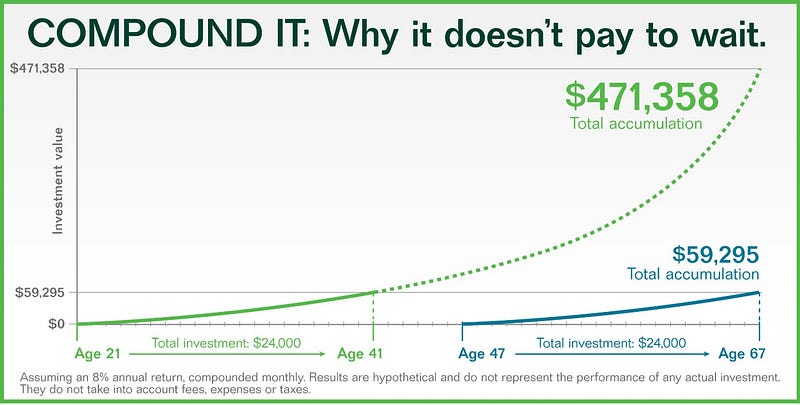
By starting early, your savings will start to grow. Consider this analogy to illustrate the power of compounding:
Mandy starts saving at the age of 24, and decides to put away $3000 every year. After 11 years (at 35), she decides to stop making contributions and only reinvests interest.
Luke doesn’t start saving until he is 35. Only then does he start putting in $3000 a year, and he keeps this up for a further 31 years (20 more than Mandy).
At age 65 (with a 10% interest rate — for simplicity sake), both Mandy and Luke retire. Mandy has $1 173 789 in her account and Luke has $600 413. By starting to save earlier, Mandy grew her savings by more than $500k.
Saving is not only powerful, it's necessary. Start today.
How To Start Your Own Business
If you want to learn how to build your own business, check out The Signal. It’s one email every week where I teach you how to do it, step-by-step. Sign up here.
Resources
Writing
Honey Copy — My favourite copywriter’s website
Kopywriting Kourse — A beginner copy-writing course. Quite rudimentary.
Fiverr — A marketplace for finding freelance work
Seth’s Blog — A daily blog post from Seth Godin, always written beautifully and thoughtfully.
Quicksprout — Complete guide to copywriting
Leadership
Tony Robbins on how to be confident
Improving your emotional intelligence


